



























By Mateo Rivera
Most people who own a dog did not set out to build an exercise habit. They set out to give an animal a bathroom break and a chance to sniff the neighborhood. Yet a body of public health research keeps landing on the same conclusion: people who walk a dog end up moving substantially more than people who do not. Researchers at the University of Western Australia reviewed the evidence in 2013 and found that dog owners consistently reported more walking than non-owners across the studies they examined, with dog walking functioning as a reliable and repeatable source of moderate activity. The U.S. Centers for Disease Control and Prevention recommends that adults get 150 to 300 minutes of moderate-intensity aerobic activity each week, and for many dog owners, the twice-daily walk already covers a meaningful share of that target without a gym membership or a training plan.
What is missing for most dog owners is structure. A walk that wanders wherever the dog wants to go, at whatever pace feels comfortable, still delivers cardiovascular benefit, but it rarely builds fitness in a progressive way. This article looks at the research on dog ownership and activity levels, then works through how to convert a routine walk into a structured training session: pace intervals, route variation, bodyweight exercises worked into stops, and the safety habits that keep both ends of the leash healthy. The goal is not to turn dog walks into boot camp. It is to use a routine you already do every day as the backbone of a real fitness practice.
What the Research Says About Dogs and Physical Activity
The connection between dog ownership and walking has been studied from several angles: self-reported surveys, objective step counts from accelerometers, and comparisons of dog owners against non-owners living in the same neighborhoods. The findings point in a consistent direction.
A 2013 review published in the Journal of Physical Activity and Health examined the existing literature on dog ownership and walking and found that most studies showed a positive association between owning a dog and higher levels of walking-based activity. The review’s authors noted that dog walking appeared to function differently than general exercise advice: it was tied to a daily obligation rather than a decision that had to be renewed each day.
A 2017 study published in the Journal of Epidemiology and Community Health followed older adults in England and found that dog owners were significantly less likely to reduce their physical activity during periods of poor weather compared to non-dog owners. Non-owners cut back sharply when it rained or turned cold; dog owners kept walking at close to their usual level, because the dog still needed to go out. The researchers framed this as evidence that the dog’s needs, not the owner’s motivation, were driving the behavior.
Objective measurement research has reached similar conclusions. Studies using accelerometers and pedometers rather than self-reported diaries have found that dog owners log more daily steps and less sedentary time than demographically matched non-owners, even after adjusting for factors like age, neighborhood walkability, and income. The American Heart Association’s 2013 scientific statement on pet ownership and cardiovascular risk, led by cardiologist Glenn Levine, reviewed this evidence and concluded that pet ownership, particularly dog ownership, is associated with a reduction in cardiovascular risk factors, while stopping short of claiming the pet itself causes the improvement, since owners who choose to get a dog may already differ from non-owners in relevant ways.
Research on adolescents has shown a related pattern. A study in the American Journal of Preventive Medicine found that teenagers in households with a dog logged more minutes of physical activity than teens in dog-free households, suggesting the effect is not limited to adults managing their own fitness routines.
None of this research claims that owning a dog automatically produces a fit person. What it shows is that the daily requirement to walk a dog creates a floor of activity that is harder to skip than a self-directed workout. That floor is a genuine asset. The rest of this article is about building on top of it.
From Bathroom Break to Structured Session
Structured exercise, in the simplest definition, is physical activity organized around specific elements: a planned duration, a target intensity, and a repeatable format you can track over time. A walk becomes structured the moment you stop treating it as pure wandering and start treating it as a session with a shape.
This does not require special equipment. It requires deciding, before you clip on the leash, what the walk is for that day.
Pace Intervals
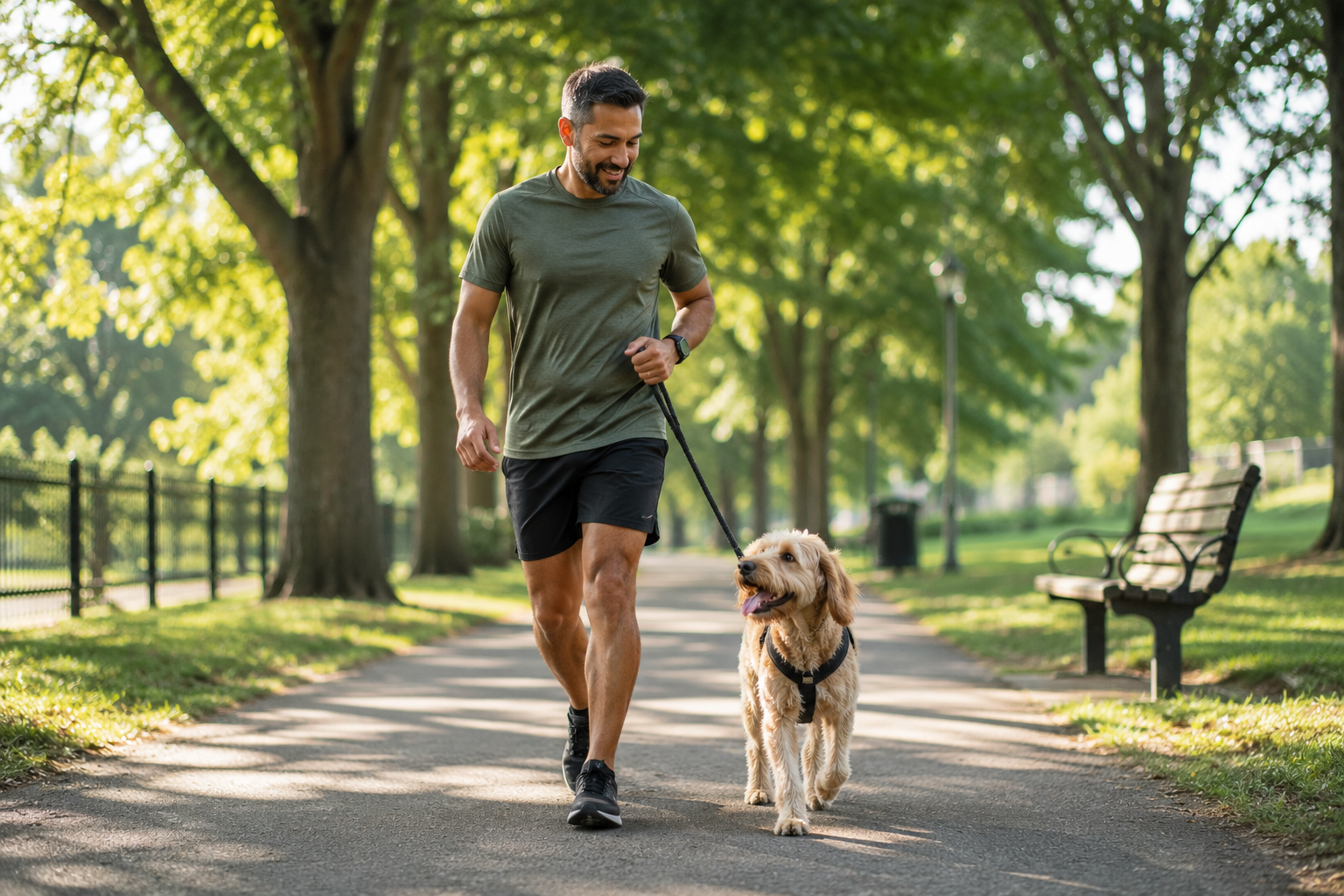
The simplest way to add training value to a dog walk is to vary your pace deliberately instead of letting it drift. Most dogs are comfortable moving faster than the pace their owner naturally settles into, which makes pace intervals a good fit for dog walks specifically.
A basic interval structure looks like this: walk at an easy, conversational pace for three to five minutes to warm up, then pick up the pace to a brisk walk, one where you could talk only in short sentences, for one to two minutes. Return to the easy pace for two to three minutes to recover, then repeat the brisk segment. Over a 30-minute walk, this might mean four to six brisk intervals worked in among easier stretches.
Dogs generally adjust to a faster human pace by shifting from a walk to a light trot, which is a normal and healthy gait for most dogs when it is not sustained for excessive periods in hot weather. Watch your dog’s breathing and gait during the brisk segments; a dog that is lagging, panting heavily, or pulling toward shade is telling you to ease off.
Varied Routes
Walking the same block on repeat is convenient, but it caps the training value of the walk because the terrain never changes. Route variation adds a second training dimension without adding time.
Look for routes that include a mix of terrain: a gentle hill for a few blocks, a stretch of uneven ground like a gravel trail or grass, and stairs or a sloped ramp if one exists nearby. Hills in particular raise heart rate and engage the glutes and calves more than flat pavement, for the walker and for the dog. Rotating between two or three routes across the week also reduces repetitive strain on the same joints and muscles, and it gives the dog new sights and smells, which most trainers and veterinary behaviorists consider valuable mental stimulation in its own right.
Bodyweight Exercises at Stops
Dogs stop to sniff. That built-in pause, which most owners treat as dead time, is a natural window for short bursts of bodyweight work. Instead of standing and waiting, use the 20 to 40 seconds while your dog investigates a scent to run through a quick movement.
Good options for sniff-break exercises include: wall or bench push-ups if you are near a sturdy surface, standing calf raises, walking lunges for the last several steps before the stop, squats using a bench or low wall for a knee reference, and standing marches with high knees to keep the heart rate elevated between pace intervals. None of these require more than a few square feet of space, and none require you to let go of the leash for more than a controlled adjustment of your grip.
The table below lays out one version of a structured 30-minute walk that combines pace intervals, terrain, and bodyweight stops into a single session.
| Segment | Duration | Pace / Focus | Add-On |
|---|---|---|---|
| Warm-up | 5 minutes | Easy, conversational | Let the dog set sniff pace |
| Interval 1 | 2 minutes | Brisk pace | Choose a route with a mild incline |
| Recovery + Sniff Stop | 3 minutes | Easy pace | 10 wall push-ups at the stop |
| Interval 2 | 2 minutes | Brisk pace | Flat or gently sloped ground |
| Recovery + Sniff Stop | 3 minutes | Easy pace | 12 standing calf raises |
| Interval 3 | 2 minutes | Brisk pace | Uneven terrain if available |
| Recovery + Sniff Stop | 3 minutes | Easy pace | 8 walking lunges per side |
| Interval 4 | 2 minutes | Brisk pace | Longest hill on the route |
| Cool-down | 8 minutes | Easy, unstructured | Free sniff time, water break |
This particular sequence adds up to roughly 30 minutes and can be repeated three to five times a week. As fitness improves, extend the brisk intervals to three minutes, add a fifth interval, or increase the number of bodyweight repetitions at each stop. The structure stays the same even as the dog ages into a slower routine, because the recovery segments can simply lengthen.
Safety Considerations
Adding intervals and bodyweight work changes the physical demands of a walk, both for the person holding the leash and for the animal on the other end of it. A few safety habits keep the added intensity from creating new risks.
Leash Handling During Faster Segments
A leash that is fine for a leisurely stroll can become a hazard once you introduce a faster pace or a sudden stop for an exercise set. Use a leash no longer than six feet for structured sessions; longer leashes and retractable models give a dog room to dart sideways or wrap around your legs exactly when you are moving fastest. Keep the leash hand close to your body rather than letting your arm swing freely, and avoid wrapping the leash around your wrist or hand, since a strong pull from a dog reacting to a squirrel or another animal can cause a fall or a joint injury. If your dog has a strong tendency to lunge at wildlife, other dogs, or cyclists, save the brisk intervals for routes and times of day where those distractions are less likely, and consider a front-clip harness, which gives you more control during sudden pulls than a standard collar.
Weather Considerations for the Dog
Structured walking means covering more ground at a higher intensity, which raises the stakes of heat and cold exposure for the dog. Dogs regulate body temperature far less efficiently than humans; they cool mainly through panting and a small amount of sweating through their paw pads, so they overheat faster than the person holding the leash realizes.
On hot days, shift brisk intervals to early morning or evening, check pavement temperature with the back of your hand before setting out, since asphalt can burn paw pads well before the air feels dangerously hot to a person, and cut the session short at the first sign of heavy panting, drooling, or reluctance to move. Breeds with short muzzles, such as bulldogs and pugs, have a harder time cooling themselves and need shorter, gentler sessions regardless of the season.
In cold weather, watch for shivering, lifted paws, or a reluctance to keep walking, particularly in short-haired breeds and older dogs, and consider a dog coat and paw protection on ice or salted sidewalks, since de-icing salt can irritate paw pads and is mildly toxic if licked off.
Quick Safety Checklist Before a Structured Walk
- Leash length of six feet or less, held close to the body during brisk segments
- Water for both of you on sessions longer than 20 minutes, especially in warm weather
- Pavement temperature check with the back of your hand before hot-weather walks
- Route scouted in advance for a mix of flat, hilly, and stable footing
- A plan to shorten or skip intervals if your dog shows heavy panting, limping, or reluctance
- Reflective gear or a light-up collar attachment for early morning or evening sessions
- ID tag and, ideally, a microchip check if the walk includes off-leash sniff areas
Using the Dog’s Needs to Build Consistency
The hardest part of any exercise routine is usually not the workout itself; it is showing up on the days motivation is low. This is where dog walking has a structural advantage over most fitness plans: the dog’s need for a walk does not disappear because you had a bad day at work or the weather turned gray. A dog waiting by the door, leash in mouth, is a form of accountability that does not rely on willpower.
That accountability can be extended deliberately rather than left to chance. Keeping the leash and shoes in the same visible spot removes a decision point. Walking at a fixed time tied to another daily anchor, such as right after breakfast or right before dinner, turns the walk into a habit attached to an existing routine rather than a task that has to be scheduled separately each day. Some owners track walks the same way they would track a workout, noting distance, route, or how many intervals they completed, which turns a habit that already exists into something with visible progress over weeks and months.
The research on weather and dog ownership mentioned earlier captures this dynamic well: dog owners kept walking through conditions that caused non-owners to skip activity altogether, not because the owners had more discipline, but because the dog’s need for a walk was not optional in the same way a personal workout goal is. Structured walking takes that built-in consistency and gives it a training purpose, so the minutes that were already happening start producing a fitness result instead of just covering the dog’s basic needs.
Building a Weekly Rhythm
A realistic week for most dog owners already includes two walks a day. Turning some of those into structured sessions does not require adding new walks; it requires designating which walks get the interval-and-exercise treatment.
A workable pattern for most healthy adult dogs and owners looks like three structured sessions a week, using the interval template above, mixed with easy, unstructured walks on the other days. The unstructured days still matter: they give both the dog’s joints and the owner’s legs recovery time, and they preserve the walk’s original purpose as something the dog can enjoy at its own pace, sniffing and exploring without a pace target attached. Puppies, senior dogs, and dogs recovering from injury or surgery should follow a veterinarian’s specific activity guidance rather than a general template, since their tolerance for intervals and hills is lower and more variable.
Getting Started This Week
The most sustainable way to begin is small. Pick one existing walk this week, the one that already happens most reliably, and add two brisk two-minute intervals to it rather than overhauling the whole routine at once. Notice how your dog handles the pace change and how your own legs and lungs respond. Add a second structured walk the following week once the first one feels manageable. Within a month, most people find that what used to be a simple bathroom-break walk has become a real piece of their weekly training, without ever requiring a separate trip to a gym.
The evidence on dog ownership and activity levels is not a guarantee that owning a dog makes someone fit. It is evidence that the daily obligation to walk a dog creates more consistent movement than most people manage on their own. Structure is what turns that consistency into progress.
Frequently Asked Questions
How long should a structured dog walk be for it to count as real exercise?
Most public health guidelines, including the CDC’s recommendation of 150 to 300 minutes of moderate activity per week, are built around sessions of at least 10 minutes of continuous moderate-intensity movement. A 20 to 30 minute structured walk with brisk intervals comfortably meets that threshold and can be repeated several times a week to reach the full weekly target.
Is it safe to add sprint-like intervals to a dog walk?
Full sprints are not necessary and are harder to control safely on a leash. A brisk walk or light jog pace during intervals delivers most of the cardiovascular benefit with far less risk of a fall, a leash tangle, or overexertion in the dog, particularly in breeds not built for speed or heat tolerance.
What if my dog is too old or too young for interval walking?
Puppies under about a year old are still developing bones and joints and generally should not do repeated hill or high-intensity interval work; short, gentle walks are more appropriate. Senior dogs can often still benefit from light pace variation, but the intensity, duration, and terrain should follow a veterinarian’s guidance rather than a generic template.
Can bodyweight exercises during sniff stops actually add up to meaningful fitness?
On their own, a few push-ups or calf raises during a single stop are minor. Across a 30-minute walk with four or five stops, and across a week with several structured walks, the accumulated volume becomes a real strength component layered onto the cardiovascular benefit of the walk itself, similar in principle to how short bouts of exercise spread through the day are now recognized as contributing to overall fitness.
Does the dog need special gear for structured walks?
No special gear is required, though a well-fitted harness, particularly a front-clip design, gives more control during pace changes than a collar alone. A leash of six feet or shorter is more useful for structured sessions than a retractable leash.
What should I do if my dog refuses to keep up during a brisk interval?
Treat it as information. A dog that lags, sits down, or pulls toward shade during a brisk segment may be overheated, footsore, or simply not built for a faster pace that day. Slow back to an easy walk immediately, check paws and breathing, and shorten future intervals rather than pushing through a clear signal of discomfort.
References
- Christian, H.E., et al. “Dog Ownership and Physical Activity: A Review of the Evidence.” Journal of Physical Activity and Health, 2013.
- Wu, Y.T., Luben, R., Jones, A. “Dog Ownership Supports the Maintenance of Physical Activity During Poor Weather in Older English Adults.” Journal of Epidemiology and Community Health, 2017.
- Levine, G.N., et al. “Pet Ownership and Cardiovascular Risk: A Scientific Statement from the American Heart Association.” Circulation, 2013.
- Sirard, J.R., et al. “Dog Ownership and Adolescent Physical Activity.” American Journal of Preventive Medicine, 2011.
- Centers for Disease Control and Prevention. “Physical Activity Guidelines for Americans, Adults.”