






















By Amara Williams
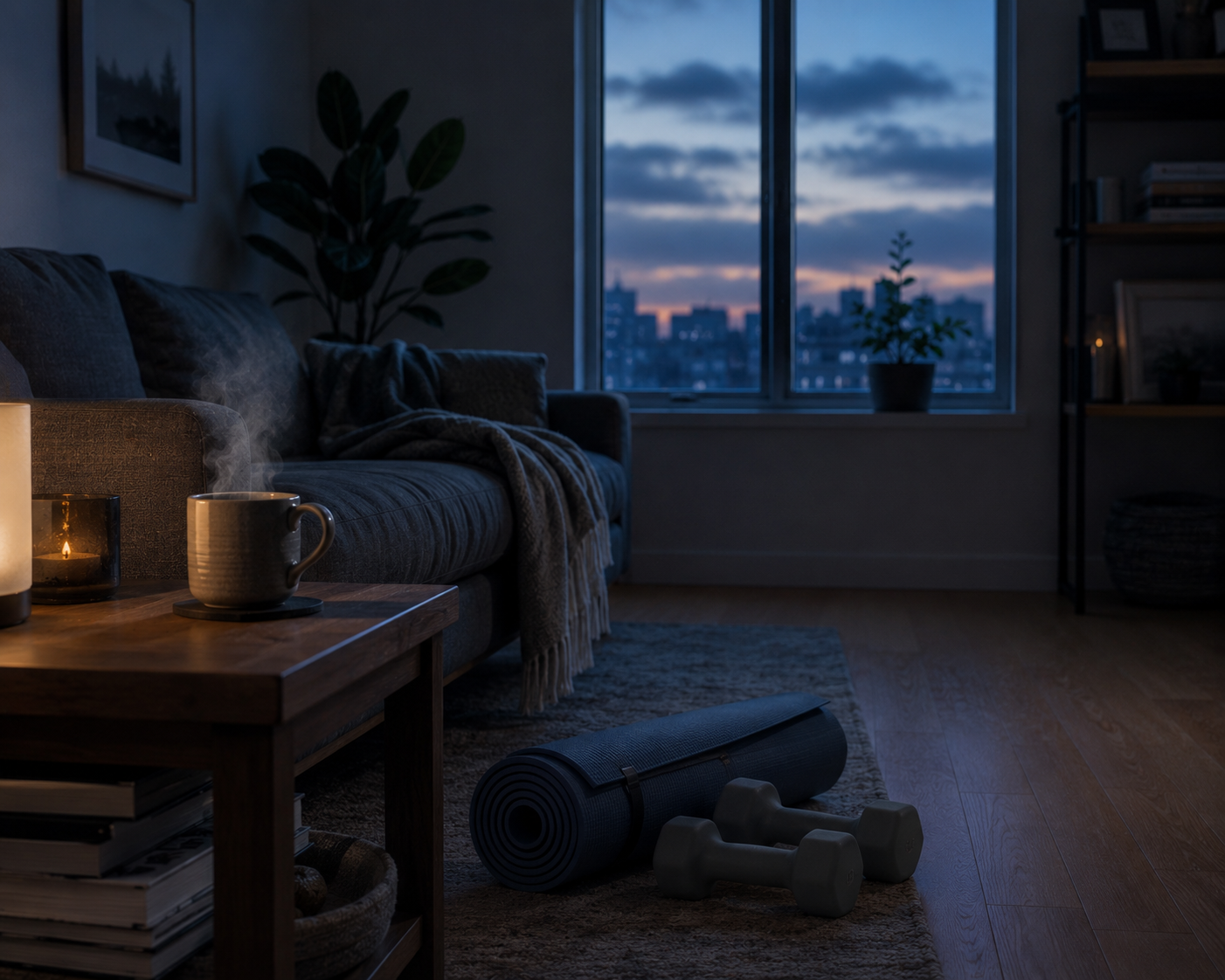
The alarm goes off at 5:45 a.m. and everyone else in the house is still asleep. You want to move your body before the day takes over, but a room-shaking set of burpees or a barbell dropped on a wood floor is going to end that plan fast. This is the exact problem silent strength circuits solve: real strength work, done in a bedroom, living room, or apartment, without a single thud that travels through the walls or wakes a partner, a baby, or the downstairs neighbor.
This guide walks through what makes a strength circuit “quiet” in a physiological and practical sense, why early mornings are a genuinely good window for this kind of training, and how to build a full-body circuit using nothing but control, tempo, and a few smart equipment swaps. You’ll also get a sample 20-minute routine, modifications for different fitness levels, and a look at the research behind strength training frequency and safety so you can build the habit with confidence rather than guesswork.
What “Silent Strength Circuits” Actually Means
A silent strength circuit is a sequence of resistance exercises selected and performed specifically to minimize impact noise and vibration. That’s a different goal than a typical strength workout, which often includes jumping, dropping weights, or fast, ballistic movement. Silence here comes from three design choices working together:
1. Exercise selection
Moves are chosen for zero or minimal ground impact. Squats, glute bridges, planks, wall presses, and controlled lunges replace box jumps, jump squats, or kettlebell swings that end in a hard set-down.
2. Tempo control
Instead of moving as fast as possible, each rep is slowed down, often with a pause at the hardest point of the movement (this is sometimes called an isometric hold). A slow squat with a three-second lowering phase and a two-second pause at the bottom builds real muscular tension without a single loud moment.
3. Surface and equipment choices
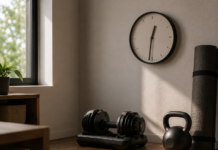
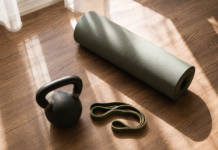
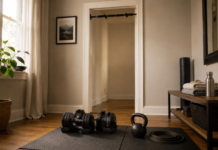
A rug, yoga mat, or folded towel under your feet absorbs vibration. Resistance bands, light dumbbells set down (not dropped), or simply body weight remove the clang of metal plates and machines entirely.
None of this makes the training “easier.” Slow, controlled, isometric-heavy work is often harder on the muscles than fast repetitions, because the muscle stays under tension longer with fewer moments of rest between reps.
Why Early Mornings Work Well for This Kind of Training
There isn’t strong dedicated research specifically comparing morning strength training to other times of day for quiet home workouts, so it’s worth being honest about what the evidence does and doesn’t say. What’s better established is the value of consistency and habit formation, and mornings tend to help with both for a simple, practical reason: fewer things compete for your attention before the rest of the household or your workday is active.
The Sleep Foundation notes that people who identify as “morning people” are more likely to be physically active, and that a consistent morning activity pattern can, over time, help reinforce a person’s circadian rhythm rather than disrupt it. That’s a modest but useful point: morning training doesn’t appear to work against your body clock the way a very intense, late-evening session sometimes can, since elevated body temperature after vigorous exercise late at night has been linked to reduced sleep efficiency in some research.
For quiet circuits specifically, the early morning window has one more practical advantage that has nothing to do with physiology: it’s the time when the building, the street, and the household are most acoustically sensitive. A dropped dumbbell at 10 a.m. on a Tuesday might not register. The same dumbbell at 5:50 a.m. can wake an entire floor. Training with intentional quiet, then, is really a scheduling problem as much as a fitness one, and the exercise choices below are built around that reality.
“Some physical activity is better than none, and adults who sit less and do any amount of moderate-to-vigorous physical activity gain some health benefits.”
— U.S. Centers for Disease Control and Prevention, Physical Activity Guidelines for Adults
What the Research Says About Strength Training Frequency and Benefits
Before building a routine, it helps to know what major health authorities actually recommend, since the quiet-workout format still needs to deliver real training benefit, not just avoid noise.
- The CDC recommends that adults do muscle-strengthening activities that work all major muscle groups at least two days a week, in addition to 150 minutes of moderate-intensity aerobic activity weekly (or 75 minutes of vigorous activity).
- The American College of Sports Medicine echoes this baseline, stating that every adult should perform activities that maintain or increase muscular strength and endurance a minimum of two days per week.
- Mayo Clinic notes that strength training sessions only need to last 20 to 30 minutes to produce meaningful results, and that one well-performed set per exercise, taken to the point where the last few repetitions feel genuinely difficult, is enough for general health benefits.
- Mayo Clinic also recommends resting a full day between sessions that train the same muscle group, to allow adequate recovery.
- The NHS advises adults do strength exercises that work all the major muscles at least two days a week, and specifically highlights simple bodyweight and household-object moves (sit-to-stand from a chair, wall press-ups, calf raises) as valid, effective options, particularly for people returning to exercise after a break.
Put together, these guidelines describe something very achievable: two or three short sessions a week, built from movements you already know how to do, performed with enough effort that the last few reps feel hard. A silent circuit fits neatly inside that framework. It doesn’t need to be softened or treated as a lesser substitute for a “real” gym session, since the intensity comes from tempo and time under tension rather than from loud or explosive movement.
The Noise Problem: What’s Actually Loud, and What to Swap It For
Most home workout noise complaints trace back to a small number of repeat offenders. Below is a practical swap list built from common gym-to-home noise sources and quiet alternatives that train similar muscles.
Every substitute in that table keeps the same muscle group working, just through a slower, controlled path instead of an explosive one. A mat or folded towel underfoot, socks or soft-soled shoes instead of trainers with hard rubber soles, and a rug beneath any dumbbells you do use will absorb most of the residual sound.
Sample 20-Minute Silent Strength Circuit
This circuit needs no equipment beyond a mat or towel and, optionally, a light pair of dumbbells or a resistance band. Move through each exercise for the listed time, then rest briefly before the next. Complete the full circuit two to three times depending on your fitness level and available time.
The Circuit
- Standing marches with knee pause — 45 seconds. Lift each knee slowly to hip height, hold one second, lower with control. Warms the hips and core without any floor contact noise.
- Slow-tempo bodyweight squat — 45 seconds. Lower for a count of three, pause two seconds at the bottom, rise for a count of two. Keep heels planted.
- Wall press-up — 40 seconds. Hands on a wall slightly wider than shoulders, lower your chest toward the wall for a count of three, push back with control.
- Glute bridge with 3-second hold — 45 seconds. Lie on your mat, drive hips upward, hold at the top, lower slowly.
- Static reverse lunge hold — 30 seconds per side. Step back into a lunge and hold the low position, weight balanced, before switching sides.
- Standing bicep curl (light dumbbells or band) — 40 seconds. Slow up, slow down, no swinging.
- Plank hold — 30 to 45 seconds. Forearms on the mat, body in a straight line, breathing steady.
- Standing calf raise with pause — 40 seconds. Rise onto your toes, hold briefly, lower with control (this one is naturally quiet since you never leave the floor).
Rest 20 to 30 seconds between exercises, and 60 to 90 seconds between full rounds. Two rounds takes about 15 minutes; three rounds fills the full 20 to 25 minutes.
Adjusting the Circuit to Your Fitness Level
If you’re just starting out
Reduce each hold and interval by 10 to 15 seconds, complete one full round instead of two or three, and use a chair or wall for balance during the squat and lunge. The NHS specifically recommends chair-assisted sit-to-stand movements as an entry point for people returning to exercise, and there’s no reason a first silent circuit can’t start there too.
If you have a consistent routine already
Add a fourth round, extend each isometric hold by 5 to 10 seconds, or add light dumbbells to the squat and lunge (lowering them to the floor by hand rather than setting them down with weight still in your grip, to avoid a soft but audible thump).
If you’re training for strength specifically, not just maintenance
Increase time under tension further: try a five-second lowering phase on the squat and lunge, and hold the plank and glute bridge for a full minute. Slow eccentric (lowering) work like this is genuinely demanding, often more so than a faster version of the same exercise, even though it produces no impact sound at all.
Equipment That Stays Quiet
You don’t need a home gym to make this work, but a few inexpensive items make quiet training easier and more comfortable.
Practical Quiet-Training Checklist
- ☐ A yoga mat or two folded towels stacked under your feet
- ☐ A rug or carpet remnant placed under any weights you use
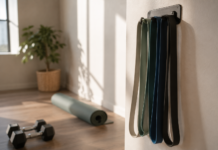
- ☐ Resistance bands (near-silent, versatile, packable for travel)
- ☐ Light dumbbells (2 to 8 kg / 5 to 18 lb) you can lower by hand rather than drop
- ☐ Socks or soft-soled shoes instead of hard-outsole trainers
- ☐ A doorframe or sturdy wall for balance support during holds
- ☐ A phone timer set to vibrate, not chime, for interval cues
Recovery, Safety, and Knowing Your Limits
Slow, isometric-heavy training feels different from fast-paced cardio circuits, and that can be misleading. The muscle burn during a long paused hold can be intense even at a low weight, so pay attention to joint position, not just effort level. A knee tracking too far forward in a static lunge, or a lower back arching during a long plank, causes more strain over a 30-second hold than it would in a two-second rep.
A few safety points worth keeping in mind: warm up for a few minutes with easy marching or arm circles before starting, breathe steadily throughout each hold rather than holding your breath, and stop an exercise immediately if you feel sharp or joint-level pain (general muscle fatigue is expected; joint pain is not). If you’re new to exercise, pregnant, managing a chronic condition, recovering from an injury, or returning to activity after a long break, it’s worth checking with a doctor or physical therapist before starting a new strength routine, particularly one built around extended isometric holds, since sustained muscle tension can temporarily raise blood pressure during the hold itself.
Mayo Clinic’s guidance to rest a full day between sessions targeting the same muscle groups applies here too. A silent circuit performed daily without any rest days isn’t necessarily better. Two to three sessions a week, spaced with rest or lighter activity in between, lines up with both CDC and NHS recommendations and gives muscles the recovery window they need to adapt and get stronger.
Warming Up Without Waking Anyone
A warm-up matters just as much in a quiet circuit as it does in any other workout, maybe more, since cold muscles and joints moving into a long isometric hold are more prone to strain than muscles that have already had a few minutes of easy blood flow. The trick is choosing warm-up movement that’s already quiet by design, so you’re not undoing the point of the whole session before you even reach the first exercise.
A simple three-minute sequence works well: thirty seconds of gentle arm circles, thirty seconds of slow torso twists, a minute of standing marches (the same low-impact move used in the circuit itself), thirty seconds of ankle circles, and a final thirty seconds of shoulder rolls. None of this involves the floor, none of it involves equipment, and all of it raises your heart rate slightly and loosens the joints you’re about to load. Skipping this step to save two or three minutes is one of the more common ways people end up sore or mildly strained after starting a new routine, so it’s worth protecting even when you’re short on time.
Cooling down deserves the same brief attention. A minute of standing forward folds, a slow neck stretch, and a few deep breaths before you start the rest of your morning helps your heart rate settle and gives your muscles a chance to begin recovering before you’re back to normal activity.
Fitting Silent Circuits Into Different Living Situations
Not every home has the same acoustic challenges, and it’s worth thinking about your specific situation rather than applying a one-size approach. In a ground-floor house with no one below you, the main concern is usually just not waking a partner or child in a nearby room, so a slightly firmer floor contact during marches or lunges is unlikely to matter. In a multi-story apartment building, especially one with hardwood or laminate flooring over a shared subfloor, even a quiet-seeming footstep can transmit surprisingly far, which is why the padding recommendations earlier in this guide (a mat plus a rug, rather than a mat alone) matter more than they might first appear.
Shared houses and dorm-style living bring a different variable: thin interior walls rather than floors. In that setup, the exercises most likely to cause a problem are ones involving any kind of tapping or repeated light contact against a wall, such as a wall press-up done too close to a shared wall. Moving that particular exercise a few feet away, or swapping it for a slow push-up from the knees on a mat, sidesteps the issue entirely while training the same muscles.
If you travel often, the same principles apply in hotel rooms, where a folded towel under your feet and resistance bands packed in a suitcase let you keep the routine going without needing to identify local gym hours or worry about a paper-thin hotel wall.
Common Mistakes That Undermine a Quiet Routine
Rushing the tempo
The entire premise of a silent circuit depends on control. Speeding through reps to finish faster reintroduces momentum, which is both louder and less effective at building strength through the full range of motion.
Skipping the floor padding
Even bodyweight moves like lunges and squats create some vibration through hardwood or laminate floors. A mat or towel isn’t optional if you live above another unit or share a wall with a light sleeper.
Treating “quiet” as “easy”
Because there’s no jumping or heavy clanging, it’s tempting to assume a silent circuit is a lesser workout. Long isometric holds and slow eccentric phases are demanding on the muscular and cardiovascular system in their own way. Effort should still bring you to genuine fatigue by the final round.
Ignoring your downstairs neighbor’s actual floor
Sound travels differently depending on building construction. If you’ve had noise complaints before, test your circuit at a lower volume first (fewer rounds, softer surface) and adjust based on real feedback rather than assumption.
Making the Habit Stick
A circuit only works if you actually do it, and mornings have a specific advantage here: decision fatigue hasn’t built up yet, and the day’s obligations haven’t had a chance to crowd out the plan. Laying out your mat and any equipment the night before removes one small barrier. Pairing the circuit with something already fixed in your morning, like right after you brush your teeth or right before you make coffee, gives it a natural anchor point rather than leaving it to float and get skipped.
Consistency, more than intensity, is what produces results over months. Two well-executed 20-minute sessions a week, done reliably, will outperform an ambitious plan that gets abandoned after two weeks because it was too loud, too long, or too disruptive to the household to sustain.
Frequently Asked Questions
Do silent strength circuits actually build muscle, or are they just a quieter version of cardio?
They build muscle through a genuine strength-training mechanism: time under tension. Slow tempos and isometric holds keep muscles working continuously rather than relying on speed or heavy load, which is a well-established way to create the muscular fatigue needed for strength adaptation, alongside traditional heavier lifting.
How long before I notice results?
This varies by person, starting fitness level, and consistency, so it’s hard to give a single number responsibly. General strength training guidance suggests noticeable changes in strength and how exercises feel often show up within a few weeks of consistent training two to three times weekly, with visible physical changes typically taking longer.
Can I do this every single morning?
Health guidance generally points toward at least one rest day between sessions that train the same muscle groups, so daily identical circuits aren’t ideal. Alternating muscle groups, or doing the full circuit two to three times a week with light stretching or walking on other days, fits standard recommendations better.
What if I still wake someone up despite doing everything on this list?
Check your floor covering first (a thin yoga mat alone often isn’t enough over hardwood), reduce hold times slightly, and consider shifting particularly floor-contact-heavy moves like lunges to a different part of your session, or swapping them for seated or wall-supported variations.
Is it safe to hold isometric positions if I have high blood pressure?
Sustained muscle contractions can temporarily raise blood pressure during the hold. If you have high blood pressure or any cardiovascular condition, talk to your doctor before starting isometric-heavy training, and they may recommend shorter holds or a different approach entirely.
Do I need dumbbells, or is bodyweight enough?
Bodyweight alone, combined with slow tempo and pauses, is enough to meet general strength training guidelines, especially early on. Resistance bands or light dumbbells become useful once bodyweight versions stop feeling challenging by the final round of the circuit.
References
- Centers for Disease Control and Prevention. Physical Activity Guidelines for Adults.
- American College of Sports Medicine. Physical Activity Guidelines.
- Mayo Clinic. Strength training: Get stronger, leaner, healthier.
- NHS. Strength Exercises.
- Sleep Foundation. Exercise and Sleep.