



























Losing weight comes down to creating a small, steady calorie deficit without starving yourself or sacrificing nutrition. In practice, that means eating in a way that keeps you fuller on fewer calories, prioritizing protein and fiber, and choosing minimally processed foods most of the time. This guide distills Weight Loss Basics into nine practical, science-backed principles you can apply today. Quick definition up front: weight loss occurs when average daily energy intake stays below energy expenditure for long enough to reduce body fat. A safe general target, as of August 2025, is gradual loss at roughly 0.5–1.0 kg (about 1–2 lb) per week for most adults.
Quick note: This article is educational and not a substitute for medical advice. If you have a health condition, are pregnant, breastfeeding, under 18, or take medications that affect appetite or blood sugar, consult a qualified clinician or dietitian before changing diet or exercise.
1. Create a modest, sustainable calorie deficit
The direct path to weight loss is to consistently eat fewer calories than you burn—without extreme restriction that backfires. Practically, most adults do well aiming for a daily deficit of ~250–500 kcal to start, which typically supports slow, steady fat loss while preserving energy and performance. Classic guidance suggests that a 500–1,000 kcal/day deficit yields about 0.5–1.0 kg (1–2 lb) per week; however, your actual rate varies with body size, activity, and adherence, so treat these as guardrails, not promises. Pairing dietary calorie reduction with more physical activity improves fat loss and cardiorespiratory fitness, and behavior strategies (sleep, stress, planning) make the deficit livable. If progress stalls for 2–3 weeks, reassess intake accuracy, step count, and liquid calories before cutting more.
1.1 Why it matters
- A moderate deficit is easier to adhere to and helps preserve lean mass.
- Extreme deficits spike hunger and increase the risk of regaining weight later.
- Slow loss improves the odds of maintenance at 6–12 months.
1.2 Numbers & guardrails
- Start with a 250–500 kcal/day deficit; monitor for 2–3 weeks.
- Aim for ~0.5–1.0 kg (1–2 lb) loss per week on average.
- Combine diet changes with more movement for better results.
Synthesis: A small, consistent deficit you can live with beats an aggressive one you can’t maintain.
2. Estimate your calorie needs (TDEE) accurately
To set a smart deficit, first estimate your total daily energy expenditure (TDEE). A widely supported way is to calculate resting metabolic rate (RMR) with the Mifflin–St Jeor equation—shown to predict RMR within ~10% of measured values more often than other popular formulas—and multiply by an activity factor. For even better personalization, the NIH/NIDDK Body Weight Planner models how your metabolism adapts over time and gives tailored calorie and activity targets to reach a specific weight by a target date. As of August 2025, these approaches remain standards for practical planning without lab testing.
2.1 How to do it (quick steps)
- Calculate RMR: Use Mifflin–St Jeor (no cost calculators abound).
- Adjust for activity: Multiply by a factor (~1.2–1.9) to estimate TDEE.
- Set deficit: Subtract 250–500 kcal from TDEE to start.
- Refine with data: Track intake/weight for 2–3 weeks and recalibrate.
2.2 Mini example
- 80 kg, 175 cm, 35-year-old man → RMR ≈ (10×80)+(6.25×175)−(5×35)+5 ≈ 1,750 kcal/day.
- Lightly active (×1.5) → TDEE ≈ 2,625 kcal/day.
- Deficit of 400 kcal → eat ~2,225 kcal/day and adjust based on progress. PubMed
Synthesis: A credible TDEE estimate plus short feedback loops beats guesswork and frustration.
3. Prioritize protein to preserve lean mass and manage hunger
Eating enough protein helps you stay fuller on fewer calories and protects lean mass while losing weight. In weight-loss phases, many adults do well targeting ~1.2–1.6 g protein/kg body weight/day (e.g., 90–120 g/day for a 75 kg person), distributed across meals. Evidence from controlled trials and meta-analyses shows higher-protein diets aid body composition by reducing fat mass loss while preserving or slightly increasing fat-free mass, especially when combined with resistance training. Choose a mix of protein sources—poultry, fish, eggs, dairy or yogurt, legumes, tofu/tempeh—and consider a supplemental shake if food alone falls short. People with kidney disease should follow clinician guidance. PubMed
3.1 Practical targets & timing
- Daily target: 1.2–1.6 g/kg/day during fat loss.
- Per-meal anchor: ~25–40 g per meal for adults, adjusted to appetite and goals.
- Pair with training: Resistance exercise plus adequate protein best preserves lean mass. British Journal of Sports MedicineBioMed Central
3.2 High-protein, lower-calorie ideas (global & South Asian-friendly)
- Skyr/Greek yogurt with berries and chia
- Daal (lentil soup) with extra lentils and a side salad
- Grilled chicken or paneer tikka with mixed veg
- Egg-white masala omelet with whole-grain roti (half portion)
- Tofu bhuna with cauliflower “rice”
Synthesis: Hit a solid protein floor daily and hunger management gets easier while muscle stays protected.
4. Fill up on fiber and low-energy-density foods
Fiber adds volume for very few calories, slows digestion, and supports a healthy gut—making it your best friend in a calorie deficit. A practical benchmark is ~14 g fiber per 1,000 kcal (e.g., ~28 g/day at 2,000 kcal), which aligns with guidance such as ~25–38 g/day for adults. Focus on vegetables, fruits, legumes, whole grains, nuts, and seeds; these foods are generally lower in energy density, improving fullness per bite compared to refined options. Increase fiber gradually with enough fluids to avoid GI discomfort; if you struggle to meet targets with food alone, consider psyllium or wheat dextrin per clinician advice.
4.1 How to hit your numbers
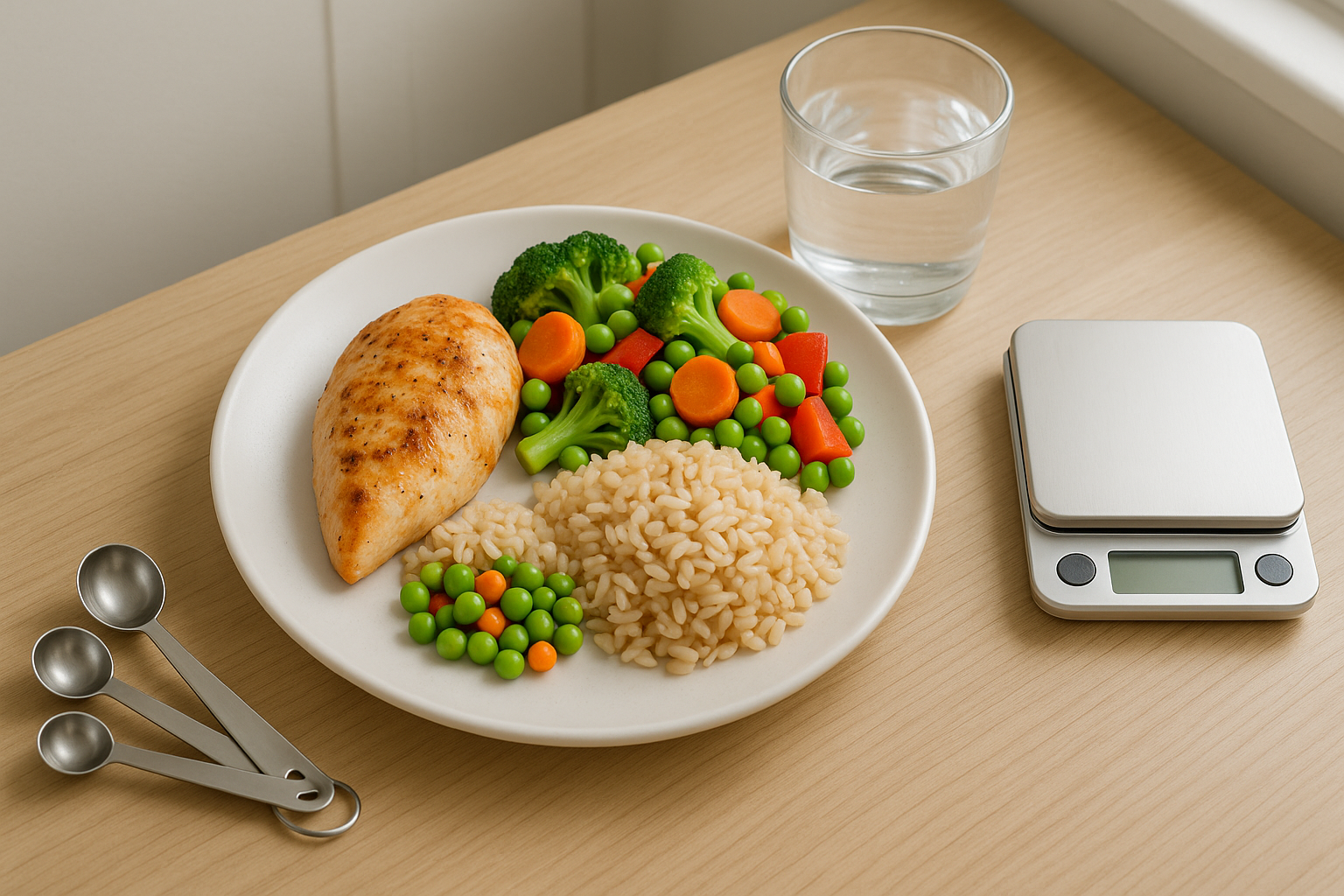
- Build your plate: Half veggies, a quarter protein, a quarter whole-grain/starch.
- Daily fiber checklist: Include at least 2 veg, 2 fruit, and 1 legume or whole-grain serving.
- Swap smart: White rice → brown rice or mixed with lentils; refined roti → atta/whole-wheat; biscuits → fruit/nuts.
4.2 Mini example
- Breakfast: Oats (50 g) + yogurt + berries (8–10 g fiber).
- Lunch: Chana masala + salad + small brown-rice portion (12–15 g fiber).
- Dinner: Grilled fish/tofu + roasted veg + quinoa (8–10 g fiber).
Synthesis: Fiber lets you eat more food for fewer calories while supporting metabolic and gut health.
5. Limit free sugars and liquid calories
Sugary drinks and added sugars add calories with little satiety and are strongly linked with weight gain. The World Health Organization advises keeping “free sugars” below 10% of energy, with a conditional suggestion toward <5% (~25 g/day at 2,000 kcal) for additional benefits. Replacing sugar-sweetened beverages with water, unsweetened tea/coffee, or low-/no-calorie options reduces total intake; meta-analyses continue to find that higher SSB intake promotes higher BMI and weight in adults and children. If using non-nutritive sweetened beverages, consider them as transitional tools while building a habit of mostly water and unsweetened drinks. PubMed
5.1 Practical swaps
- Soda/cola → sparkling water with lemon/lime
- Sweet lassi → salted or plain lassi; or diluted versions
- Sweetened chai → half-sugar, then unsweetened + spices (cardamom, cinnamon)
- Packaged juices → whole fruit + water
5.2 Guardrails (as of August 2025)
- Keep free sugars <10% of daily calories; <5% if you can.
- Review labels: 1 can soda ≈ 35–40 g sugar.
Synthesis: Cutting liquid sugars is one of the fastest ways to lower calories without feeling deprived.
6. Choose minimally processed foods most of the time
Food processing level influences how easily we overeat. In a controlled inpatient crossover trial, adults eating ultra-processed diets consumed ~500 kcal/day more and gained weight compared with when the same people ate unprocessed diets matched for macros, sugar, sodium, and fiber—suggesting processing itself can drive higher intake. You don’t need to avoid all convenience foods, but centering meals on whole or minimally processed staples (vegetables, fruits, legumes, intact grains, nuts, seeds, eggs, seafood, meats, dairy/yogurt) usually makes adherence and satiety easier. Use packaged foods strategically—frozen veggies, canned beans, or pre-cooked grains can be allies.
6.1 Smart swaps
- Flavored crisps → roasted chana/peanuts (portion-controlled)
- Sugary breakfast cereal → oats or bran flakes + nuts
- Instant noodles nightly → quick stir-fried veg + eggs/tofu over rice
- Dessert daily → fruit most days; sweets reserved and portioned
6.2 Region-savvy tip
- Build “lighter” takes on favorites: smaller ghee amounts, leaner cuts, extra veg in curries, and mindful rice/roti portions.
Synthesis: Emphasizing minimally processed foods improves fullness per calorie and naturally curbs overeating.
7. Use meal structure that reduces overeating (timing helps habit, calories drive results)
How you structure meals can reduce overeating, but total calories still dominate outcomes. Large studies and randomized trials show meal size and frequency are stronger determinants of weight change than clock timing alone, and time-restricted eating (e.g., 16:8) is not superior to standard calorie restriction when calories are matched. That said, a consistent eating window and regular meals help many people manage appetite and stick to targets. Build a routine that spaces protein-anchored meals, limits high-calorie snacking, and suits your work/sleep schedule.
7.1 Mini checklist
- Anchor 3–4 eating occasions/day, each with protein + produce.
- Keep snacks intentional (protein/produce), not constant grazing.
- Night shifts or Ramadan? Plan pre- and post-fast meals with protein and fiber.
7.2 What the research says (as of August 2025)
- Meal size/frequency relate more to weight change than time between first/last bite.
- TRE doesn’t beat calorie restriction when total intake is controlled.
Synthesis: Pick a meal schedule you can maintain; prioritize calories and composition over the clock.
8. Track the basics to stay honest (without obsession)
Self-monitoring—of food, steps, and weight—is consistently linked with better weight-loss results. Digital tools make it easy: log meals (even roughly), weigh yourself once or twice per week under similar conditions, and keep an eye on step counts or active minutes. Systematic reviews show that more frequent self-monitoring correlates with greater weight loss, whether via apps, connected scales, or simple checklists. If tracking every gram triggers stress, use lighter-touch methods (photo logging, “protein + produce” checkmarks, or a three-times-per-day quick log). The goal is awareness, not perfection.
8.1 Tools & tactics
- Apps: MyFitnessPal, Cronometer, Lose It! (or pen-and-paper)
- Weight checks: 1–2×/week; look at trends, not day-to-day noise
- Activity: 7,000–10,000 steps/day or set active-minutes goals
- Calibration: If weight trends flat for 2–3 weeks, re-estimate intake or increase activity
8.2 Use data compassionately
- Pair tracking with non-scale wins (energy, strength, clothing fit).
- If monitoring worsens body image or anxiety, switch to gentler methods and consider support from a clinician.
Synthesis: Simple, consistent tracking keeps your plan honest and adaptable—no need for all-or-nothing precision. PubMed
9. Protect the foundations: sleep, stress, and routine
Sleep and stress control appetite and decision-making—the hidden levers of calorie balance. Adults should aim for ≥7 hours/night; insufficient sleep alters hunger hormones and nudges you toward higher-calorie choices, making deficits harder to maintain. Chronic stress can elevate cortisol and promote intake of energy-dense comfort foods. Build routines that protect sleep and include stress-management (walks, prayer/meditation, breathing drills, social support). Small routines—packing a protein-rich lunch, prepping veggies, setting a wind-down alarm—reduce decision fatigue and help your plan run on autopilot. PMC
9.1 Action menu
- Sleep: Consistent bed/wake time, cool/dark room, limit late caffeine.
- Stress: 5-minute box breathing, short outdoor walk, or journaling after meals.
- Environment: Keep water visible; portion snacks; default dessert = fruit.
- Planning: Two batch-cooked proteins and two chopped veg each week.
Synthesis: When sleep and stress are handled, appetite steadies and sticking to calories becomes far easier.
FAQs
1) What is a “calorie deficit,” exactly?
It’s when your average daily energy intake is lower than your energy expenditure—so your body taps stored energy (fat and some glycogen) to make up the difference. For sustainable loss, many adults start with a 250–500 kcal/day deficit and adjust based on 2–3 week trends, aiming for roughly 0.5–1.0 kg (1–2 lb) per week. Larger bodies may lose faster initially; plateaus are normal and usually solved by refining intake accuracy and activity.
2) How fast should I lose weight?
Gradual loss is more maintainable and safer for most people. Common guidance is about 0.5–1.0 kg (1–2 lb) per week on average. If you’re smaller, older, or highly active already, you may progress more slowly. If you’re much heavier or newly active, early water-weight shifts can make the scale drop faster in the first weeks—focus on monthly averages.
3) Do I need to do intermittent fasting to succeed?
No. Intermittent fasting can help some people eat fewer calories, but when calories are matched, time-restricted eating isn’t superior to standard calorie restriction for weight loss. Choose an eating schedule that supports your lifestyle and allows protein-anchored meals; the routine you can stick with wins.
4) What macro split works best?
There isn’t one perfect split. Prioritize adequate protein (≈1.2–1.6 g/kg/day) to protect muscle and control hunger, then fill remaining calories with mostly high-fiber carbs and healthy fats based on preference and performance. Adjust day-to-day: more carbs on heavy training days, slightly more fats on lighter days if preferred.
5) How much fiber do I need, and why does it matter for weight?
Aim for ~14 g per 1,000 kcal (about 25–38 g/day for many adults). Fiber increases fullness for fewer calories and supports a healthy gut. Get it from vegetables, fruits, legumes, whole grains, nuts, and seeds; scale up gradually and drink enough water to minimize GI discomfort. National Academies Press
6) Are “ultra-processed foods” always bad?
Not always, but centering your diet on them makes overeating more likely. In a controlled clinical trial, people ate ~500 kcal/day more and gained weight on an ultra-processed diet compared with an unprocessed diet matched for macros and fiber. Use helpful convenience items (frozen veg, canned beans) while emphasizing minimally processed staples.
7) What about sugary drinks and fruit juice?
Sugar-sweetened beverages add calories with little satiety and are strongly linked to weight gain. The WHO recommends keeping free sugars <10% of calories, ideally closer to 5% for added benefit. Choose water, unsweetened tea/coffee, or plain milk; eat whole fruit instead of drinking juice.
8) Do I have to count every calorie?
No. Detailed tracking can help initially, but many people succeed with simpler methods: “protein + produce” at each meal, photo logs, or hand-portion guides. The key is consistent self-monitoring—more frequent check-ins correlate with better results, even when tracking isn’t perfect.
9) How do sleep and stress affect my results?
Short sleep and chronic stress shift hormones and behavior toward higher-calorie choices and larger portions. Adults should target ≥7 hours/night and use small stress-management habits (breathing drills, walks, prayer/meditation) to improve appetite control and adherence. Nature
10) Which calculators or tools are trustworthy?
For planning, use the NIDDK Body Weight Planner (models adaptation) and a Mifflin–St Jeor RMR calculator from credible health organizations or dietetic bodies. Reassess based on real-world trends; calculators provide starting points, not guarantees. PubMed
Conclusion
Fat loss isn’t a mystery—it’s a set of basics you can practice consistently. Start with a credible calorie target (Principles 1–2), then make adherence easier by anchoring meals with protein and fiber (Principles 3–4), reducing free sugars and liquid calories (Principle 5), and favoring minimally processed foods (Principle 6). Use meal structure that fits your life (Principle 7), and keep a light hand on the wheel with simple tracking (Principle 8). Finally, remember that sleep, stress, and routine (Principle 9) quietly determine how manageable everything feels. Choose one or two principles to apply this week, measure what matters, and iterate. Your next best step: set a realistic calorie target with the NIDDK Body Weight Planner, plan three protein-anchored meals for tomorrow, and put your water bottle where you will actually use it. Start small today—future you will thank you.
References
- Steps for Losing Weight | Healthy Weight and Growth. Centers for Disease Control and Prevention (updated Jan 17, 2025). CDC
- Key Recommendations: Clinical Guidelines on the Identification, Evaluation, and Treatment of Overweight and Obesity in Adults. National Heart, Lung, and Blood Institute (accessed 2025). NHLBI, NIH
- Dietary Guidelines for Americans 2020–2025. U.S. Department of Agriculture & U.S. Department of Health and Human Services (Dec 2020). Dietary Guidelines
- How much dietary fiber should I eat? U.S. Department of Agriculture, Ask USDA (updated 2024). Ask USDA
- Guideline: Sugars Intake for Adults and Children. World Health Organization (Mar 4, 2015). World Health Organization
- Recommendations and Remarks—WHO Sugars Guideline. World Health Organization / NCBI Bookshelf (2015). NCBI
- Ultra-Processed Diets Cause Excess Calorie Intake and Weight Gain: An Inpatient Randomized Controlled Trial. Hall KD et al., Cell Metabolism (2019). PubMed record: PubMed
- Association of Eating and Sleeping Intervals With Weight Change Over Time. Zhao D et al., Journal of the American Heart Association (Jan 2023). AHA Journals
- Calorie Restriction with or without Time-Restricted Eating in Weight Loss. Liu D et al., New England Journal of Medicine (Apr 2022). New England Journal of Medicine
- Recommended Amount of Sleep for a Healthy Adult: AASM/SRS Consensus. Watson NF et al., J Clin Sleep Med (2015). AASM PDF: AASM
- Self-Monitoring via Digital Health in Weight Loss Interventions: Systematic Review. Patel ML et al., Obesity (Mar 2021). Wiley Online Library
- Systematic Review and Meta-Analysis: Protein Intake to Maintain Muscle Mass During Weight Loss. Nunes EA et al., J Cachexia Sarcopenia Muscle (2022). Wiley Online Library
- About the Body Weight Planner. National Institute of Diabetes and Digestive and Kidney Diseases (accessed 2025). NIDDK