

























If your lower back feels tight, achy, or overworked, your hamstrings may be part of the story. Hamstring Stretches to Reduce Back Pain help by restoring hip motion, easing posterior-chain tension, and reducing the load your lumbar spine has to absorb during everyday bending and sitting. In plain terms: when the muscles at the back of your thigh move better, your pelvis can tilt more freely and your back doesn’t need to compensate as much. The best approach is steady, pain-aware stretching built into your week, paired with light activity. As of August 2025, guidelines still place exercise near the center of back-pain care; stretching is one smart piece of that plan.
Quick-start (skim list): 1) pick 3–4 stretches below; 2) hold static stretches 20–30 seconds, 2–4 rounds; 3) keep your spine neutral and breathe; 4) stop with numbness/tingling—aim for gentle tension, not pain; 5) practice 4–6 days/week alongside short walks.
Brief, sensible-use disclaimer: back pain has many causes. If you have red flags—numbness/weakness, bowel/bladder changes, unexplained weight loss, fever, or a traumatic injury—seek medical evaluation first. For radiating leg pain, add the neural-glide option below and progress cautiously.
1. Supine Strap Hamstring Stretch (Neutral Spine)
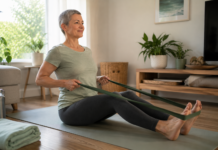
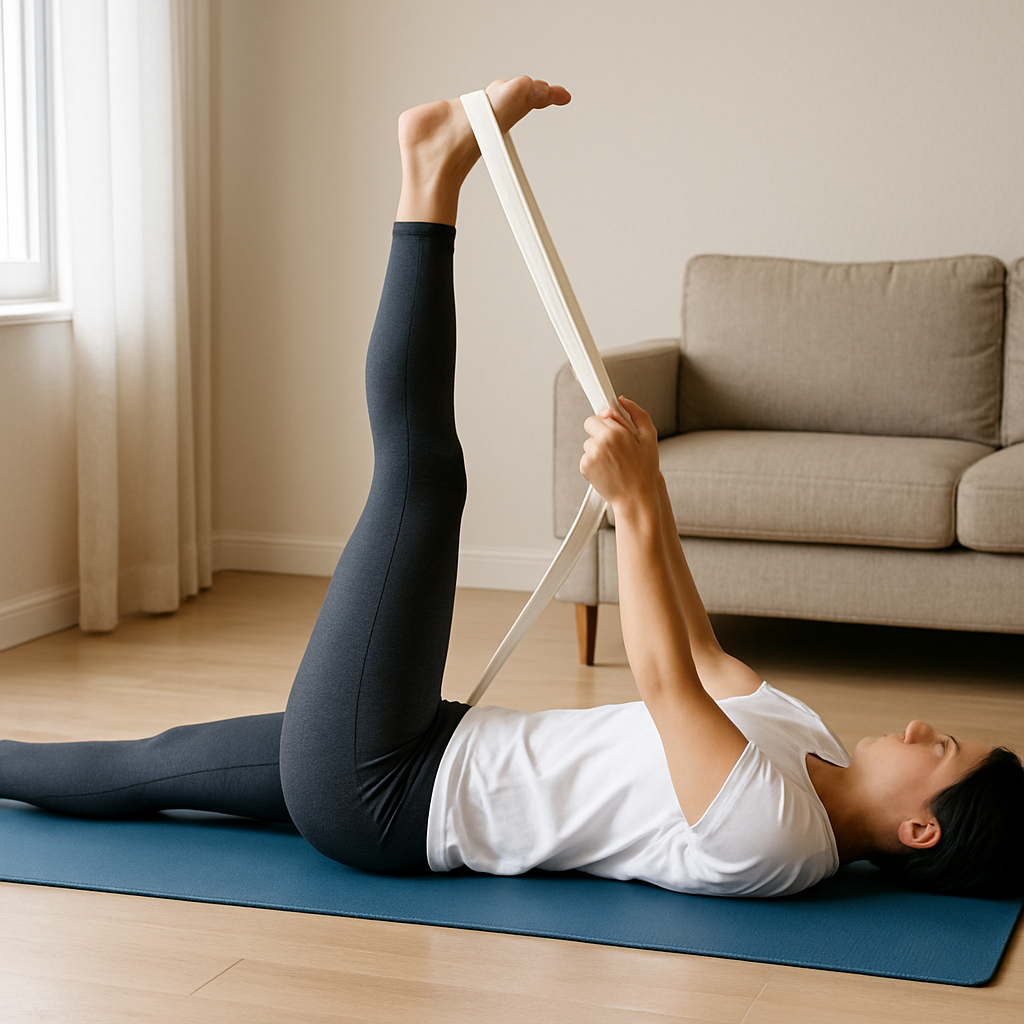
This is the most back-friendly place to start because the floor supports your spine and lets you focus on your hamstring without over-rounding your low back. Lie on your back, one knee bent with the foot planted, the other leg rising toward the ceiling with a strap or towel around your midfoot. You’ll feel a firm, even stretch in the back of your thigh—not a sharp tug behind the knee or in your lower back. For many people with irritated backs, simply returning hip motion (hip flexion with a straight knee) reduces the lumbar “borrowed” motion during daily bends. Begin with smaller ranges, keep your pelvis quiet (no tailbone tuck), and build consistency before intensity. Over days to weeks, you’ll notice easier forward folds and less stiffness after sitting.
How to do it
- Loop a strap around your raised foot; keep your ankle relaxed and knee straight but not locked.
- Gently pull the leg toward you until you reach mild–moderate tension (3–4/10).
- Keep your opposite knee bent and foot planted to anchor your pelvis.
- Breathe slowly for 20–30 seconds; release and repeat 2–4 rounds per side.
- Practice most days; pair with a 5–10 minute walk.
Numbers & guardrails
- Dosage (as of Aug 2025): static stretches 10–30 s holds, 2–4 reps suit most adults; older adults may benefit from 30–60 s holds.
- Sensations to avoid: sharp knee pain, pins-and-needles, or back pinching; ease off and slightly bend the raised knee.
Why it works: It lengthens the hamstrings without loading the spine, restores hip flexion, and reduces compensatory lumbar flexion during bending.
2. Doorway (Leg-on-Wall) Hamstring Stretch
When your back is sensitive, the doorway or “90/90” setup locks in spinal neutrality while you stretch. You lie close to a doorframe or wall and place one heel up at 90° hip flexion, knee straight, toes to the ceiling. This position reduces the temptation to yank your leg with your arms and prevents pelvic tipping that can stress the lower back. It also gives you hands-free time, which encourages longer, more relaxed holds. Many people find they can tolerate more stretch time here, which is important because minutes matter—consistent stretching rather than one-off sessions changes tissue behavior over weeks.
How to do it
- Lie with your buttocks near a doorframe, one leg up the wall, knee straight (or soft), the other leg extended through the doorway.
- Keep your low back kissing the floor and ribs heavy.
- Dorsiflex (draw toes toward you) to bias the stretch slightly lower in the hamstring.
- Hold 30–45 seconds; repeat 2–4 times per side.
Common mistakes
- Scooting too far away so the hip angle collapses (<80°), reducing stimulus.
- Forcing the knee locked out—better to keep a micro-bend and focus on hip angle.
- Letting the pelvis tilt posteriorly (tailbone scooping up); keep it neutral.
Why it works: External support creates a consistent angle that promotes longer, calmer holds—an approach that aligns with flexibility recommendations and reduces back guarding.
3. Seated Hinge Hamstring Stretch (Chair or Bench)
If you’re desk-bound, this is the stretch you can do between emails. It teaches a hip hinge instead of a spine curl, retraining how you reach for the floor or tie shoes. Sit tall on the edge of a chair, extend one leg with heel on the ground, and hinge from your hips as if you’re bowing. You should feel tension mid-thigh, not an aggressive pull behind the knee or a burn in your low back. The seated setup builds awareness: you’ll learn to maintain a long spine as the pelvis tips forward, exactly the pattern that spares your lumbar discs and ligaments during daily life. Progress by raising the heel onto a low step or by slightly dorsiflexing the ankle.
Mini-checklist
- Long spine, chest proud; think “sternum forward,” not “head down.”
- Hinge at the hips; keep the back flat (no rounding).
- Mild–moderate tension only; stop if the sensation “jumps” below the knee.
- 20–30 s x 2–4, most days; switch legs.
Numbers & guardrails
- Exercise-based care remains a core recommendation for low back pain across clinical guidelines; this seated hinge reinforces safer bending mechanics alongside stretching.
Why it works: It improves functional hamstring length in the pattern you actually use—hip hinge—so your back doesn’t need to flex excessively during everyday tasks.
4. Standing Hamstring Stretch on Step (With Ankle Dorsiflex/Plantarflex Bias)
Standing variants build real-world control. Elevating your heel on a step lets you fine-tune knee extension and ankle angle while keeping your trunk aligned. Dorsiflexing (toes up) tends to shift the sensation lower and sometimes increases neural tension; plantarflexing (toes pointed) often moves the sensation higher in the muscle belly. Alternating between the two—within comfort—helps you find the most productive line without provoking the sciatic nerve. Keep the pelvis square and the spine long; hinge forward a few degrees until you reach an easy 3–4/10 stretch.
How to do it
- Place heel on a 15–30 cm (6–12 in) step; knee straight but soft.
- Hinge forward slightly; avoid rounding the lower back.
- Explore 5 slow ankle cycles (toes up, toes down) to identify the friendliest angle.
- Hold 20–30 s in the best position; 2–4 sets per side.
Common mistakes
- Locking the knee back hard (stresses the joint).
- Twisting the pelvis toward the up-leg (reduces stretch).
- Chasing “more” by bowing the spine.
Why it works: You’re training the hamstring through knee and hip positions you’ll actually use when stepping, climbing, or reaching—reducing the lumbar “backup plan.”
5. Half Split (Ardha Hanuman) With Blocks
This yoga-inspired pose gives a deep, controllable stretch with superb spine awareness. From a low kneel/lunge, shift your hips back and straighten the front knee so your hips stack over the back knee, toes up. Place blocks under each hand to keep the chest wide and the lumbar spine long; slide the heel forward to adjust intensity. It’s a particularly good choice if you feel stiff after prolonged sitting, because it opens the entire posterior chain while reinforcing a neutral back. If you’re sensitive behind the knee, add a small pad or keep a micro-bend.
How to do it
- Start in a half-kneel; slide the front heel forward, toes up, knee straight.
- Hands on blocks; hinge the pelvis back until you feel gentle tension mid-hamstring.
- Maintain long breathing for 30–45 s; perform 2–3 rounds.
- Switch sides; finish with a short walk.
Numbers & guardrails
- Stretching is most effective when practiced regularly for ≥4 weeks; expect gradual, durable gains—not instant fixes.
Why it works: Blocks keep your trunk tall, shifting the load to the hamstrings instead of the spine, while the long lever (straight knee) provides a comprehensive, adjustable stretch.
6. PNF Contract–Relax Hamstring Stretch (Hold–Relax)
When standard holds plateau, proprioceptive neuromuscular facilitation (PNF) can unlock more range without cranking harder. In a supine strap setup, you gently resist into the strap (as if pushing the leg down) for 5–6 seconds, then relax and take up the slack into a new range for 15–20 seconds. The brief contraction reduces stretch reflex and can deliver immediate but safe gains when done calmly. This is ideal after a warm-up walk or light cycling. Keep resistance submaximal (about 50–60% effort), avoid breath-holding, and respect any nerve-type signs.
How to do it
- Raise the leg with a strap to a mild stretch.
- Contract: press your heel “down” into the strap (no movement) for 5–6 s at ~50–60% effort.
- Relax and stretch: exhale and gently pull into the new range for 15–20 s.
- Repeat 3–4 cycles; then switch sides.
Numbers & guardrails
- Practical reviews support 15–30 s static holds repeated 2–4 times; PNF’s contract-relax variant is a widely used clinical method to improve extensibility.
Why it works: The contract phase dampens protective tone, allowing a deeper but still comfortable stretch that translates to easier bending and lifting mechanics later.
7. Active Straight-Leg Raise (ASLR) With Eccentric Lower
This “loaded stretch” blends flexibility with control. From a supine position, lift your straight leg to the edge of tension (strap optional), pause, then slowly lower over 3–5 seconds. The active lift engages hip flexors and core; the slow eccentric descent encourages the hamstring to lengthen under light load—a pattern that sticks. Keep the pelvis quiet; avoid arching your back or popping ribs. Start shallow and build; the goal is smooth movement without back discomfort. If you tend to “borrow” back motion during forward bends, this pattern is especially helpful.
How to do it
- Lie supine; one leg straight and hovering, the other relaxed on the floor.
- Lift the working leg to a comfortable limit; pause 1–2 s.
- Lower over 3–5 s; repeat 8–10 reps, 2–3 sets each side.
- Finish with a gentle static hold (Section 1) for 20–30 s.
Why it matters
- Exercise therapy (strength + mobility) is among the most evidence-supported strategies for chronic low back pain; adding gentle load builds capacity and confidence while you regain motion.
Result you’ll notice: smoother, less “grabby” bends and a back that doesn’t protest after standing up from a chair.
8. Sciatic Nerve Glide (“Slider”) in Supine
Sometimes what feels like a stubborn hamstring is partly neural tension—the sciatic nerve and its branches can become irritable and limit your perceived stretch. Neural mobilization (“nerve glides” or “sliders”) move the nerve gently without holding it on stretch. In supine, you straighten the knee while pointing the toes (plantarflex) and flex the knee while pulling toes up (dorsiflex). The nerve moves like floss through its sheath, and many people find their stretch tolerance improves after a few glides. This is not a stretch to “feel a lot.” Keep it light, smooth, and symptom-free.
How to do it
- Lie on your back; raise one thigh to ~90° hip flexion (support with hands or a band).
- Slider pattern:
- Knee extends as you point toes (plantarflex)—no sharp tension.
- Knee flexes as you pull toes up (dorsiflex).
- Perform 10–15 slow reps, 1–2 sets; stop if tingling spreads.
Numbers & guardrails
- Systematic reviews and trials support neural mobilization for lumbar radiculopathy to reduce pain and disability when applied gently; use sliders first, avoid end-range holds. ScienceDirect
Why it works: It restores the nerve’s ability to move with the limb so your “hamstring stretch” no longer trips a neural alarm that can aggravate back-related leg pain.
9. Foam Roller Hamstring Release + Follow-Up Stretch
Self-myofascial release (SMR) with a foam roller can make your subsequent stretches feel easier, especially if your hamstrings are guarded. Evidence shows foam rolling can increase range of motion without hurting performance, particularly when used consistently. Use a moderate, tolerable pressure for 60–90 seconds along the mid-thigh, then immediately perform a static stretch from Sections 1–5. Think of the roller as an “entry ramp,” not the whole highway—its job is to reduce resistance so the stretch sticks.
How to do it
- Sit on the roller with the target leg extended; hands support behind you.
- Roll slowly from sit bone to just above the knee for 60–90 s; pause on tender but manageable spots for 10–15 s.
- Stand up and perform your chosen hamstring stretch for 20–30 s x 2–3.
Numbers & guardrails
- Meta-analyses indicate ROM gains from foam rolling—often similar to stretching—with longer programs (>4 weeks) producing more durable changes. Frontiers
Why it works: Reducing protective muscle tone makes the follow-up static stretch more effective, with less urge to over-pull on sensitive tissues.
10. Walking Combo: “Stretch Snacks” for Real-World Back Relief
The most effective plan is the one you’ll actually do. A powerful, back-friendly combo is short walks plus mini hamstring stretches sprinkled through your day. Walking boosts blood flow, calms pain signaling, and primes your nervous system so stretches feel smoother. Pair every 30–60 minutes of sitting with a 60-second standing stretch (Section 4) or a 30-second seated hinge (Section 3). This “snack” strategy prevents the tug-of-war between tight hamstrings and a stiff, guarded back that often flares after long desk sessions. Over weeks, these micro-inputs add up to durable mobility and calmer, more resilient back tissue.
How to do it
- Set a 45–60 minute movement reminder.
- Take a 3–5 minute walk (indoors or outdoors).
- Immediately perform a 20–30 s hamstring stretch (your favorite variant).
- Aim for 4–8 cycles/day on workdays.
Numbers & guardrails
- Staying active and using exercise (including stretching) is emphasized across modern guidelines for low back pain; multiple short bouts can be more tolerable than single long sessions.
Why it works: Frequent, gentle movement breaks the stiffness-pain loop while accumulating enough stretch time each day to change how your hamstrings—and back—feel and move.
FAQs
1) Do hamstring stretches really help low back pain—or is it just a myth?
There’s growing evidence they help when used as part of an exercise plan. A 2024 systematic review found hamstring stretching reduced pain and improved function across different low back pain groups, and improved straight-leg-raise range in those with radiating pain. Stretching won’t fix every cause of back pain, but it can reduce one common driver—limited hip motion—so your lumbar spine doesn’t over-flex during daily tasks.
2) How long should I hold each stretch—and how often?
General, adult-friendly guidance is 10–30 seconds per hold, 2–4 rounds per side, most days. Older adults may benefit from 30–60 second holds. Expect change over ≥4 weeks, not overnight. Many people do best with “little and often”—brief sessions 4–6 days per week—combined with light walking.
3) What if stretching makes my leg tingle or go numb?
Stop that particular position and try a gentler angle or a knee micro-bend. Tingles that spread below the knee can indicate neural tension; swap to nerve glides (sliders) that move, rather than hold, the nerve at end range. If numbness/weakness persists, get assessed by a clinician.
4) I sit all day. What’s the single best move for my back?
Use the Walking Combo: a 3–5 minute walk followed by a 20–30 s seated hinge or standing step stretch, every 45–60 minutes. This approach reduces stiffness, builds daily stretch minutes, and breaks the cycle that aggravates backs after sitting. Exercise-based strategies remain a cornerstone of back-pain care.
5) Are tight hamstrings the cause of back pain?
They’re one of many contributors. Tight hamstrings can limit anterior pelvic tilt and encourage lumbar rounding during forward bends; some studies show associations with pelvic/lumbar motion, while others report mixed links. Treat them as a modifiable factor, not the sole cause.
6) Is foam rolling better than stretching?
They’re complementary. Foam rolling can acutely increase range of motion and make a following stretch feel easier; over >4 weeks, both methods can improve ROM, with static stretching sometimes having a slight edge in short programs. Use rolling as a warm-up, then hold a stretch. SpringerLink
7) I have sciatica—should I still do hamstring stretches?
Start with neural sliders rather than long static holds, because sustained stretch can irritate nerve tissue. Keep reps slow and painless. As symptoms settle, gradually re-introduce short, gentle static holds. Evidence supports neural mobilization to reduce pain and disability in lumbar radiculopathy populations.
8) What’s the best time of day to stretch for back relief?
When you’ll actually do it. Many feel looser after a brief warm-up walk or at day’s end when tissues are warmer. Consistency across weeks matters more than timing. If mornings are stiff, use shorter holds and gentler angles, saving deeper work for later. (Guidelines emphasize activity and self-management over perfect timing.)
9) Will strengthening help more than stretching?
For many with persistent low back pain, both help. Exercise therapy that includes trunk/hip strengthening and mobility work generally outperforms passive strategies. Use the ASLR eccentric (Section 7), bridges, and light hip hinges alongside stretches.
10) How quickly should I progress the intensity?
Increase only one variable at a time: hold length, range, or frequency. Keep sensations at 3–4/10 (mild–moderate tension), never sharp. If you feel worse later the same day, back off 10–20% next session. Expect a weeks-long horizon for durable change.
11) Do I need special gear?
Not really. A towel/strap, a wall/doorway, and optionally two yoga blocks and a foam roller cover almost everything here. The point isn’t equipment; it’s spine-neutral positions and repeatable, calm holds. Evidence supports the role of exercise and self-management more than any particular device.
12) When should I seek medical care?
Right away for red flags (new bowel/bladder issues, significant weakness, saddle numbness, fever, weight loss, or trauma). Also seek care if pain persists beyond 6–8 weeks despite consistent, gentle activity, or if night pain or progressive neurological signs appear. A clinician can tailor exercise dosage and screen for non-musculoskeletal causes. NICE
Conclusion
Backs love options. When your hamstrings move better, your pelvis can tip where it should, your spine can share motion more evenly, and daily tasks feel less threatening. The ten strategies above aren’t about forcing flexibility—they’re about reclaiming calm, controlled hip motion while protecting a sensitive lower back. Start with the floor-based positions (strap and doorway), then build toward more functional angles (standing step and half split). Layer in the contract–relax method if you plateau, use a foam roller to soften resistance on stiff days, and practice neural sliders if your symptoms include tingling or radiating leg pain. Pair it all with short walks and frequent “stretch snacks,” and you’ll stack enough quality minutes each week to tip the system toward comfort.
Your next step: choose three moves, set a daily 10-minute block for the next four weeks, and track how your forward bend and sitting tolerance improve. Keep it gentle, keep it consistent—and let your back feel the difference.
Copy-ready CTA: Commit to 10 minutes a day for the next 4 weeks—pick any 3 stretches above and start now.
References
- The effects of hamstring stretching exercises on pain intensity and function in low back pain patients: A systematic review with meta-analysis of randomized controlled trials. SAGE Open Medicine, 2024. PMC
- Exercise therapy for chronic low back pain. Cochrane-style review (PMC), 2021. PMC
- Interventions for the Management of Acute and Chronic Low Back Pain: Revision 2021 (JOSPT CPG). Journal of Orthopaedic & Sports Physical Therapy, 2021. PMC
- Low back pain and sciatica in over 16s: assessment and management (NG59). National Institute for Health and Care Excellence (NICE), 2016; updated 2020. NCBI
- Stretching and Flexibility Guidelines—Update. American College of Sports Medicine (ACSM) blog, March 18, 2021. RebrandX
- Current Concepts in Muscle Stretching for Exercise and Rehabilitation. International Journal of Sports Physical Therapy, 2012. PMC
- Neural mobilization in low back and radicular pain. Archives of Physiotherapy, 2022. PMC
- Neural Mobilization for Reducing Pain and Disability in Patients with Lumbar Radiculopathy: A Systematic Review and Meta-Analysis. Medicina, 2023. PMC
- Influence of Hamstring Tightness in Pelvic, Lumbar and Trunk Kinematics. Journal of Human Kinetics, 2015. PMC
- Foam Rolling Training Effects on Range of Motion: A Systematic Review and Meta-Analysis. Sports Medicine, 2022. PMC
- Hamstring muscle length and pelvic tilt range among individuals with low back pain. Manual Therapy, 2017. ScienceDirect
- Noninvasive Treatments for Acute, Subacute, and Chronic Low Back Pain: ACP Clinical Practice Guideline. Annals of Internal Medicine, 2017. acpjournals.org