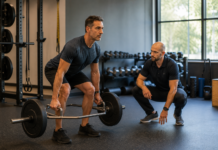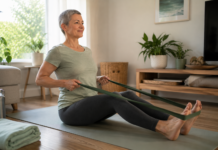




























Resistance bands are one of the most versatile, portable tools you can add to your training—use them to build strength, improve mobility, and make almost any exercise joint-friendlier. In short: incorporating resistance bands into workouts means using elastic tension (created by band stretch) to challenge muscles through a full range of motion. High-quality studies show elastic resistance can produce strength gains comparable to traditional weights when programmed well. Bands also create “variable resistance,” getting harder as they stretch, which you can use to groove technique, add power, or reduce joint stress. This guide walks you through 12 practical, field-tested ways to plug bands into your routine safely and effectively.
This article is educational and general in nature; it’s not a substitute for personalized medical advice. If you have pain, injury, or a medical condition, consult a qualified professional.
1. Run a Full-Body Strength Session Entirely with Bands
You can build a complete push-pull-legs routine using nothing but bands, hitting all major muscle groups in 30–45 minutes. The key is to select band tension you can control through a full range of motion and then progress by increasing stretch (elongation), band thickness/color, tempo, or total volume. Because band resistance increases as it lengthens, you’ll feel the toughest point near lockout—great for technique and joint comfort. Program 2–4 sets of 8–15 reps for compound moves and 10–20 reps for accessories, resting 60–90 seconds. Aim for an effort of roughly RPE 7–8 (hard but with 2–3 reps left). Done twice weekly, a balanced band program can meet standard muscle-strengthening guidelines for adults.
1.1 How to do it
- Push: Banded floor press or push-up, overhead press, triceps press-downs.
- Pull: One-arm row (door anchor), face pull, pulldown or pull-apart.
- Legs: Split squat, RDL/hinge, banded good morning, glute bridge/hip thrust.
- Core: Pallof press, anti-rotation hold, dead bug with band.
1.2 Numbers & guardrails
- Choose a band you can control for 8–15 reps per set at RPE 7–8.
- Progress weekly by adding 1–2 reps, 5–10% more stretch, or moving up one color when sets hit 15 reps with ease.
- Train 2–3 days/week for strength, respecting at least 48 hours between hard sessions per muscle group.
Synthesis: An all-band session makes strength training accessible anywhere and builds a base you can later progress with heavier bands or added implements.
2. Use Bands to Prime and Mobilize Before Lifting or Sports
Bands excel as warm-up tools because they provide smooth tension to “wake up” key stabilizers without heavy loading. A 5–8 minute primer targeting hips, shoulders, and upper-back improves joint positioning, enhances proprioception, and raises tissue temperature—so your first working set feels like your second. Think glute activation (lateral walks), scapular control (face pulls), and hip/shoulder mobility (banded distractions and pull-aparts). Keep band primer sets light to moderate (RPE 5–6), moving through the full range of motion and finishing the last rep feeling better than you started. This is especially useful before pressing days, running, or court/field sports where hip-knee-ankle alignment matters.
2.1 Quick primer (6–8 minutes)
- Hips: Mini-band lateral walk 2×12–15/side; banded glute bridge 2×12.
- Upper back: Face pull 2×12–15; band pull-apart 2×12–15.
- Shoulders: Light external rotations 2×12–15; overhead band “dislocates” 1–2×10 (control range).
- Ankles: Light banded dorsiflexion/plantarflexion 1–2×12–15.
2.2 Common mistakes
- Using bands that are too heavy for warm-ups (fatiguing stabilizers).
- Rushing reps—prime with tempo and intent.
- Stretching beyond comfortable range; keep mobility work pain-free.
Synthesis: A brief, targeted band primer helps joints track well and muscles fire in the patterns you’ll use during your main session.
3. Add “Accommodating Resistance” to Free-Weight Lifts
Looping bands on barbells or dumbbells makes the lift hardest where you’re strongest and eases load where leverage is worst. This “accommodating resistance” is ideal for squats, bench, and deadlifts to build top-end strength, sharpen bar speed, and reinforce technique. Start with light band tension (roughly 10–20% of total load at lockout) and place bands symmetrically with secure anchors (e.g., pegs or heavy dumbbells). Use submaximal sets (e.g., 5×3 at RPE 6–7) to focus on crisp reps. Variable resistance approaches have been shown to enhance maximal strength and power versus traditional loading alone when programmed well, making them a smart accessory phase in a training week or block.
3.1 Setup basics
- Squat/bench: Loop bands from base anchors to bar ends; check equal tension left/right.
- Deadlift: Stand on bands or anchor to heavy kettlebells; ensure plates stay planted.
- Safety: Inspect bands for nicks; keep eyes and face away from band path.
3.2 When to use
- Early strength blocks to build rate of force.
- Sticking-point work (lockout in bench/deadlift).
- Technique practice with lighter bar weight but high intent.
Synthesis: Bands plus iron give you a targeted, joint-friendly way to emphasize the strong range and build explosive, confident lockouts.
4. Build a Strong Back with Door-Anchored Pulls
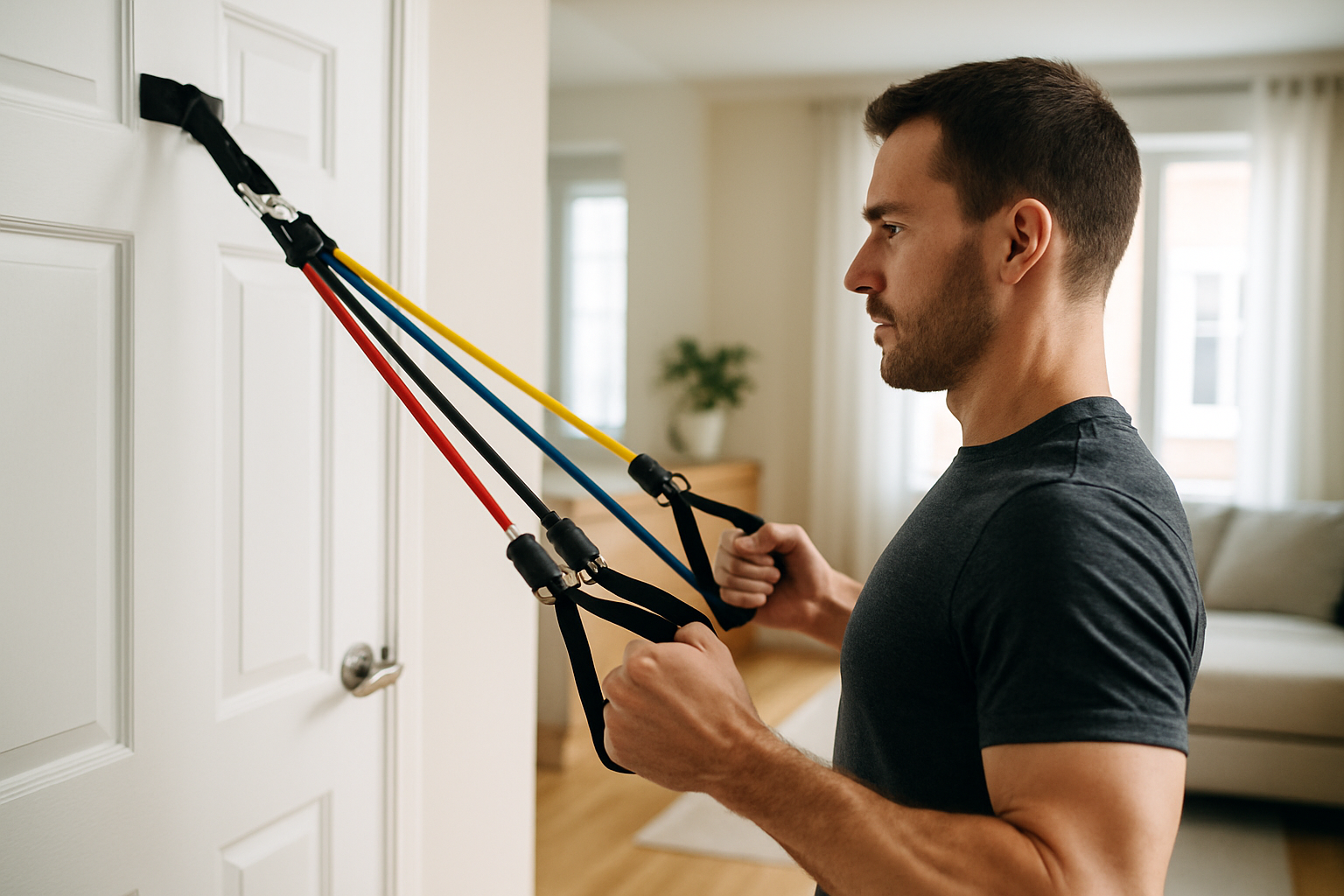
If you don’t have a cable station, a door anchor turns bands into a full pulling gym. Horizontal rows, high-to-low lat pulls, and face pulls all load the mid-back and lats while reinforcing shoulder centration. Rows and pulldowns scale easily: step further from the door to increase tension or switch colors. Keep elbows roughly 30–45° from your torso on rows; drive elbows to hips for lat pulls. For most lifters, 3–4 sets of 10–15 reps at RPE 7–8 will grow a resilient upper back that supports bigger presses and safer deadlifts.
4.1 Mini-progression (4 weeks)
- Week 1: 3×12 one-arm row (green), 3×12 face pull (yellow).
- Week 2: +1 set, +2 reps per set.
- Week 3: Step back 10–15 cm (increase stretch).
- Week 4: Move to the next band color for the row.
4.2 Checklist
- Door closes toward you with anchor on far side.
- Check hinge/anchor height for desired line of pull.
- Keep ribs stacked (no excessive arch) to load lats, not low back.
Synthesis: A simple door-anchor unlocks high-quality rowing and pulldown options at home with smooth, shoulder-friendly loading.
5. Level-Up Lower-Body Training with Glute Loops and Long Bands
Bands are exceptional for lower-body hypertrophy and knee-hip mechanics. Use a glute loop above knees during squats or bridges to cue abduction/external rotation (“push the floor apart”), reducing knee valgus. Long bands let you train hinges (RDLs, good mornings), squats, split squats, and hip thrusts nearly anywhere. Because the band gets heavier near lockout, emphasize control in the lengthened position and snap through mid-range. Pair a heavier long band for the main lift with a lighter loop for lateral walks and clamshells to build hip endurance that carries over to running and change-of-direction sports.
5.1 Lower-body tri-set (2–3 rounds)
- Banded RDL 10–15 reps (long band under feet, looped over hands/shoulders).
- Split squat 8–12/side (band under front foot, over shoulders).
- Lateral walk 12–15/side (mini-band at mid-shin or above knees).
5.2 Guardrails
- Keep tripod foot (big toe, little toe, heel).
- Spine long; hinge at hips for RDLs.
- Increase tension gradually; stop a set if technique degrades.
Synthesis: Strategic lower-body band work builds strong glutes and hamstrings while coaching clean knee tracking and hip control.
6. Train Core Anti-Rotation and Bracing You Can Feel
Bands shine for teaching the core to resist motion—an essential skill for lifting and sport. Exercises like the Pallof press, anti-rotation holds, and band-resisted dead bugs challenge bracing without the spinal compression of heavy axial loads. Set the anchor at chest height, step out to achieve moderate tension, and maintain stacked ribs-over-pelvis as you press, hold, or move limbs. Tempo (2–3 seconds out/in) raises time under tension, while half-kneeling variations help you square hips and reduce compensations.
6.1 Core block (8–10 minutes)
- Pallof press & hold 3×8 presses + 10–20s hold.
- Anti-rotation march 2×12 steps.
- Dead bug with band 2×8–10/side (band overhead to engage lats).
6.2 Common mistakes
- Letting the band pull you into rotation—own the midline.
- Leaning toward the anchor (cheating tension).
- Breathing shallow; use nasal or controlled diaphragmatic breaths.
Synthesis: Anti-rotation band work builds the “brace” that protects your spine and transfers force into the bar, bell, or sprint.
7. Take Bands on the Road: Hotel-Room and Travel Workouts
Bands weigh almost nothing and fit in any carry-on, so you never have to skip strength on the road. A travel setup—light, medium, heavy long bands plus a mini-band and door anchor—lets you run push/pull/legs circuits or maintenance sessions in 20 minutes. Focus on multi-joint patterns so you cover more with less: a push, a pull, a hinge/squat, and a core move each circuit. Keep exertion just shy of hard (RPE 7) to account for jet lag and unfamiliar environments, and finish with light mobility to feel human again before meetings or sightseeing.
7.1 20-minute hotel circuit (repeat 3–4 times)
- A1 One-arm row 12/side
- A2 Split squat 10/side
- A3 Overhead press 10–12
- A4 Pallof press 10/side
7.2 Packing checklist
- 3 long bands (light/med/heavy), mini-band, door anchor, small towel.
- Loop bands to keep tidy; store away from sharp objects/heat.
- Sanitize after use and let fully dry before packing.
Synthesis: A compact band kit turns any room into a gym, so your consistency—and results—don’t depend on access to equipment.
8. Groove Technique and Regress/Assist Hard Skills
Bands help you learn complex movements by either assisting (making the hardest range easier) or regressing (reducing overall load). Use a band for assisted pull-ups (looped over the bar and foot) to practice full-range reps; choose the lightest band that lets you get 4–6 clean reps. Add a loop above the knees in squats to cue “knees track over toes,” or try band-assisted push-ups to dial in full range while keeping great body lines. Bands also reduce fear in new skills by cushioning the bottom position, encouraging confident ROM without grinding.
8.1 How to deploy assistance
- Pull-ups: 4–6 assisted reps, then 2–3 negatives.
- Push-ups: Band around torso, ends anchored to rack or hands.
- Squats: Loop above knees to cue external rotation; remove for work sets.
8.2 Technique cues
- Drive elbows to hips in pulls; keep neck long.
- Maintain brace and neutral spine; move slow where control is hardest.
- Progress by reducing band assistance over weeks.
Synthesis: Smart band regressions/assists accelerate skill acquisition while keeping your joints and confidence happy.
9. Build Power and Speed with Variable Resistance
Because bands ramp tension as they stretch, they’re excellent for training bar speed and intent. Pair bands with submaximal loads for speed squats, band-resisted jumps, or band-assisted jumps (to reduce landing forces while practicing quick reversal). Keep sets short (2–4 reps), rest generously, and move explosively with perfect mechanics. Meta-analytic evidence indicates variable resistance (often delivered by bands or chains) can enhance maximal strength and power versus traditional loading, likely by improving force production in stronger joint angles and encouraging accelerated concentric actions. Use in 3–6 week phases to sharpen performance without grinding.
9.1 Sample power session (2–3 rounds)
- Speed squat 5×2 @ ~50–60% 1RM + light bands (focus on bar speed).
- Band-assisted jump 3×3 (attach bands overhead to deload).
- Med-ball throw 3×5 (optional add-on).
9.2 Safety notes
- Anchor bands securely overhead and at the base.
- Land soft; stop a set if height/speed drops.
- Power work needs freshness—avoid after exhaustive sessions.
Synthesis: Bands let you chase speed and explosiveness with lower joint stress and solid carryover to strength.
10. Blend Bands with Bodyweight for More Effective Calisthenics
Bodyweight staples like squats, push-ups, and rows become far more scalable with bands. To progress, loop a band over your back for push-ups or over shoulders for squats; to regress, use band assistance to reduce load in the hardest range. For isometric holds (e.g., wall sits, planks), bands add meaningful tension without extra equipment. This versatility solves the classic calisthenics plateau: you can nudge load up or down in small steps, change the strength curve, and vary tempo to keep stimulus novel.
10.1 Progression menu
- Push-ups: Add band over back; pause 1–2s at bottom.
- Squats: Band over shoulders; 3s eccentric, fast up.
- Rows: Door-anchored inverted rows with band added to hips.
10.2 Mini-case
If you can do 15 push-ups bodyweight at RPE 8, add a light band and aim for sets of 8–12. When you hit 12×3 clean, move to a medium band or slow the eccentric to 3 seconds for the same reps.
Synthesis: Bands turn bodyweight training into a finely tunable system so you can keep progressing at home or on the road.
11. Program Bands with Real-World Numbers (Colors, Stretch, and RPE)
To get repeatable results, treat bands like quantifiable resistance. Two dials matter most: percent elongation (how far you stretch from resting length) and band level (color/thickness). For example, with common TheraBand levels, a green band provides ~4.6 lb at 100% elongation and ~6.7 lb at 200%; each step up typically increases pull force ~25% through the clinical range (tan–black). Silver and gold jump ~40% per step. Combine this with RPE to keep intensity honest: most strength work lands RPE 7–9, hypertrophy RPE 6–8. Log band color, starting length, step-out distance, and reps to see clear progression week to week.
11.1 Practical tracking
- Measure starting length (e.g., 2 ft / 60 cm), note 100% elongation target.
- Record band color, anchor setup, reps, RPE.
- Progress with +5–10% more stretch, tempo change, or next color.
11.2 Example upgrade
If rows at green 100% feel easy (RPE 6), step back to ~150% elongation or move to blue (about +26% pull at 100% vs green) and retest sets of 10–12.
Synthesis: Simple notes on color and stretch convert bands from “feel-based” guesswork into measurable, progressive training.
12. Safety, Setup, and Gear That Make Bands Last
Good bands last years if you treat them well. Inspect for nicks, thinning, or chalky spots before sessions; small tears can propagate quickly under tension. Keep bands out of direct sun/heat, and wipe sweat/oils off after training. Use a door anchor correctly (door closes toward you; anchor on far side), and keep eyes/face out of the band line. If you have a latex allergy, choose latex-free options. When anchoring to heavy equipment, use a strap/loop designed for bands to prevent abrasion. Knowing the force-elongation basics and typical color progressions helps you select safe starting tensions and scale up sensibly. Performance Health
12.1 Safety checklist
- Inspect bands every session; retire damaged bands immediately.
- Anchor to sturdy objects; avoid sharp edges and rough surfaces.
- Maintain control; don’t let bands snap back.
- Store cool and dry; avoid prolonged UV exposure.
- Use latex-free bands if sensitized.
12.2 Starter kit (home)
- Light/medium/heavy long bands, one mini-band, one door anchor.
- Optional: handles, ankle straps, and a short assist strap for anchoring.
- Keep a small notebook or notes app for RPE, color, stretch logs.
Synthesis: A little attention to setup and care keeps your training safe, your progress measurable, and your bands reliable.
FAQs
1) Do resistance bands really build strength, or are they only for warm-ups?
Yes—bands can build significant strength when you train hard and progress over time. A 2019 systematic review and meta-analysis found strength gains from elastic resistance comparable to traditional weight training when programs were matched for volume and effort. Use rep ranges of 8–15 for most lifts and raise tension or reps weekly to progress.
2) How often should I do band-based strength work?
Most adults do well with two to three weekly full-body sessions or a simple upper/lower split. This aligns with general physical activity guidance that recommends muscle-strengthening activities on at least two days per week; the third day is optional if recovery is good. Space hard sessions by 48 hours for the same muscle groups.
3) Which band color should I start with?
Color systems vary by brand, but common progressions step up roughly 25% per color in the clinical range. For example, a green TheraBand at 100% elongation produces ~4.6 lb of pull, while blue produces ~5.8 lb; choose the lightest color that lets you control full-range reps with form. If in doubt, start lighter and increase stretch before moving up a color.
4) Can bands replace weights long-term?
For general fitness, bands can take you far—especially with thoughtful programming and progression. If your goals include maximal strength, bodybuilding levels of muscle mass, or specialized sport performance, combining bands with free weights or machines often works best. Variable resistance (bands/chains with loads) can even outperform traditional loading alone for certain strength and power outcomes.
5) Are bands safe for my joints?
Many people find bands joint-friendlier because tension is lowest in the most mechanically disadvantaged positions and highest where leverage is better. That said, safety depends on setup and control: inspect bands, avoid sharp anchor points, and don’t let bands snap back. If pain persists, consult a clinician.
6) What’s the fastest way to progress with bands?
Pick one primary lift per pattern (push, pull, hinge/squat) and add a small dose of tension, reps, or tempo each week. Log band color and stretch so increases are clear. When sets feel like RPE 6–7, increase stretch 5–10% or move up one color and retest at RPE 7–8 the next week.
7) How do I estimate “how heavy” a band is?
Use manufacturer charts that list pull force at specific elongations (e.g., pounds/kilograms at 100% and 200% stretch). For instance, a green TheraBand is ~4.6 lb at 100% elongation and ~6.7 lb at 200%. These are pull forces, not “weights,” but they help standardize loading and progressions.
8) Are bands good for older adults or beginners?
Yes. Bands are affordable, portable, and allow gentle, full-range loading while you learn movement patterns. They’re often used in rehabilitation and general fitness settings for exactly these reasons. Follow conservative progressions, focus on posture and control, and aim for 2 sessions/week to start.
9) Can I build power with just bands?
You can make meaningful power gains by training speed with band-resisted or band-assisted patterns and short, explosive sets. Pair with medicine-ball work if available. When you have access to weights, add banded barbell work for even better transfer to max strength and athletic tasks.
10) What if I have a latex allergy?
Choose latex-free bands—many brands make them in similar color progressions and tensions. Read product details carefully, and if you’re highly sensitive, handle new bands with gloves at first and clean them before use to remove manufacturing residues.
Conclusion
Resistance bands give you a portable, joint-friendly way to get stronger, move better, and train consistently anywhere. By understanding how band tension scales with elongation and color, you can quantify effort, log progress, and apply the same programming logic used with free weights. Use bands for complete full-body sessions, targeted primers, technique assistance, and variable resistance phases that emphasize speed and lockout strength. Anchor safely, progress methodically (more stretch, color up, or tempo tweaks), and track RPE so your sessions stay honest. Start with two balanced band workouts per week, and layer in power, core anti-rotation, and focused lower-body work as your skills grow.
Ready to start? Pick a light, medium, and heavy band, add a door anchor, and run the 20-minute circuit in Section 7 today.
References
- Effects of training with elastic resistance versus conventional resistance training on muscle strength: a systematic review and meta-analysis. Journal of Human Kinetics (Lopes et al.), 2019. https://pmc.ncbi.nlm.nih.gov/articles/PMC6383082/
- Adult Activity: An Overview. U.S. CDC, updated December 20, 2023. https://www.cdc.gov/physical-activity-basics/guidelines/adults.html
- What You Can Do to Meet Physical Activity Guidelines. U.S. CDC, updated April 16, 2024. https://www.cdc.gov/physical-activity-basics/guidelines/index.html
- American College of Sports Medicine position stand: Progression models in resistance training for healthy adults. Med Sci Sports Exerc (ACSM), 2009. https://pubmed.ncbi.nlm.nih.gov/19204579/
- Thera-band® elastic band tension: reference values for physical activity. Clinical Biomechanics (Uchida et al.), 2016. https://pmc.ncbi.nlm.nih.gov/articles/PMC4868225/
- Directions for Handling, Connecting, and Securing Thera-Band® Bands and Tubing (includes Elastic Resistance Pull Force Charts). Performance Health / Vitality Medical, Instruction Manual. https://www.vitalitymedical.com/pdf/directions-connecting-bands-tubing.pdf
- Comparing the effects of variable and traditional resistance training on maximal strength and muscle power: a systematic review and meta-analysis. Journal of Science and Medicine in Sport (Andersen et al.), 2022. https://www.sciencedirect.com/science/article/pii/S1440244022002201
- Concentric and Eccentric Force Changes with Elastic Band Versus Isotonic Strength Training. International Journal of Exercise Science (Folkins et al.), 2021. https://pmc.ncbi.nlm.nih.gov/articles/PMC8169017/
- Physical Activity Guidelines for Americans, 2nd ed. (PDF). U.S. Dept. of Health & Human Services, 2018. https://www.cdc.gov/physical-activity/media/pdfs/Physical_Activity_Guidelines_2nd_edition.pdf
- TheraBand CLX Force Chart (resistance levels overview). TheraBand CLX, accessed August 2025. https://www.therabandclx.com/extras/force-chart