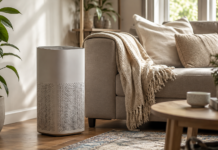




























Smoke season now stretches well beyond a few bad afternoons in late summer. Wildfires across the western United States, Canada, and increasingly the Southeast can push outdoor air quality into hazardous territory for days at a stretch, and the smoke does not stop at property lines or state borders. Most of the exposure that actually reaches your lungs during one of these events happens indoors, in the hours you spend breathing whatever has leaked in around doors, vents, and window frames.
During a wildfire smoke event, the fastest way to protect your health is to seal off one room, run a MERV 13 filter or a certified air cleaner (or a DIY Corsi-Rosenthal box) continuously, and check the AQI for PM2.5 before deciding whether to go outside at all. A properly fitted N95 respirator adds protection for any unavoidable time spent outdoors.
By Charlotte Evans
Who This Is For
This guide is for anyone who has watched an air quality alert pop up on their phone and wondered what to actually do inside their own home. That includes people living in or downwind of wildfire-prone regions, which now stretches far beyond the West Coast during large fire years. It’s especially relevant for parents of young children, people with asthma, COPD, heart disease, or diabetes, pregnant people, older adults, outdoor workers, and renters who don’t control their building’s HVAC system and have to improvise. If you’ve ever debated whether to crack a window “just to air things out” during a smoke advisory, this is written for you.
A note on scope: This guide focuses on indoor sheltering and filtration strategy during wildfire smoke events, not on evacuation logistics, active firefighting, or property protection such as defensible space and fire-resistant construction. It also does not replace guidance from your local air district, fire department, or treating clinician, particularly if you have a heart or lung condition. When local authorities issue an evacuation order, follow it regardless of what your indoor air quality reading shows.
What’s Actually in Wildfire Smoke, and Why PM2.5 Is the Number to Watch
Wildfire smoke is a mix of gases and fine particles produced when vegetation, structures, and sometimes household materials burn. The U.S. Environmental Protection Agency describes it as a genuinely “complex mixture” that includes carbon monoxide, volatile organic compounds, and fine particulate matter, with the composition shifting depending on what’s burning and how close you are to the fire. For most people sheltering at home, the pollutant that matters most is PM2.5, particles 2.5 micrometers or smaller, roughly thirty times thinner than a human hair.
PM2.5 is small enough to bypass the body’s natural filtering in the nose and throat and travel deep into the lungs, where some of it crosses into the bloodstream. That’s the reason wildfire smoke guidance from the EPA, the CDC, and the California Air Resources Board (CARB) centers on PM2.5 specifically rather than smell or visible haze. You can have a smoky-smelling house with relatively low particle counts, or a house that looks and smells fine while an air sensor shows elevated PM2.5, especially once your nose adapts to the odor after an hour or two.
How Wildfire Smoke Affects Your Body
At lower exposure levels, wildfire smoke tends to cause eye and respiratory tract irritation. At higher concentrations or with longer exposure, the EPA’s wildfire smoke course material describes more serious effects including persistent coughing, phlegm, wheezing, and difficulty breathing, along with exacerbation of asthma in people who already have it. PM2.5 can also impair the lungs’ ability to clear inhaled bacteria and viruses, which is part of why respiratory infections tend to tick up during and after heavy smoke periods.
The cardiovascular picture is also concerning. EPA materials note that short-term PM2.5 exposure is linked to cardiovascular-related illness and premature death, and while the evidence specific to wildfire smoke (as opposed to PM2.5 in general) is described as “generally consistent” but somewhat less extensive than the research on everyday urban pollution, a September 2024 study in the Proceedings of the National Academy of Sciences, led by researchers at the Yale School of Public Health, analyzed county-level data across the contiguous United States from 2007 to 2020 and estimated roughly 11,415 non-accidental deaths per year associated with wildfire smoke PM2.5, including about 4,512 attributed to cardiovascular disease. The same analysis found that cardiovascular, mental health, endocrine, and digestive conditions together accounted for about 72.5 percent of the deaths linked to smoke exposure in the dataset.
Newer research summarized in EPA course materials also points to associations between short-term smoke exposure and preterm birth (Picciotto et al., 2024), measurable effects on cognitive performance, and increased COVID-19 case counts during heavy smoke periods (Zhou et al., 2021). None of this means a single smoky week will cause lasting harm to a healthy adult, but it explains why public health agencies treat repeated, unmitigated indoor exposure as a real cumulative risk rather than a one-off nuisance.
Who tends to be affected most severely? EPA and CDC materials consistently point to adults 65 and older, young children, people with asthma or other lung disease, people with heart disease or diabetes, people with chronic kidney disease, pregnant people, and outdoor workers who cannot avoid exposure during a shift.
Sources: Yale School of Public Health / PNAS (September 2024); U.S. EPA, “Strategies to Reduce Exposure Indoors” (updated October 10, 2025); U.S. EPA Office of Research and Development / UConn bioaerosol chamber testing (October 30, 2023); California Code of Regulations, Title 8, Section 5141.1.
Reading the AQI During a Smoke Event
The Air Quality Index (AQI) translates pollutant concentrations, including PM2.5, into a single 0-500 scale with six color-coded categories. During wildfire season, the AirNow Fire and Smoke Map is the tool the EPA recommends for tracking PM2.5 specifically, since it blends regulatory monitors with a much larger network of low-cost sensors to fill in gaps near active fires. The categories below follow the standard EPA/CDC AQI breakpoints, with indoor actions adapted from CDC wildfire safety guidance, CARB’s Smoke Ready California program, and California’s wildfire smoke workplace standard.
| AQI Range (PM2.5) | Category | Recommended Indoor Action |
|---|---|---|
| 0-50 | Good | Normal ventilation is fine. No special filtration needed. |
| 51-100 | Moderate | Sensitive individuals should monitor symptoms; ventilate as usual otherwise. |
| 101-150 | Unhealthy for Sensitive Groups | Sensitive groups start using a clean room or portable air cleaner; limit prolonged outdoor exertion. |
| 151-200 | Unhealthy | Everyone runs air cleaners/MERV 13 HVAC continuously; N95 recommended for time outdoors (California’s mandatory-offer threshold for outdoor workers). |
| 201-300 | Very Unhealthy | Stay in a sealed clean room as much as possible; N95 required for any outdoor tasks. |
| 301-500 | Hazardous | Remain in the clean room continuously; avoid outdoor exposure entirely; consider relocating to a cleaner-air shelter if home filtration is inadequate. |
Building a Clean Room During a Smoke Event
The EPA’s guidance on this is specific: pick a room that’s “set up to keep levels of smoke and other particles as low as possible” and big enough for your household to be comfortable in for hours at a time. A bedroom with an attached bathroom is often the best pick because it can be closed off and used for an extended stretch without anyone needing to leave it repeatedly, which reintroduces smoky air every time the door opens.
Once you’ve chosen the room, close all its windows and doors. If it has an exhaust fan or the house has a range hood that vents outside, use them only briefly or not at all, since the EPA notes these fans can pull more smoke-laden air into the house to replace what they exhaust. If your home has central air conditioning, switch it to recirculate mode or close the fresh-air intake so it isn’t actively drawing in outdoor smoke.
A 12×12 room is about 144 square feet. Here’s a reasonable walk-through:
1. Close the door and any windows; place a rolled towel at the bottom of the door if there’s a visible gap.
2. Choose a CARB-certified portable air cleaner rated for at least 150-200 square feet (buying slightly oversized compensates for door gaps and gives faster cleanup), or build a four-filter Corsi-Rosenthal box, which is generally sized for rooms in a similar range.
3. Run it continuously on the highest tolerable fan speed. Keep the door closed as much as possible; every opening lets smoky air back in.
4. Wipe hard surfaces with a damp cloth rather than dry-dusting or vacuuming with a non-HEPA machine, which resuspends settled particles.
5. Skip candles, incense, frying, and vacuuming inside the clean room during the event; each adds particles the filter then has to remove again.
DIY Air Cleaning: The Corsi-Rosenthal Box
The Corsi-Rosenthal box, developed by engineering professor Richard Corsi and air filter manufacturer Jim Rosenthal during the COVID-19 pandemic, is a box fan taped or clipped to four or five furnace filters arranged into a cube, with the fan pulling air through the filters and pushing cleaned air out the top. The EPA’s own testing backs the design up: its “Strategies to Reduce Exposure Indoors” materials describe DIY box fan filters as “safe and effective in a laboratory setting,” capable of reducing PM2.5 by roughly 56 percent in larger rooms within 90 minutes, or as much as 99 percent in smaller spaces within about 60 minutes.
A separate round of testing by the EPA’s Office of Research and Development, done in partnership with the University of Connecticut and reported in UConn Today on October 30, 2023, put a DIY Corsi-Rosenthal box through bioaerosol chamber trials designed to test viral aerosol capture (using a surrogate for the SARS-CoV-2 virus) rather than wildfire smoke specifically. The box removed 97 percent of infectious aerosols within 30 minutes and 99.4 percent within 60 minutes, and EPA scientist Katherine Ratliff noted the boxes performed better than some far more expensive commercial air-cleaning technologies tested during the pandemic. Since wildfire PM2.5 particles fall in a broadly similar size range to the aerosols tested, this gives a reasonable, though not identical, indication of how well the design handles particulate matter in general.
The EPA is clear that DIY units are a fallback, not a first choice: the agency “recommends using DIY air cleaners only when products of known performance…are not available or affordable.” When you do build one, use MERV 13 or higher filters, a box fan manufactured in 2012 or later with UL or ETL certification, and, where possible, a shrouded or multi-filter design, since thicker filters and additional filter panels both improve performance.
| DIY Design | Filters | Approx. Cost | Notes |
|---|---|---|---|
| Basic single-filter | 1 MERV 13 | ~$45 | Lowest cost, lowest airflow through the filter face |
| Wedge | 2 MERV 13 | ~$55 | Angled design, moderate improvement over single-filter |
| Corsi-Rosenthal cube | 4-5 MERV 13 | ~$75 | Highest clean air delivery of the three DIY tiers per CARB’s comparison |
Cost estimates via California Air Resources Board, Smoke Ready California DIY air cleaner guidance.
Whichever tier you build, filter condition matters as much as filter count. EPA testing cited by CARB found that DIY units running on visibly dirty or clogged filters were “almost completely ineffective,” so plan to swap filters every few weeks, or even every few days, during a prolonged, heavy smoke stretch rather than waiting for a seasonal replacement schedule.
HVAC and Central Air: MERV Filtration During Smoke Events
If your home has central air conditioning or forced-air heating, the system itself can become your primary smoke filter. The EPA, CDC, and CARB all recommend upgrading to a MERV 13 or higher filter during smoky periods, since that rating captures fine particles far more effectively than the MERV 8 filters many systems ship with. Just as important as the filter rating is fan operation: switching the thermostat fan setting from “Auto” to “On” keeps air continuously moving through the filter instead of only when the system calls for heating or cooling.
The effect of continuous operation is substantial. EPA materials report that a high-efficiency filter run continuously can cut indoor PM2.5 by roughly 50 percent, while even a standard low-efficiency filter running continuously can still reduce particles by about 24 percent, purely from the added run time. Close the system’s fresh-air intake or set it to recirculate so it isn’t actively drawing outdoor smoke inside, and check the filter often during heavy smoke, replacing it as soon as it looks visibly dark rather than sticking to the manufacturer’s normal interval.
One caveat worth knowing before you buy a MERV 13 filter: some older or smaller residential systems weren’t designed for the added airflow resistance a denser filter creates, which can strain the blower motor over time. If you’re unsure whether your system can handle it, a quick check with an HVAC technician before smoke season starts is worth the phone call.
N95 Respirators and Time Outdoors
A well-fitted N95 respirator filters about 95 percent of airborne particles, according to guidance from the Harvard T.H. Chan School of Public Health’s Healthy Buildings program. For most outdoor exposure during a smoke event, that’s the standard both the CDC and CARB point to, ahead of surgical or cloth masks, which are not rated to filter particles in the PM2.5 size range at all. P100 respirators, which filter at least 99.97 percent of particles and typically use replaceable cartridges, are recommended specifically for situations involving visible ash or soot, such as being in or near a burn scar, rather than for routine smoke exposure.
Fit determines how well any respirator actually performs. CARB’s guidance walks through the basics: place one strap above the ears and one below (never crossed), pinch the metal nose bar to the shape of your nose, and perform a seal check, inhaling and exhaling sharply to feel for air leaking around the edges, every time you put one on. A NIOSH-approved KN95 is an acceptable substitute if its packaging documents independent testing showing at least 95 percent filtration efficiency, since not all KN95s sold in the U.S. meet that bar. The CDC notes that children age 2 and older can wear a properly fitted respirator, though a good seal is harder to achieve on smaller faces and comfort often limits how long a child will keep one on correctly.
It’s also worth knowing that a respirator, by design, adds resistance to breathing. Harvard’s guidance flags that this can be difficult for people with existing heart or lung conditions, who should check with a physician about respirator use before wildfire season rather than during an emergency. California’s workplace wildfire smoke standard, Title 8 Section 5141.1, gives a useful reference point for timing: it requires employers to make NIOSH-approved respirators such as N95s available for voluntary use once the AQI for PM2.5 reaches 151, and mandates their use, along with additional protections, once the AQI passes 500.
Common Mistakes During Smoke Events
| Mistake | Why It Backfires | Better Approach |
|---|---|---|
| Opening windows to “air out” a stuffy house mid-event | Floods the home with outdoor PM2.5, undoing hours of filtration in minutes | Wait until AQI drops or the smoke advisory lifts before ventilating |
| Running the range hood or bathroom exhaust fan during smoke | Pulls smoky replacement air in through cracks and vents | Skip outdoor-venting exhaust fans; use recirculating settings if available |
| Trusting a dirty or wrong-size furnace filter | EPA testing found dirty DIY/HVAC filters were “almost completely ineffective” | Replace filters every few weeks (or days) during heavy smoke; size units to the room |
| Wearing a cloth or surgical mask outdoors | Not designed to filter PM2.5-sized particles | Use a properly fitted, NIOSH-approved N95 or better |
| Vacuuming with a standard vacuum during a smoke event | Resuspends settled particles back into breathing air | Use a damp cloth or mop, or a HEPA-filtered vacuum |
| Waiting for symptoms before taking any action | Effects can build up over hours, especially in sensitive groups | Act once AQI hits 101+ if you’re in a sensitive group, not after symptoms appear |
What Public Health Agencies Do Differently During a Smoke Event
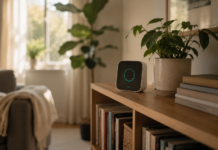
Individual households manage smoke room by room. Public health and air quality agencies manage it at a population level, and their playbook looks different in a few instructive ways. The EPA and NOAA jointly maintain the AirNow Fire and Smoke Map, which blends regulatory-grade monitors with thousands of lower-cost sensors to estimate PM2.5 in near real time, including in areas without a permanent monitoring station nearby, and layers in fire locations and smoke plume forecasts where available.
Local and state health departments issue formal advisories that go beyond a phone alert. New York City’s health department, for instance, has issued Health Alert Network advisories in 2026 specifically about wildfire-season air quality, a reminder that smoke transported from fires burning hundreds of miles away, including in Canada, can trigger the same kind of guidance in cities that have no local wildfire risk at all. CARB and local air districts in California operate cleaner-air center and cooling center networks, opening public buildings with certified filtration for residents who lack air conditioning or a home air cleaner, which matters most for renters and lower-income households least able to retrofit their own HVAC systems.
Workplace regulators go further still. California’s Title 8 Section 5141.1 doesn’t just recommend N95s, it legally requires employers to supply them once the AQI for PM2.5 hits 151, and to require their use above 500, with additional controls like enclosed cabs or filtered break rooms for employees who work outdoors. Many school districts in wildfire-prone states follow state guidance to move recess and athletics indoors, or cancel them outright, at AQI thresholds well below what would trigger an individual household to worry, because they’re managing exposure for large groups of children who can’t always self-regulate exertion the way an adult can.
Your Smoke Day Checklist
- ☐ Check the AirNow Fire and Smoke Map or local AQI reading before deciding whether to go outside
- ☐ Pick your clean room now, before smoke arrives (bedroom with attached bath is ideal)
- ☐ Close windows, doors, and the fresh-air intake on your HVAC system
- ☐ Switch the thermostat fan from “Auto” to “On” for continuous filtration
- ☐ Confirm your HVAC filter is MERV 13 or higher, or install one before smoke season
- ☐ Run a CARB-certified portable air cleaner, or a 4-5 filter Corsi-Rosenthal box, continuously in the clean room
- ☐ Keep a spare furnace filter or two on hand to swap out mid-event if it gets visibly dirty
- ☐ Stock at least one NIOSH-approved N95 per household member, sized correctly
- ☐ Skip candles, frying, and dry vacuuming inside the clean room during the event
- ☐ Avoid outdoor-venting exhaust fans and range hoods while smoke is heavy
- ☐ Wait for the advisory to lift, then air the house out and let filters run down normally
Safety Limits: When to Evacuate or Seek Medical Help
A clean room and a good filter address air quality, not fire danger. If local authorities issue an evacuation order, leave, regardless of how clean your indoor air currently reads. Sheltering strategies in this guide assume the fire itself is not an immediate threat to your home; they are not a substitute for evacuation planning.
On the medical side, seek care immediately, including calling 911, for chest pain, heart palpitations, severe shortness of breath, or confusion during a smoke event, particularly in anyone with existing heart or lung disease. Contact a clinician or urgent care sooner rather than later for a persistent cough that doesn’t ease indoors, wheezing that doesn’t respond to a rescue inhaler, unusual fatigue, or symptoms in a young child, an older adult, or anyone pregnant, since these groups can decline faster than a healthy adult would.
If you can still smell smoke strongly inside your sealed clean room after running filtration for an hour or more, treat that as a sign your setup isn’t keeping pace, not as something to simply tolerate. At that point, consider whether a larger or additional air cleaner is needed, whether the room can be sealed more completely, or whether relocating temporarily, to a cleaner-air center, a hotel outside the smoke plume, or a friend’s home in a less affected area, makes more sense than continuing to wait it out.
Key Takeaways
- PM2.5 is the pollutant to track during wildfire smoke; it’s small enough to reach deep lung tissue and the bloodstream.
- Sealing off one room and filtering it continuously matters more than trying to protect the whole house at once.
- MERV 13 or higher HVAC filters, run continuously, can cut indoor PM2.5 by roughly half.
- A well-built Corsi-Rosenthal box is a legitimate fallback when certified air cleaners aren’t affordable or available, but filter condition and correct sizing determine how well it performs.
- N95 respirators, not cloth or surgical masks, are the standard for outdoor exposure; fit and seal matter as much as the rating.
- Public health agencies treat AQI 151 as a meaningful threshold, it’s where California legally requires employers to provide N95s to outdoor workers.
- Evacuation orders always override indoor air quality readings; a clean room protects against smoke, not fire.
- Persistent chest pain, severe shortness of breath, or confusion during a smoke event warrant immediate medical attention.
Frequently Asked Questions
What AQI level should trigger setting up a clean room indoors?
Sensitive groups, including people with asthma, heart disease, older adults, and young children, should start using a clean room and filtration once AQI for PM2.5 reaches 101. For the general population, AQI 151 is the point where agencies like CDC and CARB recommend continuous filtration and limiting outdoor exposure for everyone, not just sensitive groups.
Can a box fan and furnace filters really replace an air purifier?
A well-built Corsi-Rosenthal box using MERV 13 filters and a certified box fan has performed comparably to commercial air cleaners in EPA-affiliated testing, reducing airborne particles by well over 90 percent within an hour. The EPA still recommends a certified commercial unit first when one is affordable and available, treating DIY builds as a solid fallback.
Is a MERV 13 filter safe for every HVAC system?
Not automatically. MERV 13 filters are denser and restrict airflow more than standard filters, which some older or undersized systems weren’t built to handle continuously. If you’re unsure about your system’s capacity, have an HVAC technician check it before wildfire season rather than discovering a problem mid-event.
Do N95 masks actually work for kids?
CDC guidance allows respirator use starting around age 2, but achieving a proper seal is harder on smaller faces, and many young children won’t tolerate one for long. For most families, limiting a young child’s outdoor time during heavy smoke is more reliable than counting on a respirator to do the work.
How long does wildfire smoke usually linger indoors after outdoor air clears?
It depends heavily on your home’s construction and how long the event lasted, but continuous filtration in a sealed room can bring particle counts down within roughly one to two hours once outdoor conditions improve. Give it time before assuming it’s safe to fully open the house back up.
Are ozone-generating air purifiers safe to use during wildfire smoke?
No. The EPA specifically advises against air cleaners that produce ozone as a byproduct, since ozone is itself a lung irritant that compounds smoke exposure rather than relieving it. Check that any portable unit you buy is on California Air Resources Board’s certified list, which excludes ozone generators.
How is this different from general daily AQI guidance?
Routine daily AQI planning covers everyday pollutants like ozone and traffic-related particulates and helps with decisions like whether to jog outside on an average day. This guide is specific to acute wildfire smoke events, when PM2.5 spikes sharply over hours or days and the priority shifts to sealing, filtering, and sheltering indoors rather than simply timing outdoor activity around typical pollution patterns.
References
U.S. EPA, “Create a Clean Room to Protect Indoor Air Quality During a Wildfire,” reviewed December 30, 2026.
U.S. EPA, “Strategies to Reduce Exposure Indoors,” Wildfire Smoke Course, updated October 10, 2025.
U.S. EPA, “Health Effects Attributed to Wildfire Smoke,” Wildfire Smoke Course.
U.S. EPA, “Protect Yourself From Smoke and Heat” (EPA-452/F-26-009).
Centers for Disease Control and Prevention, “Safety Guidelines: Wildfires and Wildfire Smoke,” reviewed April 15, 2024.
California Air Resources Board, “Smoke Ready California.”
California Code of Regulations, Title 8, Section 5141.1, Wildfire Smoke Emergency Standard.
Harvard T.H. Chan School of Public Health, Healthy Buildings Program, “Choosing the Right Respirator After a Wildfire,” February 28, 2025.
UConn Today, “EPA Testing Shows the Power of DIY Air Filters to Trap Viruses,” October 30, 2023 (U.S. EPA Office of Research and Development bioaerosol chamber testing).
Yale School of Public Health, findings published in Proceedings of the National Academy of Sciences (PNAS), September 2024, “Long-term exposure to wildland fire smoke PM2.5 and mortality in the contiguous United States.”
AirNow.gov, “Using AirNow During Wildfires,” U.S. EPA / NOAA.