



























Quick answer: Standing with your back against a wall and running through a wall slide, a wall angel, and a wall-supported shoulder flexion check gives you a simple, repeatable way to see how your shoulders, shoulder blades, and upper back move together. If your arms cannot stay in contact with the wall, or you feel pinching rather than a stretch, that usually points to limited thoracic mobility, poor scapular control, or a true restriction in the shoulder joint itself, not necessarily an injury. These are screening tools, not diagnostic tests, and persistent pain or a history of shoulder dislocation should be evaluated by a physical therapist.
By Laila Qureshi
Who This Matters Most For
This screening approach is aimed at people who move a lot in daily life or training and want a low-cost way to check on their shoulders between workouts, desk stretches, or physical therapy visits. That includes recreational lifters and swimmers, desk workers who spend long hours in a forward-leaning posture, older adults tracking how their overhead reach is holding up, and anyone returning to activity after a period of reduced movement. It is not aimed at people with acute shoulder pain, a recent fall or collision involving the shoulder, or a known history of dislocation or labral injury. Those situations call for a hands-on evaluation, not a self-test against a wall.
Why a Wall Is a Genuinely Useful Screening Tool
A wall is one of the few pieces of equipment that gives you honest feedback. It is flat, vertical, and unforgiving. When you try to slide your arms overhead while keeping your low back, shoulder blades, and the backs of your hands against a wall, the wall tells you immediately where your body starts to cheat, usually by arching the low back, shrugging the shoulders toward the ears, or losing contact at the wrist. That feedback is the entire point of a wall-based screen: it removes momentum and compensation strategies that are easy to hide during a normal overhead reach in open space.
Clinicians have used variations of wall-supported scapular and shoulder assessments for years, largely because they are quick, require no equipment beyond a flat wall, and expose asymmetries between the two sides of the body. The lateral scapular slide test, for example, is a long-studied clinical method that compares the position of the shoulder blade relative to the spine in several arm positions, including against a resistance surface, to flag possible scapular dyskinesis, a pattern of abnormal shoulder blade movement (Physiopedia, Lateral Scapular Slide Test). The wall-based screens in this article borrow that same logic in a simplified, at-home form.
Shoulder mobility, by the numbers
Three Wall-Based Screens You Can Run Yourself
Each of the three screens below targets a slightly different piece of the overhead movement chain. Together, they give you a rough picture of whether a limitation is coming from your upper back, your shoulder blade control, or the shoulder joint itself. None of them require special equipment: a section of clear wall, comfortable clothing, and roughly five minutes.
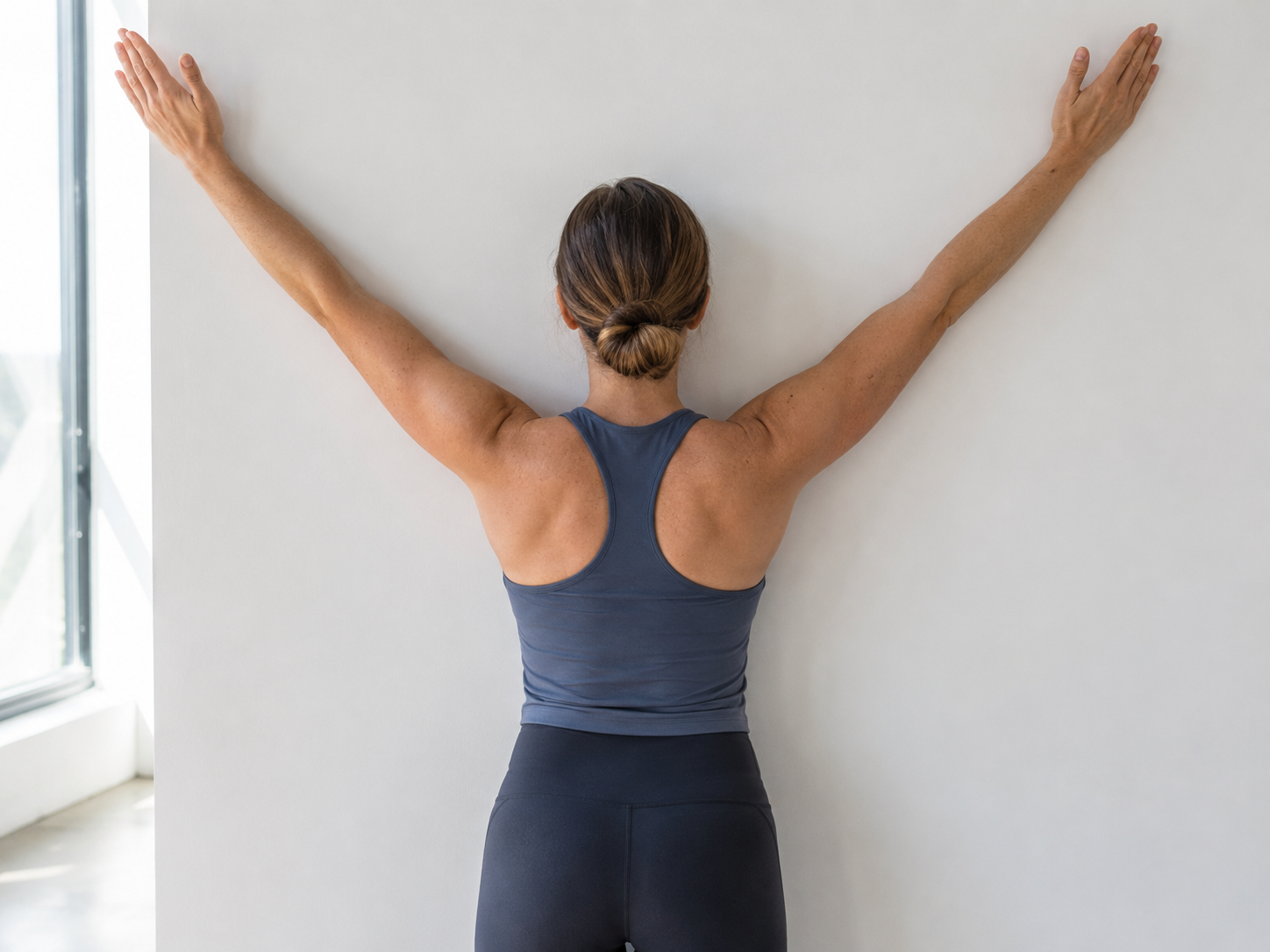
1. Wall Slide Test
- Stand with your heels, hips, upper back, and head against a wall, feet a few inches out from the baseboard so your low back can flatten comfortably rather than being forced flat.
- Bend both elbows to roughly 90 degrees and press the backs of your forearms and hands against the wall, like a goalpost shape.
- Keeping every point of contact on the wall, slide your arms upward overhead as far as you can, then slide them back down. Move slowly, in a count of four up and four down.
- Watch for the first point where contact breaks: the low back arches away from the wall, the forearms peel off, or the shoulders hike up toward the ears.
- Repeat for three to five slow reps, noting whether the range and quality change (usually improves slightly) as you repeat it.
2. Wall Angel
- Start in the same wall-supported position as the wall slide: heels, hips, upper back, and head against the wall.
- Place your arms in a low “W” position, elbows bent and tucked near your sides, backs of your hands on the wall.
- Slowly straighten your arms upward into a “Y” or “goalpost” shape overhead, keeping wrists, forearms, and elbows on the wall the entire time, then reverse the motion back to the starting “W”.
- Move deliberately, aiming for smooth, symmetrical motion on both sides rather than speed.
- Perform six to eight repetitions, paying attention to whether one side loses contact before the other, or whether your ribs flare forward as your arms rise.
3. Shoulder Flexion Against the Wall
- Stand facing away from the wall with your heels about two to three inches from the baseboard, and your low back, upper back, and head in contact with the wall.
- Raise one arm straight overhead, keeping the elbow fully extended, trying to reach as close to the wall as possible without letting your low back arch away from it.
- Note where your forearm or upper arm ends up relative to the wall: flush against it, a small gap, or a noticeable gap of several inches.
- Lower slowly and repeat on the other side, comparing the two.
- This screen isolates true shoulder flexion range because the wall behind your back prevents the common compensation of arching through the low back to make the arm look higher than it is.
Screen Comparison at a Glance
What a Limited Result Commonly Indicates
A limited wall screen is a starting point for asking better questions, not a diagnosis. Broadly, the pattern of what breaks down tells you which system is likely involved.
Thoracic mobility. If your low back arches away from the wall early in a wall slide, or your ribs flare forward during a wall angel, the limitation is frequently coming from a stiff upper back rather than the shoulder joint itself. Research on people with rotator cuff-related shoulder pain has found that they tend to show both reduced shoulder flexion and external rotation alongside more pronounced static thoracic kyphosis compared with people who do not have shoulder pain, suggesting the two regions are mechanically linked (Physiopedia, Thoracic Hyperkyphosis and The Shoulder, citing a 2024 systematic review and meta-analysis of 604 participants across eight studies). When the thoracic spine cannot extend, the shoulder blade cannot fully rotate upward and tilt backward, which narrows the space the arm bone needs to travel through during overhead reaching.
Scapular control. If your wall angel is uneven side to side, if one shoulder blade winds or flutters as your arm rises, or if you notice your shoulders creeping toward your ears instead of your arms sliding smoothly, the muscles that stabilize and rotate the shoulder blade, particularly the lower trapezius and serratus anterior, may not be coordinating well. Physical therapists describe several recognizable patterns of this abnormal movement, including early or excessive scapular elevation and a rapid downward rotation as the arm lowers, sometimes classified using a system originally described by Kibler that groups dyskinesis into inferior, medial, and superior patterns (Physiopedia, Scapular Dyskinesia). This kind of finding is common: one commonly cited figure puts the prevalence of scapular dyskinesis in overhead athletes at roughly 61 percent, compared with a lower rate in athletes who do not perform repetitive overhead motions.
True glenohumeral restriction. If the shoulder flexion-against-the-wall screen shows a persistent gap between your arm and the wall on one or both sides, even after ruling out low-back compensation, the limitation is more likely sitting in the ball-and-socket joint itself, its capsule, or the surrounding rotator cuff musculature. This is the pattern most worth discussing with a physical therapist, particularly if it is new, one-sided, or paired with pain, because it points toward the joint rather than the surrounding regions that tend to respond quickly to mobility work.
How to Follow Up on What You Find
Treat your wall screen results as a rough map, not a verdict. If your limitation looks thoracic, spend two to three weeks adding thoracic extension and rotation drills, such as open-book stretches or foam-roller extensions, and then retest against the wall. If your limitation looks like a scapular control issue, that is, uneven or shaky motion rather than a hard stop, scapular-focused strengthening work such as wall push-ups with a plus, prone Y raises, or band pull-aparts is a reasonable place to start, again followed by a retest in a few weeks.
If the limitation looks like true joint restriction, especially if it is new, one-sided, worsening, or accompanied by pain, that is the point to book an evaluation with a physical therapist rather than continuing to self-treat. A therapist can measure your actual range of motion with a goniometer, test the joint capsule directly, screen for rotator cuff involvement, and build a plan specific to what they find, which a wall screen alone cannot replace.
Full Summary Table: Instructions and Interpretation
Copy-Ready Checklist: Running Your Own Shoulder Screen
- Clear a section of flat wall with no baseboard trim in the way, and wear clothing that lets you see your shoulders move.
- Warm up briefly first: a few minutes of light arm circles or a short walk so you are testing mobility, not a cold, tight starting point.
- Run the wall slide, wall angel, and shoulder flexion screens in that order, resting 30-60 seconds between them.
- Compare left side to right side on every screen, not just your total range.
- Note where contact breaks or a gap appears, using simple language: “low back arched at halfway,” “left shoulder shrugged before the right.”
- Stop immediately if you feel sharp or pinching pain, and do not push through it to “pass” the screen.
- Write results down or photograph your end position from the side so you can compare against a retest in four to six weeks.
- Retest under the same conditions each time (same warm-up, same wall, similar time of day) for a fair comparison.
Worked Example: Reading a Real Screen
Consider a 42-year-old who spends most workdays at a desk and lifts weights three times a week. On the wall slide, their low back stays flat until their forearms are roughly two-thirds of the way up the wall, at which point their ribs flare and their low back arches slightly to finish the motion. On the wall angel, the right side moves smoothly through the full W-to-Y range, but the left shoulder blade visibly hikes upward about halfway through, and the left elbow loses wall contact a few inches before the right. On the shoulder flexion screen, both arms come within an inch of the wall, with no meaningful side-to-side difference.
Put together, this pattern points away from a true joint restriction (the flexion screen looked close to symmetrical and close to full) and toward a combination of moderate thoracic stiffness (the rib flare and low-back compensation on the wall slide) and a left-sided scapular control issue (the early hike and lost contact on the wall angel). A reasonable next step for this person is two to three weeks of thoracic extension drills paired with left-side scapular strengthening work, followed by a retest, rather than assuming a shoulder injury is present.
Common Mistakes That Skew Results
What Physical Therapists Say
Clinicians who work with shoulder mobility tend to describe wall-based screens as useful entry points rather than stand-alone diagnostic tools, largely because the research on similar wall-referenced tests is mixed. Studies evaluating the lateral scapular slide test, a related clinical measurement that compares scapular position at the wall or against resistance in different arm positions, have generally found weak diagnostic accuracy on its own. One review noted low specificity in asymptomatic athletes, meaning the test can flag “abnormal” positioning in people who have no shoulder problems at all, which challenges the assumption that both shoulders should sit perfectly symmetrically to begin with (Physiopedia, Lateral Scapular Slide Test, summarizing findings from Odom, Shadmehr, and Koslow). That is precisely why therapists tend to combine a screen like this with a broader picture: symptoms, training history, and how the pattern responds to a short trial of corrective exercise, rather than treating a single wall test as conclusive.
Reliability research on related wall-referenced scapular measurements is more encouraging when it comes to consistency of measurement itself. A study on musicians found the distance between the shoulder blade and a reference point could be measured reliably between different testers, and a later study in overhead athletes reached a similar conclusion about the reliability of static scapular posture measurement (Struyf et al., 2009, Journal of Athletic Training; Papandreou et al., 2017, Journal of Sports Medicine and Physical Fitness). Reliable measurement is a separate question from diagnostic accuracy, and both studies were focused on measurement consistency rather than proving the tests predict injury, which is a distinction worth keeping in mind before treating any single wall screen result as a firm conclusion.
Safety and Scope
This article is general educational information about self-screening tools, not medical advice, and it is not a substitute for an in-person evaluation, diagnosis, or treatment plan from a qualified clinician.
If you feel sharp, pinching, or radiating pain during any of these screens, or if you have a history of shoulder dislocation, labral injury, rotator cuff surgery, or ongoing shoulder pain, skip self-testing and see a physical therapist or physician instead. A limitation found through self-screening is a reason to ask questions, not a reason to push through discomfort to force a better-looking result.
Key Takeaways
- A wall removes compensation strategies, giving you a more honest look at overhead shoulder mobility than reaching in open space.
- The wall slide, wall angel, and shoulder flexion-against-wall screens each highlight a different piece of the movement chain: thoracic mobility, scapular control, and true joint range.
- Where the movement breaks down matters more than a pass or fail label; a low-back arch points to the upper back, while an uneven wall angel points to scapular control.
- A persistent gap in the shoulder flexion screen, especially if one-sided or painful, is the finding most worth bringing to a physical therapist.
- These are screening tools intended to guide follow-up, not diagnostic tests, and they should never be pushed through pain.
Frequently Asked Questions
How often should I run this screen?
Once every four to six weeks is usually enough to notice a meaningful change, since mobility work needs time to show an effect and daily testing adds little useful information.
Can a wall angel replace a physical therapy evaluation?
No. It is a screening exercise you can do at home to notice patterns, while a physical therapy evaluation includes hands-on joint testing, strength assessment, and a history review that a wall screen cannot replicate.
Why does my low back arch during the wall slide?
Arching often means your upper back cannot extend enough to let your arms travel fully overhead without help, so your body borrows range from the low back instead, which is a common sign of limited thoracic mobility.
Is it normal for one side to be different from the other?
Small differences are common, especially between a dominant and non-dominant arm, and research on related wall-referenced scapular measurements has found that shoulder posture varies naturally between sides even in people with no symptoms, so minor asymmetry alone is not automatically a problem.
Should I do these screens before or after a workout?
Before, after a brief general warm-up, so you are testing your baseline mobility rather than the temporary looseness that follows a full training session.
What if I can’t get my forearms flat on the wall at all during the wall slide?
Start with your elbows lower on the wall or increase the distance your heels sit from the baseboard, and treat the fact that you cannot complete the position as useful information about limited starting mobility rather than something to force.
Does age affect these results?
Overall mobility tends to gradually decline with age and reduced activity, so comparing your own results over time is generally more useful than comparing them to a younger person’s range.
Can I use these screens to track progress after a shoulder injury?
Only with your physical therapist’s guidance. Early after an injury, self-testing overhead range can aggravate healing tissue, so wait until you have clearance to reintroduce full overhead motion before adding this screen back into your routine.
References
- Physiopedia. “Range of Motion Normative Values.”
- Physiopedia. “Lateral Scapular Slide Test.”
- Physiopedia. “Scapular Dyskinesia.”
- Physiopedia. “Thoracic Hyperkyphosis and The Shoulder.”
- Physiopedia. “Force Couple Between Trapezius and Serratus Anterior.”
- Stanford Medicine 25. “Shoulder Examination.”
- Struyf F, Nijs J, De Coninck K, Giunta M, Mottram S, Meeusen R. “Clinical assessment of scapular positioning in musicians: an intertester reliability study.” Journal of Athletic Training, 2009;44(5):519-26.
- Papandreou M, Diamantis E, Vrachlioti VI, Billis E, Gliatis J. “Clinical evaluation of static scapular posture in overhead athletes with asymptomatic shoulder injuries.” Journal of Sports Medicine and Physical Fitness, 2018;58(7-8):1071-1077.