




















By Mateo Rivera
Somewhere around your late thirties, a quiet shift starts happening in your muscles and nervous system. It doesn’t announce itself. You still lift the same weights, still finish your workouts feeling fine, still walk up the stairs without thinking twice. But underneath that surface-level normalcy, strength on your left side and strength on your right side are drifting apart, ever so slightly, year by year. Your balance reactions are getting a fraction slower. The stabilizing muscles around your hips and shoulders, the ones that never show up in a mirror check, are doing less work than they used to.
Bilateral exercises like the barbell squat, the bench press, and the leg press are excellent tools, and nothing here argues for abandoning them. But they have a blind spot: they let your stronger, more coordinated side quietly compensate for the weaker one, rep after rep, year after year, until the gap between your limbs becomes a real functional problem rather than a minor asymmetry. Unilateral training, meaning any exercise performed with one limb at a time, closes that gap. It’s the single-leg squat, the single-arm row, the split-stance deadlift, the step-up. And as you move past your thirties, forties, and beyond, this style of training stops being a nice accessory to your program and starts being one of the more important things you can do for how you move, how you balance, and how well you age.
This article walks through the science behind unilateral training, why it matters more as the years accumulate, and exactly how to build it into a real training week, whether you’re working with a full gym or just your bodyweight and a couple of dumbbells at home.
What Unilateral Training Actually Means
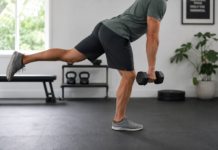
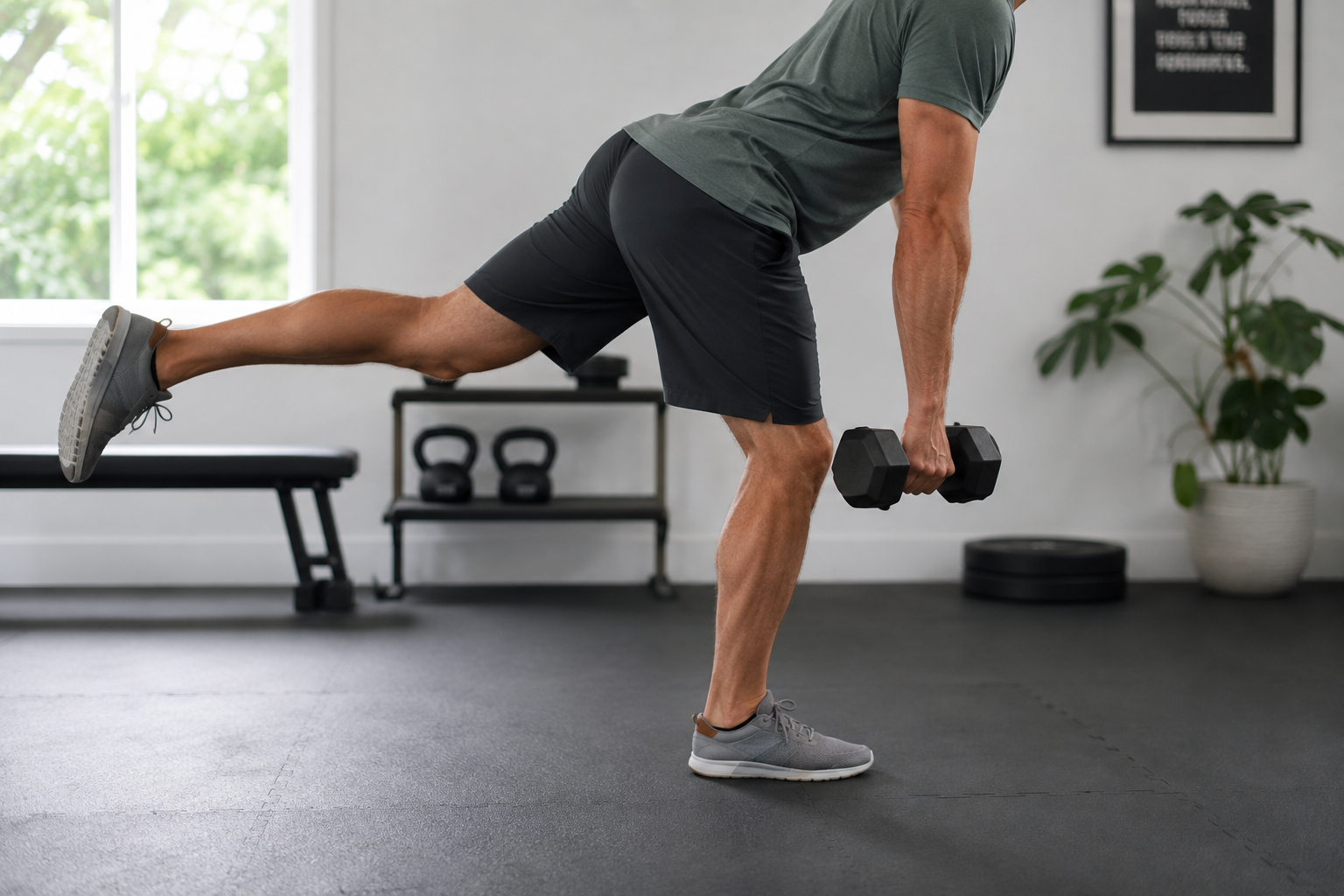
Unilateral training refers to any resistance exercise performed with one arm or one leg working independently, rather than both limbs moving together as in a bilateral lift. A back squat is bilateral. A single-leg Romanian deadlift is unilateral. A dumbbell bench press with both arms pressing at once is bilateral (with a unilateral stability demand); a single-arm dumbbell press, where one side is completely unloaded while the other works, is fully unilateral.
There’s a useful middle category too: split-stance or staggered-stance exercises, like a reverse lunge or a rear-foot-elevated split squat, where both legs are in contact with the ground but one leg is doing the overwhelming majority of the work. These movements sit between bilateral and true single-limb training, and they’re often the easiest entry point for people who aren’t yet comfortable balancing on one leg under load.
Why the Body Treats One-Sided Loading Differently
When you load one limb at a time, three systems get challenged simultaneously in a way bilateral lifting doesn’t replicate:
- The prime movers (the muscle you’re trying to train) work at a higher relative intensity for the same total load, since one limb isn’t splitting the work with the other.
- The core and hip stabilizers have to resist rotation and lateral shift, because an unopposed load on one side creates a torque that the trunk must control.
- The balance and proprioceptive system, meaning your body’s sense of joint position and movement, gets recruited constantly to keep you upright on a narrower base of support.
That combination is exactly what tends to erode with age if it isn’t deliberately maintained.
The Bilateral Deficit: A Strange Quirk of How Muscles Cooperate
Here’s something that surprises a lot of experienced lifters: when researchers measure the force a person can produce with both limbs at once versus the sum of what each limb can produce separately, the two-limb total is usually lower than expected. This gap is called the bilateral deficit, and it reflects how the nervous system doesn’t simply add up limb strength when both sides act together. Some neural inhibition happens.
Studies on unilateral versus bilateral resistance training have found that dedicated single-limb work can shrink this bilateral deficit over time, effectively teaching the nervous system to coordinate both sides more efficiently. One study on post-menopausal women specifically examined unilateral and bilateral strength training and its effects on the bilateral deficit and lean tissue mass, adding to evidence that single-limb work has measurable value for older populations, not just athletes chasing marginal performance gains.
Older adults, in particular, tend to show a larger bilateral deficit than younger adults, and training interventions that included unilateral work were associated with a reduction in that gap, bringing older participants’ performance closer to what’s typical in younger people. That’s a meaningful finding: it suggests some of what looks like unavoidable “aging decline” in coordinated strength is actually a trainable, reversible pattern.
Why This Matters More As You Age
1. Sarcopenia Doesn’t Wait for a Diagnosis
Muscle mass and strength generally peak in the early thirties, hold fairly steady through midlife, and then decline more noticeably after roughly age 65 in women and 70 in men, according to research summarized by the National Institute on Aging. This progressive loss of muscle mass, strength, and function has a name: sarcopenia. It’s associated with weakness, fatigue, a higher risk of falls and fractures, and, in more advanced cases, a higher risk of losing independence. Roughly 30% of adults over 70 report difficulty with basic tasks like walking, rising from a chair, or climbing stairs.
Resistance training, in general, is the most consistently supported countermeasure. But unilateral movements have a specific advantage here: they train the exact single-limb strength and control that daily tasks demand. Getting out of a chair, climbing a curb, catching yourself on uneven ground, and recovering from a stumble are all, functionally, single-leg events. Training that pattern directly transfers better than training that never asks one leg to work alone.
2. Balance and Fall Risk Are Directly Trainable
Falls are the leading cause of injury among adults aged 65 and older, and CDC data indicates roughly 1 in 4 older adults report falling each year, with about 37% of those falls resulting in an injury serious enough to need medical care or to limit activity for at least a day. That adds up to an estimated 9 million fall-related injuries annually in the United States. The CDC’s STEADI initiative, aimed at screening and reducing fall risk, specifically calls out poor strength and balance as modifiable risk factors.
There’s also a striking, if indirect, signal from balance research: one widely discussed study found that adults who could not hold a single-leg stance for at least 10 seconds were 84% more likely to die within the following decade compared with those who could. Researchers are careful to note this isn’t proof that poor balance itself causes earlier death. It more likely reflects that balance is a visible marker of overall health, since chronic conditions, inactivity, and reduced physical capacity all tend to erode balance at the same time they raise other health risks. But that correlation still makes the single-leg stance a useful, low-cost gauge of where you stand, and unilateral training is the most direct way to move that number in a better direction.
Quick Self-Check: The 10-Second Single-Leg Stance
Stand near a wall or countertop for safety. Lift one foot slightly off the floor, arms at your sides or crossed over your chest, and hold for 10 seconds without touching down or grabbing support. Switch sides. If one side is noticeably easier than the other, or you can’t hold either side for the full count, that’s useful information, not a verdict. It simply tells you where unilateral training and balance work belong in your routine right now.
3. Left-Right Asymmetries Compound Quietly Over Time
Almost everyone has some degree of side-to-side strength difference, often shaped by handedness, old injuries, sport history, or simply which leg leads when you walk up stairs. Left unaddressed, these asymmetries tend to compound. A slightly weaker hip on one side changes how you load your knee on that side. A weaker shoulder changes how you press or carry. Over years, these small differences can contribute to overuse patterns and repetitive-strain issues, particularly at the knees, hips, and lower back.
Unilateral training exposes these differences immediately, since you can’t let the stronger side compensate for the weaker one. That visibility is itself valuable: it turns a hidden imbalance into a specific, correctable one.
4. Cross-Education Offers Real Protection During Injury or Immobilization
One of the more counterintuitive findings in strength science involves what happens when you train just one limb. A controlled study on wrist flexor strength found that when one arm was immobilized in a cast while the other arm trained normally, the immobilized arm still preserved strength far better than an untrained control group. In that study, the immobilized limb in the training group lost only about 2.4% of its strength, compared with a 21.6% loss in the group that didn’t train the healthy arm at all. Muscle size in the immobilized limb also held up notably better in the training group.
This phenomenon, called cross-education, happens through neural pathways that carry some training effect from one side of the body to the other, even though only one limb physically moved. For anyone managing a sprained ankle, a shoulder recovering from surgery, or any single-limb injury, this is a genuinely practical takeaway: training the healthy limb isn’t just about maintaining what you have, it can measurably protect the injured side’s strength while it heals.
How Unilateral Training Compares to Bilateral Work
| Factor | Bilateral Training | Unilateral Training |
|---|---|---|
| Load per session | Typically higher total weight moved | Lower absolute load, higher relative demand per limb |
| Balance demand | Low to moderate | High; trains proprioception directly |
| Core involvement | Present but often passive | Actively resists rotation and lateral shift |
| Asymmetry detection | Can mask a weaker side | Reveals and directly trains each side |
| Joint loading (lower back) | Higher spinal compression at heavy loads | Generally lighter load, less spinal compression per exercise |
| Functional carryover | Good for overall force and power | Strong carryover to walking, stairs, single-leg recovery |
| Best role in a program | Foundation for maximal strength | Complement for balance, symmetry, and joint-friendly volume |
None of this means bilateral lifting is inferior or should be dropped. The two approaches solve different problems. A well-built program past midlife typically leans on both: bilateral lifts for building and maintaining overall strength efficiently, unilateral work for balance, symmetry, joint-friendly volume, and the kind of single-limb control that daily life actually requires.
Building Unilateral Work Into Your Training Week
Start Where You Actually Are
If you haven’t done much single-limb training, the jump straight to a barbell single-leg deadlift or a heavy single-arm dumbbell row is a good way to get frustrated or hurt. Progress through stability before you chase load.
A Practical Progression Timeline
- Weeks 1-2 — Split-stance foundations. Reverse lunges, split squats, staggered-stance deadlifts. Both feet stay grounded, but one leg does most of the work.
- Weeks 3-4 — Add single-leg balance drills. Single-leg stance holds, single-leg reaches (touching one hand to the floor while balancing on the opposite leg), step-ups with a controlled lowering phase.
- Weeks 5-6 — Introduce loaded single-limb strength work. Single-arm dumbbell rows and presses, single-leg Romanian deadlifts with light dumbbells, rear-foot-elevated split squats.
- Weeks 7-8 and beyond — Progress load and complexity. Add tempo changes, single-leg work on slightly unstable surfaces (a folded mat, not a wobble board for beginners), and pair unilateral lower-body work with rotational core exercises.
Exercises Worth Prioritizing
- Split squat or rear-foot-elevated split squat — builds single-leg quad and glute strength with a manageable balance demand.
- Single-leg Romanian deadlift — trains hip hinge control, hamstring and glute strength, and balance simultaneously; excellent carryover to catching yourself when you trip.
- Step-ups — closely mimics stair climbing and is easy to load progressively with dumbbells.
- Single-arm dumbbell row — trains back strength while forcing the core to resist rotation.
- Single-arm overhead press — smaller load than a bilateral press, but demands real shoulder and core stability.
- Lateral lunge — trains a movement plane (side-to-side) that bilateral lifts almost never touch, which matters for hip health and lateral stability as you age.
How Much, How Often
You don’t need to rebuild your entire program around unilateral work. A sensible approach for most people past their late thirties is to include two to three unilateral or split-stance exercises per week, either woven into existing strength sessions or as a dedicated portion of one session. Two to three sets of 8 to 12 controlled repetitions per side is a reasonable general target, adjusted for your current strength and any joint concerns. Balance-specific work, like single-leg stance holds, can be done more frequently, even daily, since the demand on the muscles is low but the neurological practice benefit accumulates with repetition.
What the Research Doesn’t Yet Settle
It’s worth being honest about the limits of the current evidence. Much of the unilateral-versus-bilateral research comes from smaller trials, often with young or middle-aged trained participants rather than large, long-term studies of older adults specifically. The single-leg-stance-and-mortality research is correlational, meaning it identifies an association, not a proven cause-and-effect chain, and the researchers behind that work are explicit that other health factors likely explain much of the link. Individual response to any strength training also varies quite a bit, so results for a given person may look different from the group averages typically cited in the studies.
None of that undercuts the basic case for unilateral training. Even setting aside the more headline-grabbing mortality correlation, the mechanical logic (reduced bilateral deficit, more direct core recruitment, closer transfer to real-world single-leg tasks, protective cross-education effects during injury) is well supported and consistent across the literature. The honest summary is that unilateral training is a well-justified, low-risk addition to a strength program, not an unproven fad promising outsized rewards.
Frequently Asked Questions
Is unilateral training better than bilateral training for building overall strength?
Not necessarily “better,” just different in what it emphasizes. Bilateral lifts generally allow more total load and are efficient for building maximal strength and power. Unilateral training is better suited to correcting asymmetries, improving balance, and training the kind of single-limb control that daily movement and fall prevention depend on. A well-rounded program uses both.
How do I know if I have a meaningful strength imbalance between sides?
Pay attention during single-arm and single-leg exercises: does one side fatigue noticeably faster, wobble more, or feel weaker at the same weight and rep count? A difference of a rep or two, or slightly less stability, is common and not alarming. A large, consistent gap, especially one paired with pain on one side, is worth discussing with a physical therapist or trainer.
Can unilateral training help with an old injury or chronic pain on one side?
It can help address the muscular imbalances that sometimes develop around an old injury, but it should be approached gradually and, ideally, with guidance from a physical therapist if pain is still present. Cross-education research also suggests that training the uninjured side may offer some protective benefit to the injured side during recovery, though this doesn’t replace direct rehabilitation of the affected limb once it’s cleared to load.
Do I need special equipment to do unilateral training at home?
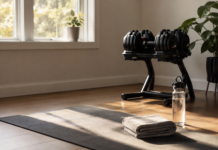
No. Bodyweight step-ups on a sturdy chair or stair, single-leg stance holds, reverse lunges, and single-arm exercises with a household object (a filled backpack, a jug of water) can cover most of the basics. A pair of adjustable dumbbells expands your options considerably but isn’t required to get started.
How often should older adults do balance-specific unilateral work?
Balance holds and simple single-leg drills are low-fatigue enough to practice most days of the week, even briefly, such as during a pause while brushing your teeth or waiting for the kettle. Loaded unilateral strength exercises are better suited to two or three sessions per week, with adequate recovery between sessions targeting the same muscle groups.
At what age should someone start prioritizing unilateral training?
There’s no strict cutoff, and younger athletes benefit from it too, particularly for injury prevention and correcting sport-specific imbalances. But the case for prioritizing it tends to strengthen from the late thirties onward, as natural side-to-side asymmetries, balance decline, and the early stages of age-related muscle loss start to become more relevant. It’s reasonable to introduce it earlier and simply keep it as a permanent part of a program rather than waiting for a specific age.
The Bottom Line
Bilateral lifts will always have a place in a well-built training program, since nothing else moves as much total load as efficiently. But they let compensation hide in plain sight, letting a stronger side quietly cover for a weaker one until the difference becomes a real liability. Unilateral training closes that gap. It trains balance directly, engages the core in a way bilateral lifts often don’t, reduces the bilateral deficit that tends to widen with age, and offers a documented protective effect on an injured limb through cross-education.
None of this requires an overhaul of your current routine. Two or three single-leg or single-arm exercises worked into your existing sessions, plus a habit of practicing balance in small, low-stakes moments throughout your day, is enough to start shifting the trend line. The goal isn’t to train for some hypothetical decade-away scenario. It’s to keep the ordinary things, getting up from the floor, catching yourself on uneven pavement, carrying a bag of groceries in one hand while unlocking a door, well within your capability for as long as possible.
References
- Centers for Disease Control and Prevention, Older Adult Falls Data
- Cleveland Clinic, Can the 10-Second Balance Test Predict Your Lifespan?
- National Institute on Aging, How Can Strength Training Build Healthier Bodies As We Age?
- BarBend, What Is Unilateral Training and Does It Really Fix Imbalances?
- American Council on Exercise, The Benefits of Unilateral Training
- PMC (National Institutes of Health), Unilateral Strength Training Leads to Muscle-Specific Sparing Effects During Opposite Homologous Limb Immobilization
- Frontiers in Sports and Active Living, Prognostic Accuracy of the One-Legged Balance Test in Predicting Falls