



























A diagnosis of osteoporosis or low bone density often triggers a reflex: move less, sit more, avoid anything that feels risky. That instinct is understandable, but it works against the goal. Bone is living tissue, and it responds to the forces placed on it. Take away load entirely and bone tends to weaken further. The real question is not whether to move, but which kinds of loading help bone and which ones raise the odds of a fracture, particularly a spinal compression fracture, if bone strength is already reduced.
This article walks through what research and major bone health organizations say about safe and effective exercise for people who are managing osteoporosis, osteopenia, or simply want to protect bone density as they age. It is written for general education. It is not a substitute for an evaluation by a physician or physical therapist who knows your bone density scores, fracture history, and overall health, and nothing here should be used to self-diagnose fracture risk.
Bone density typically peaks in the late twenties to early thirties, then holds fairly steady for a couple of decades before beginning a slow decline. For women, the years around menopause bring a sharper drop, driven by falling estrogen levels, which is why osteoporosis is diagnosed far more often in postmenopausal women than in any other group, though men and younger people can develop it too, sometimes from medications, hormonal conditions, or prolonged inactivity. Wherever someone falls on that timeline, the exercise principles below apply, though the starting point and pace of progression should shift with individual risk.
How Bone Responds to Mechanical Loading
Bone tissue is constantly being broken down and rebuilt in a process called remodeling. Specialized cells called osteoclasts dissolve small amounts of old bone, and cells called osteoblasts lay down new bone in its place. Under normal conditions these two processes stay roughly balanced. After menopause, and with aging more generally, the balance can tip toward breakdown, which is a major reason bone density declines over time.
Mechanical loading changes that balance in bone’s favor. The basic idea, often traced back to the nineteenth-century surgeon Julius Wolff and now generally referred to as Wolff’s law, is that bone adapts its internal structure to the loads it regularly experiences. Bone that is loaded, through body weight, muscle pull, or impact, receives a biological signal to add or preserve density along the lines of stress. Bone that goes unloaded, such as during prolonged bed rest or a sedentary lifestyle, tends to lose density because the signal to maintain it is missing.
Two features of loading matter most for triggering this bone-building response: the size of the force relative to what the bone normally experiences, and how quickly that force is applied. A brief, somewhat higher force delivered at an unfamiliar angle tends to stimulate more bone response than the same total amount of low-level, repetitive loading, which is part of why a mix of resistance training and impact activity is generally recommended over walking alone. This does not mean more force is always better. For a person whose bones are already fragile, the same properties that make loading effective, namely, novel direction and higher force, are also what can raise fracture risk if applied carelessly. That is the balancing act this whole topic is built around.
It is also worth understanding that bone responds locally, not globally. Loading the legs through walking builds density mainly in the hips and legs; it does little for the wrists or spine. Loading the arms through resistance training with dumbbells builds density mainly in the arms and shoulders. This is one reason bone health organizations recommend a mix of activities that load different regions of the skeleton, rather than relying on a single exercise, and it is part of why a program built entirely around one activity, such as walking alone, tends to under-deliver on bone protection compared with a combined approach that also includes resistance work targeting the hips, spine, and wrists.
Exercise Types That Build and Preserve Bone Density
Major bone health organizations generally group beneficial exercise into three categories: weight-bearing aerobic activity, resistance or strength training, and, for some people, higher-impact loading. Each works through a somewhat different mechanism.
Weight-bearing aerobic activity
Weight-bearing exercise is any activity performed on your feet, where your skeleton supports your body weight against gravity. The Bone Health & Osteoporosis Foundation describes walking, stair climbing, dancing, and low-impact aerobics as accessible weight-bearing options, noting that higher-impact versions such as jogging or tennis build bone more effectively but may need to be avoided by people who have already had an osteoporosis-related fracture. Swimming and cycling, while excellent for cardiovascular health, are not weight-bearing in this sense, because the water or the bike supports the body’s weight, so they are typically recommended as an addition to, not a replacement for, weight-bearing work.
Resistance and strength training
When a muscle contracts against resistance, it pulls on the bone at its attachment point, and that tug is itself a loading stimulus. Strength training with free weights, resistance bands, weight machines, or body weight is consistently listed by the Royal Osteoporosis Society and the Bone Health & Osteoporosis Foundation as one of the two pillars of bone-protective exercise, alongside impact loading. Strength work also builds the muscle mass that supports posture and protects joints, and it directly reduces fall risk by improving the strength needed to catch yourself or recover balance.
Research on higher-intensity resistance training in particular has grown over the past decade. The LIFTMOR randomized controlled trial, published in the Journal of Bone and Mineral Research, tested a supervised program of high-intensity resistance and impact training in postmenopausal women with low bone mass, including some with osteoporosis. The trial found that this approach improved bone mineral density at the spine and hip compared with a lower-intensity home program, along with gains in functional strength and balance, and it was delivered under close supervision with attention to safe technique. The takeaway many clinicians draw from LIFTMOR is not that everyone should lift maximally heavy loads unsupervised, but that appropriately dosed, well-supervised resistance training can be both effective and manageable for people with reduced bone density, provided form and progression are carefully controlled.
Impact loading, where appropriate
Impact activities, jumping, hopping, skipping rope, or brisk activities that involve a foot strike, deliver a quick, higher-magnitude load that is particularly effective at stimulating bone formation in the hip and leg. The International Osteoporosis Foundation and the Royal Osteoporosis Society both note that impact exercise is valuable for people who do not yet have significant bone loss or fracture history, but that the decision to include it once osteoporosis is diagnosed, especially with a prior spine fracture, should be made with a clinician or physical therapist rather than added independently.
For someone still building bone in their thirties or forties with no diagnosed low density, this category of exercise, along with team sports, jump training, and recreational running, is generally the most efficient way to build reserve bone strength for later decades. For someone who already has a diagnosis, impact can still have a place, but usually a scaled-down version, such as heel drops or gentle stepping, introduced only after strength and balance foundations are established and only with professional sign-off. The right level of impact is highly individual, which is exactly why blanket rules copied from a fitness article are less useful than a plan built around an actual bone density scan.
Movements to Approach Cautiously
Once bone density is reduced, certain movement patterns carry more fracture risk than others, mainly because they combine spinal flexion, twisting, or high impact with load. The Royal Osteoporosis Society explains that when the spine bends forward under load, pressure concentrates unevenly on the front portion of the vertebral bodies, which is the mechanism behind many spinal compression fractures. Mayo Clinic gives similar guidance, specifically flagging toe touches, full sit-ups, and rapid twisting motions at the waist as movements worth reconsidering once osteoporosis has been diagnosed.
It is worth being precise here: ordinary daily forward bending, done slowly and within a comfortable range, is not automatically dangerous, and the Royal Osteoporosis Society is careful to say so. The concern is with repetitive, loaded, sudden, or end-range spinal flexion and twisting, not with every instance of bending over. The table below summarizes this distinction for common exercise categories.
This table is a general guide, not an individual prescription. Fracture risk depends on bone density scores, fracture history, and other health factors that only a clinician can weigh properly.
A Sample Safe Progression
People who are new to structured exercise after an osteoporosis or osteopenia diagnosis often do better starting from a conservative baseline and building up gradually, rather than jumping into a generic strength program. A typical progression, again to be adjusted with a physical therapist, might move through phases like the one below.
Sample Progression Framework
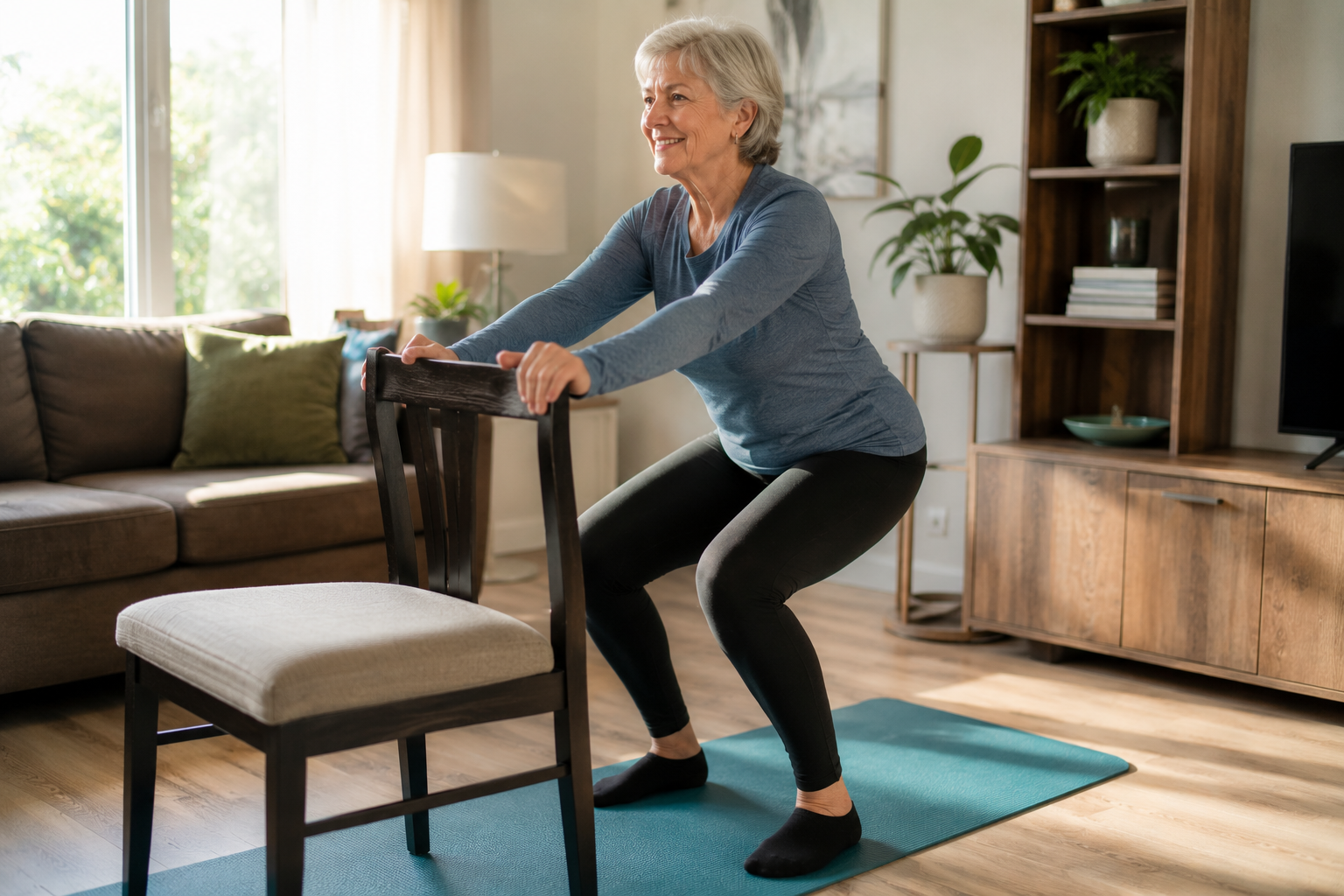
Weeks 1 to 4, foundation: Daily brisk walking, posture and balance drills, bodyweight sit-to-stands from a chair, wall push-ups, and light resistance band rows. Goal: build tolerance and confidence with correct form.
Weeks 5 to 10, building strength: Add two to three supervised resistance sessions per week using light dumbbells, resistance bands, or machines, targeting the back extensors, hips, and legs, along with continued balance work such as single-leg stands near a counter.
Weeks 11 to 16, progressive loading: Gradually increase resistance as strength and form allow, add step-ups or low-level stair work, and, only if a clinician has cleared it, introduce controlled low-impact loading such as heel drops.
Every phase should be reviewed against how the body actually responds, not just the calendar. Pain, unusual fatigue, or new symptoms are a signal to slow down and check in with a provider before moving to the next stage.
The Balance and Fall-Prevention Component
Bone density matters, but most fractures happen because of a fall, not because bone simply gives way during normal activity. That is why balance training is treated as a core pillar of a bone-protective exercise plan, alongside strength and weight-bearing work, rather than an optional extra. The Royal Osteoporosis Society lists balance exercises as one of the three essential exercise categories for bone health, specifically because reducing fall frequency reduces fracture frequency, independent of what happens to bone density itself.
Balance training can be as simple as practicing standing on one leg near a countertop for support, walking heel-to-toe along a line, or practicing controlled weight shifts from side to side. Tai chi and structured balance classes are commonly recommended because they combine slow, controlled movement with attention to stability and body awareness. For someone with a meaningful fall history or significant unsteadiness, a physical therapist can assess gait and balance directly and build a plan around specific deficits, which is more useful than a generic list of balance drills.
Environmental changes matter too. Clearing loose rugs, improving lighting, using handrails, and wearing supportive, non-slip footwear during exercise all reduce fall risk in ways that complement, but do not replace, an active balance training routine.
Vision and inner-ear function also play a role in balance that is easy to overlook. Annual eye exams, reviewing medications that cause dizziness or drowsiness with a pharmacist or physician, and addressing any known inner-ear or vestibular issues all support the same goal as balance drills: fewer falls. For people who have already had a fall or a near-fall in the past year, mentioning this to a physician is worthwhile even outside the context of an exercise program, since it can prompt a more detailed fall-risk assessment.
Red Flags: When to Stop and Seek Medical Guidance
Certain signs during or after exercise call for stopping the activity and contacting a healthcare provider rather than pushing through. These include sudden or severe back pain, especially after bending, lifting, or a fall; new height loss or a change in posture such as increased forward curvature of the upper spine; pain that radiates into the ribs or abdomen; numbness, tingling, or weakness in the arms or legs; and any pain that does not ease with rest. Sudden severe back pain after even a minor movement can be a sign of a vertebral compression fracture, and it warrants prompt medical evaluation rather than a wait-and-see approach.
More generally, any new or worsening pain during exercise, joint swelling, dizziness, or shortness of breath out of proportion to the activity are reasons to pause a session and get it checked out. This is especially true for people managing osteoporosis alongside other conditions, since medications, balance issues, and comorbidities can all interact with an exercise plan in ways that are worth reviewing with a provider periodically, not only at the start.
It is also reasonable to check in with a provider proactively, not just when something goes wrong. Bone density is typically reassessed every one to two years with a DXA scan, and that reassessment is a natural point to revisit an exercise plan: confirming which movements remain appropriate, whether impact loading can be safely added or should stay off the table, and whether strength gains have changed the picture. Treating the exercise plan as something that gets revisited on a schedule, rather than set once and left alone, tends to produce better long-term outcomes than either avoiding all activity or ignoring changes in symptoms.
Key Terms to Know
Bone mineral density (BMD): A measurement of the calcium and mineral content in a segment of bone, commonly assessed with a DXA scan and used to estimate bone strength and fracture risk.
Osteopenia: A bone density level lower than normal peak bone mass but not low enough to meet the diagnostic threshold for osteoporosis.
Wolff’s law: The principle that bone tissue adapts its structure and density in response to the mechanical forces placed on it over time.
Osteogenic loading: Exercise loading specifically applied to stimulate new bone formation, typically involving higher force or novel direction relative to habitual movement.
Vertebral compression fracture: A fracture in which a vertebral body partially collapses, often from a combination of low bone density and loaded spinal flexion, sometimes occurring with minimal trauma.
Moving Forward With a Plan That Fits
The evidence from bone health organizations and clinical research points in a consistent direction: staying still is not the safer option for bone health, and neither is exercising without regard for technique. Weight-bearing aerobic activity, resistance training, and, for many people, some form of impact loading, build and preserve bone density, while balance training reduces the falls that lead to most fractures in the first place. For someone who already carries a diagnosis of osteoporosis or a fracture history, the specific exercises, the loads used, and the pace of progression should be worked out with a physician or physical therapist who can review bone density scans, fracture history, and any spinal changes before a program is built. A qualified professional can also teach the technique details, such as hip-hinge mechanics and neutral spine positioning, that make the difference between loading that helps bone and loading that puts it at risk.
None of this needs to feel like a restriction list. Most days, a workable routine looks like ordinary activity done with attention to form: a brisk walk, a short strength session with a band or light weights, a few minutes of balance practice near a countertop, and enough rest between sessions to recover. Consistency over months and years, built on a plan reviewed with a physician or physical therapist, does more for bone health than any single workout ever will.
Frequently Asked Questions
Is it safe to exercise at all if I have osteoporosis?
For most people, yes, and organizations including the Bone Health & Osteoporosis Foundation and the Royal Osteoporosis Society actively recommend regular exercise as part of managing osteoporosis. The type, intensity, and progression should be individualized, ideally with input from a physician or physical therapist, particularly if there is a history of spinal fracture.
What is the safest type of exercise to start with after a diagnosis?
Many people start with walking, posture and balance drills, and light, supervised resistance training that keeps the spine in a neutral position. This builds a foundation of strength and confidence before progressing to more challenging loading.
Can exercise reverse bone loss once osteoporosis has developed?
Exercise can help preserve existing bone density and, in some cases, contribute to modest gains, particularly with supervised resistance and impact training, but it works alongside medical treatment rather than replacing it. Decisions about medication and treatment goals should be made with a physician.
What exercises are generally discouraged with osteoporosis?
Movements combining loaded spinal flexion or fast twisting, such as toe touches, full sit-ups, and rapid golf-style or racquet-sport swings, are commonly flagged as higher risk, along with running or jumping without medical clearance. See the table above for a more complete comparison.
How often should I do weight-bearing or resistance exercise for bone health?
General public health guidance points toward weight-bearing aerobic activity most days of the week and resistance training at least two to three times weekly, but the right frequency and starting point for someone with diagnosed osteoporosis should be set individually with a healthcare provider.
Do I really need to see a physical therapist before starting, or can I just follow general guidelines?
If you have never had a fracture and have no diagnosed bone condition, general public health exercise guidelines are a reasonable starting point. If you have osteoporosis, a low bone density score, or any spinal fracture history, a physical therapist or physician evaluation is strongly recommended before beginning a new program, since they can assess your specific fracture risk and teach safe technique for your situation.
References
- Bone Health & Osteoporosis Foundation. Weight-Bearing and Muscle-Strengthening Exercises
- Bone Health & Osteoporosis Foundation. Osteoporosis Exercise for Strong Bones
- Royal Osteoporosis Society. Exercise for Bones
- Royal Osteoporosis Society. Bending Forward (Flexion)
- Mayo Clinic. Exercising With Osteoporosis: Stay Active the Safe Way
- International Osteoporosis Foundation. Exercise
- Watson SL, et al. High-Intensity Resistance and Impact Training Improves Bone Mineral Density and Physical Function in Postmenopausal Women With Osteopenia and Osteoporosis: The LIFTMOR Randomized Controlled Trial. Journal of Bone and Mineral Research
This article is for general educational purposes and does not replace individualized medical advice. If you have osteoporosis, osteopenia, or a history of fractures, talk with your physician or a physical therapist before starting or changing an exercise program, particularly regarding movements that involve spinal flexion, twisting, or impact.