

























A sustainable weight loss diet is a way of eating you can keep doing for years, not weeks. In practice, it means creating a modest, steady calorie deficit while prioritizing nutrient-dense foods, adequate protein and fiber, and habits that fit your real life. A safe, sustainable pace is typically about 1–2 pounds (0.5–0.9 kg) per week, paired with regular physical activity and sufficient sleep. This guide is for anyone who wants results that last—without crash diets or all-or-nothing rules. (General information only—if you have a medical condition or take medications, speak with your healthcare professional before making changes.)
At a glance, the 9 steps:
- Set a clear target and safe weekly pace.
- Calculate a realistic daily calorie budget.
- Center meals on protein and fiber.
- Use the Plate Method and low energy density.
- Plan, shop, and batch-cook for the week.
- Make carbs and fats work for you (quality over extremes).
- Lock in hydration, sleep, and stress basics.
- Move more and strength train to protect muscle.
- Track, review trends, and adjust—then transition to maintenance.
1. Define Your Target and Safe Weekly Pace
A sustainable diet begins with clarity: know what you’re aiming for and how quickly you’ll go. The direct answer: aim for gradual loss of ~1–2 lb (0.5–0.9 kg) per week, which research and national guidance associate with better long-term maintenance than aggressive cuts. Set a time horizon (e.g., 12–24 weeks), decide what you will measure (weight trend, waist, habits), and pick a process you can repeat on busy days. This upfront framing prevents panic pivots when the scale stalls for a few days and helps you judge progress beyond a single number. Importantly, slower, steady loss preserves more lean mass and reduces the “rebound” risk that comes with severe restriction.
1.1 Why it matters
When pace expectations are realistic, you’re less likely to adopt extreme diets or cut entire food groups—patterns linked to short-term drops and long-term regain. Anchoring to a safe weekly range also makes it easier to plan meals and activity that you can sustain.
1.2 Numbers & guardrails
- Sustainable rate: ~0.5–0.9 kg (1–2 lb) per week.
- Expect plateaus; body weight fluctuates with glycogen, sodium, and hormones.
- Reassess every 4 weeks using a 7-day weight average to smooth daily noise.
1.3 Mini-checklist
- Define the “why.” Energy, health markers, mobility, confidence.
- Pick metrics. Weight trend, waist, step count, protein/fiber targets.
- Set a review cadence. Weekly habit checks; monthly progress review.
Wrap-up: choose a destination and a pace you can sustain; this step prevents overcorrecting later.
2. Calculate a Realistic Daily Calorie Budget
To lose weight, you must consistently eat fewer calories than you burn. The straightforward answer: estimate your maintenance calories, then create a daily deficit—commonly ~500 kcal/day for ~0.5 kg (1 lb) per week. Many clinical guidelines cite 500–1,000 kcal/day deficits for 1–2 lb/week, but your best number depends on body size, activity, and adherence. Use a dynamic calculator (not just “3500-calorie rule”) because metabolism adapts as you lose weight; the NIH Body Weight Planner accounts for this and gives a more realistic target. Start conservatively and adjust based on 2–4 weeks of trend data.
2.1 How to do it
- Estimate maintenance. Use the NIH Body Weight Planner.
- Choose deficit. Begin with ~300–500 kcal/day; larger bodies may tolerate ~500–750.
- Set floor limits. Avoid very-low-calorie diets unless medically supervised.
- Recalculate monthly. Targets change as weight and activity change.
2.2 Numbers & guardrails
- Typical starting deficit: 500–750 kcal/day for many adults seeking 0.5–1.0 kg/week.
- VLCDs (<800 kcal/day) are medical tools—not DIY.
- Use your 7-day average weight; if trend loss <0.3% body weight/week for 3–4 weeks, consider a 5–10% calorie adjustment.
2.3 Example
If your maintenance is ~2,300 kcal, start at 1,800–2,000 kcal/day. Track for 3–4 weeks; if your 7-day average isn’t trending downward as expected, adjust ~100–150 kcal or add ~2,000–3,000 weekly steps.
Bottom line: choose a deficit you can actually adhere to; accuracy plus consistency beats aggressive math.
3. Center Meals on Protein and Fiber
The fastest way to make fewer calories feel easier is to prioritize protein and fiber. The direct answer: include a solid protein source (animal or plant) at each meal, and aim to hit daily fiber around 28 g on a 2,000-kcal diet (or roughly 14 g per 1,000 kcal). Higher-protein, higher-fiber patterns improve fullness and dietary adherence—crucial when you’re in a deficit. Protein supports muscle retention; fiber slows digestion and moderates blood glucose. This combination lets you keep portions satisfying while staying within your calorie budget.
3.1 Numbers & guardrails
- Fiber: ~28 g/day at 2,000 kcal (scale with intake).
- Protein: include a quality source at every meal; many active adults do well with higher-protein patterns for satiety and lean-mass support.
- Produce: aim for ≥5 servings/day of vegetables and fruits.
3.2 How to do it
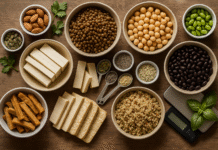
- Build plates around eggs, fish, poultry, tofu/tempeh, Greek yogurt, lentils, chickpeas.
- Add fiber-rich sides: beans, berries, pears, leafy greens, oats, barley, chia, flax.
- Swap refined grains for whole grains most of the time.
3.3 Mini case
A 75-kg person distributes protein across 3 meals + 1 snack: yogurt (20 g), lunch chicken/bean bowl (35 g), tofu stir-fry (30 g), evening omelet (25 g) → ~110 g/day with ample fiber from beans, veg, and chia.
Takeaway: protein-and-fiber centric meals raise satiety per calorie—your best friend in a deficit.
4. Use the Plate Method and Low Energy Density
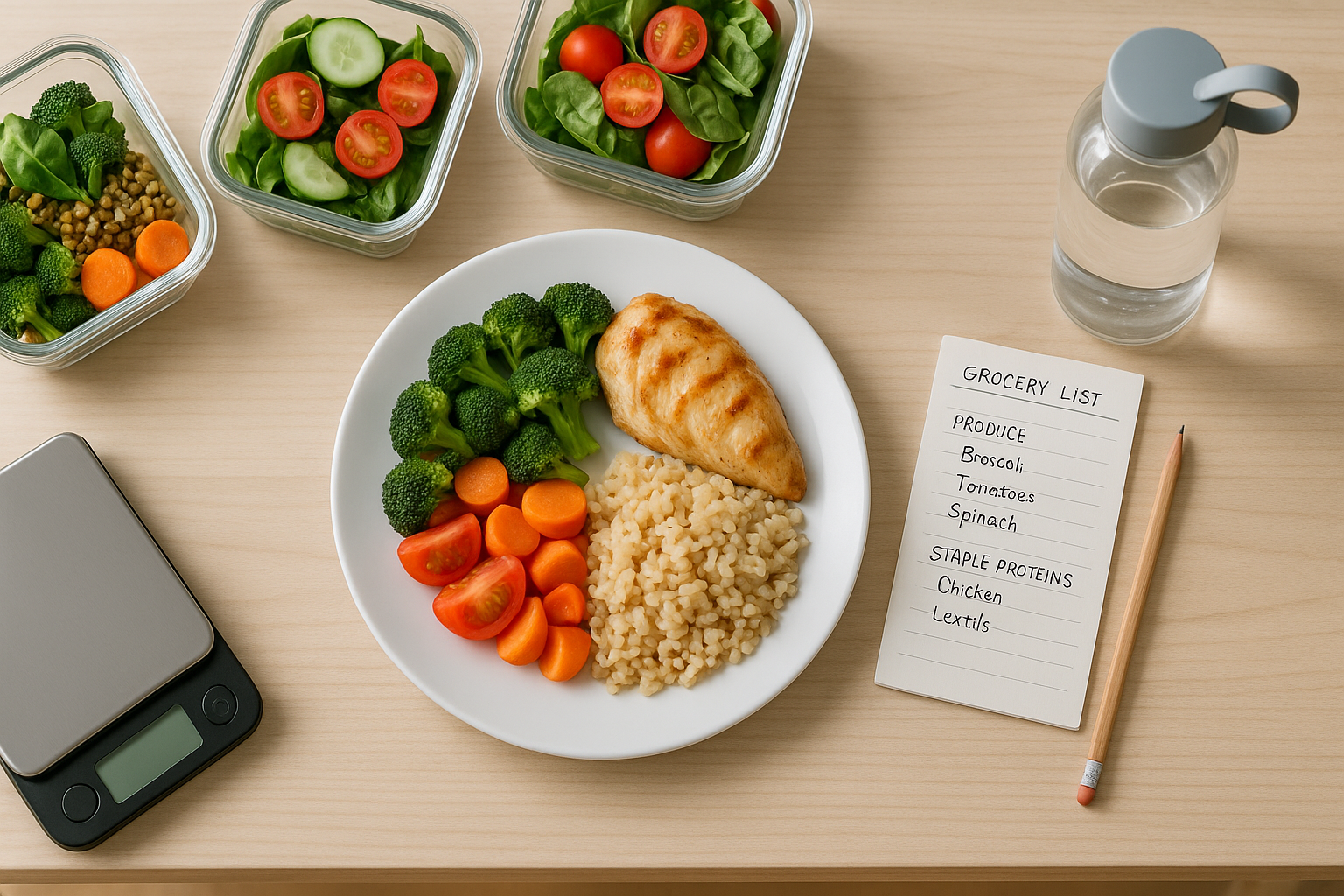
If you want portion control without constant measuring, use visual structure. The direct answer: fill ½ your plate with non-starchy vegetables and fruit, ¼ with lean protein, and ¼ with whole grains or starchy carbs; add a thumb of healthy fats. Focusing on low energy density (foods with fewer calories per gram) lets you eat satisfying volumes while staying in a deficit—think vegetables, fruits, broth-based soups, cooked grains, and legumes. This approach simplifies choices at home, restaurants, and family dinners.
4.1 How to do it (with region-specific notes)
- South Asia–friendly swaps (Pakistan):
- Protein: grilled chicken tikka, masoor/moong dal, chana, paneer (moderate portions).
- Carbs: 1 small chapati/¼ plate brown rice; prefer whole-wheat roti or mixed-grain atta.
- Vegetables: sabzi (okra, gobi, bhindi, baingan), kachumber salad, sautéed spinach.
- Fats: a small drizzle of mustard/olive oil; limit ghee to mindful portions.
- Dining out: order an extra veg side, share rice/naan, start with soup/salad.
4.2 Numbers & guardrails
- Make vegetables the largest volume on the plate.
- Choose grilled/roasted over fried; sauces on the side.
- Soups/salads first course can reduce total intake.
4.3 Mini-checklist
- Half-plate veg?
- One palm-sized protein?
- One cupped handful whole grains/starches?
Synthesis: the plate method plus low energy density delivers effortless portion control without counting every bite. PMC
5. Plan, Shop, and Batch-Cook for the Week
Your diet is only as sustainable as your environment. The direct answer: plan 3–5 simple, repeatable meals each week, shop once or twice, and batch-cook basics so “default meals” are always ready. This turns willpower problems into logistics wins. Build a short roster of breakfasts, lunches, and dinners you actually like; prep 2–3 proteins (e.g., chicken breast, lentils, tofu), 2 grains (e.g., brown rice, quinoa), and a tray of mixed vegetables. Pre-portioned, ready-to-heat meals crush the “what’s for dinner?” friction that derails adherence—especially on busy weekdays. CDC
5.1 Tools & examples
- Tools: grocery list app, calendar, food containers, slow cooker/Instant Pot, digital scale.
- Batch ideas: dal + brown rice; sheet-pan chicken + mixed veg; chana masala + salad; tofu-veg stir-fry + quinoa.
- Snack station: fruit, yogurt, roasted chickpeas, nuts (portioned), carrot/cucumber sticks.
5.2 Numbers & guardrails
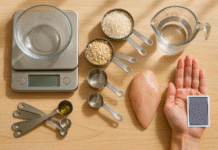
- Portion cooked grains using a ½–1 cup (120–240 ml) scoop.
- Pre-portion nuts/seeds to 1–2 Tbsp (10–20 g).
- Aim for 20–40 g protein per main meal; add veg until the plate looks abundant.
5.3 Mini-checklist
- Menu set? Groceries bought? Proteins + grains cooked? Veg washed and chopped?
Close: planning once reduces decision fatigue for the next 4–5 days—a cheat code for consistency.
6. Make Carbs and Fats Work for You (Quality Over Extremes)
Carb vs. fat debates miss the main point: calorie balance and food quality drive weight change. The direct answer: choose a mix of minimally processed carbs and fats you enjoy, keep portions aligned to your calorie target, and let protein/fiber anchor satiety. Evidence shows low-fat and low-carb diets can both work when calories are controlled; long-term success depends on adherence. Prioritize whole grains, legumes, fruit, and unsaturated fats (olive oil, nuts, seeds, fish), while limiting added sugars and trans fats. Adjust your macro split to personal preference and blood sugar response.
6.1 Numbers & guardrails
- Carbs: often 40–55% of calories works well if mostly high-fiber sources.
- Fats: often 25–35% of calories with emphasis on unsaturated fats.
- Keep added sugars and trans fats as low as possible.
6.2 How to do it
- Swap refined grains for oats, brown rice, barley, whole-wheat roti.
- Choose beans, lentils, and fruit for carbs that bring fiber.
- Favor olive/mustard oil, nuts, seeds; include fatty fish weekly.
- Use sauces and spreads mindfully; measure oils for cooking.
6.3 Common mistakes
- Demonizing one macro leads to binge/compensation later.
- Drinking calories (sweetened beverages) sabotages deficits.
- Forgetting that “healthy” fats still have dense calories.
Summary: pick a macro balance you can live with, but keep quality high and portions honest. World Health Organization
7. Lock In Hydration, Sleep, and Stress Basics
Diet isn’t just food—it’s recovery and regulation. The direct answer: drink water regularly, aim for ≥7 hours of sleep nightly, and manage stress with repeatable routines. Sleeping less than 7 hours is associated with higher risks of weight-related conditions and can increase appetite and cravings, making adherence harder. Daily hydration supports energy and appetite control (especially if you’re increasing fiber). Build small, reliable habits: wind-down alarms, short walks between tasks, and “screens-off” 30–60 minutes before bed.
7.1 How to do it
- Sleep: fixed bed/wake times; dark, cool room; no caffeine late afternoon.
- Stress: walking, prayer/meditation, brief breathing drills (e.g., 4-7-8), journaling.
- Hydration: start the day with a glass of water; sip with each meal; carry a bottle.
7.2 Numbers & guardrails
- Adults: ≥7 hours/night recommended.
- Pair higher fiber with adequate fluids to avoid GI discomfort.
7.3 Mini-checklist
- Did I protect my sleep window?
- Did I get a brief “stress reset” today?
- Did I drink water with each meal/snack?
Bottom line: better sleep and lower stress make calorie control feel easier, improving adherence.
8. Move More and Strength Train to Protect Muscle
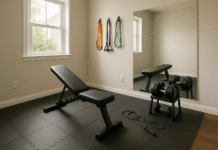
Weight loss is easier and healthier when paired with movement. The direct answer: aim for 150+ minutes/week of moderate-intensity activity (or 75 minutes vigorous), plus 2+ days/week of muscle-strengthening. Strength work preserves (or builds) lean mass so more of your weight loss comes from fat. Walking, cycling, or swimming add calorie burn and cardio benefits; short strength sessions (even 2×/week) maintain muscle and function. Choose modes you’ll actually do, then schedule them like appointments.
8.1 How to do it
- Cardio menu: brisk walks, cycling, swimming, dance workouts, rucking.
- Strength staples: squats, hinges (deadlifts/hip bridges), pushes, pulls, loaded carries—machines or free weights.
- Micro-doses: 10-minute “movement snacks” between meetings add up.
8.2 Numbers & guardrails
- Start with 3×30-minute walks weekly; add intensity or steps over time.
- Strength: 6–10 hard sets/muscle/week works for most; beginners can start lower.
- Protein intake plus strength work helps preserve lean mass in a deficit.
8.3 Mini case
A beginner schedules Mon/Thu 30-min full-body sessions (machines + goblet squats, rows, presses), and Tue/Sat 30-min brisk walks. After 4 weeks, they add a third walk and one extra set for big lifts.
Takeaway: movement multiplies diet—protecting muscle and mood while nudging calories.
9. Track, Review Trends, and Adjust—Then Transition to Maintenance
The final step is feedback. The direct answer: track a few key behaviors (protein, fiber, steps, workouts) and your 7-day average weight, then adjust calories or activity based on 2–4 weeks of trend—not daily fluctuations. Successful maintainers often weigh in regularly, keep some food/step tracking, and maintain consistent meal routines. Use trend data to decide whether to tweak portions, add movement, or hold steady. As you approach goal weight, bring calories slowly up toward maintenance and keep the habits that got you there.
9.1 How to do it
- Track: simple app or paper checklist for protein/fiber/steps/workouts.
- Review: every 2–4 weeks, compare trends to targets.
- Adjust: modify calories by ~5–10% or add ~1–2 activity sessions.
9.2 Numbers & guardrails
- Expect weight to fluctuate ±0.5–1.0% from sodium, carbs, and cycle.
- If trend stalls 3–4 weeks, adjust food/activity modestly.
- Transition to maintenance by adding ~50–100 kcal/day each week until weight stabilizes.
9.3 Mini-checklist (maintenance)
- Keep protein high and veg abundant.
- Keep a default breakfast/lunch.
- Keep weekly weigh-ins and one “prep hour.”
Synthesis: measure a little, adjust a little, and keep the simple habits that made the difference.
FAQs
1) What exactly is a “sustainable weight loss diet”?
It’s an eating pattern you can follow long-term that creates a modest calorie deficit, prioritizes nutrient-dense foods, and fits your lifestyle and culture. Practically, that means balanced plates, adequate protein and fiber, and changes you can keep doing on busy days—not rapid cuts or banned food lists. Guidance favoring gradual loss (about 1–2 lb per week) aligns with better maintenance and fewer side effects.
2) Do I have to count calories forever?
No. Counting is a tool, not a rule. Many people count for 4–12 weeks to calibrate portions and then switch to visual methods like the Plate Method while keeping a few objective anchors (regular weigh-ins, step counts, protein targets). The NIH Body Weight Planner can set an initial budget; from there, use habit tracking and your weight trend to guide adjustments.
3) Is low-carb better than low-fat?
Both can work because calorie balance is king. Trials and reviews suggest no single macro split is universally superior for fat loss when calories and protein are similar; adherence and food quality matter most. Choose the approach that helps you eat fewer calories without feeling deprived—whole-food carbs and unsaturated fats both fit. PMC
4) How much fiber should I eat for weight loss?
Fiber doesn’t automatically cause weight loss, but higher fiber intakes improve fullness and adherence, which support a calorie deficit. A practical target is around 28 g/day at a 2,000-kcal intake (scale with calories), emphasizing legumes, whole grains, vegetables, fruits, nuts, and seeds.
5) How much protein do I need?
Include a quality protein source at each meal and snack. Higher-protein patterns can help preserve lean mass and increase satiety during weight loss; athletes and very active people may benefit from even higher intakes spread across the day. Focus less on exact grams and more on consistency across meals, supported by strength training.
6) What if I hit a plateau?
Plateaus are normal—metabolic adaptation and behavioral drift happen. Confirm your calorie target with a dynamic tool (NIH Body Weight Planner), tighten tracking for 1–2 weeks, add a bit of movement, and consider a small calorie adjustment (~5–10%). Remember, the old “3500 kcal per pound” rule overestimates weight loss because the body adapts over time.
7) Can I lose weight without exercise?
Yes, through diet alone—but pairing diet with activity works better for body composition, health, and maintenance. Aim for 150+ minutes/week of moderate activity plus 2+ days/week of strength training to preserve muscle and support overall health. Even short “movement snacks” help.
8) Do I need supplements?
Most people can meet needs with food. Some may benefit from vitamin D, omega-3s, or iron/B12 depending on diet pattern, labs, and clinician input. Avoid fat-burner supplements; they are often ineffective and can be risky. Prioritize a varied diet following national guidelines, then personalize with your healthcare professional.
9) How do sleep and stress affect weight loss?
Short sleep and high stress can raise appetite and cravings, reduce motivation, and nudge you toward calorie-dense foods. Protect a 7- to 9-hour sleep window and add small stress resets (walking, breathing drills) to make adherence easier. CDC
10) What should my plate look like at restaurants or family events?
Lead with vegetables and lean protein, keep starchy sides to about a quarter of your plate, and share desserts or take half home. Ask for sauces on the side and choose grilled/roasted over fried. The Plate Method adapts well across cuisines, including Pakistani dishes like grilled tikka, dal, and sabzi. MyPlate
11) Is it OK to include favorite foods?
Yes—allowing favorite foods intentionally (in portion-controlled ways) reduces the restrict-binge cycle. Budget for them within your calories, pair them with protein and fiber, and keep most meals simple and nutrient-dense. Long-term success comes from patterns, not perfection.
12) How do I transition to maintenance?
Increase calories gradually (e.g., +50–100 kcal/day each week) until your 7-day average weight stabilizes for 3–4 weeks. Keep the habits that worked—regular weigh-ins, default meals, activity—and maintain a protein-and-fiber focus. Successful maintainers commonly continue some self-monitoring behaviors over time.
Conclusion
Sustainability isn’t about willpower—it’s about design. You’ll get further (and keep results longer) by building a realistic calorie budget, structuring meals around protein and fiber, and relying on visual tools like the Plate Method to keep portions straightforward. Pair those with sleep, stress, and movement basics, then use simple tracking to review trends and make small adjustments. Over time, your “default day” becomes your strategy: a short list of meals you enjoy, some built-in steps and strength, and a weekly prep ritual that keeps good choices easy and friction low. If you’re deliberate about the first 4–12 weeks, maintenance becomes an evolution—not an afterthought. Start with the step that feels most achievable this week, and keep stacking from there.
Ready to begin? Pick one meal to optimize today, schedule two brief strength sessions, and set a 10-minute “Sunday prep.” Repeat for 4 weeks.
References
- Steps for Losing Weight | Healthy Weight and Growth, Centers for Disease Control and Prevention (CDC), Jan 17, 2025. https://www.cdc.gov/healthy-weight-growth/losing-weight/index.html
- Adult Activity: An Overview | Physical Activity Basics, CDC, accessed Aug 2025. https://www.cdc.gov/physical-activity-basics/guidelines/adults.html
- Dietary Guidelines for Americans, 2020–2025 (9th ed.), U.S. Department of Agriculture & U.S. Department of Health and Human Services, Dec 2020. https://www.dietaryguidelines.gov/sites/default/files/2020-12/Dietary_Guidelines_for_Americans_2020-2025.pdf
- Daily Value on the Nutrition and Supplement Facts Labels, U.S. Food & Drug Administration (FDA), Mar 5, 2024. https://www.fda.gov/food/nutrition-facts-label/daily-value-nutrition-and-supplement-facts-labels
- About the Body Weight Planner, National Institute of Diabetes and Digestive and Kidney Diseases (NIDDK/NIH), accessed Aug 2025. https://www.niddk.nih.gov/health-information/weight-management/body-weight-planner
- Key Recommendations for Weight Loss (clinical guidance excerpt), National Heart, Lung, and Blood Institute (NHLBI/NIH), accessed Aug 2025. https://www.nhlbi.nih.gov/health/educational/lose_wt/recommen.htm
- Healthy Eating Plate, Harvard T.H. Chan School of Public Health—The Nutrition Source, accessed Aug 2025. https://nutritionsource.hsph.harvard.edu/healthy-eating-plate/
- Dietary energy density: applying behavioural science to weight management, Rolls BJ, Nutrition Bulletin, 2017. https://onlinelibrary.wiley.com/doi/abs/10.1111/nbu.12280
- Popular Dietary Patterns: Alignment With American Heart Association Guidelines, Gardner CD et al., Circulation, 2023. https://www.ahajournals.org/doi/10.1161/CIR.0000000000001146
- Fiber Intake Predicts Weight Loss and Dietary Adherence in Adults With Overweight/Obesity, Miketinas DC et al., Nutrients, 2019. https://pmc.ncbi.nlm.nih.gov/articles/PMC6768815/
- Physical Activity Patterns in the National Weight Control Registry, Catenacci VA et al., Obesity, 2008. https://pmc.ncbi.nlm.nih.gov/articles/PMC4578963/
- International Society of Sports Nutrition Position Stand: Protein and Exercise, Jäger R. et al., JISSN, 2017. https://jissn.biomedcentral.com/articles/10.1186/s12970-017-0177-8