





















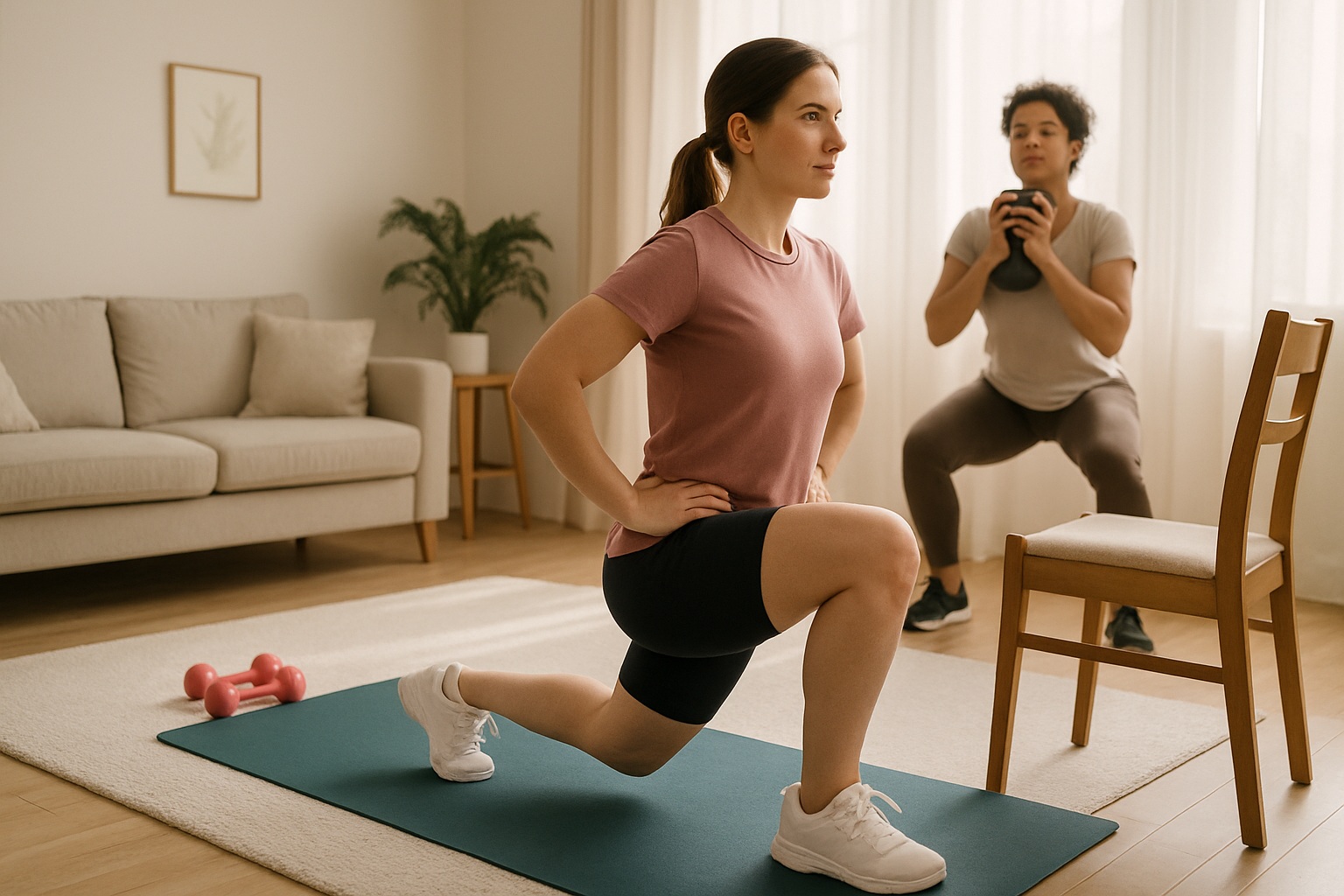
You can build strong, balanced legs and glutes at home with nothing more than your bodyweight, a pair of dumbbells (optional), and smart programming centered on squats and lunges. This guide gives you 11 complete routines—from beginner-friendly to power-focused—that cover strength, endurance, and athleticism safely. In short: a “lower body home workout” that prioritizes squat and lunge patterns can hit quads, hamstrings, glutes, and calves efficiently while improving balance and knee/hip stability. Adults generally benefit from muscle-strengthening work on at least two days per week; these routines are designed to help you hit that target.
Quick start: Warm up 5–7 minutes; pick 1 routine below; aim for 2–4 total sets per exercise; rest 60–120 seconds between heavy efforts; progress weekly by adding a rep, a small load, or stricter tempo. If pain (not training discomfort) appears, stop and modify the range of motion or choose a knee-friendlier option.
1. Bodyweight Squat + Reverse Lunge Circuit (Beginner Base)
This circuit is the safest starting point to groove perfect patterns, elevate heart rate, and build foundational strength without equipment. You’ll alternate air squats and reverse lunges—two moves that train quads and glutes while teaching you to keep your knees tracking over your toes. Starting with reverse lunges is knee-friendly because the step-back reduces braking forces at the knee compared with stepping forward, making it a solid choice for newer lifters or anyone easing back in. Expect a moderate burn but not joint pain; keep reps clean and stop 1–2 reps before form breaks. Do this 2–3 times per week for 3–4 weeks before progressing to loading or tempo work.
1.1 How to do it
- Warm-up (5–7 min): March in place → hip circles → 10 deep squat prys → 10 alternating lunges with reach.
- Circuit (20 minutes):
- Air Squat × 12–15
- Reverse Lunge (alt.) × 8–10/leg
- Glute Bridge × 12–15
- 45–60 sec rest; repeat 3–4 rounds.
- Form cues: Chest tall, ribs down; sit hips between heels; knee tracks over mid-foot; full foot on floor.
1.2 Numbers & guardrails
- Effort: RPE 6–7 (challenging but you could do ~3–4 more reps).
- Progression: Add one rep per set weekly until you hit 15–18 reps, then move to Routine #2 or add a backpack for squats.
- Common mistakes: Heels lifting; knees collapsing inward (add a mini-band or think “spread the floor”); rushing reps.
Synthesis: Nail these patterns and breathing here—your knees and hips will thank you when the loads go up later.
2. Goblet Squat & Reverse Lunge Strength Pair (Dumbbell Option)
If you have a single dumbbell or kettlebell, this superset builds significant lower-body strength with minimal gear. The goblet position encourages an upright torso and deeper squat depth, biasing quads and glutes; pairing it with reverse lunges keeps the same muscle groups under tension while adding unilateral stability. Load only as heavy as your form allows; most lifters thrive in the 6–10 rep range here for 3–5 sets. Start light and let your technique decide the jumps.
2.1 How to do it
- A1. Goblet Squat: 3–5 sets × 6–10 reps; 2–3 min rest after A2.
- A2. Reverse Lunge (alt., DBs optional): 3–5 sets × 8–10/leg.
- Tempo: 2–0–1 (two seconds down, no pause, drive up).
- Brace: Inhale 360° into your belt line before each rep; exhale through the top.
2.2 Numbers & guardrails
- Effort: Sets should land ~RPE 7–9; stop 1 rep shy of failure on your last set. The Borg RPE method is a validated way to gauge intensity when training without a coach or barbell.
- Progression example: Week 1: 12 kg × 8 reps; Week 2: 14 kg × 8; Week 3: 14 kg × 10; Week 4: 16 kg × 8.
- Common mistakes: Letting elbows drop in the goblet; lunging too narrow; pushing off the front toe instead of mid-foot.
Synthesis: With just one weight, this pairing delivers a high return on effort and forms the backbone of home strength training.
3. Tempo Squats + Split Squats (Time-Under-Tension Builder)
To increase muscle without chasing heavier dumbbells, manipulate tempo and pauses. Slowing the eccentric (lowering) phase to 3–4 seconds and adding a 1–2 second pause at the bottom makes light loads feel heavy, improving control and positional strength. Pair a tempo back-loaded air squat or goblet squat with a split squat (rear foot on floor) to bias quads and glutes while reinforcing hip-knee alignment and balance.
3.1 How to do it
- B1. Tempo Squat (3–1–2): 3–4 sets × 6–8 reps; 90–120 sec rest.
- B2. Split Squat (front-foot flat): 3–4 sets × 8–10/leg; 90 sec rest.
- C. Optional finisher: 30–45 sec squat iso-hold (parallel) × 2–3 rounds.
3.2 Mini-checklist
- Track the knee over the second/third toe; don’t let it cave inward (dynamic valgus is tied to increased ACL strain in athletes—good alignment habits matter for resilience).
- Keep the front heel heavy in the split squat; think “elevator down, rocket up.”
- Use a box or wall support if balance wobbles—quality before load.
Synthesis: Time under tension is your built-in “progressive overload” when weights are limited—expect deep, controlled strength gains.
4. Box/Chair Squat & Step-Back Lunge (Knee-Friendly Focus)
When knees get cranky—or you’re relearning depth—the box or chair squat is a smart constraint. Sitting lightly to a target reinforces consistent depth and posterior weight shift, while step-back lunges maintain unilateral work with generally lower knee moments versus forward lunges. Keep the target height that allows a neutral spine and no knee pain, then lower it 2–5 cm over weeks as tolerance improves.
4.1 How to do it
- A. Box/Chair Squat: 4 sets × 8–12; control the descent and “hover” before touch.
- B. Step-Back Lunge (alt.): 3–4 sets × 8–12/leg.
- C. Optional: Supported assisted squat (hold a doorframe) × 10 slow reps.
4.2 Why it works
- Joint loading: Studies comparing lower-limb exercises show reverse/step-back patterns can produce lower knee-joint moments than single-leg squats and similar or lower than forward lunges, making them friendlier for some knees.
- Coaching cues: “Sit back to the box,” “Shins like railroad tracks,” “Knee kisses the floor softly.”
Synthesis: Use the box to groove consistent, pain-free depth; let step-back lunges reintroduce single-leg control without protest.
5. Bulgarian Split Squat Pyramid + Lateral Lunge Stability
The Bulgarian split squat (BSS) magnifies single-leg loading for strength and hypertrophy with minimal weight, while the lateral lunge trains frontal-plane control that squats often miss. Together they improve balance, hip stability, and glute medius strength—key for knee tracking and athletic movement.
5.1 How to do it
- A. BSS Pyramid: 5 sets/leg: 12, 10, 8, 6, 12 (light→moderate→heavy→moderate). Rest 90–120 sec.
- B. Lateral Lunge (bodyweight or light DBs): 3 sets × 8–12/side.
- Set-up tips: Rear foot on a chair/sofa edge; front shin vertical at the bottom; torso tall.
5.2 Numbers & support
- Biomechanics: Research comparing BSS to back squat shows distinct ankle/knee/hip kinetics; BSS offers high quad and glute demand with less spinal loading—ideal for home strength.
- EMG insights: Variations (e.g., unstable surfaces or suspension assist) can shift muscle activation; stick to a stable floor for strength phases. PMC
Synthesis: Hit strength, balance, and hip stability in one session; when in doubt, keep the front heel heavy and drive straight up.
6. Sumo Squat & Curtsy Lunge (Glute-Bias Builder)
Wider-stance sumo squats bias adductors and glutes, while curtsy lunges challenge hip rotators and lateral glute fibers. This routine complements conventional squats by training a greater variety of hip angles and addressing “side-to-side” control. Keep the pelvis level and avoid twisting—curtsies should be controlled, not deep or jammy.
6.1 How to do it
- A1. Sumo Squat (to depth you own): 4 sets × 8–12.
- A2. Curtsy Lunge (alt.): 4 sets × 8–10/side.
- Tempo: 2–1–1 with a one-count pause at bottom to own the position.
6.2 Common errors & fixes
- Over-crossing curtsy: Step only a foot-length behind; knee still tracks over mid-foot.
- Pelvic drop: Imagine headlights on hip bones pointing straight ahead.
- Feet too wide in sumo: Toes 15–30° out; knees follow toes; keep mid-foot pressure.
Synthesis: By mixing planes and angles, you’ll iron out weak links that stall squat depth and lunge stability.
7. Front-Foot Elevated Split Squat + Pause Air Squats (Quad Emphasis)
Elevating the front foot 2–4 cm increases knee flexion range and the quad’s demand in the front-foot elevated split squat (FFESS). Pair it with pause air squats to reinforce control at depth and time under tension. This is a terrific option for those chasing stronger, more defined quads without heavy equipment.
7.1 How to do it
- A. FFESS: 4 sets × 8–10/leg; use a small book or plate under the front foot; slight forward torso lean is fine.
- B. Pause Air Squat: 3–4 sets × 10–15 with a 2–3 sec pause below parallel.
- C. Optional: Wall sit 45–60 sec × 2 rounds.
7.2 Numbers & guardrails
- Effort: RPE 7–8; if last reps wobble, park the ego and reduce range.
- Knee alignment: Keep valgus in check; valgus mechanics are linked to higher ACL loads—build the habit of tracking over toes.
- Progression: Add light dumbbells or backpack; increase pause time by 1–2 seconds weekly.
Synthesis: Expect serious quad stimulus from small tweaks—no barbell required.
8. Plyometric Power Block: Jump Squats & Split Jumps (Once per Week)
Power matters—even at home. This short block uses jump squats and split jumps to train the stretch-shortening cycle, improving rate of force development. Keep volume conservative, land softly, and reserve this for days when joints feel great. Newer athletes should start with low contacts and longer rests to manage stress.
8.1 How to do it
- Warm-up: 3 rounds—10 squat prys, 5 pogo hops, 5 drop landings (stick).
- Block (10–12 min):
- Jump Squat × 5
- Split Jump (alt.) × 4/side
- Rest 60–90 sec; repeat 4–6 rounds (40–60 “foot contacts”).
- Intensity: Max height isn’t required; prioritize quiet landings and stacked joints.
8.2 Numbers & safety
- Volume guidance: Low-to-moderate plyometric volume ≈ 50–100 foot contacts/session for general fitness; progress gradually.
- Work-to-rest: 1:5 to 1:10 for power sets helps quality reps (e.g., 10 seconds work → 50–100 seconds rest).
- Skip if: Knee pain, poor landing mechanics, or fatigue compromises control.
Synthesis: Sprinkle power work sparingly; quality beats quantity for joints and results.
9. Ladder Endurance: 1-to-10 Squat/Lunge Ladder (Metabolic Burn)
When you want a simple, sweaty challenge, use a ladder. You’ll alternate air squats and alternating lunges, climbing from 1 rep per move up to 10—and back down if you’re advanced. This builds muscular endurance, pumps the legs and glutes, and provides a time-efficient conditioning dose.
9.1 How to do it
- Ladder up (beginner): 1 squat → 1 lunge/side; 2/2; … up to 10/10. Stop.
- Ladder up & down (intermediate): 1→10→1 with a 60–90 sec break every 3 rungs.
- Advanced: Add a 10–20 lb backpack or dumbbells for squats and lunges.
9.2 Tips & guardrails
- Pacing: Keep a steady cadence; aim to finish the 1→10 ladder in 12–16 minutes.
- Form check: Chest tall; full foot contact; knees track.
- Finish: 2×45-sec glute bridge hold to flush hips.
Synthesis: Ladders deliver a big stimulus with minimal planning—just start climbing and keep reps clean.
10. EMOM 15: Alternating Squat & Lunge Minutes (Consistency Hack)
EMOM (“every minute on the minute”) structures intensity and rest automatically. In this 15-minute block, odd minutes are squats, even minutes are lunges. You’ll learn to produce crisp sets under gentle fatigue without losing form. Adjust reps so each set finishes around 40–45 seconds, giving you 15–20 seconds to breathe and reset.
10.1 How to do it
- Minute 1: 12–15 goblet or air squats.
- Minute 2: 8–10 reverse lunges/leg.
- Repeat minutes 1–2 for 6 more rounds (total 15 min).
10.2 Numbers & tweaks
- Beginner: Bodyweight only; target 10 squats + 6 lunges/leg.
- Intermediate: Light dumbbell for squats; keep lunges unweighted.
- Advanced: Both loaded; trim reps to keep quality.
- Goal: Maintain steady technique across all minutes—when the last minute looks like the first, you nailed the dose.
Synthesis: EMOMs make home workouts predictable and potent; you’ll leave feeling worked, not wrecked.
11. Micro-Workouts: 3×10-Minute Daily Squat & Lunge Snacks
If long sessions don’t stick, break training into 3 ten-minute “snacks” spread across your day. Short bouts still count toward weekly activity goals, and they’re often easier to maintain. Each snack features a squat, a lunge, and one accessory. Rotate variants through the week to hit quads, glutes, and hamstrings from multiple angles.
11.1 Template (each 10-minute snack)
- Minute 0–2: Dynamic warm-up (hip hinges, leg swings, ankle rocks).
- Minutes 2–8:
- Day A: Air Squat 3×12; Reverse Lunge 3×8/leg.
- Day B: Sumo Squat 3×10; Lateral Lunge 3×8/side.
- Day C: Goblet Squat 3×8; Split Squat 3×8/leg.
- Minutes 8–10: Iso hold (wall sit or split-squat hold) + breathing.
11.2 Guardrails & progression
- Weekly minimum: Aim for at least two “muscle-strengthening days” that feel meaningfully challenging; micro-workouts can add up to meet that guideline.
- Progress: Add 1 rep per set or a 1–2 second pause; upgrade to light dumbbells when all sets feel like RPE 6–7.
Synthesis: Ten minutes, three times a day is a habit most people can keep—consistency compounds into real lower-body strength.
FAQs
1) How many days per week should I train legs at home?
Most people progress well with 2–3 non-consecutive days of lower-body strength work. That aligns with public-health guidance to perform muscle-strengthening activities at least twice weekly, covering all major muscle groups. If you also add walking or cycling, you’ll cover aerobic needs too; keep at least one day buffer between hard lower-body sessions.
2) What if my knees hurt during squats or lunges?
First, differentiate muscular burn from joint pain. Try step-back lunges instead of forward, use a box or chair to control squat depth, and shorten range until pain-free. Focus on knee-over-mid-foot tracking and full-foot pressure. Persisting pain warrants medical input; technique fixes help many, but they’re not a substitute for a clinician.
3) Do I need heavy weights to grow my legs at home?
Not necessarily. You can drive progress with tempo (slower eccentrics), pauses, higher reps (8–15+), and unilateral work like Bulgarian split squats. Aim to increase reps, reduce rest, or tighten tempo weekly. When you can complete all sets well above your target reps, add small loads (backpack, dumbbells).
4) Are jump squats and split jumps safe?
Yes—when progressed gradually and performed with good landings (soft knees, hips back). Keep volume modest (roughly 50–100 foot contacts for general fitness), rest generously, and skip if joints feel off. Prioritize quality over height; stop before form breaks.
5) How heavy should my goblet squat be?
Pick a weight that makes sets of 6–10 reps challenging at RPE 7–9 (you could do 1–3 more reps). If reps feel easy and stable, move up next session. When load options are limited, slow the eccentric or add a 2-second pause at the bottom to increase stimulus.
6) What’s the difference between split squats and lunges?
A split squat keeps feet in place (up-down), emphasizing control and time under tension; lunges step in and out, adding a dynamic component. Reverse lunges often feel friendlier on knees; lateral lunges build side-to-side control. Rotate both for comprehensive development.
7) How deep should I squat at home?
As deep as you can while keeping a neutral spine, heels down, and knees tracking—depth that you own. Many lifters benefit from full-depth squats for strength carryover and mobility when performed with proper technique and load management. Use a box or pauses to build control at depth.
8) Can these routines improve my running or cycling?
Yes. Stronger quads, glutes, and improved single-leg control reduce energy leaks and may help resilience. Add a power block (Routine #8) once weekly and single-leg work (Routines #5 or #7). Keep heavy efforts 24–48 hours away from key runs/rides to maintain freshness.
9) How long until I see results?
Neuromuscular improvements in coordination show up within 2–3 weeks; visible changes in muscle size/definition typically follow in 4–8 weeks with consistent training and adequate protein/sleep. Track simple metrics (reps at a given weight, time to finish EMOMs) to see progress even before the mirror does.
10) What’s a smart warm-up for squats and lunges?
Spend 5–7 minutes on light cardio (marching, steps), hip openers, ankle rocks, and 1–2 “ramp-up” sets of your first exercise. The goal is to increase temperature, rehearse ranges, and activate hips—not to get tired. If you feel warmer, more mobile, and more stable, it worked.
11) I have only one dumbbell—what now?
Great. Use goblet squats, suit-case reverse lunges (hold on one side; switch each set), and tempo manipulation. Unilateral moves like BSS and FFESS make one dumbbell feel heavy very quickly—prioritize them, then add bodyweight finishers.
12) Is there a best routine among these?
The best routine is the one you’ll do consistently. Start with #1 or #2, then rotate in #3 and #5 for progression. Sprinkle #8 (power) once per week if joints feel great. Reassess every 4–6 weeks and change one variable (load, tempo, reps, exercise choice).
Conclusion
You don’t need a barbell or a commercial gym to build strong, resilient legs. Squats and lunges—applied with intention—give you everything you need at home: strength, muscle, balance, and power. Start with a routine that matches your current level (#1–#2 for beginners, #2–#7 for intermediate, #5–#8 for advanced), and progress systematically by adding reps, tightening tempo, or increasing load. Keep sessions short and focused (20–40 minutes), and consider micro-workouts when life gets busy (#11). Above all, chase quality reps: knees tracking over toes, heels planted, hips and ribs aligned. In a few weeks you’ll notice better control, deeper squats, stronger lunges—and daily activities will feel easier. Ready to train? Pick one routine above and start today—your next set is waiting.
References
- Physical Activity Guidelines for Americans, 2nd Edition — U.S. Department of Health & Human Services (2018). Health.gov
- Piercy KL et al. “The Physical Activity Guidelines for Americans.” JAMA (2018). PubMed
- Williams N. “The Borg Rating of Perceived Exertion (RPE) scale.” Occupational Medicine (2017). Oxford Academic
- Hewett TE et al. “Biomechanical measures of neuromuscular control and valgus loading predict ACL injury risk.” Am J Sports Med (2005). PubMed
- Comfort P et al. “Joint kinetics and kinematics during common lower-limb exercises.” J Athl Train (2015). PMC
- Hartmann H et al. “Influence of squatting depth on jumping performance.” J Strength Cond Res (2012). PubMed
- Aguilera-Castells J et al. “Muscle activity of Bulgarian squat—effects of additional instability.” PLOS ONE (2019). PLOS
- NSCA. “Recovery and Volume; Plyometric foot-contact guidelines.” TSAC Module 4.0–4.5 (2018). NSCA
- Davies G et al. “Current Concepts of Plyometric Exercise.” Int J Sports Phys Ther (2015). PMC
- ACSM. “Resistance Exercise for Health” (June 6, 2024). ACSM
- Mackey ER et al. “Bulgarian Split-Squat vs. Back Squat: Kinetic and Kinematic Differences.” Sports Health (2021). PMC