











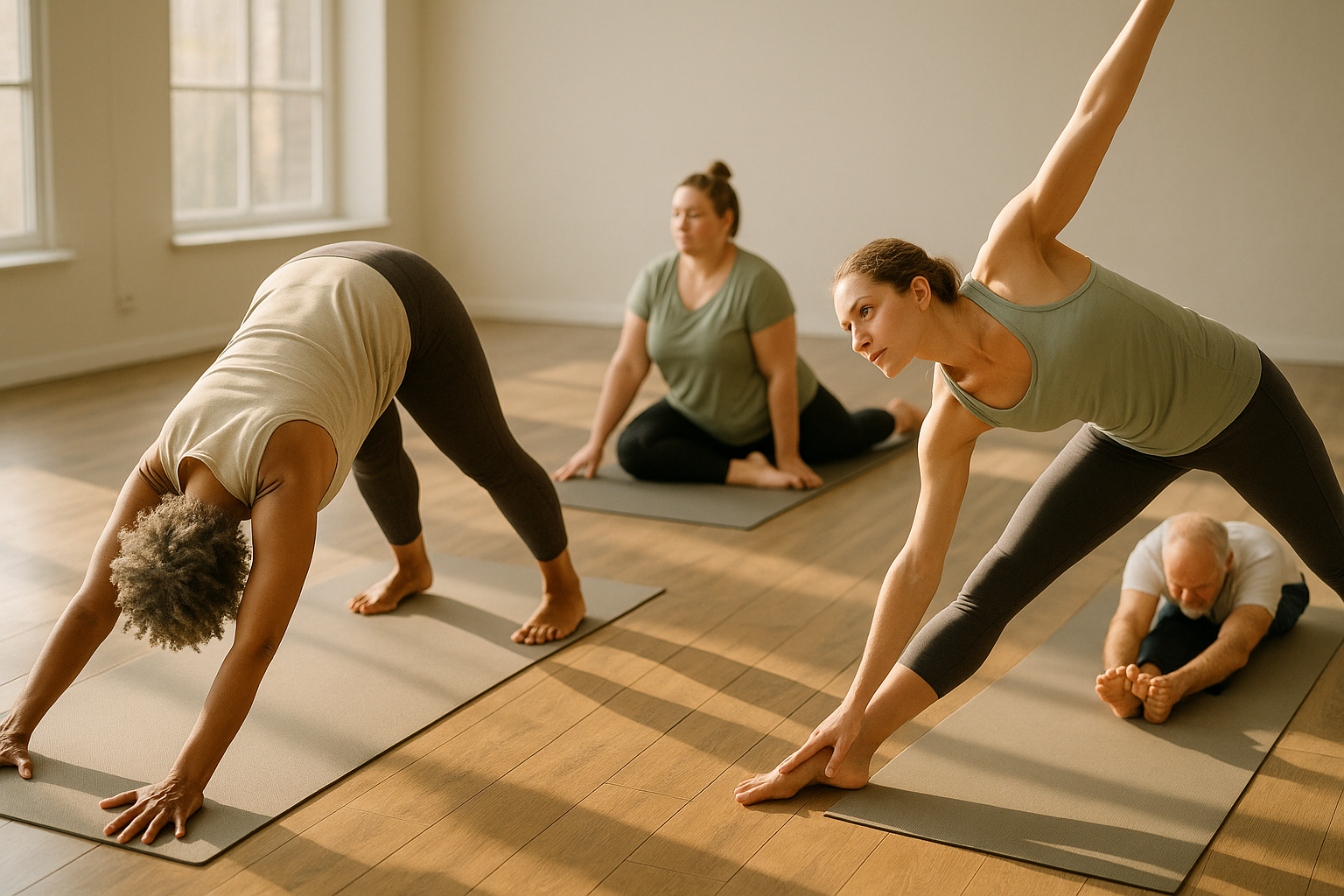
Flexibility isn’t about forcing your body into extreme shapes—it’s about building comfortable, sustainable range of motion you can actually use in daily life. If you’re new to stretching or returning after a break, yoga offers a structured, breath-led way to loosen tight hips and hamstrings, open the chest and shoulders, and relieve back tension. This guide walks you through 12 yoga poses to increase flexibility with step-by-step cues, hold times, and smart modifications, so you progress safely at your own pace. It’s designed for beginners and experienced movers alike who want practical guidance without the fluff. As with any movement practice, this article is educational, not medical advice—if you have pain, injuries, or recent surgery, consult a qualified professional first.
Quick answer: The best yoga poses to increase flexibility are Downward-Facing Dog, Low Lunge, Pigeon, Reclined Figure Four, Seated Forward Bend, Bound Angle, Triangle, Wide-Legged Forward Fold, Lizard, Puppy Pose, Pyramid, and Garland. Start with 15–30 seconds per hold, repeat 2–4 times, 2–3 days per week, and breathe slowly through your nose.
Fast-start protocol (3–6 minutes):
- Warm up with 30–60 seconds of easy Cat–Cow and gentle hip circles.
- Pick 4–6 poses from the list below that target your tightest areas.
- Hold each 15–30 seconds (or 3–5 slow breaths), repeat 2–3 rounds.
- Keep effort at 4–6/10—mild stretch, no sharp pain or numbness.
- Finish with one minute of relaxed breathing lying on your back.
1. Downward-Facing Dog (Adho Mukha Svanasana)
Downward-Facing Dog is a full-body posterior-chain stretch that lengthens calves, hamstrings, and the entire back line while decompressing the shoulders and upper back. It’s a top pick to increase flexibility because you can fine-tune intensity by bending the knees or elevating hands on blocks. Start in a tabletop, tuck your toes, and lift your hips to form an inverted “V.” Aim for a long spine first; heels can stay high and knees soft if hamstrings feel tight. This pose also builds light strength in the arms and core, which helps you control range over time, not just chase it. If wrists are sensitive, elevate palms on wedges or fold the mat edge to reduce extension.
1.1 How to do it
- From hands-and-knees, spread fingers wide, press evenly through palms.
- Exhale, lift knees, send hips up and back; keep neck long, gaze between feet.
- Bend knees as needed to lengthen spine; then slowly work heels toward floor.
- Wrap outer upper arms down to broaden shoulders; ribs draw gently in.
- Breathe 3–6 slow breaths, maintain a steady, moderate stretch.
1.2 Numbers & guardrails
- Hold 20–40 seconds; repeat 2–3 rounds.
- Intensity: 4–6/10 stretch sensation; no pinching at wrists or shoulders.
- Common tweaks: pedal the feet, bend one knee at a time, or place hands on blocks.
1.3 Common mistakes
- Collapsing shoulders toward ears—actively press the floor away.
- Forcing heels down at the expense of a rounded back—prioritize long spine.
- Locked elbows—maintain a micro-bend and external rotation.
Finish by lowering to Child’s Pose for a breath or two to reset before the next posture.
2. Low Lunge (Anjaneyasana)
Low Lunge directly targets hip flexors and quads of the back leg while opening the front of the body—key if you sit long hours. It’s excellent for restoring extension at the hip, which reduces strain on the lower back and helps your stride feel smoother in walking or running. From a kneeling lunge, keep your front knee stacked over ankle and gently shift the pelvis forward without overarching the lumbar spine. Reach arms overhead (optional) to add a gentle side-body and chest stretch. If your back knee is sensitive, pad it with a folded blanket or double your mat.
2.1 How to do it
- Step right foot forward, left knee on the mat behind hips.
- Tuck tail slightly and lift low belly; square hips forward.
- Ease pelvis forward until you feel a front-hip stretch (back leg).
- Option: reach arms up; add a side bend toward front knee.
- Breathe steadily 3–6 breaths, then switch sides.
2.2 Numbers & guardrails
- Hold 20–45 seconds per side, 2–3 rounds.
- Keep ribcage stacked over pelvis; avoid dumping into low back.
- Intensify by tucking back toes or elevating hands on blocks to lengthen spine.
2.3 Common mistakes
- Lunging past a stacked front knee—keep knee above (or slightly behind) ankle.
- Overarching lower back—instead, lightly tuck tail and engage glutes.
- Collapsing chest—keep sternum lifted without flaring ribs.
Conclude by stepping back to a brief Downward Dog or a tall kneel to neutralize.
3. Pigeon Pose (Eka Pada Rajakapotasana, prep)
Pigeon targets the outer hip and deep glute muscles of the front leg while lengthening hip flexors of the back leg. It’s a favorite for improving hip rotation and easing tension that can contribute to low-back tightness. Start with a gentle setup: shin at an angle (not necessarily parallel to the mat edge) and hips supported by a folded blanket or block. Keep the pelvis level—if the front hip hovers high, prop underneath. Fold forward onto forearms for a milder stretch; stay upright for more intensity. If your knees protest, skip this and try Reclined Figure Four instead.
3.1 How to do it
- From Downward Dog, bring right knee toward right wrist; place shin diagonally.
- Extend left leg back, toes down, hips square; prop front hip if it lifts.
- Inhale to lengthen spine, exhale to fold or remain upright as preferred.
- Keep front foot relaxed; monitor knee comfort at all times.
- Breathe 4–8 slow breaths, then switch sides.
3.2 Numbers & guardrails
- Hold 30–60 seconds per side, up to 2 rounds.
- Sensation should be in the hip, not the knee; back off if you feel knee strain.
- If hips are tight, stack blankets under the front hip for better alignment.
3.3 Common mistakes
- Forcing shin parallel—angle it to respect your hip anatomy.
- Tilting heavily to one side—use props to level the pelvis.
- Holding breath—smooth nasal breathing helps muscles release.
After Pigeon, briefly lie on your back or do a gentle hip bridge to balance the front-body opening.
4. Reclined Figure Four (Supta Kapotasana variation)
Reclined Figure Four delivers a knee-friendlier route to the same outer-hip stretch as Pigeon, with the added benefit of relaxing the lower back. Lying down also reduces the temptation to “muscle through,” making it ideal at the end of a long day. You’ll cross one ankle over the opposite thigh and pull the legs in like a seated stretch—but gravity does more of the work. It’s simple to scale with a strap behind the thigh or by moving closer/farther from the chest.
4.1 How to do it
- Lie on your back, knees bent. Cross right ankle over left thigh.
- Thread hands behind left hamstring (or shins if knees are happy).
- Flex right foot lightly; draw legs toward chest while keeping sacrum heavy.
- Keep shoulders relaxed and jaw soft; breathe slowly.
- Hold, then switch sides.
4.2 Numbers & guardrails
- Hold 30–60 seconds per side; 2–3 rounds if you’re especially tight.
- If neck strains, place a folded blanket under head.
- If knee feels stressed, back off and hold behind the hamstring, not the shin.
4.3 Mini-checklist
- Tailbone heavy, low back neutral on the mat.
- Foot of crossed leg gently flexed to protect the knee.
- Sensation localized to the outer hip and glutes.
Release both feet to the floor and windshield-wiper the knees to clear residual tension.
5. Seated Forward Bend (Paschimottanasana)
Seated Forward Bend lengthens the hamstrings and the entire back line from calves to spine. It’s especially helpful for people who feel “pulled” in the low back during daily activities. The key is to hinge from the hips rather than rounding aggressively. If your hamstrings are tight, sit on a folded blanket, bend your knees, and use a strap around the feet to keep the spine long. Over time, gradually straighten the knees while maintaining comfortable breath and a neutralish back.
5.1 How to do it
- Sit tall with legs extended; sit on a blanket for lift.
- Loop a strap around the feet; inhale to lengthen the spine.
- Exhale, hinge at hips; keep chest broad and collarbones wide.
- Rest hands on shins, strap, or feet—wherever you can keep length.
- Breathe 4–8 slow breaths, easing slightly deeper on exhales.
5.2 Numbers & guardrails
- Hold 20–45 seconds; 2–3 rounds.
- Bend knees as needed to avoid pulling at the low back.
- If you feel nerve-like zings, ease off immediately and reduce the angle.
5.3 Common mistakes
- Yanking on the feet—use a strap to avoid shoulder and back strain.
- Rounding hard through the mid-back—prioritize a long spine first.
- Locking knees—maintain a gentle micro-bend.
Finish by sitting upright, taking a few shoulder rolls to rebalance the spine.
6. Bound Angle (Baddha Konasana)
Bound Angle opens the groin and inner thighs (adductors) while giving the lower back a gentle release. It’s great for countering deskbound stiffness and improving hip external rotation for squats and daily movements. The shape is simple—soles of the feet together, knees out—but setup matters: sit on a blanket to tilt pelvis forward, and bring heels closer to the body for a stronger stretch or farther away for milder sensation. You can fold forward for more intensity, but keep the spine long.
6.1 How to do it
- Sit tall, bring soles together, knees widen apart.
- Hold ankles or shins; lengthen through crown of head.
- Option to hinge forward while keeping chest open.
- Support knees with blocks if the stretch is sharp.
- Breathe evenly 4–8 breaths.
6.2 Numbers & guardrails
- Hold 30–60 seconds; 2 rounds.
- Adjust heel distance to dial intensity.
- If knees feel pressured, elevate hips higher or place blocks under thighs.
6.3 Mini-checklist
- Pelvis tipped slightly forward.
- Chest broad, shoulders easy.
- Stretch felt along inner thighs, not in the knees.
Close the pose by bringing knees together with your hands and briefly hugging them to the chest.
7. Triangle Pose (Trikonasana)
Triangle is a standing hamstring and adductor stretch that also opens the side body and chest. It’s a smart choice for building flexibility with control because your legs stay active while you lengthen. Set up with a long stance, front toes forward, back foot angled slightly in. Hinge at the front hip and place your hand on a block or shin—avoid collapsing onto the knee. Rotating the chest open creates a gentle shoulder and thoracic spine opener without overreaching.
7.1 How to do it
- Step feet wide; turn right toes forward, left toes slightly in.
- Inhale, reach arms out; exhale, hinge over the right hip.
- Place right hand on block/shin; left arm stacks over shoulder.
- Spin chest open; keep both legs strong and long.
- Breathe 3–6 steady breaths; switch sides.
7.2 Numbers & guardrails
- Hold 20–40 seconds per side; 2 rounds.
- If hamstrings are tight, shorten stance and use a high block.
- Keep a micro-bend in the front knee to avoid locking.
7.3 Common mistakes
- Reaching for the floor at the expense of spinal length—use props.
- Collapsing chest down—rotate open from mid-back.
- Hyperextending front knee—keep it soft and aligned.
Stand tall and shake out the legs, noticing the difference side to side.
8. Wide-Legged Forward Fold (Prasarita Padottanasana)
This pose lengthens the inner thighs, hamstrings, and calves while gently decompressing the spine. Because your feet are wide, many people can fold more comfortably without tugging on the lower back. Begin with hands on blocks beneath shoulders and let the spine grow long before softening the elbows. Variations include a half-lift for back length, hands to ankles for intensity, or a shoulder stretch by clasping the hands behind you. Avoid dumping weight into the heels; stay centered.
8.1 How to do it
- Step feet wide (about 1–1.25 leg lengths), toes parallel.
- Inhale, lengthen spine; exhale, hinge forward from hips.
- Place hands under shoulders on blocks or floor.
- Option: interlace fingers behind back and reach knuckles up.
- Breathe 4–8 slow breaths.
8.2 Numbers & guardrails
- Hold 20–45 seconds; 2 rounds.
- Micro-bend the knees if hamstrings tug on the low back.
- If dizzy on standing, come up halfway first, then rise.
8.3 Mini-checklist
- Weight balanced across feet, not all in heels.
- Crown of head lengthens toward floor; spine stays long.
- Neck relaxed; jaw unclenched.
Exit by half-lifting with a flat back, then heel-toe feet in before standing.
9. Lizard Pose (Utthan Pristhasana)
Lizard offers a deep, targeted stretch for the hip flexors and inner thighs while also lengthening the hamstrings of the front leg. It’s a go-to for runners and anyone who sits a lot, as it restores front-hip extension and adductor mobility. Start in a low lunge with both hands inside the front foot. You can stay on palms, drop to forearms, or place the front foot slightly out and angle the toes for a different line of stretch. Use blocks liberally to make space for your torso.
9.1 How to do it
- From Low Lunge, step both hands inside the front foot.
- Scoot front foot slightly out; knee tracks over second toe.
- Stay on palms or lower forearms to blocks.
- Option: tuck back toes and lift back knee for intensity.
- Breathe 4–8 slow breaths; switch sides.
9.2 Numbers & guardrails
- Hold 30–60 seconds per side; 1–2 rounds.
- Keep the front knee aligned; avoid letting it collapse inward.
- If the low back pinches, lift the chest or reduce depth.
9.3 Common mistakes
- Sinking into the shoulders—press the floor away and broaden collarbones.
- Forcing back knee lift in early stages—build tolerance gradually.
- Turning the front foot too far out—track knee safely with the toe line.
After Lizard, a brief hamstring stretch (half-splits) helps balance sensations in the front leg.
10. Puppy Pose (Uttana Shishosana)
Puppy Pose is a shoulder and chest opener that bridges the gap between Child’s Pose and Downward Dog. It increases flexibility through the front of the shoulders (pecs and deltoids) while encouraging upper-back extension without compressing the lower spine. Knees stay under hips as you walk hands forward, letting the heart melt toward the mat. It’s especially effective if you work at a computer or do upper-body training that tightens the front chain.
10.1 How to do it
- From tabletop, keep hips over knees and walk hands forward.
- Lower forehead or chin to the mat (chin increases intensity).
- Spread fingers, press palms, and roll outer upper arms down.
- Soften ribs and breathe into the side body and back.
- Stay for 4–8 slow breaths.
10.2 Numbers & guardrails
- Hold 20–45 seconds; 2 rounds.
- If shoulders feel pinchy, widen hands or elevate them on blocks.
- Keep hips stacked above knees to avoid low-back compression.
10.3 Mini-checklist
- Neck neutral unless chin-down feels comfortable.
- Gentle engagement in low belly to support the spine.
- Sensation across chest and lats, not sharp in the shoulders.
Return to tabletop and cycle once through Cat–Cow to re-center.
11. Pyramid Pose (Parsvottanasana)
Pyramid provides a precise stretch for the hamstrings and calves of the front leg while training hip alignment and spinal length. It’s a strong but controllable forward fold: a shorter stance than Triangle, both hips square forward, and hands supported on blocks for spinal integrity. If your hamstrings are tight, keep a generous front-knee bend and hinge only to the point where the back stays long.
11.1 How to do it
- Step into a short stance: front toes forward, back heel down, toes slightly in.
- Square hips; inhale to lengthen spine, hands on blocks by front foot.
- Exhale, hinge forward over front leg, chest open.
- Keep micro-bend in front knee; press back heel firmly down.
- Breathe 4–8 slow breaths; switch sides.
11.2 Numbers & guardrails
- Hold 20–40 seconds per side; 2 rounds.
- Use two blocks at their highest setting to maintain length.
- If the low back rounds, shorten stance or bend the front knee more.
11.3 Common mistakes
- Over-striding and losing alignment—shorten stance.
- Collapsing chest—keep sternum moving forward.
- Rolling onto the outer edge of the back foot—root the inner heel.
Reset in Mountain Pose between sides to notice the length through the back of the legs.
12. Garland Pose (Malasana)
Garland is a deep squat that improves ankle dorsiflexion, calf length, groin openness, and hip external rotation—all vital for functional flexibility in daily life. Many adults lose access to this range due to prolonged sitting and stiff footwear; Malasana helps reclaim it. Start with heels elevated on a rolled towel or wedges and sit your hips between your heels, not behind. Elbows press into inner knees to create space; the spine stays long rather than rounding forward.
12.1 How to do it
- Stand feet slightly wider than hips, toes turned out 10–30°.
- Bend knees and sink hips between heels; hands at heart, elbows to inner knees.
- Lift chest; lengthen spine; keep heels grounded (elevate if needed).
- Relax jaw and breathe into the back body.
- Hold, then rise slowly.
12.2 Numbers & guardrails
- Hold 20–45 seconds; 2 rounds.
- If heels lift, elevate them on a towel; if hips pinch, widen stance.
- Avoid collapsing arches—press through big-toe mounds and heels.
12.3 Mini-checklist
- Knees track over toes, not collapsing inward.
- Pelvis heavy but chest lifted.
- Breath slow; face relaxed.
Stand up with support, shake out the legs, and finish with a gentle forward fold to balance the squat.
FAQs
1) How often should I do yoga poses to increase flexibility?
Most people progress with 2–3 sessions per week, 10–20 minutes each. Hold each pose 15–30 seconds, repeating 2–4 times. Consistency matters more than intensity: a mild, regular stretch beats one hard session. If you sit a lot, add micro-sessions (1–3 poses) during the day for extra gains.
2) How long should I hold each stretch?
A practical starting point is 15–30 seconds per hold for beginners and up to 30–60 seconds as tolerance builds. Repeat 2–4 times. Use a 4–6/10 effort scale—slight to moderate stretch. You should be able to breathe slowly through your nose and speak a sentence without strain.
3) Is it better to stretch before or after workouts?
Before training, prioritize dynamic, movement-based prep (leg swings, lunges, shoulder circles). Save longer static holds for after exercise or separate sessions, when tissues are warm. If you need to open a specific range pre-workout, use brief holds (10–20 seconds) and then reinforce with light strength through that range.
4) I’m very tight—where should I start?
Pick 3–4 foundational shapes (Downward Dog, Low Lunge, Reclined Figure Four, Bound Angle) and practice them three times weekly. Use props—blocks, strap, blankets—to find a sustainable stretch. Track progress with simple checks (e.g., heel distance from floor in Down Dog or seat height in Garland).
5) What if I feel pain or tingling?
Sharp pain, joint pinching, or nerve-like tingling means the stretch is too intense or misdirected. Back off immediately, adjust alignment, and use more support. Sensation should be muscular and broad, not focal in a joint. Persistent symptoms warrant evaluation by a qualified clinician.
6) Do I need to be warm to stretch?
Warm tissues lengthen more comfortably. Spend 2–3 minutes with light movements (marching in place, Cat–Cow, shoulder rolls) before holding stretches. After a hot shower or a walk is also a great time to practice—your body will accept range with less resistance.
7) Can yoga improve posture as well as flexibility?
Yes—many poses here lengthen tight tissues while encouraging active alignment (e.g., Triangle and Puppy open the chest; Low Lunge restores hip extension). Pair stretching with gentle strength (glutes, mid-back, deep core) to help your new range “stick” in posture and movement.
8) Is it safe to stretch every day?
Light daily mobility is fine, and many people benefit from brief, frequent sessions. For deeper holds, alternate focus areas and respect recovery, especially if you also strength train. If soreness lingers, reduce duration or frequency and keep your effort at a conversational intensity.
9) Which props should beginners buy first?
Two foam blocks and a simple yoga strap (or long towel) cover most needs. A folded blanket protects knees and assists seated folds. Props don’t make the practice “easier”; they make it doable and more anatomically friendly, accelerating progress.
10) How long until I notice results?
With consistent practice (2–3 times weekly), many notice improvements in 2–4 weeks—easier squats, less back tightness, or heels closer to the floor in Down Dog. Bigger changes can take a few months. Celebrate small wins and focus on smooth breath and repeatable setups.
Conclusion
Flexibility grows from small, repeatable wins—clean setups, gentle holds, and steady breathing—not from forcing bigger ranges. The 12 yoga poses to increase flexibility you learned here cover every major area: hips (outer and inner), hamstrings and calves, chest and shoulders, and the spine. Use the quick-start protocol when time is short, and on days when you want more, layer 2–4 rounds per pose with generous props. Prioritize sensation quality over depth, and you’ll notice range that not only feels better in class but also shows up in everyday life—walking, sitting, lifting, and playing. Pair these stretches with light strength work in your new ranges, and your gains will be both faster and more durable.
Ready to begin? Pick three poses, set a 6-minute timer, and start breathing.
References
- Yoga: In Depth. National Center for Complementary and Integrative Health (NCCIH), 2022. https://www.nccih.nih.gov/health/yoga-in-depth
- ACSM Position Stand: Quantity and Quality of Exercise for Developing and Maintaining Musculoskeletal Fitness. American College of Sports Medicine, 2011. https://doi.org/10.1249/MSS.0b013e318223df97
- Stretching: Focus on Flexibility. Harvard Health Publishing, n.d. https://www.health.harvard.edu/staying-healthy/stretching-focus-on-flexibility
- Stretching 101: Benefits, How to Stretch. Cleveland Clinic, 2021. https://health.clevelandclinic.org/how-to-stretch
- Flexibility Training Guidelines. ACE (American Council on Exercise), n.d. https://www.acefitness.org/education-and-resources/lifestyle/blog/
- Yoga for Health. NHS (UK), 2019. https://www.nhs.uk/live-well/exercise/guide-to-yoga/
- Downward-Facing Dog Pose. Yoga Journal, n.d. https://www.yogajournal.com/poses/downward-facing-dog/
- Hip Flexors: Why They Matter & How to Stretch. HSS (Hospital for Special Surgery), 2020. https://www.hss.edu/article_hip-flexor-stretches.asp