

























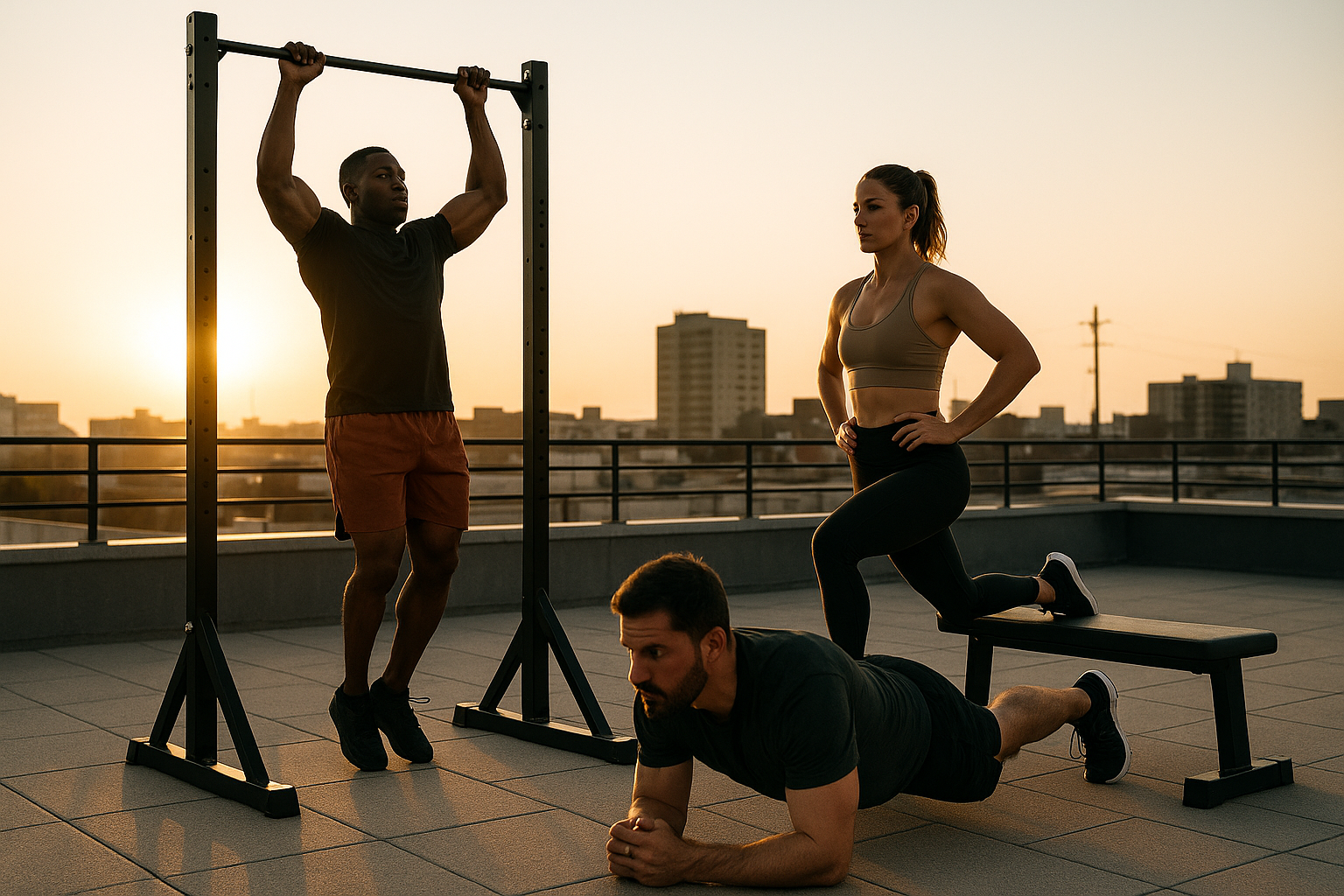
If you want stronger legs, a sturdier core, and real-world upper-body power—without a single dumbbell—these ten movements will deliver. Below you’ll find exactly how to do each exercise, the cues that keep you safe, and the progressions that keep you gaining. This guide is for anyone who wants efficient, equipment-light training at home, while traveling, or between gym days. Quick answer: the top bodyweight moves for strength are the push-up, pull-up, Bulgarian split squat, pistol squat, dip, inverted row, pike push-up (toward handstand push-ups), single-leg Romanian deadlift, single-leg glute bridge/hip thrust, and the RKC plank. As always, this is educational information—not medical advice. If you have pain, significant injury history, or medical conditions, consult a qualified professional before you begin.
1. Push-Up
The push-up is the most scalable bodyweight press for chest, shoulders, and triceps, and it trains your trunk to stay rigid under load. Start here if you want pressing strength that carries into everyday life and sport. The direct goal is simple: keep a straight line from heels to head, lower under control until your chest is within a fist of the floor (or touches a target), and press back up without losing alignment. For strength, work in lower-to-moderate reps near technical failure, then progress the lever (elevation, tempo, deficit, or foot-elevated) as it becomes easy. Because the push-up tolerates frequent practice, you can train it multiple times per week while rotating variations to avoid elbow or shoulder irritation. Expect steady improvements in rep quality, pressing power, and shoulder stability when you treat the setup and tempo as seriously as the effort.
1.1 How to do it (key cues)
- Hands under or slightly outside shoulders; index fingers pointing forward; forearms vertical at the bottom.
- Brace ribs down, glutes tight; imagine “screwing” hands into the floor to create shoulder stability.
- Lower for ~3 seconds, elbows ~30–45° from the torso; chest moves between the hands.
- Touch chest to a consistent target; no head pecking or hips sagging.
- Press through the whole hand, finishing with locked elbows and a long neck.
1.2 Numbers & guardrails
- Sets/Reps: 3–5 × 5–10 at RPE 7–9 (stop 0–2 reps shy of true failure).
- Tempo/Rest: 3–1–1 tempo; 90–150 seconds between sets.
- Progressions: hands-elevated → floor → deficit (push-up handles/hex dumbbells) → feet-elevated → ring/unstable or tempo pauses.
- Regressions: higher hand elevation, shortened ROM with a consistent target, or eccentric-only reps.
1.3 Common mistakes
- Flaring elbows to 90°; shrugging toward ears; collapsing hips; bouncing off the floor; rushing the eccentric.
Mini-case: If you can do 3×12 floor push-ups with perfect form across two sessions, move to 3×8 foot-elevated at ~30 cm next week. Strength rises when the variation difficulty rises slightly while technique stays crisp.
Bottom line: Lock in body alignment, standardize depth, and progress the lever arm. Push-ups build pressing strength that transfers broadly.
2. Pull-Up
For upper-back and arm strength, few moves compete with the pull-up. It drives lat, lower-trap, and biceps development while building grip strength and shoulder resilience. Your aim is to move your body as a single unit from a dead hang to a chest-proud top position with the chin clearly over the bar—no hip kicking, no half reps. Because true bodyweight pulling is demanding, use smart progressions to live in a strength rep range rather than flailing at failure. Trained 2–3 times per week with adequate rest, the pull-up will steadily improve posture, climbing capacity, and overall upper-body power—with minimal equipment.
2.1 How to do it (key cues)
- Begin from a dead hang, hands just outside shoulder width; ribcage stacked; legs long.
- Initiate with a “shoulders down and back” set (scapular depression), then pull elbows toward ribs.
- Keep ribs down—no excessive arching; think “chest to bar.”
- Control the descent for ~3 seconds back to a quiet dead hang.
2.2 Numbers & guardrails
- Sets/Reps: 4–6 × 2–6 (or clusters of singles) at RPE 7–9; 2–3 minutes rest.
- Progressions: band-assisted → leg-assisted on a box → controlled eccentrics (3–5 seconds down) → full reps → chest-to-bar → archer/towel grips → weighted.
- Grip Options: overhand (pull-up), underhand (chin-up), neutral; rotate grips to manage elbow comfort.
- If no bar: sturdy doorframe bar, playground bars, or rings set high; prioritize safety and stability.
2.3 Common mistakes
- Half reps without full hang; kipping when strength is the goal; neck jutting to “reach” the bar; letting shoulders ride up to ears at the top.
Mini-case: Can’t get a single? Do 6–8 sets of 1 eccentric (3–5 seconds down) after a jump to the top, plus 3×6–10 band-assisted reps. When you can do 3×6 quality assisted reps and 6 clean eccentrics, test a strict single.
Bottom line: Earn clean, full-range pulls with stable shoulders and progressive assistance. Your back and grip will respond quickly.
3. Bulgarian Split Squat (Rear-Foot-Elevated)
The Bulgarian split squat is a unilateral leg powerhouse that challenges quads, glutes, and balance with a long strength range of motion. Elevating the rear foot increases the front-leg demand without needing external load, and the split stance spares your lower back while building athletic stability. The key is to keep your front foot far enough forward to allow the back knee to drop straight down, chest proud, and shin roughly vertical at the bottom. Because it’s self-limiting, it’s safer to push hard here than in many bilateral moves when training at home. Mastering this pattern pays off in stair-climbing, running economy, and knee comfort.
3.1 How to do it (key cues)
- Set rear foot on a bench/sofa (~30–45 cm) with laces down; front foot forward enough to sink straight down.
- Descend for ~3 seconds until front thigh is at or just below parallel; keep torso slightly forward but neutral.
- Drive through the whole front foot; finish tall with hips under ribs.
- Keep the front knee tracking over the middle toes—no wobbling inside.
3.2 Numbers & guardrails
- Sets/Reps: 3–5 × 6–10 per leg at RPE 7–9; 90–150 seconds rest between legs.
- Progressions: increase ROM (deficit front foot), slow eccentrics/pauses, front-foot elevation, load with backpack or water jugs if available.
- Regressions: lower rear-foot height, shorter ROM to a box, supported balance with fingertips on a wall.
3.3 Common mistakes
- Front foot too close (knee jams forward); collapsing torso; bouncing the back knee off the floor; rushing reps.
Mini-case: Week 1—3×8 per leg to a consistent knee hover. Week 2—3×8 with a 2-second pause at the bottom. Week 3—4×6 with a slight deficit under the front foot. Controlled ROM progression = strength progression.
Bottom line: A deep, controlled split squat is your at-home leg press—stable, strong, and joint-friendly.
4. Pistol Squat (Single-Leg Squat)
The pistol squat is the apex bodyweight knee-dominant leg builder, delivering high force through a long range on one leg. It demands ankle mobility, quad strength, hip control, and balance. For strength seekers, the pistol is a long-term project worth pursuing because it lets you apply heavy mechanical tension with zero equipment. The first milestone isn’t a full rep; it’s a controlled single-leg box squat to a consistent height. From there, gradually lower the target and add pauses. This approach safeguards knees and builds real stability rather than chasing a shaky first rep.
4.1 How to do it (key cues)
- Stand tall on one foot; reach the other leg and both arms forward for counterbalance.
- Sit the hips back slightly, then down; keep the working knee tracking over mid-foot.
- Touch a box/bench lightly (or hover), then stand by pushing the floor away.
- Maintain a neutral spine; avoid collapsing into the bottom position.
4.2 Numbers & guardrails
- Sets/Reps: 3–5 × 3–6 per leg (box/target height that keeps form pristine); 90–150 seconds rest.
- Progressions: box height lower → add a 2–3 s eccentric → bottom pauses → full pistol → tempo pistols or deficit.
- Regressions: hold a counterweight (plate or heavy book), use a TRX/door strap, or partial ROM to a higher box.
4.3 Common mistakes
- Letting the knee cave; rounding the back to “dive” into depth; bouncing out of the bottom; chasing ROM at the expense of control.
Numeric example: If your best controlled height is 45 cm, program 4×5/leg there in Week 1. Each week, drop 2–5 cm or add a 2-second pause. When you own 4×4 below 30 cm, test a single full pistol.
Bottom line: Progress depth slowly, prioritize knee tracking and balance, and the pistol becomes a potent one-leg strength tool.
5. Dip
Dips are the bodyweight equivalent of a heavy parallel-bar press, lighting up chest (sternal fibers), triceps, and anterior delts. They’re also a shoulder stability test—great for strength but unforgiving of sloppy depth. Your goal is to descend with elbows tracking back (not flared), shoulders depressed, and forearms near vertical, then press to locked elbows without shrugging. Because leverage is tough at the bottom, build tolerance with partials and isometrics before chasing deep ROM. Done well, dips translate to stronger pressing, improved lockout, and a thicker upper body.
5.1 How to do it (key cues)
- Use stable parallel bars, rings (harder), or two sturdy surfaces at hip width.
- Start with shoulders down and chest slightly forward; legs tucked behind to keep balance.
- Lower for ~3 seconds until shoulders are just below elbow height only if shoulders stay packed.
- Press back up by driving elbows toward extension and re-depressing the shoulders at the top.
5.2 Numbers & guardrails
- Sets/Reps: 4–6 × 3–8 at RPE 7–9; 2–3 minutes rest.
- Progressions: assisted with band/feet → partial ROM → full reps → slow eccentrics → ring dips → weighted.
- Regressions: bench dips with feet on floor (mind shoulder comfort), isometric top-holds, or eccentric-only.
5.3 Common mistakes
- Flaring elbows; sinking into the shoulders at the bottom; bouncing; rushing the eccentric; excessive forward head posture.
Mini-case: Alternate two sessions weekly: Session A—4×5 assisted full ROM. Session B—6×3 unassisted partials to a fixed depth stop. Retest full ROM in Week 4; the combined exposure typically boosts clean reps.
Bottom line: Respect shoulder position and depth. Build strength with controlled ROM and the dip becomes a premier upper-body press.
6. Inverted Row (Bodyweight Row)
The inverted row is a horizontal pull that balances pressing volume and strengthens mid-back, rear delts, and grip—without the barrier to entry of pull-ups. With feet on the floor and a bar or rings at waist height, you can immediately dial difficulty by changing body angle or foot elevation. Because the trunk must stay rigid, it doubles as anti-extension core training. Rows done through a consistent touch point (bar to lower chest) with a controlled tempo build scapular control and shoulder health that carry into pull-ups and daily posture.
6.1 How to do it (key cues)
- Set a bar in a squat rack/smith at waist height or use rings; lie under it, hands just outside shoulder width.
- Squeeze glutes, brace, and keep a straight line from heels to head.
- Pull elbows to ribs; touch the bar/rings to the lower chest; pause briefly; lower under control.
6.2 Numbers & guardrails
- Sets/Reps: 3–5 × 6–12 at RPE 7–9; 90–150 seconds rest.
- Progressions: lower bar (steeper angle), feet-elevated, slow eccentrics, pause reps, rings (more stability demand).
- Regressions: raise bar (more upright), bend knees with feet flat, partial ROM with a fixed target.
6.3 Common mistakes
- Sagging hips; shrugging; pulling to the neck; letting wrists collapse; bouncing off the bottom.
Numeric example: Start at a 45° body angle for 3×10. Each week, move the feet 5–10 cm forward (flatter) or elevate heels on a box. When you can do 3×12 flat-body rows, try 3×8 feet-elevated.
Bottom line: Standardize body line and touch point. Small lever changes create big strength gains.
7. Pike Push-Up → Toward Handstand Push-Up
Pike push-ups bridge the gap between horizontal pressing and vertical pressing, targeting anterior delts and triceps with significant core demand. They’re the safest way to begin building toward handstand push-ups at home. The immediate goal is a hips-high, head-to-triangle pressing pattern: crown of the head moves to a spot slightly in front of the hands, then back up by driving through the palms and elevating the shoulders. Because leverage changes dramatically with hip height and foot elevation, you can finely tune difficulty to live in strength ranges without compromising scapular mechanics.
7.1 How to do it (key cues)
- From a downward-dog-like setup, hands shoulder-width, hips stacked over shoulders as much as mobility allows.
- Descend in a vertical line—think “head to the floor slightly ahead of the hands,” elbows tucked ~45°.
- Press by pushing the floor away and finishing with active shoulder elevation.
- Progress to feet on a box for a steeper angle; keep ribs down to avoid over-arching.
7.2 Numbers & guardrails
- Sets/Reps: 4–6 × 3–8 at RPE 7–9; 2 minutes rest.
- Progressions: floor pike → feet-elevated pike → wall-assisted negatives → partial-ROM handstand push-ups → full handstand push-ups.
- Regressions: higher hand targets (yoga blocks), smaller range, or hands-elevated.
7.3 Common mistakes
- Turning it into a horizontal push-up; flared elbows; collapsing the midline; craning the neck to reach the floor.
Mini-case: When 5×5 feet-elevated pike push-ups are smooth, add 2–3 controlled wall-assisted negatives (3–5 s down) at the end of sessions. Within a training block, those negatives usually unlock your first partial-ROM handstand push-ups.
Bottom line: Use pike variations to own the vertical pressing pattern. Build angle and time-under-tension before depth.
8. Single-Leg Romanian Deadlift (Bodyweight Hinge)
Hinging on one leg builds hamstrings, glutes, and intrinsic foot strength while teaching the hip-dominant pattern that protects your back. The single-leg RDL is a pure strength move when you slow it down and reach long through the back leg. It rewards patience: the goal is to keep hips level, shin vertical, and spine long as you hinge until you feel a deep hamstring stretch, then stand by pushing the floor away. Because balance is part of the load, even bodyweight reps near the end of a set feel heavy. Expect improvements in sprint mechanics, knee robustness, and hip stability.
8.1 How to do it (key cues)
- Stand tall; soften the working knee; hinge by sending the hips back as the torso tips forward.
- Reach the non-working leg long behind you, heel heavy; keep hips square to the floor.
- Stop when your torso and back leg form a straight line; return by driving the big toe and heel through the floor.
8.2 Numbers & guardrails
- Sets/Reps: 3–5 × 6–10 per leg at RPE 7–9; ~90 seconds rest.
- Progressions: longer pauses at end range, slower eccentrics, eyes closed (advanced), or load with a backpack if available.
- Regressions: light fingertip support on a wall or dowel, shorter ROM.
8.3 Common mistakes
- Opening the hip; rounding the back; bending the working knee too much (turning it into a squat); rushing the bottom.
Numeric example: Program 4×8/leg at a 3–2–1 tempo (3 s down, 2 s pause, 1 s up). When you can hold positions without wobbling, add range or a light external load.
Bottom line: Square hips, slow tempo, and consistent depth make the single-leg hinge a potent posterior-chain builder.
9. Single-Leg Glute Bridge / Hip Thrust
For pure hip extension strength without equipment, the single-leg bridge or hip thrust is unrivaled. It targets glute max through a long lever while teaching pelvic control. Your aim is to finish each rep with a straight line from shoulder to knee, pelvis level, and ribs stacked—not flared. The unilateral setup limits compensation and loads the working side significantly even at moderate reps. When hamstrings cramp, it’s a sign to adjust foot position (closer to the glutes) and emphasize a posterior pelvic tilt.
9.1 How to do it (key cues)
- Lie supine, one foot planted ~30–45 cm from the glutes; other leg extended in line with thigh.
- Posteriorly tilt the pelvis (flatten low back to the floor), then drive through the heel to lift hips.
- Lock out with glutes, not lumbar arch; pause for 1–2 seconds; lower under control.
9.2 Numbers & guardrails
- Sets/Reps: 3–5 × 8–15 per side at RPE 7–9; ~60–90 seconds rest.
- Progressions: feet-elevated on a step, longer top pauses, deficit shoulders on a bench/sofa (hip thrust), tempo reps.
- Regressions: two-leg bridges, shorter ROM, or isometric holds.
9.3 Common mistakes
- Driving with the low back; letting the pelvis rotate; foot too far (hamstring-dominant); dropping the hips at lockout.
Mini-case: Build to 3×12 single-leg hip thrusts with a 2-second squeeze. When you own that, elevate the shoulders on a bench and work 4×8 with a 3-second pause to increase peak tension.
Bottom line: Control the pelvis, feel the glutes, pause at the top. Unilateral bridges are simple, scalable strength work.
10. RKC Plank (Hardstyle Plank)
The RKC plank is a high-tension anti-extension drill that builds “true core” strength for squats, hinges, presses, and pulls. Unlike casual planks, this version uses short, high-effort sets where you create total-body irradiation—crushing the floor with forearms, squeezing glutes, and pulling elbows toward toes. The objective is a straight line from head to heels with a slight posterior pelvic tilt and a strong exhale to lock the ribcage down. Treat each set like a max-effort isometric rep rather than a passive hold. Within weeks, you’ll notice better spinal stiffness under load and improved transfer to other lifts.
10.1 How to do it (key cues)
- Forearms on the floor, elbows under shoulders, fists together; feet hip-width.
- Tuck pelvis slightly; squeeze glutes and quads; press the ground away.
- Strong exhale through pursed lips; hold 10–20 seconds at very high tension; breathe shallow without losing position.
10.2 Numbers & guardrails
- Sets/Time: 6–10 × 10–20-second “hardstyle” holds; 30–45 seconds rest.
- Progressions: longer holds up to 30 seconds, feet closer, arms on a deficit, or contralateral reach variations.
- Regressions: high-plank on hands, incline forearm plank, or shorter holds.
10.3 Common mistakes
- Letting the low back sag; holding too long at low tension; shrugging shoulders; losing the posterior pelvic tilt.
Numeric example: Week 1—8×15 s @ RPE 8. Week 2—10×15 s with a 3-second exhale on each rep. Week 3—8×20 s. Keep tension the priority; time is secondary.
Bottom line: Make each second count. High-tension planks build the core stiffness your big lifts demand.
FAQs
1) How many days per week should I train these moves?
Most people progress on 2–4 days per week, dividing sessions into push/pull/legs/core emphases or full-body days. Leave at least 48 hours between hard sessions for the same muscle group. If you’re new, start with two full-body days and add a third once soreness and technique are manageable.
2) What rep ranges build strength with bodyweight?
Strength comes from lower-to-moderate reps performed near technical failure with full control. For upper-body moves, think 3–8 reps; for legs and glutes, 5–12 reps often work well. If you exceed the top of the range easily, progress the variation (harder leverage, deficit, pauses) instead of inflating reps indefinitely.
3) How do I apply progressive overload without weights?
Use lever changes (elevation/deficit), range of motion, tempo (slow eccentrics/pauses), density (more quality sets), and assistance scaling (bands/holds). Only increase one variable at a time and keep form constant. A simple rule: when you can hit the top of your rep range across all sets twice, move to a slightly harder variation next session.
4) Can I build serious muscle with bodyweight alone?
Yes—if you train hard, close to failure, with adequate volume and recovery. Multi-joint moves like push-ups, pull-ups, dips, rows, and split squats supply sufficient mechanical tension when progressed. Eat enough protein (roughly 1.6–2.2 g/kg/day) and calories to support growth, and sleep 7–9 hours for recovery.
5) What if my wrists or shoulders hurt on push-ups/dips?
First, reduce range and slow the tempo; elevate hands for push-ups and use parallel bars for neutral wrist alignment. Strengthen the pattern with isometrics (top-holds) and scapular control drills. Persistent joint pain warrants an assessment from a qualified clinician; don’t “push through” sharp or worsening pain.
6) I can’t do a full pull-up—what’s the fastest route?
Train the pattern 3 times/week with a blend of band-assisted reps, controlled eccentrics (3–5 s), and isometrics. Sprinkle in inverted rows for volume. Track total weekly “hard reps” and gradually increase. Most lifters earn a strict single sooner by practicing singles and eccentrics rather than grinding high-rep band sets alone.
7) How long should I rest between sets for strength?
For compound upper-body moves like pull-ups and dips, rest 2–3 minutes. For push-ups, rows, and planks, 1.5–2 minutes usually works. For unilateral legs, rest ~90–150 seconds per side. Longer rest supports higher force output and better technique on the next set.
8) Where do core exercises fit in?
Place the RKC plank at the end of sessions or between upper-body sets if it doesn’t sap performance. Its high tension complements heavy work but can fatigue you if done first. Two to three focused core slots per week are plenty when the big lifts already challenge trunk stability.
9) Do I need a warm-up?
Yes, but keep it brief: 3–5 minutes of pulse raiser (skips or marching), then 1–2 ramp sets per exercise that rehearse the range you’ll use (e.g., hands-elevated push-ups before floor push-ups, box-assisted split squats before Bulgarian split squats). The best warm-up makes your first work set look like your last.
10) How should I organize a 30–40 minute session?
Use a push/pull superset (e.g., push-ups + rows), then a leg focus (Bulgarian split squats or pistols), then a vertical press/pull slot (pike push-ups or pull-ups), and finish with RKC planks. Cap accessory sets, honor rest times, and stop a rep or two shy of form breakdown.
11) What’s a good beginner progression path?
Start with hands-elevated push-ups, inverted rows (higher bar), split squats, two-leg bridges, and incline planks. Aim for 3×8–10 per movement. Each week, lower the hand or bar height slightly, add a 2-second pause, or extend the eccentric. When sets are crisp at the hardest regression, graduate to the next variation.
12) How soon should I expect results?
Technique and neural strength often improve within 2–3 weeks. Visible muscular changes typically show in 6–8 weeks with consistent training, adequate protein, and sleep. Progress rarely follows a straight line—track reps, ranges, and variations to see the overall upward trend.
Conclusion
You don’t need barbells to get seriously strong—you need clear standards, smart progressions, and consistent practice. The ten movements above cover every major pattern: horizontal and vertical push/pull, knee-dominant and hip-dominant legs, and high-tension trunk work. Start with variations that let you own full range and accumulate crisp sets near technical failure. Progress by changing just one variable—lever, range, tempo, or density—while keeping your form identical from week to week. If you train these moves 2–4 days per week, eat enough protein, and prioritize sleep, your strength will rise steadily, and so will your confidence under your own bodyweight.
Copy-ready next step: Pick three moves (one push, one pull, one leg) and perform 3×6–10 each, plus 6×15-second RKC planks—twice this week. Log your reps and beat them next time.
References
- WHO Guidelines on Physical Activity and Sedentary Behaviour. World Health Organization, 2020. https://www.who.int/publications/i/item/9789240015128
- Physical Activity Guidelines for Americans (Current Guidelines). U.S. Department of Health & Human Services, 2018 (current page maintained). https://health.gov/our-work/physical-activity/current-guidelines
- Progression Models in Resistance Training for Healthy Adults. American College of Sports Medicine Position Stand, Med Sci Sports Exerc., 2009. https://doi.org/10.1249/MSS.0b013e3181915670
- Muscle-Strengthening Activities. Centers for Disease Control and Prevention, updated resource page. https://www.cdc.gov/physicalactivity/basics/muscle-strengthening/index.htm
- Exercise Library (Technique Guides). ExRx.net, accessed August 2025. https://exrx.net/Lists/Directory
- ACE Exercise Library (How-to for Bodyweight Moves). American Council on Exercise, accessed August 2025. https://www.acefitness.org/education-and-resources/lifestyle/exercise-library/
- The Best Body-Weight Exercises. Harvard Health Publishing, 2019. https://www.health.harvard.edu/staying-healthy/the-best-body-weight-exercises
- Association Between Push-up Capacity and Future Cardiovascular Events Among Active Adult Men. JAMA Network Open, 2019. https://jamanetwork.com/journals/jamanetworkopen/fullarticle/2724778
- NHS Strength and Flexibility Exercises (Press-ups, Squats, Planks). National Health Service (UK), updated resource. https://www.nhs.uk/live-well/exercise/strength-and-flexibility-exercises/
- Resistance Training—Rest Intervals, Volume, and Intensity Overview. National Strength and Conditioning Association (resource page), accessed August 2025. https://www.nsca.com/education/articles/