
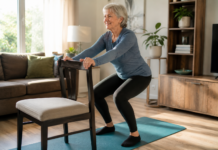





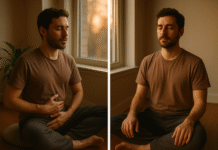














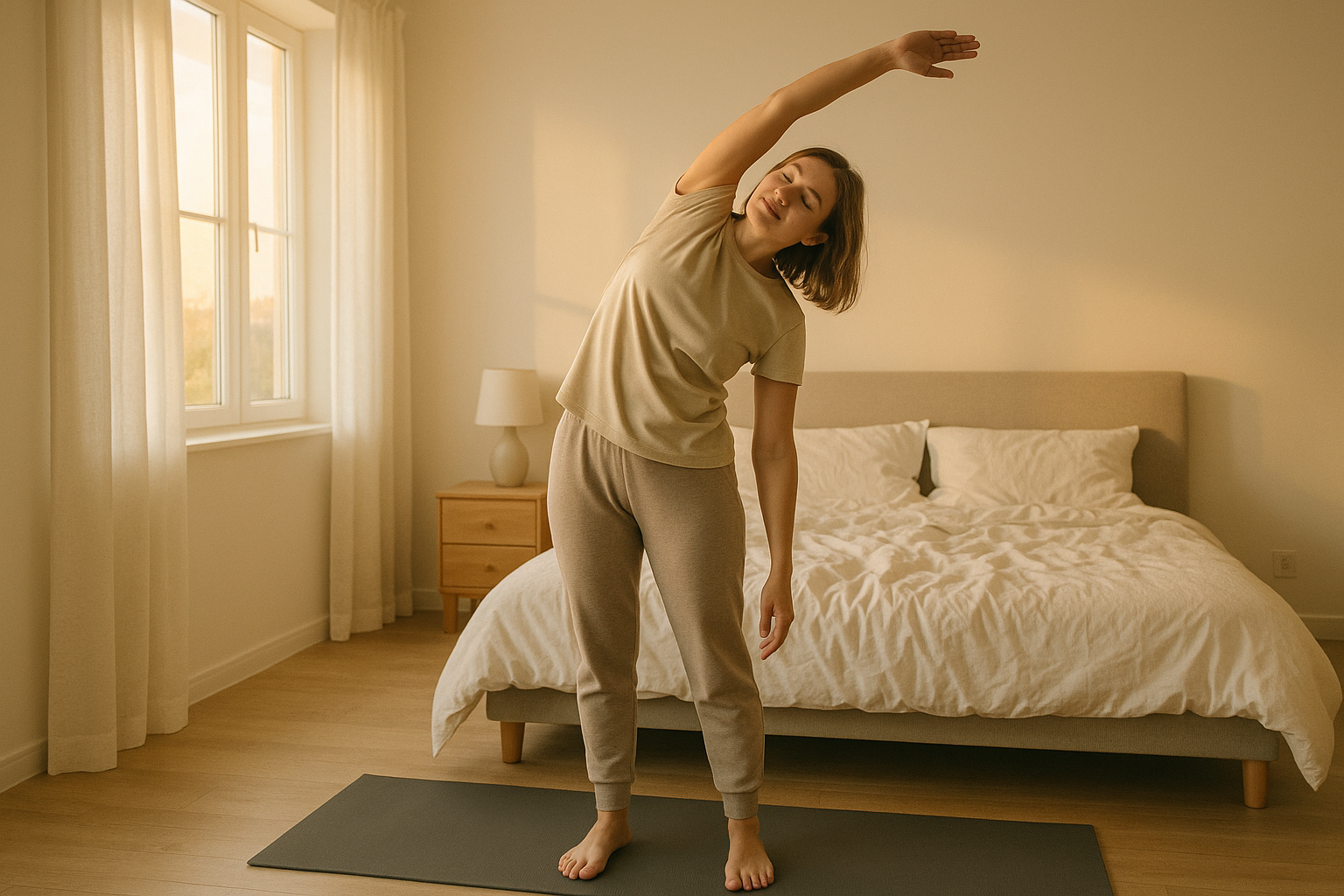
A good morning starts with movement you can actually stick to. This 10-step routine wakes up your joints, boosts circulation, and sets your posture and focus for the day—no equipment, about 8–12 minutes total. A morning stretching routine is a simple sequence of gentle mobility moves and brief holds that gradually take your major joints through comfortable ranges. As a rule of thumb, use mostly dynamic motions early and save longer static holds for later or after workouts; shorter holds (10–30 seconds) are fine in the morning when done gently.
Fast start (skim list):
- Yawn & Reach (pandiculation), 2) Cat–Cow Spine Wave, 3) Child’s Pose → Thread the Needle, 4) Lunge With T-Spine Reach, 5) Half-Kneeling Hip Flexor + Glute Squeeze, 6) Hamstring Hinge & Calf Pump, 7) Seated Figure-Four (or 90/90), 8) Chest Opener & Scap Slides, 9) Neck & Upper-Trap Reset, 10) Ankle Rocks & Balance to Toes.
Safety note: If you have pain, dizziness, recent injury, or a medical condition, go gently and consult a clinician when in doubt. Warm up with a minute of easy marching in place if you wake stiff.
1. Wake-Up Yawn & Reach (Pandiculation)
Start by lying in bed and doing what your body naturally wants: a yawn-like full-body stretch. This “pandiculation” reflex contracts and lengthens muscles in one smooth arc, resetting resting tension after sleep. It’s a gentle way to signal your nervous system that it’s time to move without forcing range of motion. Begin with a slow inhale, reach arms overhead, point toes away, then soften everything as you exhale. Two to three cycles wake up the torso, hips, and feet, making the rest of the routine feel easier and more fluid. This step is especially helpful if you often wake with tight calves or a stiff back from staying in one position overnight.
1.1 How to do it
- Inhale through your nose, lightly contract while reaching long from fingers to toes for 3–5 seconds.
- Exhale and fully relax, letting shoulders and hips melt.
- Repeat 2–3 times; add a side-reach arc on the last repetition.
1.2 Numbers & guardrails
- 2–3 cycles; keep effort at 3–4/10—this is not a max stretch.
- Move slowly; stop if you feel sharp pain.
Why it works: You’re priming muscle tone and connective tissue with a natural reflex, not forcing a cold static stretch, which helps the rest of your joints move more comfortably.
2. Cat–Cow Spine Wave (Thoracic-First)
This is your spine’s morning espresso shot. Cat–Cow takes your neck, mid-back, and low back through controlled flexion and extension while syncing breath to motion. It quickly increases spine segment awareness and lubricates facet joints after hours of stillness. Start on hands and knees with hands under shoulders and knees under hips. Exhale as you round (cat), feeling your shoulder blades glide. Inhale as you extend (cow), lifting your sternum without dumping into your low back. Keep the movement smooth and within pain-free range. If your wrists are sensitive, do forearms-down or fists. Expect a gradual sense of space between ribs and a calmer breathing rhythm by the fifth rep.
2.1 How to do it
- 6–10 slow reps, exhale to round, inhale to extend.
- Add a small “wave”: pelvis leads, then ribcage, then head.
- Finish with 3 circles each direction shifting hips to explore tight spots.
2.2 Mini-checklist
- Shoulders glide, don’t shrug.
- Keep core lightly braced—think zipper up from pubic bone.
- Move neck last; don’t jam into end ranges.
Synthesis: A supple thoracic spine makes every later stretch—especially shoulder and hip work—more effective by freeing rotation and rib expansion.
3. Child’s Pose → Thread the Needle (Shoulders & Upper Back)
Go from Child’s Pose to an upper-back opener to address desk-posture stiffness. Child’s Pose lengthens the lats and low back while letting your belly expand into the thighs for easier diaphragmatic breathing. Then “Thread the Needle” rotates your thoracic spine, opening the posterior shoulder capsule. Begin with knees wide, big toes touching, and reach forward; breathe into the back ribs for three slow cycles. Next, sweep your right arm under your chest, palm up, lowering your right shoulder and temple to the mat; press the left palm to gently rotate. You should feel a broad stretch between shoulder blade and spine, not pinching in the front of the shoulder. Repeat on the other side.
3.1 How to do it
- Child’s Pose: 3 breaths, 6–8 seconds per inhale/exhale.
- Thread the Needle: 2×15–30 seconds per side, gentle pressure with opposite hand.
- Option: Add a small overhead reach of the top arm for more lat length.
3.2 Common mistakes
- Collapsing into the neck; keep space between ear and shoulder.
- Forcing rotation; prioritize easy breath over bigger range.
- Hips lifted too high; sit them back comfortably toward heels.
Synthesis: Combining forward flexion and rotation early frees your upper back, so later chest openers hit the right tissues instead of cranking the neck.
4. Lunge With T-Spine Reach (“World’s Greatest Stretch”)
This dynamic sequence quickly covers hips, groin, hamstrings, and mid-back rotation. From a tall plank or half-kneel, step your right foot outside your right hand. Drop the back knee if needed. Keep the front knee over the ankle, then rotate and reach your right arm toward the ceiling, following with your eyes. Return the hand down, straighten the front knee into a brief hamstring bow, then bend it again and step back. You’ll feel a gentle opening through the hip flexors and adductors while training your core to resist twisting. Do both sides. Dynamic movements like this are preferred first thing or before activity, with longer static holds saved for later in the day.
4.1 How to do it
- 3–5 cycles per side: lunge → reach → brief hamstring bow.
- Spend 2–3 seconds in each position; breathe steadily.
- Keep the back glute lightly squeezed to protect the low back.
4.2 Numbers & guardrails
- Effort 4–5/10; no bouncing at end range.
- If knees are sensitive, pad the back knee or keep it lifted only if comfortable.
Synthesis: One flowing move checks off multiple joints, increases heat, and prepares you for more specific hip flexor and hamstring work next.
5. Half-Kneeling Hip Flexor + Glute Squeeze
Long sitting can leave hip flexors short and glutes underactive. In half-kneeling, tuck your tail slightly (posterior pelvic tilt) and gently squeeze the back-side glute; you’ll feel the front of that hip lengthen without cranking your low back. Reach the same-side arm overhead and lean slightly away for a line of stretch from knee to ribs. Brief static holds of 10–30 seconds are appropriate here in the morning; longer pre-activity holds (≥60 s) can blunt power in some contexts, so keep it brief and comfortable.
5.1 How to do it
- 2–3×10–30 seconds per side, easy breath.
- Hips square; imagine headlights pointing forward.
- Option: add gentle pulses (1–2 cm) while keeping the glute engaged.
5.2 Mini-checklist
- Feel it in the front of the hip, not the low back.
- Keep ribs stacked over pelvis; avoid flaring.
- If balance wobbles, hold a chair or wall.
Synthesis: Balancing a light pelvic tuck with a glute squeeze gives you a focused stretch where you need it most—without overextending your lumbar spine.
6. Hamstring Hinge & Calf Pump
Morning hamstrings are often cranky; treat them with rhythm, not force. Stand tall, hinge at the hips with a soft-knee “micro-bend,” and reach your sit bones back until you feel a mild pull along the back of the thighs. Come up, then rock into a calf pump by lifting both heels for 2–3 slow reps. Repeat the pattern. This alternation burns off stiffness while encouraging blood flow. Save long toe-touch holds for post-workout or evening. When you do hold, stay in the mild stretch zone and breathe; bouncing increases strain without benefit.
6.1 How to do it
- 8–12 smooth hinge reps; spine long, neck neutral.
- Between reps, perform 2–3 controlled calf raises.
- Option: elevate toes on a book for more calf/plantar fascia load.
6.2 Numbers & guardrails
- Hinge tempo ~2 seconds down, 2 seconds up.
- Calf raises to a comfortable top; lower under control.
- Stop if you feel tingling or nerve-like symptoms.
Synthesis: Alternating hinge and heel raises mobilizes the entire posterior chain from hamstrings to ankles without overdoing static end-range first thing.
7. Seated Figure-Four (or 90/90) Hip Opener
Hips love variety. For external rotation, sit on the edge of a chair, cross your right ankle over your left thigh, and hinge forward until you feel a stretch in the glutes/outer hip. Keep the back neutral and chest open. If you prefer floor work, use the 90/90 position: both knees bent at 90°, front shin parallel to the mat, and hinge forward over the front shin. Breathe evenly. This move counteracts the inward-turned posture many of us assume at desks and helps relieve low-back tension driven by tight lateral hip tissues.
7.1 How to do it
- Chair version: 2×20–30 seconds per side, gentle forward hinge.
- Floor 90/90: 2×20–30 seconds per side, optional torso rotations.
- Keep the lifted foot flexed to protect the knee.
7.2 Common mistakes
- Rounding the low back instead of moving at the hips.
- Pressing down on the knee (skip this—use your hinge).
- Holding your breath; exhale to soften the tissues.
Synthesis: A small daily dose of hip external-rotation work pays off in easier squats, stairs, and less nagging back tightness later in the day.
8. Chest Opener & Scapular Slides
Hours of phone and laptop time pull shoulders forward; undo it with a doorway chest opener, then teach shoulder blades to glide. Stand in a doorway with forearms on the frame, elbows just below shoulder height, and step forward until you feel a mild stretch across the chest. Hold briefly, step out, then perform scapular slides: arms straight ahead at shoulder height, protract (reach) and retract (pull shoulder blades together) without shrugging. This pairing restores pec length and reinforces smooth shoulder mechanics so your neck isn’t doing all the work.
8.1 How to do it
- Doorway opener: 2×15–30 seconds, gentle, no joint pain.
- Scap slides: 8–12 slow reps, elbows soft, neck long.
- Option: hands-behind-back clasp for an alternative opener.
8.2 Mini-checklist
- Stretch should be across the chest, not in the anterior shoulder joint.
- Keep rib cage stacked; avoid leaning through ribs.
- Scap slides are small and controlled—quality over range.
Synthesis: Opening the chest and retraining scapular motion gives you immediate posture relief and reduces neck/upper-trap overuse later.
9. Neck & Upper-Trap Reset
Neck stiffness thrives on bracing and shallow breathing. Start by lengthening tall through the crown of your head, then tilt your right ear toward your shoulder until you feel a gentle stretch on the left side of the neck. Hold briefly, then switch. Add a slight chin nod and a controlled look-to-the-armpit variation to target the levator scapulae. Keep intensity modest; neck tissues respond best to subtle, well-timed inputs. Pair with two deep belly breaths per side to downshift nervous-system tension that often amplifies tightness.
9.1 How to do it
- 2×10–20 seconds in each direction (side-bend and armpit look).
- Keep opposite shoulder heavy; hold a towel if it hikes up.
- Add 4–6 gentle neck rotations afterward (small circles).
9.2 Numbers & guardrails
- Low intensity (3/10). Tingling or radiating pain = stop.
- Avoid end-range cranking; “no pain, some stretch.”
Synthesis: Treat your neck kindly—brief holds and breath work calm things down without provoking spasms, helping your head feel lighter all day.
10. Ankle Rocks & Balance to Toes (Finish Strong)
Finish at the feet to cue balance and ground-up stability. Stand facing a wall for light support. Rock forward and back through the ankles, keeping knees soft and heels down, then up onto the balls of your feet and lower under control. Next, try a 10–20 second single-leg balance per side, focusing on a steady exhale. Healthy ankles improve walking efficiency and reduce stumble risk on morning commutes. If you’re heading into a workout, a few controlled calf raises and ankle circles round out your warm-up nicely; longer static calf holds can wait for later.
10.1 How to do it
- 10–12 ankle rocks, then 6–10 calf raises.
- 10–20 seconds single-leg balance each side.
- Option: trace the alphabet with your toes for extra mobility.
10.2 Mini-checklist
- Weight centered over the big toe and second toe at the top.
- Don’t lean from the hips—move from the ankles.
- Lower slowly; control matters more than height.
Synthesis: You leave the routine taller and steadier, with ankles awake, calves warm, and your balance system switched on.
FAQs
1) How long should this entire routine take?
Most people finish in 8–12 minutes. If you only have 3–5 minutes, do Steps 1–4 plus Step 10 to cover spine, hips, and ankles. On days you plan a workout, keep holds brief (10–30 seconds) and rely more on dynamic moves; save longer holds for after training or later in the day.
2) Is dynamic or static stretching better in the morning?
Use both, with emphasis on dynamic first thing. Dynamic moves (like Step 4) increase temperature and blood flow without reducing readiness. Brief static holds are fine if gentle and paired with breath; avoid long pre-activity holds (≥60 seconds) if you need maximal power soon after.
3) What if stretching makes me sore?
Mild next-day awareness can happen as tissues acclimate, but regular gentle practice usually reduces baseline stiffness. Stretching doesn’t meaningfully prevent delayed onset muscle soreness (DOMS) after a hard workout, so don’t rely on it for that—use sleep, nutrition, and gradual training progressions. PubMed
4) Can this help with lower-back tightness?
Yes, especially Steps 2, 3, and 7, which address thoracic mobility and hip rotation—common upstream contributors. Keep ranges comfortable, breathe slowly, and avoid end-range spinal cranking. If pain radiates down a leg or persists, consult a clinician for individualized guidance.
5) Do I need to warm up before stretching?
If you wake up very stiff, do 1–2 minutes of light movement—marching in place, easy arm swings—before holding positions. Gentle dynamic motion raises tissue temperature and makes holds feel safer and more effective.
6) How long should I hold each stretch?
General guideline: 10–30 seconds per position for most adults, 2–4 rounds per side. Older adults may benefit from 30–60 seconds when done later in the day or after activity. Morning holds work best on the shorter side to maintain freshness.
7) Is it okay to stretch before coffee or breakfast?
Absolutely. Hydrate with a few sips of water first if you tend to wake dehydrated, and move gently for the first minute. Eat or caffeinate after the routine if you prefer; nothing in this sequence requires a full stomach.
8) Can I replace my workout with morning stretching?
Stretching supports how you move but doesn’t replace cardio and strength training. Aim for at least 150 minutes/week of moderate activity plus two days of muscle-strengthening, and use this routine as your daily mobility anchor.
9) What if I sit all day?
Repeat a mini-circuit (Steps 6, 8, 9, 10) in two minutes a couple of times during the workday. It opens the posterior chain, chest, and neck while restoring ankle movement and balance—key antidotes to desk posture.
10) Are there risks to static stretching in the morning?
Brief, comfortable holds are low risk for healthy adults. Long, intense pre-activity holds can temporarily reduce maximal strength/power in some contexts; keep morning holds short and gentle if you’ll be active soon after. If you feel tingling or joint pain, ease off.
11) What equipment helps?
None required. A mat, towel, or pillow can make kneeling more comfortable; a doorway helps for chest openers. If balance is tricky, use a chair or wall. Props should make positions easier—not force more range.
12) How soon will I notice benefits?
Many people feel looser and more alert immediately; steadier posture and easier movement show up within 2–4 weeks of daily practice. Consistency matters more than intensity—think small, repeatable wins you can layer into your morning rhythm.
Conclusion
Mornings set the tone for everything that follows. By moving your spine, hips, shoulders, neck, and ankles through gentle ranges, you signal your nervous system to wake up, improve circulation, and prime posture before the day’s demands stack up. The 10 steps here balance dynamic motion and brief holds so you feel ready without feeling wrung out. Over the next few weeks, track how your first hour feels—less stiffness when you sit, lighter steps on the stairs, fewer neck twinges after laptop sessions—and adjust hold times to your body’s responses. Pair the routine with smart habits (hydration, a short walk, and strength work twice weekly) and it becomes a reliable foundation for how you move and feel all day.
Take the next step: set a recurring 10-minute morning block on your calendar and lay a mat where you’ll see it when you wake.
References
- Take Time to Stretch, Harvard Health Publishing, Jan 1, 2025. Harvard Health
- Kay, A.D., & Blazevich, A.J. Effect of acute static stretch on maximal muscle performance, Med Sci Sports Exerc, 2012. PubMed
- Stretching and Flexibility Guidelines Update, American College of Sports Medicine (ACSM), Mar 18, 2021. RebrandX
- Stretching: Focus on Flexibility (Stretching and flexibility overview), Mayo Clinic, Mar 29, 2024. Mayo Clinic
- Herbert, R.D., & de Noronha, M. Stretching to prevent or reduce muscle soreness after exercise, Cochrane Database of Systematic Reviews, 2011. Cochrane Library
- Adult Activity: An Overview, Centers for Disease Control and Prevention (CDC), Dec 20, 2023. CDC
- How to stretch after exercising, NHS, (date not listed; accessed Aug 2025). nhs.uk
- Flexibility exercises, NHS, (date not listed; accessed Aug 2025). nhs.uk
- What Is Pandiculation, and Why Does It Feel So Good?, Cleveland Clinic Health Essentials, Apr 10, 2025. Cleveland Clinic
- A guide to basic stretches (Stretching safely tips), Mayo Clinic, (date not listed; accessed Aug 2025). Mayo Clinic