




























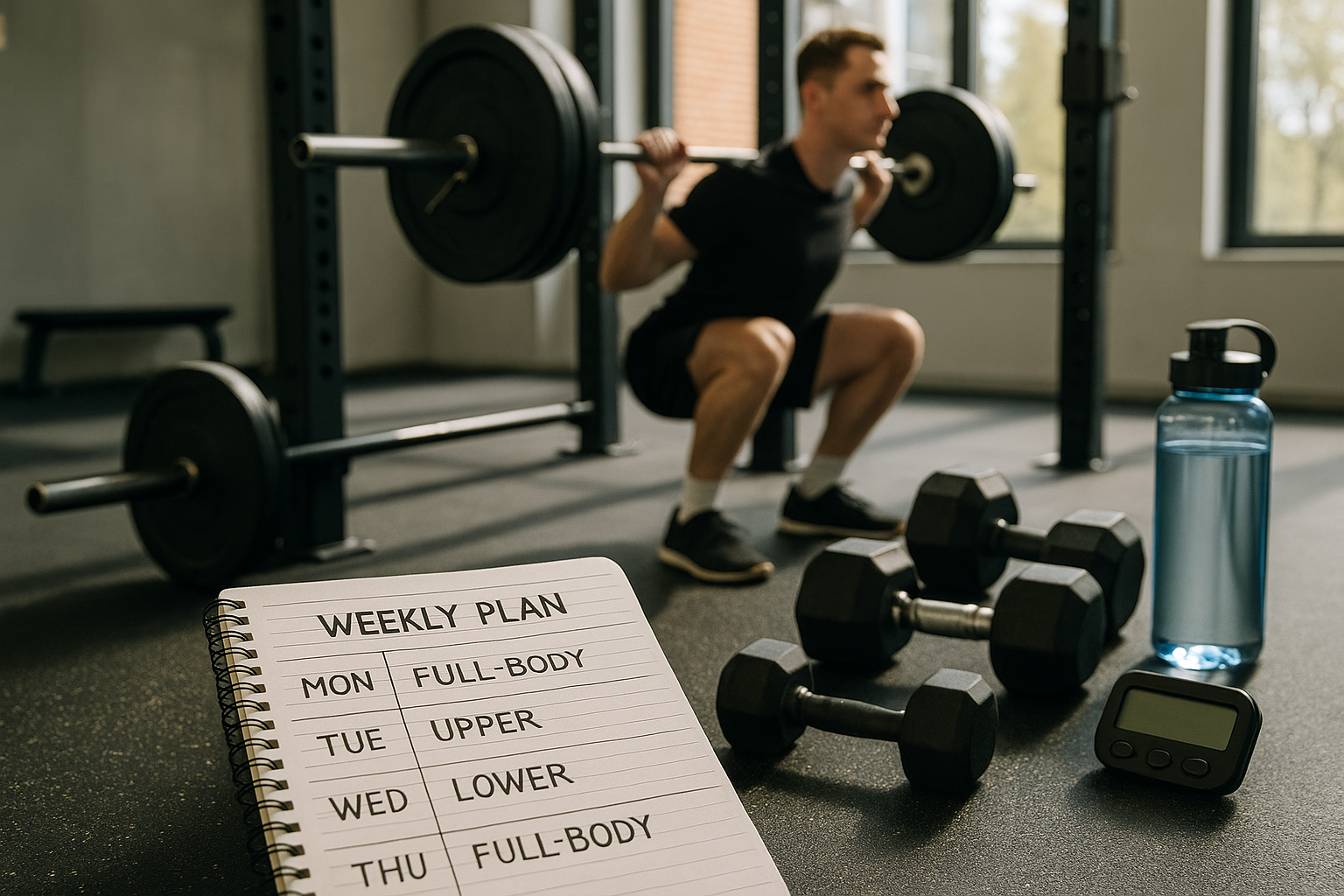
A balanced strength workout is one that matches your goal, fits your schedule, trains the whole body across key movement patterns, and progresses at a pace you can recover from. This guide walks you through eight practical steps—from choosing a weekly split to setting sets, reps, and rest—so you can build muscle and strength safely and efficiently. It’s written for beginners through busy intermediates who want results without guessing. Quick note: this is educational information, not medical advice; if you have a health condition or injury, consult a qualified professional before starting.
In one line: A balanced strength workout organizes your week, movement patterns, and training dose (sets × reps × load) so you can make steady progress while managing fatigue.
Fast plan overview:
- Define your goal, time, and equipment.
- Pick a weekly split you can stick to.
- Cover all major movement patterns each week.
- Set evidence-based sets, reps, and intensity.
- Map out progressive overload and deloads.
- Order lifts smartly; dial rest and tempo.
- Warm up well and recover on purpose.
- Track, test, and adjust with simple metrics.
1. Clarify Your Goal, Time, and Equipment
Start by pinning down what you want, when you can train, and what tools you have; this immediately shapes your plan. In practice, choose one primary outcome (e.g., “get stronger on the squat and press,” “add 2–3 kg muscle,” or “lift for general health”) and constrain your week (e.g., 2–4 sessions, 45–60 minutes each). Decide where you’ll train (commercial gym, home gym, or limited equipment) to define exercise options up front. Your training age (brand-new vs. 1–2+ years lifting) also sets expectations: beginners progress with fewer sets and simpler programming; intermediates need more careful volume and fatigue management. By locking these constraints first, you prevent scope creep and ensure every later decision is realistic.
1.1 Why it matters
- Clarity prevents program-hopping. A single target (strength, muscle, or general fitness) makes set/rep choices straightforward.
- Time sets the ceiling. If you have 3 × 50 minutes weekly, your plan must prioritize high-return compound lifts.
- Equipment defines movements. No barbell? Center your plan on dumbbells, kettlebells, and bodyweight variations.
- Recovery reality check. Sleep, stress, and nutrition determine how much training you can adapt to—not just tolerate.
1.2 Mini-checklist
- One-sentence goal that’s measurable in 8–12 weeks.
- Weekly availability (days × minutes).
- Equipment list (barbell, rack, DBs, bands, bench, kettlebells).
- Training age and any injury considerations.
Synthesis: When the target, time, and tools are fixed, the “balanced” part becomes possible because every later choice has guardrails.
2. Choose a Weekly Split You Can Sustain
Pick the least complex split that hits each major muscle group at least twice weekly if possible, within your available days. With 2–3 days, go full-body each session; with 4 days, upper/lower works beautifully; with 5–6, consider upper/lower + full-body, or a push/pull/legs rotation if you enjoy variety and have time. Frequency supports practice and growth while spreading fatigue. For most recreational lifters, 2–4 days/week covers strength, hypertrophy, and health without overwhelming recovery. Sustainability beats perfection: the “best” split is the one you’ll complete for months.
2.1 Common splits (how to pick)
- 2 days: Full-body A/B (squat or hinge focus + push + pull + core each day).
- 3 days: Full-body with small emphasis shifts (e.g., Day 1 squat, Day 2 press, Day 3 hinge).
- 4 days: Upper/Lower/Upper/Lower or Full/Upper/Lower/Full.
- 5–6 days: Push/Pull/Legs sequence; or Upper/Lower plus 1–2 short full-body sessions.
2.2 Numbers & guardrails
- Per-muscle frequency: ~2×/week suits most lifters; 1× can maintain, 3× may help smaller muscle groups if recovery is solid.
- Session length: Plan ~45–70 minutes; cap accessories if you exceed this.
- Time buffers: Insert one rest day between heavy lower sessions where possible.
Synthesis: Choose the simplest split that trains each pattern often enough without crowding your calendar—adherence equals balance.
3. Cover the Big Movement Patterns Each Week
Program around movement patterns so your body is trained comprehensively, not just individual muscles. Aim to include (across the week): squat (knee-dominant), hinge (hip-dominant), horizontal push, horizontal pull, vertical push, vertical pull, unilateral/lunge, and a carry or anti-core movement. Compound lifts deliver the biggest return on time; accessories then fill gaps, build weak links, and support joint health. If equipment is limited, use close variants (e.g., goblet squats instead of back squats, single-leg RDLs instead of barbell RDLs). This pattern-led approach ensures your plan is strong, symmetrical, and resilient.
3.1 Tools/Examples
- Squat: Back squat, front squat, goblet squat, leg press.
- Hinge: Deadlift, RDL, hip thrust, kettlebell swing.
- Horizontal push/pull: Bench press, push-up / barbell row, chest-supported row.
- Vertical push/pull: Overhead press, DB press / pull-up, lat pulldown.
- Unilateral & carry/core: Split squat, walking lunge, suitcase carry, Pallof press, dead bug.
3.2 Common mistakes
- Overemphasizing mirror muscles (chest, arms) while neglecting back and posterior chain.
- Skipping unilateral work, which helps iron out side-to-side strength differences.
- Dropping carries and anti-rotation moves that build bracing and grip.
Synthesis: Training patterns—not just parts—keeps your weekly plan balanced by default and reduces “forgotten” functions.
4. Set Sets, Reps, and Intensity That Match the Goal
Match the training dose to your outcome using simple ranges, then fine-tune with effort measures like RPE (rate of perceived exertion) or RIR (reps in reserve). For general strength and muscle, most sets should land around 6–12 reps at 60–80% of 1RM, leaving 1–3 RIR (i.e., stop 1–3 reps before failure). Very heavy strength sets live at 1–6 reps (80–95% 1RM) with longer rests; muscular endurance leans 12–20+ reps (40–60% 1RM) with shorter rests. Weekly volume (hard sets per muscle) often sits around 10–20 for growth, spread over 2+ days, adjusting up or down based on recovery.
4.1 Numbers & guardrails
- Beginners: Start near 8–12 hard sets/muscle/week, 2 days frequency, 1–3 RIR.
- Intermediates: 12–20 sets/muscle/week, use 1–2 lifts as anchors per pattern.
- Strength focus: 3–6 reps on primaries; accessories 6–10 reps.
- Endurance/conditioning bias: 12–20 reps on accessories; keep one heavier compound for strength retention.
4.2 Practical example
A 3-day full-body week targeting legs/back/pressing might include per week:
- Squat pattern: 3 × 6–8 (Day 1), 3 × 8–10 (Day 3) → 6 sets
- Hinge pattern: 3 × 5–6 (Day 2), 2 × 8–10 RDL (Day 3) → 5 sets
- Horizontal push/pull & vertical push/pull: 10–14 total sets spread across days, 1–3 RIR.
Synthesis: Dose drives adaptation. Keep most work in the middle (6–12 reps, 1–3 RIR), then season with heavier or lighter work based on your goal.
5. Plan Progressive Overload and Simple Periodization
Progress happens when training becomes very slightly harder over time—via load, reps, sets, density, or range of motion—while staying recoverable. Use double progression on most lifts: hold the load steady, add reps until the top of a target range across all sets (e.g., 3 × 8–10), then bump the load by 2.5–5% next session and restart the range. For big barbell lifts, microloading (0.5–1.0 kg) helps. Every 4–8 weeks, schedule a deload (reduce volume ~30–50% and/or intensity modestly) to shed fatigue. Intermediates often benefit from undulating periodization, rotating rep ranges (e.g., 5s, 8s, 12s) across days or weeks to train multiple qualities.
5.1 How to do it
- Double progression: Example bench press 3 × 8–10 @ 60–80% 1RM—when you hit 10/10/10 with ~1–2 RIR, add 2.5–5% next time.
- Rep cycling: Heavy day (3–5 reps), moderate day (6–8), pump day (10–12).
- Density: Hold total reps constant; shorten rests slightly over a cycle.
- Deload timing: When performance, motivation, or sleep dip, pull back for a week.
5.2 Mini-checklist
- A written progression rule for each anchor lift.
- Planned microloads for small jumps.
- A penciled deload in weeks 5–7 (adjust by feel).
Synthesis: Codifying how you’ll progress removes guesswork, keeps training sustainable, and ensures long-term balance.
6. Order Lifts Smartly, Set Rest, and Use Tempo on Purpose
Put the highest-skill, heaviest lifts first, when you’re freshest, then layer in moderate compound lifts and finish with simpler accessories. Rest 2–3 minutes (even 4+) between heavy compound sets; rest 60–90 seconds for accessory supersets. Use tempo strategically (e.g., 2–3 second controlled lowering) to build control without turning every set into cardio. If short on time, pair non-competing movements (e.g., a squat pattern with a horizontal pull) so one muscle rests while another works. This order and pacing keep quality high, technique crisp, and fatigue in check—core ingredients of a balanced session.
6.1 Numbers & guardrails
- Order: Power/skill → heavy compound → secondary compound → accessories → core/carries.
- Rest: 2–3+ min big lifts; 90–120 s secondary; 60–90 s accessories.
- Tempo: Typical 2-0-1-0 (down-pause-up-pause); emphasize control, not slow-motion grinding.
6.2 Common mistakes
- Turning strength work into conditioning by rushing rests.
- Fatiguing stabilizers with too many isolation sets before compounds.
- Overloading tempo on every set, which limits load and total volume.
Synthesis: Smart ordering and rest preserve the quality of your strongest work and prevent fatigue from wrecking balance.
7. Build a Warm-Up, Mobility, and Recovery Loop
A brief, purpose-built warm-up elevates temperature, rehearses patterns, and primes joints; it doesn’t need to be long. Spend 5–10 minutes on light cardio and dynamic mobility for today’s patterns (e.g., ankles/hips for squat day, T-spine/shoulders for overhead day). Add 2–4 ramp-up sets of your first lift, gradually increasing load. After training, a short cooldown (walking, easy breathing drills) and regular mobility work maintain range of motion without eating your whole evening. Outside the gym, prioritize sleep, protein, and hydration; recovery is where adaptation happens. If pain persists, stop and seek guidance from a qualified clinician.
7.1 Mini-checklist
- Before: 5 min easy cardio + 2–3 dynamic drills for the day’s patterns.
- During: 2–4 ramp-up sets before first working set.
- After: 3–5 min easy walk + 1–2 gentle mobility moves.
- Daily: Consistent bedtime; protein with each meal; fluids to thirst.
7.2 Tools/Examples
- Dynamic drills: leg swings, 90/90 hip switches, thoracic rotations, band pull-aparts.
- Cooldown: nasal breathing walk, child’s pose with reach, easy hamstring flossing.
- Recovery supports: sleep tracker, training log, kitchen scale for protein checks.
Synthesis: The right warm-up and recovery habits protect joints, improve performance, and let balanced training stay consistent.
8. Track, Test, and Adjust Without Overthinking
Use a simple log (app or notebook) to record exercises, sets, reps, load, RIR, and brief notes on sleep and stress. Re-test key lifts every 6–12 weeks (e.g., 3RM or submax AMRAP with RIR cap) to confirm progress without maxing out weekly. Track circumferences, progress photos, or clothing fit if muscle gain is a goal; for health, monitor energy, aches, and daily step counts. Adjust volume or frequency when performance stalls for 2–3 consecutive weeks or soreness lingers. Keep tweaks small (e.g., +2 sets/week for a lagging pattern) and give them 3–4 weeks to work. The plan should evolve—but not lurch—over time.
8.1 Numbers & guardrails
- Progress checks: Every 6–12 weeks; avoid frequent max testing.
- Adjustments: Change one variable at a time (sets, reps, load, or frequency).
- Readiness cues: If joints ache or sleep drops, hold volume steady or deload.
8.2 Practical tools
- Apps: Strong, Hevy, Stacked; or a simple spreadsheet.
- KPIs: Estimated 1RMs, rep PRs at fixed loads, total weekly set counts.
- Signals: Appetite, morning energy, and bar speed trends.
Synthesis: Consistent, lightweight tracking keeps your training honest and your “balanced” plan truly responsive to your body.
FAQs
1) What’s the simplest balanced plan if I only have two days?
Use two full-body sessions. Each day include: one squat or hinge, one press (push-up or bench/overhead), one pull (row or pull-up), and one core/carry. Keep 3–4 lifts to 3–4 hard sets each. Leave 1–3 reps in reserve so you can recover. This structure trains all major patterns without crowding your week and is easy to progress with double progression.
2) How many sets per muscle do I really need?
Most people grow well on about 10–20 hard sets per muscle per week split over at least two days. Beginners can start closer to 8–12 sets and add slowly. If your joints feel beat up or progress stalls, hold volume steady for a week or deload. Quality (effort, control, and progression) matters more than chasing the highest possible set count.
3) Should I train to failure for best results?
Save true failure for the final set of safer accessories (machines, cables) if you enjoy it. For big compounds, stop 1–3 reps shy of failure to preserve technique, manage fatigue, and keep weekly performance high. This balance helps you progress consistently while reducing injury risk, especially when training multiple times per week.
4) How long should I rest between sets?
Rest long enough to repeat high-quality reps—typically 2–3 minutes or more for heavy compounds and 60–90 seconds for accessories. If you’re limited on time, pair non-competing movements (e.g., squats with rows) so one muscle rests while another works. Shortening rest too much turns strength work into conditioning and can blunt progress.
5) Do I need a specific tempo?
You don’t need a strict tempo for every lift. Use a controlled eccentric (about 2–3 seconds down), smooth change of direction, and a strong but not jerky concentric. Reserve intentionally slow tempos for phases focused on control or tendon health. Excessively slow tempos across the board limit load and overall training volume.
6) How do I pick accessory exercises?
Choose accessories that directly support your main lifts and address your weak links. For example, if your knees cave in the squat, add goblet squats and lateral band walks; if your bench stalls off the chest, add long-range DB presses and paused push-ups. Rotate accessories every 6–8 weeks to stay fresh while keeping primaries consistent.
7) What if my shoulders or knees feel cranky?
First, reduce load or volume by ~20–30% for a week and swap any painful range with a close variant (e.g., high bar to safety bar squat, barbell press to neutral-grip DB press). Emphasize technique, warm-up specificity, and recovery. If pain persists or worsens, stop the aggravating movement and consult a qualified clinician before returning.
8) Can I combine strength and cardio without losing gains?
Yes—separate hard lifting and intense cardio by several hours or alternate days. Keep easy zone 2 cardio (e.g., brisk walking, cycling) on off days for 20–40 minutes. Prioritize lifting first if muscle/strength are primary goals. Most lifters can progress fine with 2–3 cardio sessions weekly, provided sleep and protein are adequate.
9) How fast should I try to progress?
On double progression, expect small, steady jumps: add 1–2 reps per set session to session until you top the range, then increase load by 2.5–5% (microloads for small lifts). If you fail to hit planned reps for two consecutive weeks, deload or trim a set. Sustainable progress beats aggressive jumps that outpace recovery.
10) What’s a good warm-up template?
Use 5 minutes of light cardio, then 2–3 dynamic drills for today’s patterns, then ramp-up sets for the first lift (e.g., 5 reps with empty bar, 3–4 sets building to your work weight). Keep the whole warm-up to ~10 minutes so it primes you without eating the session. As loads rise, add an extra ramp set rather than stretching forever.
11) Is push/pull/legs better than upper/lower?
Neither is universally better. PPL offers higher volume per session and variety if you train 5–6 days; upper/lower is more time-efficient for 4 days and recovers well. Choose based on available days and recovery. If in doubt, upper/lower is a reliable starting point that’s easy to balance.
12) How do I keep the plan “balanced” long term?
Audit your log every 6–8 weeks. Check each pattern’s weekly set count, compare left/right work, and note which lifts stalled. Add 1–2 sets to lagging patterns, rotate an accessory, or slightly change rep targets. Keep primaries consistent for comparability and use deloads to reset fatigue before pushing again.
Conclusion
A balanced strength workout isn’t a mystery—it’s a series of clear, practical choices that align with your goal, schedule, and recovery capacity. Start by defining constraints, then choose a weekly split you can actually sustain. Build sessions around the big movement patterns and dose the work with evidence-based sets, reps, and effort. Codify progression with double progression or light undulation, and protect performance with smart ordering, adequate rest, and a quick, purpose-built warm-up. Finally, keep a simple log and adjust incrementally; balance is maintained through small, regular course corrections, not wholesale overhauls.
Put these eight steps into action for the next 8–12 weeks, review your log, and make one small tweak at a time. That’s how “balanced” becomes your default—and how strength and muscle gains become steady, repeatable, and enjoyable. Start today: schedule your first three sessions and write your primary progression rule for each anchor lift.
References
- ACSM Position Stand: Progression Models in Resistance Training for Healthy Adults, American College of Sports Medicine, 2009. https://journals.lww.com/acsm-msse/Fulltext/2009/03000/Progression_Models_in_Resistance_Training_for.26.aspx
- ACSM Guidelines for Exercise Testing and Prescription (11th ed.), American College of Sports Medicine, 2021. https://global.oup.com/academic/product/acsm-guidelines-for-exercise-testing-and-prescription-9781975150181
- WHO Guidelines on Physical Activity and Sedentary Behaviour, World Health Organization, 2020. https://www.who.int/publications/i/item/9789240015128
- The 2018 Physical Activity Guidelines for Americans, 2nd Edition, U.S. Department of Health and Human Services, 2018 (updates and resources accessed 2024). https://health.gov/our-work/physical-activity/current-guidelines
- Effects of Resistance Training Frequency on Measures of Muscle Hypertrophy, Brad J. Schoenfeld et al., Journal of Sports Sciences, 2016.
- Dose–Response Relationship Between Weekly Resistance Training Volume and Muscle Hypertrophy, Brad J. Schoenfeld et al., Journal of Sports Sciences, 2017. https://www.tandfonline.com/doi/full/10.1080/02640414.2016.1210197 (meta-analysis discussion and follow-ups)
- A Systematic Review of Rest Interval Length in Resistance Training, Paulo Gentil & Beatriz S. de Salles et al., Sports Medicine, 2009/2010. https://link.springer.com/article/10.2165/11319430-000000000-00000
- Evidence-Based Recommendations for Natural Bodybuilders: Nutrition and Strength, Eric R. Helms et al., Journal of the International Society of Sports Nutrition, 2014/2015; and RPE-Based Autoregulation in RT, Helms et al., 2018. https://jissn.biomedcentral.com/
- Position Statement on Progression and Overload in Resistance Exercise, National Strength and Conditioning Association (NSCA), 2009–2016 resources. https://www.nsca.com/education/articles/
- Resistance Training for Health and Fitness, Centers for Disease Control and Prevention (CDC), reviewed 2023. https://www.cdc.gov/physicalactivity/basics/strength-training/index.htm