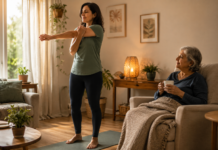
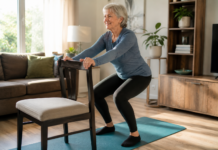

























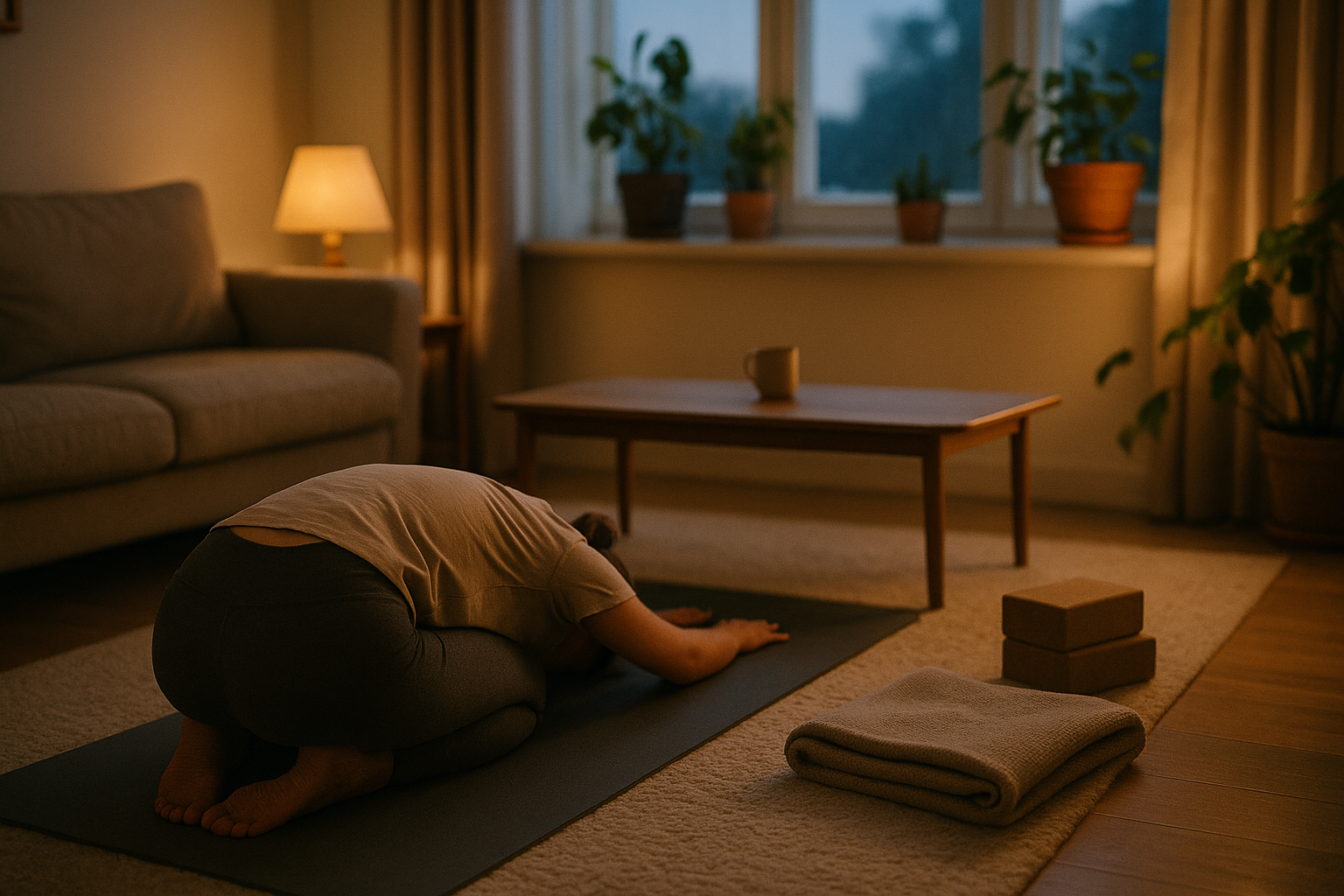
You don’t need a studio—or more than a few square meters—to feel your nervous system downshift. This living room yoga flow for relaxation is a gentle, beginner-friendly sequence designed to quiet mental noise, release common tension spots (neck, back, hips), and prepare you for quality rest. Quick safety note: yoga is generally safe for most people, but modify for injuries, pain, or pregnancy and consult a clinician if you have medical concerns. A “living room yoga flow for relaxation” is a short, low-effort series of poses and breathing that emphasize slow, nasal breaths and longer exhales to cue the “rest-and-digest” response. Evidence suggests that slow breathing around 6–10 breaths per minute helps calm the autonomic nervous system—perfect for winding down in the evening.
At-a-glance flow: Clear a ~2×2 m (≈6×6 ft) area → dim lights → 2–3 minutes of slow breathing → gentle spinal warm-ups → hamstrings/hips → easy twists → 5–10 minutes of supported rest.
1. Set the Scene: Space, Props, and Intention
A relaxed practice starts before your first breath. This first step answers the practical question: how do I make a small living room feel like a calming mini-studio? Begin by clearing a square of floor space about 2×2 meters; remove shoes, silence notifications, and soften overhead lights (lamps or warm bulbs beat bright ceiling lights at night). Place a mat or non-slip rug where you won’t be interrupted. Gather simple “props”: two firm pillows or cushions, a folded blanket, and a strap or scarf. Decide on a time budget—15, 20, or 30 minutes—and choose an intention, e.g., “unwind and breathe.” These small decisions reduce friction, making you more likely to stick with the routine. If you’re practicing within an hour of bedtime, keep the room slightly cool and the soundtrack quiet or absent; the body reads these environmental cues as permission to settle.
1.1 How to do it
- Lighting & sound: Dim task lamps; avoid blue-white overheads. Keep music slow and low, or try silence.
- Surface & props: Use a mat or low-pile rug; keep pillows/blanket within reach for support under knees, hips, or head.
- Wardrobe & temperature: Soft layers you can move in; aim for comfortable room temp (about 20–22°C / 68–72°F).
- Boundaries: Tell others you’re unavailable for this short window; set your phone to Do Not Disturb.
- Intention card: One line on a sticky note (e.g., breathe slow, move slow) placed where you can see it.
1.2 Numbers & guardrails
- Timebox: 2–3 minutes setup; total practice 15–30 minutes.
- Pain rule: Sensation is okay; sharp or escalating pain is not—back out or modify.
- Pregnancy note: Prefer side-lying rest after mid-pregnancy; avoid long supine holds and deep compressions.
A prepared environment becomes a cue for relaxation. Future sessions will feel easier because you’ve already streamlined decisions.
2. Centering Breath: Coherent Breathing (5–6 Breaths/Minute)
The fastest way to dial down stress is through the breath. Start seated or lying down with one hand on your lower belly. Inhale and exhale through the nose, letting your belly expand on the inhale and soften on the exhale. Your goal is “coherent” or resonance breathing—roughly 5–6 breaths per minute—with equal or slightly longer exhales. Expect the first 30–60 seconds to feel a touch effortful; by minute two, the rhythm smooths out. Physiologically, slower nasal breathing can increase heart-rate variability (HRV), shift you toward parasympathetic dominance, and reduce perceived stress. If you feel lightheaded, shorten the breath counts or pause. Two to four minutes is enough to set the tone for the rest of your flow and is sustainable on busy evenings.
2.1 How to do it
- Counting cue: Inhale 5, exhale 5 (or inhale 4, exhale 6).
- Hand placement: One hand on belly to encourage diaphragmatic movement; one hand at ribs or heart.
- Jaw/face: Keep tongue resting on the roof of your mouth; soften the jaw and space between eyebrows.
- Option: Hum softly on your exhale to lengthen it and add vagal stimulation.
2.2 Numbers & guardrails
- Cadence: 5–6 breaths/minute (≈5–6 seconds inhale + 5–6 seconds exhale).
- Dose: 2–4 minutes at start; add 1–2 minutes before rest.
- Why it matters: Slow nasal breathing at ~6 breaths/min is linked with improved HRV and calmer autonomic tone.
Even a short bout primes your nervous system, making the rest of the session feel smoother and more grounded.
3. Melt the Kinks: Spinal Warm-Up & Neck/Shoulder Reset
Before deeper stretches, give your spine and shoulders a friendly warm-up. This segment targets the places that store daily tension—upper traps, neck flexors/extensors, thoracic spine—and prepares tissues for safer range of motion. Begin in tabletop for 60–90 seconds of Cat-Cow, syncing each movement with your breath. Add three rounds of thread-the-needle on each side to open the posterior shoulder and ribcage. Finish with slow “yes/no/maybe” neck movements and a few scapular circles. Keep the pace unhurried; you’re persuading the body to relax, not forcing mobility. If you sit much of the day, this section can deliver the biggest immediate relief as it lubricates facet joints and invites fuller breaths.
3.1 How to do it (mini-sequence, ~4 minutes)
- Cat-Cow: 6–10 slow reps; inhale arch, exhale round.
- Thread-the-needle: 3 breaths each side; pad the head/shoulder with a cushion as needed.
- Neck sequence: 3 slow nods “yes,” 3 turns “no,” 3 side tilts “maybe,” keeping shoulders heavy.
- Shoulder circles: 6–8 circles each direction, elbows wide, chest soft.
3.2 Common mistakes
- Moving faster than your breath (racing mind = racing body).
- Collapsing shoulders to ears—keep space between shoulders and jaw.
- Forcing end ranges (especially in the neck); stay within a pain-free arc.
Finish with one cleansing exhale; notice how your breath feels easier when your ribcage can actually move.
4. Ease the Back: Forward Folds & Hamstring Release
Done gently, forward folds reduce posterior chain tension and help many people’s backs feel safer. The key word is gently—long hamstrings are not the goal; a relaxed nervous system is. Start in Ragdoll (a soft standing forward fold) with generous knee bend, belly resting on thighs, arms hanging or elbows held. Sway side to side. Move to Half Lift at the Wall: hands on the wall, walk back until your hips stack over ankles and spine lengthens parallel to the floor. End with Supine Strap Hamstring: lying on your back, loop a scarf around your right foot and extend the leg to a comfortable angle (often 45–70°), left knee bent. Sensation should be steady and mild; if the low back protests, bend the lifted knee slightly more or back off a few degrees.
4.1 Numbers & guardrails
- Holds: 60–90 seconds in Ragdoll; 60–90 seconds Half Lift; 45–60 seconds per leg in Supine Strap.
- Breath: Keep inhales soft; make exhales a beat longer to cue release.
- Back care: For chronic low-back pain, yoga may offer small improvements in pain and function, similar to other exercise, but respect flare-ups and progress slowly.
4.2 Mini-checklist
- Knees as bent as needed; prioritize spinal length over leg straightness.
- Weight slightly forward toward the balls of the feet in Ragdoll to keep hips over ankles.
- Support the head on blocks or pillows if folding feels compressed.
Close with a few wider, easier breaths and notice if your back feels more “available” rather than stretched to its limit.
5. Unstick the Hips: Low Lunge + Figure Four (Supine)
Tight hip flexors and deep rotators can amplify the sense of stress in your body by tugging on the low back and restricting pelvic movement. This step balances a gentle Low Lunge (Anjaneyasana) with a Supine Figure Four to address both front-of-hip and outer-hip tension. From hands-and-knees, step your right foot forward and lower your left knee onto a folded blanket. Slide the hips forward until you feel a mild front-hip opening; lift your chest softly and keep your ribs stacked. After 5–8 slow breaths, transition to your back: cross your right ankle over left thigh, hug the left knee toward your chest, and keep the tail heavy. The supine version supports the nervous system more than seated options because it invites the back body to release into the floor.
5.1 How to do it
- Low Lunge alignment: Back knee padded; front knee roughly over ankle; tailbone gently down.
- Breath cue: Inhale length, exhale soften forward (no pushing).
- Supine Figure Four: Flex the lifted foot; keep neck neutral; use a strap behind the thigh if shoulders tense.
5.2 Numbers & guardrails
- Dose: 5–8 breaths per side in Low Lunge; 60–90 seconds per side in Figure Four.
- Back sensitivity: If lunge feels crunchy, shorten your stance; if figure four strains the knee, choose a cross-legged seated fold instead.
- Evidence note: For low-back pain generally, an exercise approach (including yoga) is recommended, but all movement should be symptom-guided and progressive. NICE
Balanced hips often translate into a more neutral, effortless spine—one of the quietest forms of stress relief your body recognizes.
6. Decompress & Unwind: Twists and Side-Body Openers
Twists and side-bends wring out residual tension in the ribs and fascia around your diaphragm, making slow breathing feel natural rather than forced. Move onto your back for a Supine Twist: draw both knees to chest, then lower them to the right while reaching your left arm long; keep both shoulders heavy and eyes closed. After 5–8 breaths, switch sides. Follow with a Banana Pose (side-body stretch): slide feet and hands toward the right edge of the mat, making a soft crescent; repeat left. These shapes are less about “range” and more about allowing. If the breath feels shallow during a twist, ease out of depth until your exhale lengthens again.
6.1 How to do it
- Supine twist: Place a pillow between or under the knees if the low back pinches.
- Banana pose: Cross the outer ankle over inner if you want a bit more stretch; keep both hips grounded.
- Optional: Add a 30-second Seated Neck Twist (gentle) to finish—turn head one way, then the other.
6.2 Common mistakes
- Lifting or gripping the shoulder off the floor—support knees to let the chest relax.
- Forcing end-range rotation; instead, imagine the twist starting from your breath at the ribs.
- Holding the breath—keep exhales unhurried.
When your ribcage moves freely, the diaphragm does less “work,” and relaxation becomes a by-product rather than an objective you’re chasing.
7. Downshift to Neutral: Legs Up the Wall or Supported Savasana + Body Scan
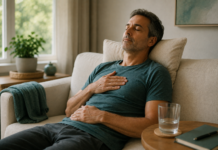
The final step closes the loop: guide your nervous system into a restful, parasympathetic state. Choose Legs Up the Wall (Viparita Karani) or a Supported Savasana. For legs up the wall, sit sideways to a wall, lie back, and swing your legs up so your hips are a few inches away from the wall; support under the low back as needed. For supported savasana, place a pillow under knees and a folded blanket under head; cover your eyes if that helps. Add a 3–6 minute body scan: move attention slowly from toes to crown, observing sensation without judgment. Research and clinical guidance suggest restorative shapes and slow breathing can reduce stress and support better sleep; many find the gentle inversion of legs up the wall soothing, with potential benefits for venous return and a subjective sense of calm.
7.1 Numbers & guardrails
- Time: 5–10 minutes here if you can; if short on time, take at least 3 minutes.
- Breath: Return to 5–6 breaths/minute or a relaxed 4-count inhale, 6-count exhale.
- Pregnancy: After mid-pregnancy, favor side-lying rest (especially left side) or elevate torso; avoid prolonged flat supine positions.
7.2 Mini-checklist
- Support the low back and head so the throat/face can soften.
- If legs tingle in Viparita Karani, bend knees or switch to Supported Savasana.
- End with one clear intention for the evening: light dinner, no email, lights out by 11.
Treat this last segment as a gift to your future self—rest now so tomorrow’s you has a fuller battery.
FAQs
1) How long should this living room flow take?
Most people do well with 20–30 minutes, but even 12–15 minutes can help—especially if you keep the breathing slow (5–6 breaths/minute) and finish with 3–6 minutes of supported rest. In the evening, softer lighting, quiet music, and a cooler room amplify the downshift in nervous system arousal. If you have only 10 minutes, do Steps 2, 6, and 7.
2) I’m new to yoga—will this be too hard?
No. The flow prioritizes comfort and breath over depth or “perfect” shapes. Keep knees bent in forward folds, support joints with pillows, and focus on slow nasal breathing. Pain that is sharp, electric, or escalating is a red flag—back out and modify. For persistent pain or medical issues, check in with a clinician first; reputable organizations note yoga can be helpful for some conditions and less so for others, emphasizing safety and gradual progress.
3) Can this help with anxiety or racing thoughts?
It can be a useful component. A major randomized clinical trial found an 8-week mindfulness-based program was noninferior to the antidepressant escitalopram for treating anxiety disorders; breath-led, gentle movement complements similar mechanisms of down-regulation and interoceptive awareness. Yoga isn’t a replacement for personalized care, but it can be a powerful adjunct.
4) What breathing rate should I aim for—and how do I count it?
Start with an inhale for 5 seconds and an exhale for 5 seconds (about 6 breaths/minute). If that’s too long, try 4 in/6 out. The goal is comfort and longer exhales, not hitting an exact number. Studies show slow breathing around 6 breaths/minute is associated with higher HRV and a calmer autonomic state.
5) I have a sensitive low back. Which steps should I emphasize or avoid?
Emphasize Steps 2 (breathing), 3 (warm-ups), 6 (gentle twists with support), and 7 (rest). In Step 4, keep knees generously bent and spine long; prioritize Half Lift at the Wall over deep forward folds. Evidence suggests yoga can offer small improvements in pain and function for chronic low-back pain, similar to other exercise approaches—progress slowly and stop anything that aggravates symptoms.
6) Is Legs Up the Wall safe?
For most people, yes, especially when used for short periods (5–10 minutes) and supported. Many find it calming, and clinicians note potential benefits for easing leg swelling after prolonged standing or sitting. If you feel tingling or numbness, bend your knees or switch to Supported Savasana. People with glaucoma or unmanaged blood pressure should consult a clinician.
7) Can I do this while pregnant?
With modifications. Use props generously, avoid long supine holds after mid-pregnancy, skip deep compressions or hot environments, and favor side-lying rest. Prenatal-specific classes are excellent. ACOG encourages exercise in uncomplicated pregnancies, including yoga, with provider guidance. ACOG
8) What if I only have a small or busy living room?
No problem. You only need about 2×2 meters. Roll the mat out perpendicular to the couch, slide the coffee table aside, and practice with eyes closed or soft-focused to reduce visual clutter. Keep a “yoga basket” (blanket, two pillows, scarf) so setup takes under a minute.
9) Should I stretch to the point of strong sensation?
Aim for mild-to-moderate sensation that eases with your exhale. Chasing intensity often increases muscular guarding—the opposite of relaxation. If sensation spikes or breath becomes choppy, you’ve gone too far. Finishing the session feeling calm is more valuable than hitting a range-of-motion target.
10) Evening or morning—what’s better?
Evenings suit this flow because the sympathetic “gas pedal” naturally subsides; relaxing practices can support sleep by lowering arousal and easing muscle tension. Morning is fine too; just keep transitions extra slow and skip anything that makes you feel groggy. Gentle yoga sequences are often used to support better sleep quality. Harvard Health
11) What if I get bored focusing on my breath?
Use anchors: hum lightly on exhales, count up to five then down to one, or silently label sensations (“warm,” “heavy,” “soft”). Body scans provide structure and have been studied as a tractable, time-efficient mindfulness component for stress reduction—especially when full programs feel too long. PubMed
12) How often should I practice to notice benefits?
Start with 3–4 evenings per week for two weeks, then reassess. Most people notice easier sleep onset, fewer “knotty” areas, and an improved mood on days they practice. Consistency beats duration; even 12 minutes done regularly can retrain your body to downshift on cue.
Conclusion
A relaxing yoga flow you can do in your living room doesn’t ask for perfection—it asks for permission: to dim the lights, to slow the breath, to notice where your body holds the day, and to give that place some room. The seven steps above form a coherent arc: you prepare the space and your mind, guide the breath into a slower rhythm, gently mobilize the spine and shoulders, release the back and hips, wring out residual tension with twists and side-bends, and then rest long enough for your nervous system to believe you’re safe. Keep your doses short, your props cozy, and your exhales just a beat longer than your inhales. If you practice a few evenings each week—especially before bed—you’ll likely find your body remembers the route to calm more quickly each time. Roll out your mat tonight, take a slow breath in, a slower breath out, and begin.
CTA: Save this flow, set a 20-minute timer, and try Step 2 right now—your evening will feel different.
References
- Yoga for Health (eBook). National Center for Complementary and Integrative Health (NCCIH). Updated August 2024. NCCIH
- Yoga: Effectiveness and Safety. NCCIH. Accessed August 2025. NCCIH
- Breathing exercises to lower your blood pressure. Harvard Health Publishing. September 1, 2023. Harvard Health
- Relaxation techniques: Breath control helps quell errant stress response. Harvard Health Publishing. July 24, 2024. Harvard Health
- The physiological effects of slow breathing in healthy humans. Breathe / PMC. 2017. PMC
- An overview of heart rate variability metrics and norms. Frontiers in Public Health. 2017. Frontiers
- Yoga for chronic non-specific low back pain. Cochrane Database of Systematic Reviews. November 18, 2022. Cochrane Library
- Health Benefits of Legs Up the Wall. Cleveland Clinic. August 6, 2021. Cleveland Clinic
- Mindfulness-Based Stress Reduction vs Escitalopram for Anxiety Disorders (Randomized Clinical Trial). JAMA Psychiatry. Published online November 9, 2022. https://jamanetwork.com/journals/jamapsychiatry/fullarticle/2798510 (PDF: ) Surg.me
- Exercise During Pregnancy (FAQ). American College of Obstetricians and Gynecologists (ACOG). Reviewed 2024; Accessed August 2025. ACOG