




























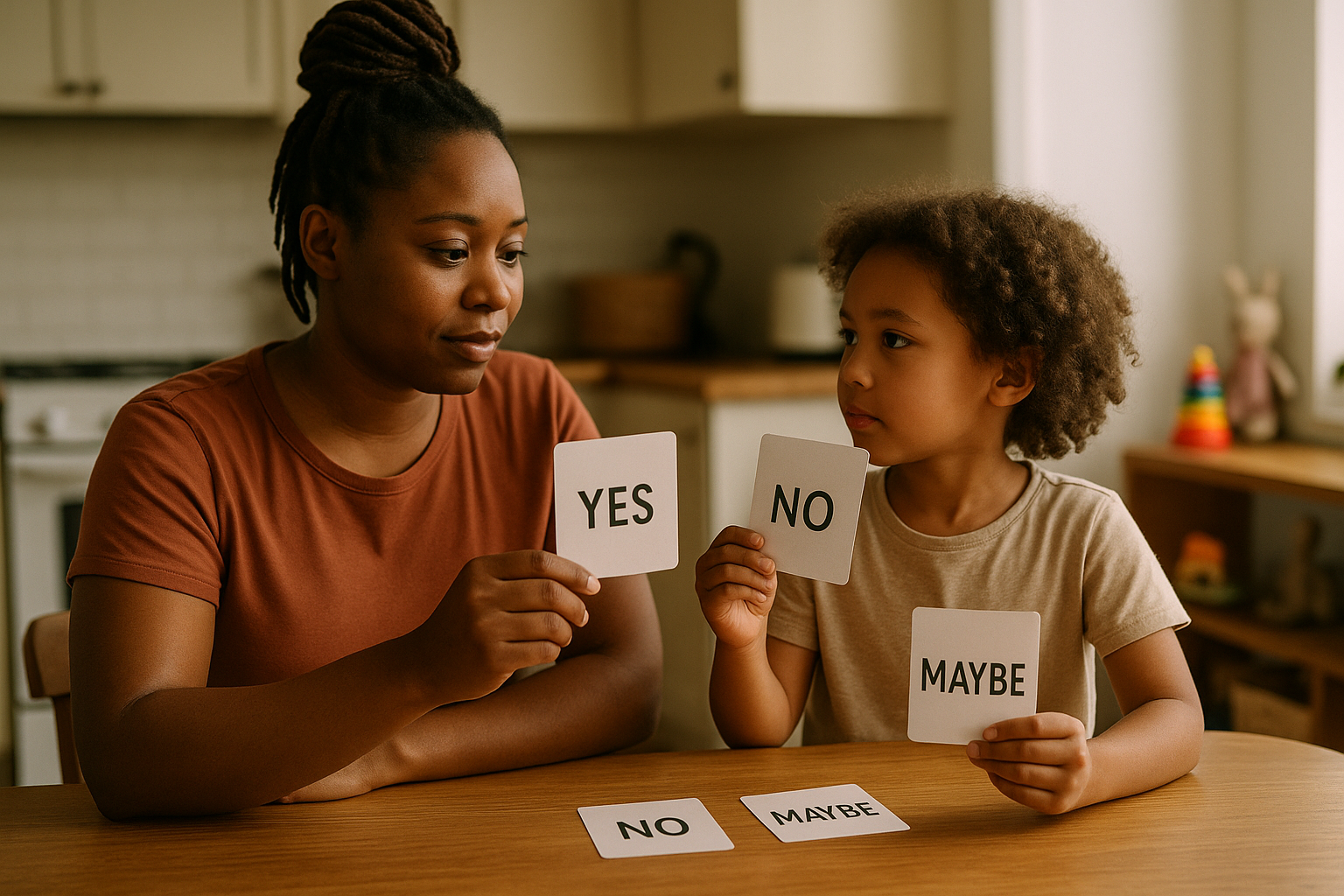
Personal boundaries are the rules we use to protect our bodies, time, feelings, and spaces; for children, they start with simple ideas like “my body belongs to me” and “I can say yes or no to touch.” Respect is the behavior that follows—listening to others’ limits and acting with care. Teaching children about personal boundaries and respect means modeling consent, giving language for choices, and practicing skills in safe, everyday moments. This guide is educational and family-focused; it’s not a substitute for medical, legal, or therapeutic advice. In short: start early, keep it simple, and repeat often.
Quick start (5 steps):
- Name body parts correctly and use plain, shame-free language.
- Ask before touch (“Can I give you a hug?”) and honor the answer.
- Practice a simple consent script: Ask → Agree → Act.
- Create family agreements for privacy, devices, and photos.
- Repair harm with calm, restorative conversations when boundaries are crossed.
1. Model Consent in Everyday Moments
Children learn boundaries first by watching us. The fastest way to teach consent—and to normalize respect—is to make asking permission and honoring answers part of daily routines. Say, “Do you want a hug or a wave?” before contact, and respond to a “no” with warmth, not pressure. Narrate your own limits (“I’m cooking—please give me space by the stove”) and show how you respect others’ limits (“Grandma said no hugging today; let’s high-five”). Pediatric groups emphasize that consistent, developmentally appropriate boundaries foster autonomy while maintaining safety and connection. Modeling also helps children link rules with empathy: when adults listen to their bodies and feelings, kids learn to listen to others’ too. Over time, this steady, low-drama modeling becomes a family norm that kids carry into school, friendships, teams, and digital spaces.
1.1 Why it matters
- Everyday consent routines build safety without fear; they are associated with healthier autonomy and family communication (American Academy of Pediatrics guidance on boundary setting).
- Consistency is developmentally tuned: younger children need simple cues and repetition, while older kids need more autonomy and shared rule-making (CDC developmental milestones).
1.2 How to do it (mini-checklist)
- Ask before touch: “Can I pick you up?” Wait for yes/no.
- Offer choices: “Hug, high-five, or wave?”
- Narrate limits: “I’m not ready to be climbed on; sit next to me.”
- Praise boundary-setting: “Thanks for telling me you didn’t want a tickle.”
- De-pressure affection: Don’t force hugs for greetings; offer alternate connections. Contemporary Pediatrics
Close with calm, consistent follow-through. Children learn that “no” is safe to say—and safe to hear—which is the foundation of respect.
2. Teach a Simple “Ask–Agree–Act” Consent Script
Kids need a memorable, repeatable way to navigate boundaries. A three-step script—Ask → Agree → Act—keeps consent concrete: Ask (“Can I borrow your marker?” or “Do you want to play tag?”), wait for the answer; Agree (confirm “yes,” clarify limits—“No tackling”), and then Act (do only what was agreed, stop if anything changes). This works for physical play, sharing items, and digital situations (“Can I take your photo?”). Practice the script in calm moments so children can use it under excitement or peer pressure. Pair the words with simple gestures (thumbs up/down/flat for “maybe”), and post a fridge card to keep it visible. As children grow, the same script expands: older kids add timing (“for 10 minutes”), context (“only in the backyard”), and reversibility (“you can change your mind”), which aligns with mainstream consent education frameworks.
2.1 Practice ideas
- Micro-drills: Two-minute role-plays before school: one asks to borrow a pencil; one asks to take a photo; one asks to join a game.
- Signal words: “Pause, check, change.” Any player can call “pause,” everyone checks feelings, then changes if needed.
- Photo rule: “Ask → Agree → Act → Ask again before sharing.” Add a final check before posting or forwarding. (UNICEF stresses privacy and permission online.)
2.2 Common mistakes to avoid
- Treating silence or a shrug as “yes.”
- Asking while already acting (“tickle ambush”).
- Ignoring “maybes”—teach kids to treat “maybe/not sure” as “no” until there’s a clear yes.
Close by reinforcing that consent is ongoing—anyone can change their mind, and respectful friends check in.
3. Use Correct Body Names and Body-Safety Rules (e.g., PANTS)
A core boundary skill is naming the body accurately and teaching body-safety rules without shame. Use anatomically correct terms for all body parts; this normalizes bodies and helps children report concerns clearly. Introduce a simple framework like the NSPCC PANTS rule: Private parts are private, Always remember your body belongs to you, No means no, Talk about secrets that upset you, Speak up—someone can help. The tone should be calm and matter-of-fact, starting in early childhood and growing in detail with age and readiness. Include rules for safe vs. unsafe touch and the difference between secrets (never okay if they make you uncomfortable) and surprises (time-limited and fun). Adapt materials for neurodiverse learners using visuals, Makaton/sign support, or social stories; many PANTS resources include these supports.
3.1 How to teach it
- Daily language: Use proper names during bath time and doctor visits (“The doctor checks your penis/vulva with a parent present”).
- Story time: Read body-safety books; discuss feelings (“butterflies,” “tight tummy”) as cues to seek help.
- Practice “No + Go + Tell”: Say no firmly, leave the situation, and tell a trusted adult—identify 3–5 safe adults at home, school, and community. (Stop It Now offers caregiver handouts and conversation prompts.)
3.2 Numbers & guardrails
- Keep lessons short (3–5 minutes) but frequent; repeat weekly for young children.
- Use visual prompts (poster or fridge card) as retrieval cues.
- Revisit after transitions (new school, clubs, travel) when risks and routines change.
Close by making it clear: body-safety rules are about empowerment, not fear; the goal is confident, help-seeking behavior.
4. Create Family Boundary Agreements for Space, Privacy, and Media
Written family agreements turn values into visible habits. Collaboratively set rules for personal space (knocking before entering rooms, changing with privacy), property (asking before borrowing), and media use (where, when, and what). The American Academy of Pediatrics provides a customizable Family Media Plan to set device-free zones, bedtime rules, content expectations, and sharing/“sharenting” guidelines; updating it as kids mature keeps it relevant. Post the agreement in shared spaces, review it monthly, and model adherence—adults follow the same rules. Include a short section on photo consent: ask before taking or posting a child’s image and get their input; UNICEF notes that both you and your child have a right to privacy.
4.1 Agreement builder (starter bullets)
- Space: Knock, wait, and accept “not now.”
- Stuff: Ask before borrowing; return as agreed.
- Screens: Device-free meals/bedrooms; shared charging spot at night.
- Photos: Ask to take; ask again to share; no posting locations/school names. (UNICEF online safety guidance.)
4.2 Tools/Examples
- AAP Family Media Plan (customizable online template).
- Sample family media agreements for elementary learners (Common Sense Media–style templates used by schools).
Close by reminding kids that agreements are living documents—everyone has a voice, and updates happen when needs change.
5. Coach Assertive Communication: Saying—and Hearing—“No”
Respect grows when children can state limits clearly and accept others’ limits gracefully. Teach assertive (not aggressive or passive) communication with body language (steady voice, neutral face, hands down), short scripts, and practice. For young children, start with “Stop. I don’t like that.” For older kids, add reasons and alternatives: “No thanks—too rough. Let’s play catch instead.” Just as crucial: teach kids to hear no—pause, breathe, and pivot without labeling peers as “mean” or sulking. Praise both skills publicly: “I saw you say ‘no’ and keep playing kindly—great respect.”
5.1 Mini-checklist
- Scripts on repeat: “No, thank you.” “I’m not comfortable.” “Please step back.”
- Neutral posture: Feet planted, shoulders relaxed, voice steady.
- Exit plan: “I’m going to read now,” walk to a new space, or find an adult.
- Debrief: After conflicts, ask, “What would you try next time?”
5.2 Why it matters & evidence notes
- Practicing refusal and acceptance skills is a central component of age-appropriate consent education frameworks supported by global health and education agencies (UNESCO/WHO technical guidance). United Nations Population Fund
- Skills should be tuned to developmental stage; expectations for language, impulse control, and perspective-taking change as children grow (CDC milestones).
Close by weaving the language into daily life—boundary words should feel ordinary, not confrontational.
6. Build Emotional Literacy and Empathy That Support Respect
Boundaries stick when children can recognize feelings in themselves and others. Emotional literacy—naming feelings, noticing body cues, and choosing regulation strategies—reduces explosive conflicts that trample limits. Pair this with empathy practice: perspective-taking, labeling others’ feelings, and predicting impact (“If I grab the toy, how will Malik feel?”). Research summaries from psychology organizations emphasize that modeling kindness and explicitly teaching empathy improves caring behavior; in families, children copy both how adults treat them and how adults treat others. Use brief daily routines: “Feelings check-in” at breakfast, “rose/thorn/bud” after school, and “repair scripts” at bedtime.
6.1 Tools & routines
- Name + need: “You feel frustrated; do you need space, help, or a break?”
- Perspective switch: “Tell the story from your friend’s view in one sentence.”
- Regulation menu: Water sip, 10 belly breaths, wall push-ups, quiet corner.
- Media moments: Pause shows to ask, “Who set a boundary? What happened next?”
6.2 Common traps
- Shaming feelings (“Don’t be mad”) instead of guiding behavior.
- Skipping repair after a calm-down.
- Adult sarcasm; kids absorb tone and replicate it with peers.
Close with a reminder: empathy fuels respect; regulation protects boundaries.
7. Practice With Role-Play, Social Stories, and Games (Neurodiversity-Inclusive)
Kids build confidence through playful rehearsal. Role-play typical boundary scenes—joining games, refusing tickles, asking for privacy, saying “stop” during rough-and-tumble play, or declining a photo. Use social stories or visual schedules for children who benefit from clear, concrete expectations. For neurodiverse learners, pair spoken scripts with icons, first/then boards, or Makaton/signs; keep drills short with predictable routines and celebrate small wins. Include peer practice: siblings or classmates alternate roles of “asker” and “decider,” rotating through scenarios. Teaching teams—parents, teachers, coaches—should share the same language so children hear consistent cues across settings. (Educational bodies and charities publish adapted PANTS/social-story materials and symbol-supported videos.)
7.1 Practice pack (3–7 scenarios)
- Play invite: “Can I join your game?” Group offers choices if it’s not a fit.
- Toy conflict: “I’m using it; you can have it when my timer ends.”
- Body safety: “No, stop. I’m going to tell an adult.”
- Privacy: “Door closed means knock and wait.”
- Photo consent: “No photo; please delete that one.”
7.2 Mini case
Run five 90-second drills after dinner three nights a week for two weeks. Track with stickers. Most families see faster, calmer responses in real situations once scripts and signals are rehearsed.
Close by reinforcing that practice isn’t punishment—it’s how teams get good at their plays.
8. Create Safe Digital Habits and Photo/Permission Rules
Respect extends online. Teach children that privacy and consent apply to accounts, devices, photos, and messages: you don’t log into someone else’s account, use their phone without permission, or share their images or information without a clear “yes.” Build habits early—shared screens in common spaces, device-free bedrooms, and a family charging spot at night—then update as maturity grows. Before a child’s first phone or social account, co-create a family media agreement and practice “post checks”: Is it kind? Is it true? Do we have the person’s permission? UNICEF’s parent guidance and the AAP’s Family Media Plan both emphasize checking privacy settings, limiting location sharing, and discussing what to do if something online feels wrong (tell a trusted adult; gather screenshots; block and report).
8.1 Digital boundary checklist
- Ask → Agree → Act → Ask again before sharing any photo/video.
- No secrets online: Surprises are okay; secret chats that feel risky are not.
- Protect info: No posting school names, schedules, or addresses.
- Controls: Use device settings and parental tools as training wheels; revisit quarterly. (AAP guidance) AAP
8.2 Family tools
- AAP Family Media Plan (customize by child/age).
- School-used media agreements for elementary students. Safer Schools Together
Close by making your rule simple: If we wouldn’t do it face-to-face without permission, we won’t do it online either.
9. Repair Harm with Restorative Conversations (Not Shame)
Even with great teaching, boundaries will be crossed—siblings grab, friends ignore “stop,” a child posts a photo without asking. Replace punitive, shame-laden reactions with restorative conversations that teach accountability and repair relationships. Start by regulating a child’s nervous system (water, breath, quiet), then explore: What happened? Who was affected? What needs to be done to make things right? Agree on specific actions (apology, returning items, redraw game rules, delete an image, take a break from certain play). Caregivers stay calm, guide reflection, and connect consequences to learning—short-term restrictions teach when paired with practice and a clear path back. When disclosures involve potential abuse or serious risk, follow child-safeguarding guidance: believe the child, thank them for telling you, keep them safe, and contact appropriate services. (Global and national organizations provide clear, caregiver-friendly guidance and printable scripts.)
9.1 Restorative script (for kids)
- Acknowledge: “I grabbed the toy after you said no.”
- Impact: “You felt mad and left the game.”
- Repair: “I’m sorry. I’ll set a timer next time. Want to play a different game now or later?”
- Plan: Post a written rule: “Timer before turn-taking.”
9.2 Caregiver guardrails
- Separate behavior from identity (“You made an unsafe choice,” not “You’re mean”).
- Rehearse the better choice immediately after the repair.
- Document repeated issues briefly and loop in school/caregivers so strategies match.
Close by celebrating repairs—kids need to see that relationships can mend when we take responsibility with respect.
FAQs
1) What age should I start teaching boundaries and consent?
Start in early childhood with simple, concrete routines: use correct body names during diapering/bath time, ask before touch, and offer choices like hug/hand-wave. As children’s language and impulse control grow (typically through preschool and early primary years), expand the detail—more scenario practice, property rules, and digital habits. Development varies, so match expectations to your child’s skills and revisit often. (CDC milestone checklists can help you tune the language to age.)
2) Won’t talking about private parts sexualize young children?
No. Using anatomically correct terms and matter-of-fact body-safety rules normalizes bodies, reduces shame, and helps children seek help if something’s wrong. The goal is health, safety, and autonomy, not sexual content. Caregiver guides from pediatric and safeguarding organizations encourage starting early with simple language and calm tone.
3) How do I explain “no means no” without making my child fearful of touch?
Keep the message balanced: we say yes or no based on comfort, and we respect others’ answers. Pair rules with lots of positive, consent-based affection—“Do you want a snuggle?”—and model gracious responses to “no.” Emphasize trusted adults and safe, everyday choices. This creates confidence rather than fear. (AAP boundary-setting guidance supports autonomy with safety.)
4) What’s a simple way to teach photo and posting consent?
Use a two-step rule: ask before taking a photo and ask again before sharing. Teach kids to check if any personal information (names, school logos, location) is visible. Keep device privacy settings tight and review them together each term or season. UNICEF’s parent pages provide clear, practical privacy checklists.
5) My child struggles with social cues; what adaptations help?
Use visuals (choice cards, traffic-light cues), short scripts, and predictable practice routines. Adapt body-safety lessons with symbol-supported materials (e.g., PANTS resources for children who use Makaton or have autism), and coordinate the same cues at home and school. Celebrate small steps and keep drills short and frequent.
6) How do we align with school or caregiver rules?
Share your language and agreements (space, property, devices) with teachers, coaches, and babysitters, and ask for theirs. Keep a one-page summary on the fridge/backpack. Update after transitions like new classes or activities so expectations stay consistent across settings. Many schools also invite families to sign media agreements; align your home plan with school policies. Cloudinary
7) What should I do if my child tells me about unsafe touch or bullying?
First, ensure immediate safety. Thank them for telling you, believe them, and say it is not their fault. Keep your tone steady, avoid leading questions, and contact appropriate services/school according to local guidance. Then continue offering predictability, connection, and supportive routines. Caregiver handouts from prevention organizations outline step-by-step responses and talking points. stopitnow.org
8) Are “family media plans” really necessary?
They turn good intentions into consistent habits. A written plan helps you set device-free zones, bedtime rules, content guardrails, and photo/permission rules—and gives kids a voice in the process. The AAP provides a customizable template you can update as children mature. Revisit it quarterly or after major changes such as a new device or app.
9) How often should we practice boundary scripts?
Short, frequent practice works best—think two or three 90-second drills a few times a week. Rehearse common scenarios (borrowing items, saying “stop,” photo permission) and rotate roles. Pair practice with positive feedback and a quick debrief (“What worked? What next?”). Over time, kids reach for scripts automatically during real-life stress.
10) Where can I find trustworthy, non-alarmist resources?
Start with pediatric and child-safety organizations and UN partners: the American Academy of Pediatrics (boundary setting and media plans), NSPCC (PANTS), UNICEF (privacy/online safety), UNESCO/WHO (age-appropriate consent and respect within comprehensive education guidance), and the CDC (developmental milestones). These sources focus on health, autonomy, and respect, not fear.
Conclusion
Teaching children about personal boundaries and respect is less about one “big talk” and more about hundreds of small, calm moments. When you model consent in everyday routines, give kids a repeatable script, make body-safety language normal, and co-create family agreements, children internalize that boundaries are both protective and kind. Assertive communication, emotional literacy, and playful rehearsal help kids act on their values even under excitement or peer pressure, while restorative conversations turn mistakes into learning and relationship repair. The result is a home culture where everyone’s “yes” and “no” matter—and where children carry these habits into friendships, classrooms, and online spaces.
First next step: pick one strategy—like posting an Ask–Agree–Act card on the fridge—and try it tonight.
References
- Parenting and Boundary Setting: Pediatric Mental Health Minute Series. American Academy of Pediatrics, n.d. AAP
- Make a Family Media Plan. American Academy of Pediatrics / HealthyChildren.org, December 19, 2024. HealthyChildren.org
- Talk PANTS: Conversation to Help Keep Children Safe. NSPCC, n.d. NSPCC
- PANTS Resources for Children with Autism and Makaton Users. NSPCC Learning, n.d. NSPCC Learning
- How to Keep Your Child Safe Online. UNICEF Parenting, n.d. UNICEF
- Online Privacy: Checklist for Parents. UNICEF Parenting, n.d. UNICEF
- International Technical Guidance on Sexuality Education. UNESCO/WHO/UNFPA/UNICEF/UNAIDS/UN Women, 2018. World Health Organization
- CDC’s Developmental Milestones (Act Early). U.S. Centers for Disease Control and Prevention, 2024. CDC
- Milestone Moments Checklists (PDF). U.S. Centers for Disease Control and Prevention, 2025. CDC
- Cultivating Empathy. American Psychological Association, November 1, 2021. American Psychological Association