



























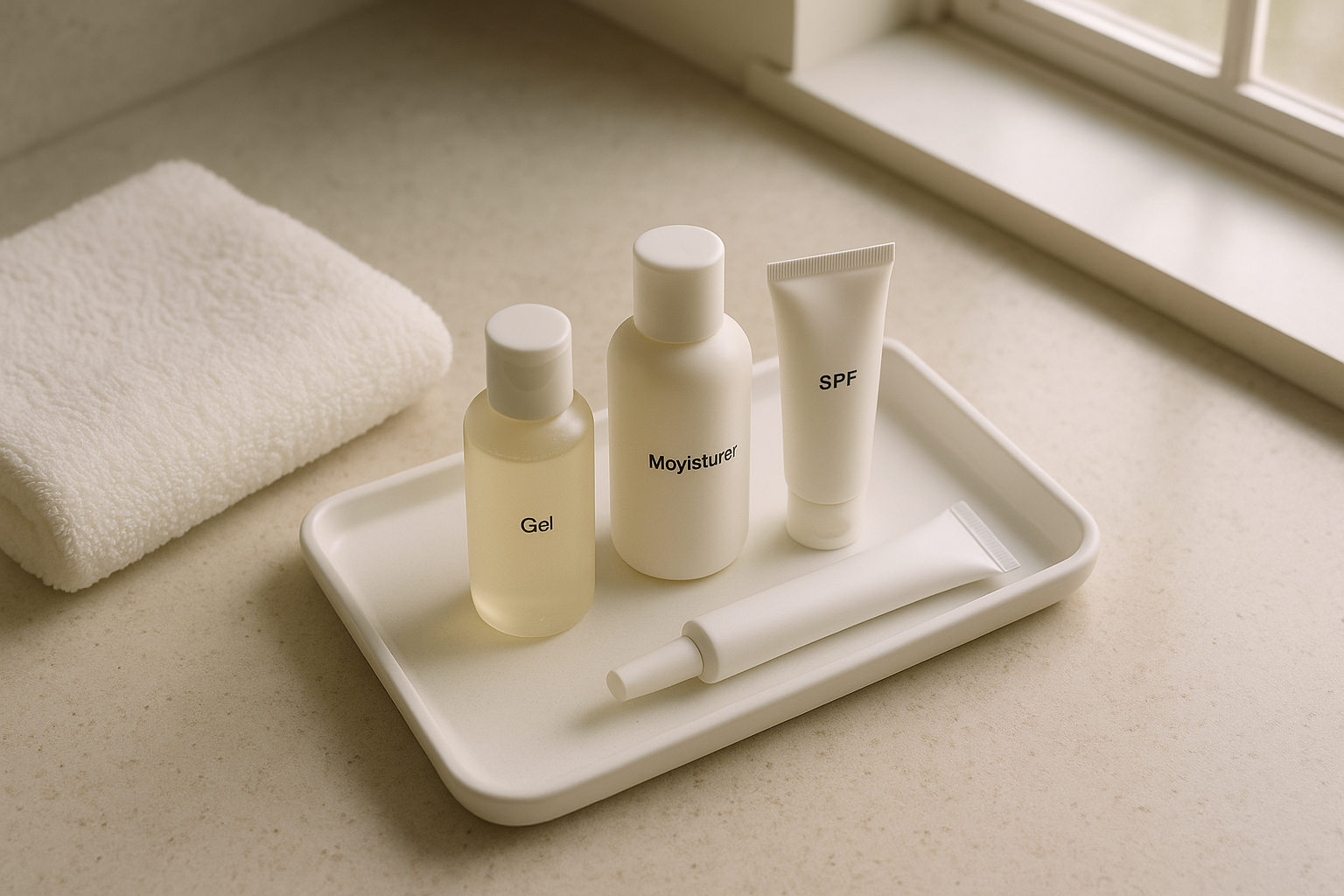
Minimalist skincare isn’t about doing less for the sake of it—it’s about doing only what reliably works. If your counter is crowded but your skin is still stressed, this guide is for you. Below you’ll find a five-step routine that trims the extras and focuses on dependable habits that protect the skin barrier, reduce breakouts, and improve clarity. Expect clear, practical instructions, exact amounts, and realistic timelines. Minimalist skincare means sticking to a gentle cleanse, a barrier-supporting moisturizer, daily SPF, one targeted treatment, and consistent habits. In one line: cleanse, moisturize, protect, treat, and keep it steady.
Quick definition: Minimalist skincare is a results-first routine that uses a few essential steps—gentle cleansing, moisturizing, daily SPF, and one targeted treatment—done consistently to keep skin clear and calm.
At-a-glance steps:
1) Cleanse gently. 2) Moisturize to protect the barrier. 3) Wear SPF 30+ daily. 4) Add one proven treatment (retinoid and/or benzoyl peroxide). 5) Be consistent and patch test before changes.
Brief health note: This guide is educational and not a substitute for personalized medical care. If you have a diagnosed condition (e.g., eczema, rosacea) or use prescription treatments, follow your clinician’s advice.
1. Cleanse Gently, Once or Twice a Day
A minimalist routine starts with a calm, consistent cleanse. Wash in the morning if you feel oily or dirty and always at night to remove sunscreen, sweat, and buildup; after workouts, cleanse promptly. Use lukewarm water and a mild, non-abrasive cleanser (avoid alcohol-heavy toners or harsh scrubs). Over-washing and hot water can strip lipids, weaken the barrier, and trigger more oil or sensitivity—the opposite of clear skin. For makeup, use a dedicated remover or a brief first cleanse, then your regular gentle cleanser; keep any “double cleanse” simple and friction-free. The aim is clean, not squeaky: your face should feel comfortable, not tight.
1.1 Why it matters
Cleansing removes residue that can mix with sebum and dead cells to clog pores, while preserving the skin’s acid mantle so it can defend against irritants. A gentle routine reduces micro-inflammation that often shows up as persistent redness, roughness, or “tiny bumps.” It also sets the stage for your treatment step to penetrate evenly; excessive residue or film can dilute actives and lead to patchy results. A measured cleanse also lowers the risk of barrier disruption that can mimic breakouts.
1.2 How to do it (in 60 seconds)
- Wet with lukewarm—not hot—water.
- Use a nickel-sized amount of a gentle gel or lotion cleanser; massage 30–60 seconds.
- Rinse thoroughly; don’t leave residue at the hairline or jaw.
- Pat dry with a clean towel; avoid rubbing.
- If you wore heavy makeup/sunscreen: remove with micellar water or balm first, then cleanse.
1.3 Numbers & guardrails
- Frequency: Usually once at night; add a morning cleanse if oily or after sweating.
- Time: 30–60 seconds of contact is enough; longer doesn’t mean cleaner.
- Water temp: Comfortably lukewarm; extreme temperatures can aggravate skin.
1.4 Common mistakes
- Scrubbing with rough cloths or brushes “for a deeper clean.”
- Switching cleansers constantly; give a formula two weeks before judging.
- Using body bar soap on the face (often too alkaline).
- Neglecting the rinse—residue along the hairline is a breakout magnet.
Bottom line: Clean, calm skin responds better to everything else. Keep it gentle, brief, and consistent.
2. Moisturize to Lock In Water and Protect Your Barrier
Moisturizer is non-negotiable—even for oily or acne-prone skin. A good formula reduces transepidermal water loss, supports the lipid matrix, and keeps the barrier resilient so actives like retinoids are better tolerated. Apply within three minutes of cleansing (“the damp-skin rule”) and look for non-comedogenic or oil-free on the label to minimize pore-clogging risk. Ingredients to favor: humectants (glycerin, hyaluronic acid) to attract water; emollients (squalane, fatty alcohols) to smooth; and occlusives (petrolatum, mineral oil) to seal—dry skins often need all three, while oilier skins may prioritize humectants + light emollients. Ceramide-containing creams can help reinforce the barrier, and ointments outperform lotions for severe dryness. American Academy of Dermatology
2.1 How to choose (by skin feel, not just type)
- Shiny by midday / frequent breakouts: Gel-cream labeled non-comedogenic with glycerin + niacinamide; avoid heavy occlusives in daytime.
- Tight or flaky after cleansing: Cream with ceramides + hyaluronic acid; consider a thin petrolatum layer (pea-size) at night on the driest zones.
- Combination: Use a light gel-cream on T-zone and a cream on cheeks.
- Sensitive: Fragrance-free, short ingredient list; patch test first (see Step 5).
2.2 Numbers & guardrails
- Amount: About a blueberry-size for the face; more if neck/chest are included.
- Order: Cleanser → treatment (if used) → moisturizer → sunscreen (AM).
- Timing: Within 3 minutes post-cleanse to trap water.
2.3 Mini-checklist
- Labeled non-comedogenic/won’t clog pores for acne-prone skin.
- Fragrance-free if easily irritated.
- Ceramides/humectants for barrier support.
- Texture you’ll actually use twice daily.
Bottom line: A steady moisturizer routine keeps the barrier intact, so your skin looks clearer, less reactive, and more even over time.
3. Wear Broad-Spectrum SPF 30+ Every Day, the Right Amount
Daily sunscreen is the single most protective habit for long-term clarity and tone. UV exposure fuels hyperpigmentation, redness, and texture changes; sunscreen helps prevent these while protecting your barrier. Use broad-spectrum SPF 30 or higher and apply enough: about 1 ounce (a shot-glass) for the body, and ~1 teaspoon for the face/neck—a common shorthand is “two finger lengths” of sunscreen for the face. Reapply every two hours outdoors, and every 40–80 minutes if water-resistant and you’re swimming or sweating. If sprays are your preference, spray until skin glistens and rub in to ensure even coverage.
3.1 How to make SPF minimalist (and wearable)
- Try a lightweight gel-cream SPF to replace a separate morning moisturizer if your skin tolerates it.
- Choose tinted mineral formulas if you’re sensitive; the iron oxides may also help with visible light-induced pigmentation.
- Prefer labeled non-comedogenic SPFs to reduce pore-clogging risk.
3.2 Numbers & guardrails
- Face amount: ~1 teaspoon (≈ 5 mL); for a quick visual, the length of two fingers.
- Body: ~1 ounce (≈ 30 mL) per full-body application.
- Reapply: Every 2 hours outdoors; sooner after swimming or heavy sweat.
- Lead time: Apply 15 minutes before sun exposure if using chemical filters.
3.3 Region & lifestyle notes
- Humid climates: Favor gels or fluids; blot, then reapply mid-day.
- Dry/cold weather: Layer SPF over a hydrating moisturizer.
- Sport/water: Use water-resistant SPF 40–80 min; set a timer to reapply.
Bottom line: Correct amount + consistent reapplication is what turns SPF from a nice idea into real-world protection and clearer, more even skin.
4. Add One Proven Treatment: Retinoid and/or Benzoyl Peroxide
A minimalist routine uses at most one or two evidence-based actives. For most people pursuing clear skin, the highest-impact pair is a topical retinoid (e.g., adapalene 0.1%) and benzoyl peroxide (BPO 2.5–5%). Retinoids normalize cell turnover and help prevent clogged pores; BPO reduces acne-causing bacteria and inflammation without promoting antibiotic resistance. Start with adapalene 0.1% at night, three times weekly, then build to nightly as tolerated; add a thin layer of BPO in the morning or on alternate nights for inflamed breakouts. Expect 6–8 weeks for a visible change and up to 12 weeks for steady clarity—rushing and stacking extra acids just adds irritation. Adapalene 0.1% is FDA-approved for over-the-counter acne treatment (ages ≥12), and guidelines strongly recommend retinoids and BPO for mild-to-moderate acne. Retinoids can increase sun sensitivity; pair with daily SPF (Step 3). FDA Access Data
4.1 How to layer (so it actually works)
- Night (introducing retinoid): Cleanse → pat dry → wait 10–20 minutes → pea-size of adapalene for the whole face (not spot-only) → moisturizer.
- Morning: Cleanse (if needed) → light moisturizer → thin layer of BPO (2.5–5%) on breakout-prone areas → sunscreen.
- Sensitive approach: Sandwich retinoid between two thin moisturizer layers.
4.2 Numbers & guardrails
- Amounts: Pea-size for retinoid; a fingertip unit of BPO treats ~2 palm-size areas.
- Ramp-up: 3 nights/week × 2 weeks → 5 nights/week × 2 weeks → nightly.
- Irritation plan: Reduce frequency; add moisturizer; avoid other exfoliants.
4.3 Common mistakes
- Spot-treating with retinoids (they’re preventive, not just corrective).
- Quitting at week 3 during the “adjustment” phase.
- Layering multiple acids/peels while learning a retinoid—keep it simple.
- Using BPO with colored towels/sheets (it can bleach fabric).
4.4 Example: 12-week clarity plan
- Weeks 1–2: Adapalene 3x/week; moisturizer nightly; BPO every other morning.
- Weeks 3–6: Adapalene 5x/week; adjust BPO to daily if tolerated.
- Weeks 7–12: Adapalene nightly; BPO as needed for maintenance.
Bottom line: One retinoid + one BPO, introduced methodically, clears and prevents most mild-to-moderate breakouts with less irritation than a crowded routine.
5. Be Consistent, Patch Test, and Keep Changes Deliberate
The minimalist difference is consistency. Use the same core products daily and resist the urge to constantly “fix” your skin with new jars. Before adding anything new, patch test on a small area twice daily for 7–10 days; if no reaction appears, then apply to your face. Give a new routine 6–8 weeks before judging results unless you see obvious irritation (burning, severe peeling). Follow a simple order in the morning (cleanser → treatment if using → moisturizer → sunscreen) and at night (cleanser → treatment → moisturizer). If acne isn’t improving after three months of over-the-counter care, or if you develop scarring or nodules, see a dermatologist for prescription options.
5.1 Mini-checklist for sticky habits
- Same place, same time: Keep products visible where you wash up.
- Prep for reapply: Carry a travel SPF and blotting papers.
- Laundry & hair: Wash pillowcases weekly; keep hair products off the hairline to avoid “pomade acne.”
- Track, don’t guess: Snap weekly photos in the same light; compare at weeks 4, 8, and 12.
5.2 When to adjust
- Too dry/irritated: Increase moisturizer, reduce retinoid nights, pause other actives.
- Still breaking out after 8–12 weeks: Confirm you’re using enough BPO and sunscreen isn’t too occlusive; consider an in-office consult.
- Dark marks linger: Maintain SPF; retinoid helps; consider azelaic acid later, one change at a time.
5.3 Example minimalist AM/PM (acne-prone, normal-oily)
- AM: Gentle gel cleanse → BPO (thin layer) → gel-cream moisturizer → SPF 50.
- PM: Gentle cleanse → pea-size adapalene → moisturizer.
Bottom line: Clear skin is rarely about the latest product; it’s about steady, well-chosen steps and giving them time to work.
FAQs
1) What exactly counts as “minimalist skincare”?
A routine that prioritizes effectiveness over variety: a gentle cleanse, a barrier-supporting moisturizer, daily SPF 30+, and one targeted treatment (usually a retinoid ± benzoyl peroxide). Everything else is optional and added only if there’s a clear, consistent benefit for your skin. Minimalist skincare isn’t anti-science; it’s pro-discipline and pro-results.
2) If my skin is oily, do I still need moisturizer?
Yes. Oil and water are different needs. Oily skin can still be dehydrated; a lightweight, non-comedogenic gel-cream with humectants reduces water loss and helps balance shine. Skipping moisturizer often leads to compensatory tightness and irritation, which can trigger more perceived oiliness and make actives harder to tolerate long-term.
3) How long before I see results with a retinoid or BPO?
Plan on 6–8 weeks to see meaningful change, and up to 12 weeks for steady “new normal” clarity. Improvement is gradual because retinoids work on cell-turnover cycles, and BPO reduces inflammatory lesions over weeks. Snap weekly photos in consistent lighting so you can see trajectory rather than day-to-day noise.
4) Do I have to cleanse in the morning?
If you’re dry or sensitive, rinsing with lukewarm water and applying moisturizer + SPF can be enough. If you’re oily or sweat overnight, a quick gentle cleanse helps. Always cleanse after workouts and at night to remove sunscreen and buildup. Default to what keeps your skin comfortable, not squeaky.
5) Is double cleansing necessary?
Only if you wear heavy, water-resistant sunscreen or long-wear makeup. Keep it minimal: a brief oil/micellar step to dissolve makeup, then your regular gentle cleanser. If you don’t wear much makeup, a single cleanse is fine—and kinder to your barrier.
6) Mineral or chemical sunscreen—which is better for acne-prone skin?
Both can work. If your skin is reactive, tinted mineral formulas (zinc oxide/titanium dioxide) often feel gentler and the tint can help with visible light-induced pigmentation. If you prefer the feel of chemical filters, choose a lightweight gel-cream labeled non-comedogenic and apply enough; amount and reapplication matter more than filter class.
7) Can I use niacinamide, vitamin C, or acids in a minimalist routine?
You can—but add selectively and one at a time. Start with the core five steps first. If hyperpigmentation is a concern, vitamin C or azelaic acid can be helpful, but introduce only after your skin tolerates a retinoid and daily SPF. Avoid stacking multiple acids with a new retinoid to minimize irritation.
8) How much sunscreen do I really need for my face?
Around one teaspoon (~5 mL), which roughly equals two finger lengths for most lotions. Reapply every two hours outdoors and sooner if you’re swimming or sweating. Many people under-apply; using the correct amount is the simplest “upgrade” you can make.
9) My retinoid makes me peel. What should I change?
Try the “sandwich” method: moisturizer → pea-size retinoid → moisturizer. Reduce to every other night, and avoid other exfoliants temporarily. Peeling often settles within a few weeks as your barrier adapts; if irritation persists, scale back and consider a consult.
10) How do I know if a product will clog my pores?
Look for “non-comedogenic,” “won’t clog pores,” or “oil-free” on the label. These aren’t absolute guarantees for every person, but they reduce risk. If you break out, it may be the product or the amount/frequency—simplify, patch test, and re-introduce slowly to identify the culprit.
11) Can I skip moisturizer if my SPF is hydrating?
Yes, if your SPF formula provides enough hydration and you’re comfortable all day. Many gel-cream SPFs can double as daytime moisturizer for normal to oily skin. If you feel tight or flaky, add a separate moisturizer underneath.
12) When should I see a dermatologist?
If you’re developing scars or cystic/nodular acne, if over-the-counter care hasn’t helped after 12 weeks, or if you have significant redness, scaling, or pain. Prescription options (topical combinations, oral medications, or in-office treatments) can prevent scarring and accelerate results.
Conclusion
Minimalist skincare trades novelty for reliability. By centering your routine on five essentials—gentle cleansing, barrier-savvy moisturizing, daily SPF, one proven treatment, and consistent habits—you lower irritation, cut decision fatigue, and give your skin what it actually needs to stay clear. The payoff is compounding: calmer skin tolerates actives better, which improves clarity, which reduces the urge to over-treat. Keep the steps small but exact: cleanse for comfort, moisturize on damp skin, measure your SPF, introduce a retinoid and/or benzoyl peroxide slowly, and stick with the plan long enough to see real change. Your routine should be so simple you can do it on your most tired day—and so effective you don’t want to change it.
CTA: Start tonight: cleanse, pea-size retinoid, moisturizer—then measure your sunscreen tomorrow morning.
References
- How to apply sunscreen, American Academy of Dermatology (AAD), n.d., https://www.aad.org/public/everyday-care/sun-protection/shade-clothing-sunscreen/how-to-apply-sunscreen
- Sunscreen FAQs, AAD, n.d., https://www.aad.org/media/stats-sunscreen
- How to decode sunscreen labels, AAD, Apr 25, 2024, https://www.aad.org/public/everyday-care/sun-protection/shade-clothing-sunscreen/understand-sunscreen-labels
- How to use stick and spray sunscreens, AAD, n.d., https://www.aad.org/public/everyday-care/sun-protection/shade-clothing-sunscreen/how-to-use-stick-spray-sunscreens
- Face washing 101, AAD, n.d., https://www.aad.org/public/everyday-care/skin-care-basics/care/face-washing-101
- Acne — Do not wash more than twice a day, NHS (UK), last reviewed Dec 2023, https://www.nhs.uk/conditions/acne/
- Dermatologist-recommended skin care for your 20s (cleansing frequency; retinoid timing), AAD, Feb 23, 2023, https://www.aad.org/public/everyday-care/skin-care-basics/care/skin-care-in-your-20s
- Moisturizer: Why you may need it if you have acne, AAD, n.d., https://www.aad.org/public/diseases/acne/skin-care/moisturizer
- 4 skin care tips for your hands (ceramides, humectants, occlusives), AAD, May 25, 2021, https://www.aad.org/public/everyday-care/skin-care-basics/care/skin-care-tips-hands
- How to care for your skin in your 60s and 70s (ointment vs. cream; barrier), AAD, Sep 8, 2021, https://www.aad.org/public/everyday-care/skin-care-basics/care/skin-care-in-your-60s-and-70s
- Guidelines of care for the management of acne vulgaris, Journal of the American Academy of Dermatology (JAAD), 2024 update, https://www.jaad.org/article/S0190-9622%2823%2903389-3/fulltext
- Topical retinoid acne treatment approved for OTC use (Differin Gel 0.1% adapalene), U.S. FDA, 2016, https://www.fda.gov/files/science%20%26%20research/published/Topical-retinoid-acne-treatment-approved-for-OTC-use.pdf
- How to test skin care products (patch testing 7–10 days), AAD, Aug 10, 2021, https://www.aad.org/public/everyday-care/skin-care-secrets/prevent-skin-problems/test-skin-care-products
- 9 things to try when acne won’t clear (non-comedogenic labeling; habits), AAD, Sep 12, 2023, https://www.aad.org/when-acne-wont-clear