




























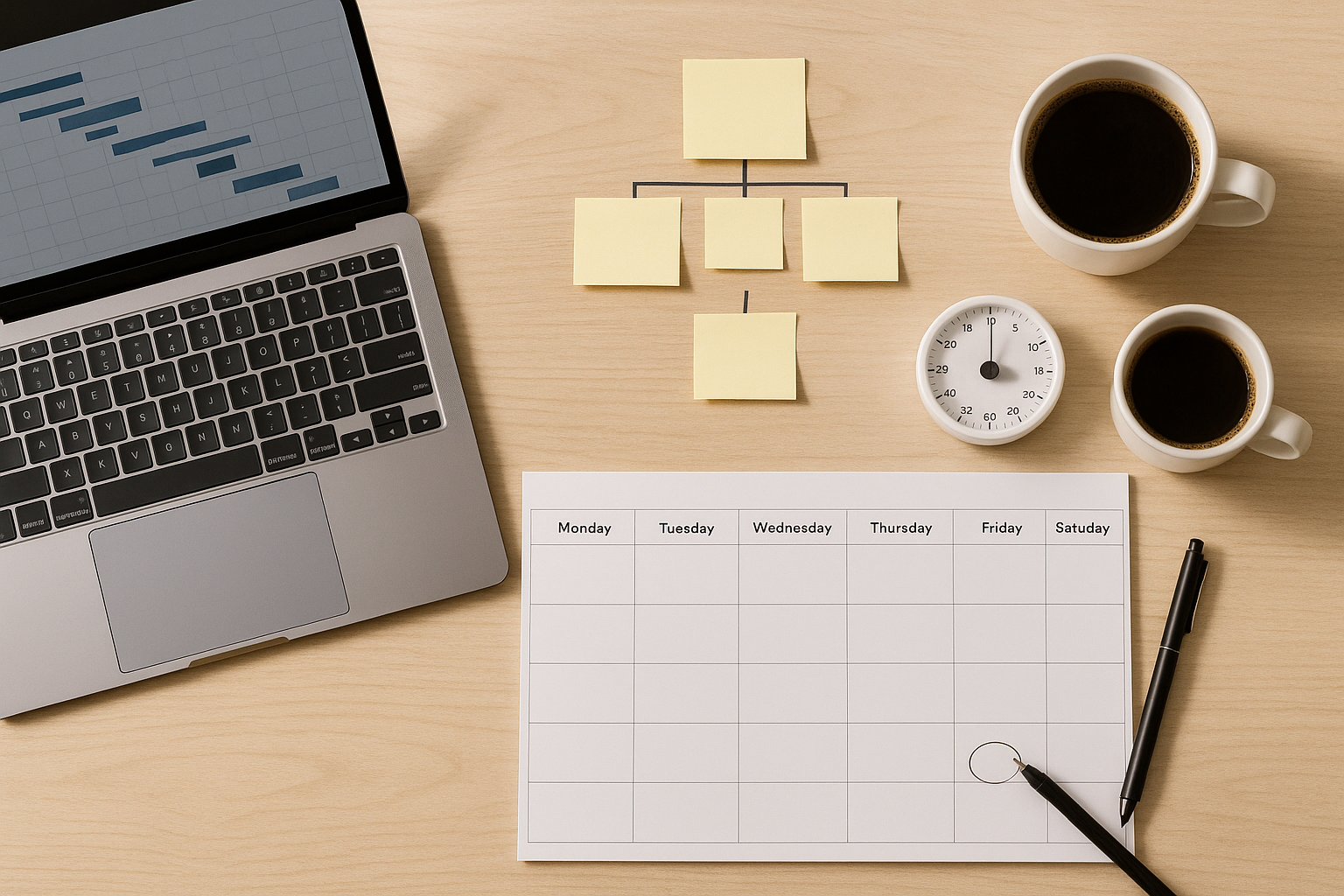
Big goals stall when they stay abstract. The fastest way to move them is to translate the “someday” outcome into visible milestones and small, calendar-protected actions you can do today. This guide is for anyone with a multi-month or multi-year project—launching a product, writing a thesis, changing careers—who needs a method to make daily progress without burning out. You’ll learn eight research-backed strategies that connect your North Star to the next ten minutes, including how to structure milestones, pick the right daily step, and protect time to do it.
Quick definition: Long-term goal planning is the process of turning a multi-month or multi-year objective into measurable outcomes, staged milestones, and daily actions that are scheduled, tracked, and reviewed.
Quick start: Pick one objective → define one success metric → list three milestones → choose the smallest next action → schedule it for tomorrow morning.
1. Define a Measurable Finish Line (Vision + Success Metric)
Begin by deciding exactly what “done” means and how you’ll know you’re getting closer. A clear finish line reduces ambiguity and helps you choose the right daily steps. In practice, this means writing a one-sentence vision (“Publish a 60,000-word first edition of X by December 15”) and pairing it with a small set of success metrics (e.g., word count, beta-reader scores, or preorders). Research on goal setting consistently shows that specific, challenging goals outperform vague intentions, because they direct attention, mobilize effort, and encourage persistence. When you define a finish line in concrete terms, you also create natural checkpoints for feedback and course correction—the raw material for effective daily planning. Finally, clarity at the top prevents wasted motion; it’s easier to say no to nice-to-have tasks when you know exactly what “win” looks like.
1.1 How to write it
- Vision statement: One sentence starting with a verb and a date (e.g., “Launch a B2B analytics product to 50 paying teams by Nov 30”).
- Success metrics: 1–3 quantifiable measures tied to outcomes (e.g., activation rate ≥40%, NPS ≥30, revenue ≥$X).
- Boundary conditions: What you will not do (e.g., “No enterprise features in v1”).
- Initial scope notes: Audiences, platforms, languages, or regions included/excluded.
1.2 Numbers & guardrails
- Keep metrics count to three or fewer to avoid dilution.
- Make each metric observable weekly (e.g., “chapters drafted” instead of “quality”).
- If you’re unsure, ask: What number would convince a skeptical peer we’re on track?
Synthesis: A measurable finish line is the anchor; every other strategy below exists to make its daily pursuit easier and more reliable.
2. Translate the Vision into Quarterly OKRs and SMART Targets
Turn the finish line into quarterly OKRs (Objectives & Key Results) backed by SMART targets so you can measure progress in 12–13-week chunks. The Objective captures what you’re trying to achieve this quarter; the Key Results define how you’ll measure it. At Google and elsewhere, Key Results are graded on a 0.0–1.0 scale—useful because it forces clarity and honest scoring at the end of the period. Pairing OKRs with SMART criteria (Specific, Measurable, Achievable, Relevant, Time-bound) eliminates ambiguity and helps you design daily steps that obviously move the needle. This combo creates a bridge: the long-term vision guides the OKR, and the OKR’s metrics tell you which actions to take today.
2.1 Example
Objective (Q4): “Release v1 and reach early product-market fit.”
Key Results:
- KR1: 50 paying teams (graded 0.0–1.0).
- KR2: Activation rate ≥40% in first week.
- KR3: Median time-to-value ≤10 minutes.
2.2 Mini-checklist
- Convert each KR into weekly leading indicators (e.g., “# onboarding calls booked”).
- Write one SMART target per KR (e.g., “Ship onboarding checklist by Oct 10”).
- Resist adding more than 3–4 KRs per objective.
Synthesis: OKRs make the vision manageable; SMART turns each KR into a daily to-do you can actually schedule and finish.
3. Build a Work Breakdown Structure (WBS) and Milestones
A Work Breakdown Structure decomposes your project into hierarchical deliverables and work packages so nothing critical hides inside vague labels. Instead of planning by activities (“work on app”), a WBS organizes by outcomes (“Authentication module → OAuth flow → redirect handling”). This product-oriented tree becomes your milestone map, clarifying dependencies and revealing the true size of the work. Space agencies and large programs rely on WBS to define total scope and assign accountability; the same logic works for personal and team projects—if you can’t place a task under a deliverable, it probably shouldn’t be on your list.
3.1 How to do it
- Top level: 5–10 major deliverables (chapters, modules, campaigns).
- Next levels: Break each deliverable into work packages that can be completed in ≤1–2 weeks.
- Milestones: Name stage gates with dates (e.g., “Beta ready 11/05”).
- Dictionary: For each package, write a 1–2 sentence description, owner, and acceptance criteria.
3.2 Tools/Examples
- Tools: Project boards (Jira/Trello), mind-map apps, or a spreadsheet with WBS codes (1.0, 1.1, 1.1.1).
- Example (book): 1.0 Manuscript → 1.1 Outline → 1.1.1 Chapter list; 1.2 Draft → 1.2.1 Ch.1 first draft, etc.
Synthesis: A WBS transforms a fuzzy project into concrete, schedulable chunks—fuel for the daily step you’ll pick each morning.
4. Script Daily If–Then Actions (Implementation Intentions)
To ensure today’s step actually happens, write implementation intentions: “If it’s 8:30 a.m. and I’ve opened my laptop, then I’ll outline Section 2 of the onboarding guide.” This if–then format links a cue (time or context) to a precise action, dramatically reducing the gap between intention and behavior. Decades of research shows these plans help people get started, persist through difficulty, and complete intended behaviors more often than vague resolutions. Combining this with mental contrasting (imagining success and the main obstacle) strengthens motivation and prepares you to navigate friction when it shows up.
4.1 How to write one
- Cue: Time, location, or preceding routine (“after I make tea at 9:00”).
- Action: Specific, observable, small enough to finish in ≤60 minutes.
- Fallback: One pre-decided backup if the cue is missed (“at 3:00 p.m. instead”).
4.2 Mini case
- Goal: “Publish 12 chapters.”
- If–then: “If it’s 7:30–8:30 a.m., then draft 300 new words with Wi-Fi off.”
- Contrast: “The obstacle is Slack pings; I’ll quit the app before starting.”
Synthesis: Implementation intentions remove decision fatigue at the moment of action; you’ve already chosen what to do and when to do it.
5. Turn Steps into Habits (Be Patient with Automaticity)
Daily progress sticks when it becomes automatic. Studies tracking real-world habit formation found that consistency—repeating the behavior in the same context—gradually increases automaticity, often taking many weeks (with wide variation). That’s a cue to stay patient: you’re building a pattern that pays compounding returns. Design your environment to make the step obvious and easy: stage your tools, prewrite your next starting line, and reduce the number of clicks between you and the task. Expect missed days, and treat them as signals to simplify, not reasons to quit.
5.1 How to accelerate stickiness
- Use a stable cue: Same time and place each weekday.
- Lower the bar: Define a minimum viable step (e.g., “open IDE and run tests”).
- Track visibly: Tally streaks on paper or a habit app.
- Automate setup: Scripts, templates, or checklists that make starting trivial.
5.2 Numbers & guardrails
- If you miss a day, restart tomorrow; protect the pattern over the perfect streak.
- Consider labeling the block “standing appointment” so teammates respect it.
Synthesis: Habits turn willpower into autopilot. Keep the context stable and the step small enough to repeat regardless of mood or meetings.
6. Timebox Your Day to Beat Parkinson’s Law
Put your daily step on the calendar in a protected block (e.g., 45–90 minutes), and treat it like a real meeting. This is timeboxing—migrating important tasks into scheduled time slots rather than keeping them on a hopeful list. In comparative reviews of productivity techniques, timeboxing stands out because it forces focus, creates a natural stopping point, and shrinks work to fit the box (countering the tendency for work to expand to fill available time). Pair each box with a clear deliverable (“finish API test plan”) and a visible timer; once the bell rings, stop, log results, and schedule the next box.
6.1 Practical setup
- Block length: Start with 50 or 75 minutes; add a 10–15-minute buffer after.
- Naming: Use verbs (“Draft intro”) so your future self knows what to do.
- Boundaries: Mute notifications; close chat; set status to “Focus—back at 11:15.”
- End ritual: Write the very next action you’ll take tomorrow.
6.2 Mini-checklist
- Put two boxes for your highest-leverage work before noon if possible.
- Keep at least 20% of the day unscheduled for inevitable surprises.
- If you overrun twice in a row, split the task or tighten the definition.
Synthesis: Calendars are commitment devices; timeboxes turn intention into a date with your future self—and a finished slice of the project.
7. Estimate Realistically and Add Buffers (Defeat the Planning Fallacy)
Humans chronically underestimate how long tasks will take, even when they’ve done similar work before—a bias known as the planning fallacy. The fix is to estimate using reference classes: look at how long similar tasks took last time (yours or others’) and use that as the baseline. Convert that history into a range (optimistic, most likely, pessimistic), and add buffers at the milestone (not day) level. This keeps today’s step crisp while protecting the schedule against overruns. When you review, compare actuals to estimates and adjust the next range; over a few weeks your forecasting gets sharper and your stress drops.
7.1 How to estimate (3-point)
- O (Optimistic): If everything clicks (e.g., 2 hours).
- M (Most likely): Typical conditions (e.g., 4 hours).
- P (Pessimistic): If you hit the usual snags (e.g., 8 hours).
- Planned duration: Use a weighted average or plan against M with a buffer.
7.2 Common mistakes
- Relying on inside view (“This time will be different”) instead of past data.
- Hiding buffers inside daily tasks; put them at milestone or sprint level.
- Estimating large, fuzzy tasks; decompose first, then estimate.
Synthesis: Honest ranges plus milestone buffers make schedules believable—and keep daily steps achievable without heroics.
8. Review Weekly: Score, Learn, and Reset the Next Steps
End every week with a short review: score outcomes, reflect on what worked, and reset next week’s daily steps. Borrow the OKR habit of grading Key Results on a 0.0–1.0 scale; it encourages nuance (0.6 is decent progress) and exposes where your plan needs adjusting. Summarize three bullets: Shipped, Learned, Next. Reconcile your WBS and timeline, then pre-load your calendar with next week’s timeboxes. This rhythm keeps the long-term goal alive in your day-to-day and prevents drift. Over a quarter, these reviews become a record of incremental wins that compound into finished projects.
8.1 Weekly agenda (25–40 minutes)
- Score: Update metrics and KR grades (0.0–1.0).
- Debrief: What helped or hindered? Note one small process fix.
- Reset: Choose next week’s 3–5 critical steps; schedule timeboxes.
- Risks: Name emerging risks; decide one pre-emptive action.
8.2 Mini case
- Grade KR1 at 0.5 (25/50 paying teams).
- Learning: Activation stalls on step 3; fix is guided tour.
- Next: Timebox “Ship tour” Monday 10–12; “Run 5 user calls” Tue–Thu.
Synthesis: Reviews close the loop: score reality, learn fast, and feed what you learn back into Monday’s calendar.
FAQs
1) What’s the difference between long-term goal planning and project management?
Long-term goal planning focuses on translating a big, personal or team objective into measurable milestones and daily actions you can execute consistently. Project management adds formal layers—scope, schedules, budgets, risk logs—useful as projects grow. If you’re a solo creator, you can get far with a lightweight WBS, weekly reviews, and calendar timeboxes; as teams and stakes increase, borrow more PM tools. The point is to keep a tight link between the North Star and today’s next step, not to produce documents for their own sake.
2) How small should a “daily step” be?
Small enough to finish in ≤60 minutes without external dependencies. “Draft the API errors section” or “Outline Chapter 3 scenes” works; “Finish Chapter 3” doesn’t. The aim is momentum plus completion signals—you should be able to mark it done and see how it nudges your Key Results. If you routinely run over, split the step or redefine the deliverable until it fits one timebox.
3) Do SMART goals still matter if I’m using OKRs?
Yes—use SMART to write each Key Result and its supporting tasks clearly, then use OKRs to align and score. SMART eliminates ambiguity at the task level; OKRs ensure those tasks ladder up to what matters this quarter. A simple rule: every KR should be SMART enough that a neutral observer can tell if you hit it without debate.
4) How do I prioritize today’s step when everything feels important?
Use the Eisenhower Matrix: pick the important-but-not-urgent action that moves a KR and schedule it before reactive work. Then limit the number of “urgent” tasks that hijack your morning by deferring, delegating, or deleting. This prevents your day from being consumed by other people’s priorities while your long-term goal stalls. Asana
5) What if I keep underestimating how long things take?
That’s normal—the planning fallacy bites everyone. Start keeping a personal reference class: log estimated vs. actual time by task type (e.g., “spec writing,” “debugging,” “editing”). Next time, plan using the historical median rather than your optimistic gut. Add buffers at the milestone level so daily steps stay achievable. Your estimates will improve within a few weeks.
6) How do I maintain motivation over months?
Combine mental contrasting (visualize success and the main obstacle) with implementation intentions (if–then plans). This mixture (MCII) is shown to strengthen follow-through across ages and domains. Celebrate process wins—timeboxes completed, drafts shipped—not just outcome milestones, so you get more frequent reinforcement. Social Psychology and Motivation
7) Is timeboxing better than a traditional to-do list?
They complement each other, but timeboxing solves a key failure of to-do lists: prioritization by calendar. By assigning when you’ll do a step and for how long, you protect focus and prevent work from expanding endlessly. For high-leverage work, move it to the morning calendar, not the someday list.
8) What tools do you recommend?
Pick tools that match the strategies: a whiteboard or spreadsheet for WBS, a calendar for timeboxing, and a lightweight tracker for OKR grades. Many teams use Jira/Linear for work packages, Google Sheets or Notion for OKRs, and any major calendar app for focus blocks. The tool matters less than the habits: weekly reviews, clear next actions, and visible metrics.
9) How often should I review progress?
Weekly is the sweet spot: long enough to accumulate signal, short enough to correct course. Use a 25–40 minute Friday review to grade KRs (0.0–1.0), note one process fix, and pre-schedule next week’s timeboxes. Do a heavier quarterly review to reset OKRs.
10) How do I avoid burnout while pushing a big goal?
Design for consistency over intensity: shorter daily steps, stable cues, and protected recovery. Keep at least 20% of your week unscheduled for variability. When you miss, resume the pattern the next day without compensation marathons—habits form through repetition, not heroic sprints.
Conclusion
Big goals become real when you can point to what you’ll do today. The eight strategies above connect your North Star to a calendar slot you’ll actually protect. You defined a measurable finish line, turned it into quarterly OKRs and SMART targets, decomposed the work with a WBS, and scripted if–then daily actions. You made those steps stick by building habits, timeboxing them on your calendar, estimating honestly with buffers, and closing the loop with weekly reviews. None of this relies on motivation showing up on cue; it relies on structure, clarity, and small wins that accumulate.
Pick one goal. Write a one-sentence finish line and three metrics. Build a rough WBS in 20 minutes. Schedule one 50-minute timebox tomorrow with an if–then plan. Show up, ship a slice, and log what you learned. Repeat next week with a short review and an honest reset. Your future self is built in these tiny, well-designed steps—start now with one block on your calendar.
CTA: Choose your goal, schedule one 50-minute block for tomorrow morning, and write the exact if–then action you’ll start with.
References
- Building a Practically Useful Theory of Goal Setting and Task Motivation: A 35-Year Odyssey, American Psychologist (Locke & Latham), 2002. Stanford Medicine PDF: Stanford Medicine
- Set goals with OKRs, Google re:Work (guide, grading 0.0–1.0), n.d. Rework
- There’s a S.M.A.R.T. Way to Write Management’s Goals and Objectives, Management Review (George T. Doran), 1981. PDF (Temple University): Temple University Community
- Work Breakdown Structure (WBS): Basic Principles, Project Management Institute, n.d. Project Management Institute
- NASA Work Breakdown Structure (WBS) Handbook, NASA/SP (2018 edition). PDF: essp.larc.nasa.gov
- Implementation Intentions: Strong Effects of Simple Plans, American Psychologist (Peter M. Gollwitzer), 1999. PDF: KOPS
- Mental Contrasting with Implementation Intentions (MCII), Frontiers in Psychology (Duckworth et al.), 2013. NIH/PMC: PMC
- How are habits formed: Modelling habit formation in the real world, European Journal of Social Psychology (Lally et al.), 2010. Wiley page: Wiley Online Library
- How Timeboxing Works and Why It Will Make You More Productive, Harvard Business Review (Marc Zao-Sanders), Dec 12, 2018. Harvard Business Review
- Parkinson’s Law, The Economist, Nov 19, 1955. The Economist
- Exploring the “Planning Fallacy”: Why People Underestimate Their Task Completion Times, Journal of Personality and Social Psychology (Buehler, Griffin, Ross), 1994. PDF (MIT): Massachusetts Institute of Technology
- Underestimating the Duration of Future Events: Memory Moderates the Planning Fallacy, Psychological Bulletin (Roy, Christenfeld, McKenzie), 2005. PDF (UCSD): UC San Diego Pages