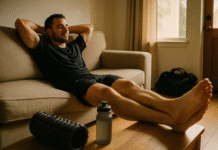


















Rest days aren’t laziness; they’re deliberate recovery. Rest-day rituals are small, repeatable routines—think warm baths, meditation, and reading—that downshift your nervous system, reduce mental noise, and help your tissues and sleep rebound. Below you’ll find 12 practical, science-informed rituals you can mix and match to build a personal “Sunday reset.” Use 1–3 per rest day, and rotate them so recovery stays fresh and enjoyable. Quick start: pick a calming anchor (bath, breath, or book), add a supporting cue (tea, timer, or music), and protect a 60–90-minute window without screens.
This guide is educational, not medical advice. If you’re pregnant or have cardiovascular, skin, or musculoskeletal conditions, talk with a clinician before heat, breathwork, or self-massage.
1. Take a Warm Bath to Signal “Wind-Down”
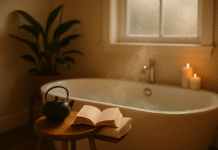
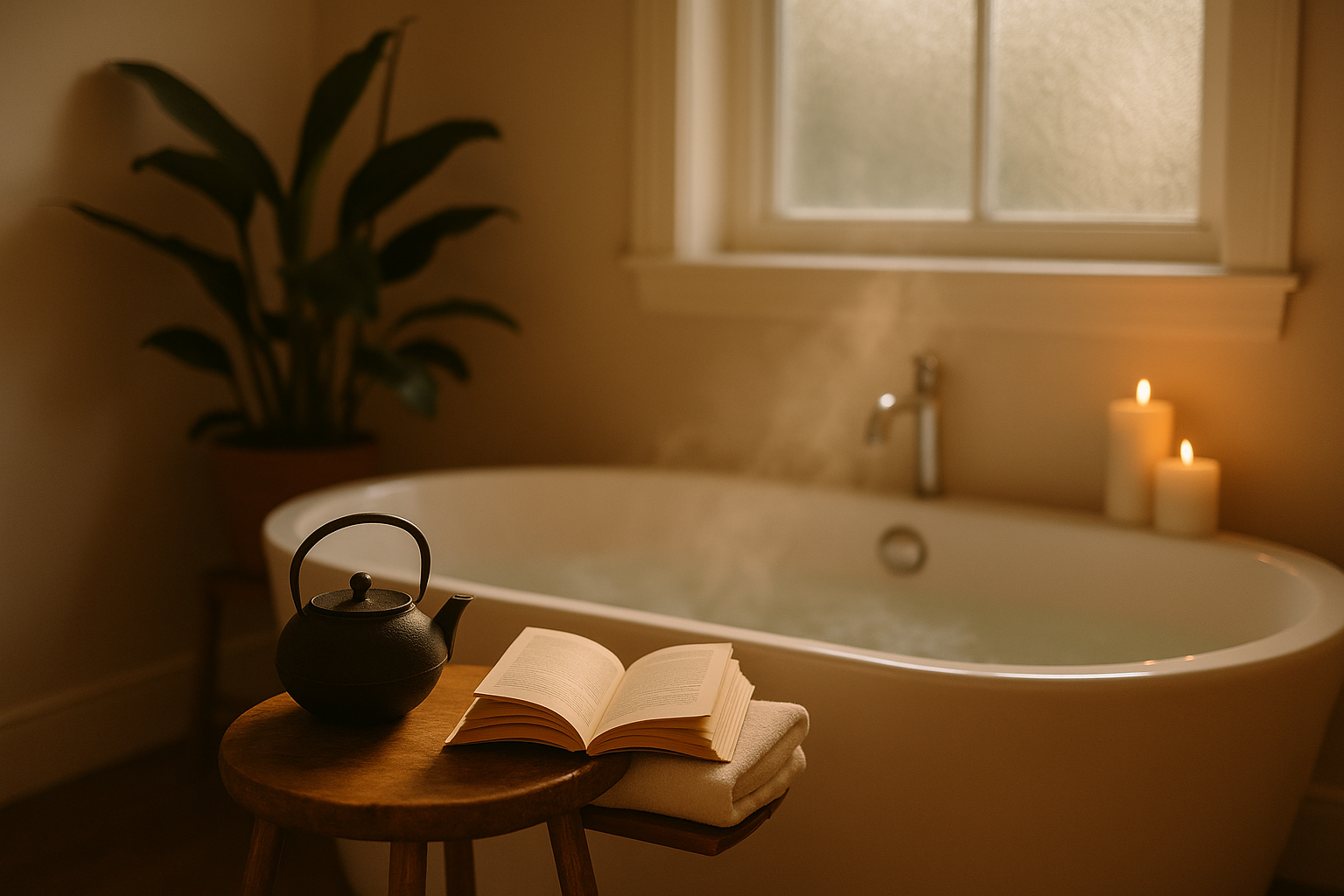
A warm bath helps your body cool itself afterward, nudging melatonin and sleepiness later that evening; it’s one of the simplest rest-day signals to the brain that the hard work is done. Start by deciding the goal: luxurious relaxation now or better sleep tonight. For sleep support, evidence suggests a warm bath 1–2 hours before bed can shorten sleep-onset latency and improve perceived sleep quality; as little as 10–20 minutes may help. For daytime tension release, treat the tub as a “no-notifications zone”: lights low, book ready, water bottle nearby. Keep temps comfortable (about 40–42 °C / 104–108 °F at most) and shorten if you feel dizzy, flushed, or light-headed. Epsom salts and essential oils can make it pleasant; the key recovery effect still comes from the warm soak and the quiet.
How to do it
- Aim for 10–20 minutes, ideally 1–2 hours before bedtime if sleep is the target.
- Keep the bathroom dim; bring a paper book or calming playlist.
- Hydrate before and after; stand up slowly; skip alcohol.
- In hot climates, reduce temp and time; finish with a cool rinse if you overheat.
Mini-checklist
Temperature tolerable • Timer set • Phone outside • Towel/robe warming nearby.
Close your bath by moving deliberately—slow dressing, herb tea, no sudden bright light—to preserve the calm “bath afterglow.”
2. Pair Meditation with Easy Breathwork
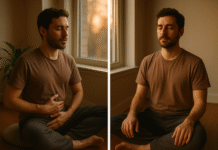
Quieting your attention for 10–20 minutes can lower perceived stress and steady arousal. Mindfulness meditation shows small-to-moderate reductions in anxiety and depressive symptoms in systematic reviews (and it’s low-risk when practiced gently). Layer in simple breathwork and the effect can feel immediate: try 4–6 slow breaths per minute or a 1–2 minute “physiological sigh” sequence to down-shift. Studies comparing breathwork to mindfulness suggest daily slow-breathing (especially cyclic sighing) can boost positive affect more than mindfulness alone, making it a potent add-on to your rest-day ritual. PMC
2.1 Why it matters
- Mind–body bridge: attention training + CO₂/pressure changes from slow exhale calm the autonomic system.
- Low barrier: no mat or app required; 5–10 minutes helps on busy days.
2.2 How to do it (2 options)
- Mindful breath: Sit or lie down. Inhale through the nose ~4 s, exhale ~6 s, for 5–10 minutes.
- Cyclic sighs: Two quick inhales through the nose (second shorter), long mouth exhale, repeat 1–5 minutes.
Tip: If you feel spacey, open your eyes and anchor on a fixed object; if anxious, lengthen the exhale.
3. Read on Paper to Gently Absorb Your Attention
Reading printed pages is a deceptively powerful recovery tool: it focuses attention on a single narrative, slows mental time, and occupies your hands—without the arousal curve of scrolling. To protect sleep, prefer paper or e-ink in the last hour of the evening; compared with paper, light-emitting screens before bed suppress melatonin, delay circadian timing, and can make you feel less sleepy at bedtime. Pick restorative genres: nature writing, gentle fiction, or well-paced history; avoid cliff-hangers if you’re sensitive to suspense at night. 20–45 minutes is plenty; stop while you still want more.
Mini-checklist
- Paper or e-ink device • Warm lamp below eye level • Blanket/tea • Phone in another room.
Common mistakes
- “Just a quick check” between chapters—leave the phone elsewhere.
- Reading in harsh overhead light; swap for warm, dim light to cue wind-down.
4. Do Restorative Yoga or Yoga Nidra
Restorative postures (bolsters, cushions, long holds) and Yoga Nidra (guided non-sleep deep rest) create structured stillness that many find easier than silent sitting. Early randomized trials and reviews suggest yoga and Yoga Nidra can reduce perceived stress and modestly improve sleep quality in some adults; effects vary by program and consistency. On a rest day, one 20–30 minute restorative sequence or an 11–30 minute Nidra track is enough. Treat it like you would a nap: quiet room, eye cover, and no alerts.
4.1 How to set up
- Support joints (knees/low back) with pillows; keep a light blanket handy.
- Try a reputable recorded Nidra: lie supine, follow the body-scan and breath cues.
- If you get sleepy at night, allow it; by day, finish with two minutes of seated breathing.
Numbers & guardrails
- 1–3 sessions/week is realistic; many feel calmer immediately, others after 2–4 weeks.
Close each session with one intentional sentence (“I’m off duty for the next hour”) to lock in the recovery frame.
5. Walk or Sit in Nature for a “Green Dose”
Nature time buffers stress and restores directed attention. Large population data associate ~120 minutes per week in natural settings with better self-reported health and well-being, and forest-therapy studies report short-term reductions in stress and mood symptoms in many groups. On a rest day, aim for a slow 20–60 minute walk in a park, garden, or tree-lined street—or simply sit on a bench and notice birdsong, wind, and shade-light patterns. This is recovery, not cardio: leave metrics off. Wiley Online Library
Mini-checklist
- Comfortable shoes • Sun/heat plan • Water • One sensory focus (sound or color).
- In poor air quality or extreme heat/cold, simulate with indoor plants + nature sounds.
How to keep it simple
Name three things you can see, three you can hear, and three you can feel—then repeat on the way home.
6. Create a Digital Sabbath Window
Notifications and late-night screens keep your brain in “on-call” mode. A practical rest-day ritual is a digital Sabbath—a device-free block (e.g., 2–6 hours, and the last 60 minutes before bed). Sleep and circadian research shows evening use of light-emitting devices suppresses melatonin and delays sleep timing; sleep societies commonly advise turning off electronics 30–60 minutes pre-bed to make room for low-arousal routines like reading or journaling. Build a charging station outside the bedroom and set app limits for email/social.
Steps
- Declare the window (calendar block + phone in a drawer).
- Swap in analog activities: bath, paper book, stretch, tea.
- Use “Do Not Disturb,” auto-replies, or focus modes to protect the boundary.
Keep it compassionate: this is a sabbath, not a punishment—if you slip, just restart the window.
7. Nap or Optimize Your Sleep Window
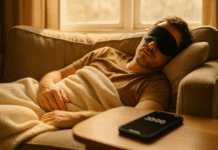
Rest days shine when you pay back sleep debt and protect your circadian rhythm. If you nap, keep it short (10–20 minutes) to avoid grogginess, or go a full cycle (~90 minutes) if you’re exhausted and can sleep early that night. Plan naps in early-to-mid afternoon; avoid caffeine within ~6 hours of bedtime because it impairs sleep even when taken in the afternoon. Anchor your nighttime routine: consistent wake time, dim lights 60 minutes before bed, and a wind-down ritual (bath, book, breath).
Quick setup
- Cool, quiet room • Eye mask • Alarm • 10 minutes of slow breathing on waking.
- If naps hurt your night sleep, replace with Yoga Nidra (Section 4).
Guardrail: If you routinely need long daytime naps, screen for sleep disorders with a clinician.
8. Brew a Calming Tea & Use Gentle Aromas
A small tea ritual—chamomile, lemon balm, or decaf rooibos—creates a sensory off-ramp. The evidence for herbal sleep aids is mixed; think of tea as a soothing behavior more than a pill. Aromatherapy with lavender shows modest benefits on sleep quality in some groups; responses vary, and safety matters (don’t ingest oils; diffuse briefly in ventilated rooms; patch-test on skin). The win here is predictability: the smell and hand-warming mug cue your nervous system that it’s time to idle.
How to do it
- Keep it caffeine-free after mid-afternoon; reserve mint for daytime if it stimulates you.
- Limit diffusers to 15–30 minutes; stop if you get a headache.
- Pair with a two-line journal entry or three slow breaths.
Close with a savoring pause: three breaths while holding the cup; label the flavor, temperature, and aroma.
9. Journal to “Empty the Buffer”
Writing externalizes worries and plans. A 5-minute to-do list at bedtime has been shown to shorten how long it takes some people to fall asleep compared with writing about completed tasks. Expressive or gratitude journaling can also improve subjective well-being and sleep quality over weeks. Keep it light on rest days: two columns—“Keep” (what worked this week) and “Drop” (what you’ll skip next week)—plus 3 gratitude lines.
Prompts
- “One tension my body is holding is…”
- “Three small wins I don’t want to forget…”
- “If next week were 10% calmer, I would stop…”
Tip: Cap it at 10 minutes. You’re not writing a memoir; you’re closing mental tabs.
10. Play Calming Music or Try a Short “Sound Bath”
Music can modulate arousal, pain perception, and mood. Meta-analyses report that listening to or engaging with music reduces anxiety symptoms across settings, with low risk and high acceptability. For a rest-day ritual, cue a 20–40 minute playlist in the 60–80 BPM range (roughly resting heart rate), instrumental if lyrics pull you into rumination. If you enjoy “sound baths,” treat them as guided relaxation: dark room, eyes closed, slow breathing.
How to do it
- Headphones or speakers; volume just under “immersive.”
- Choose consistent opening/closing tracks so your brain learns the routine.
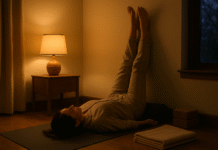
- Pair with legs-up-the-wall or gentle supine twist for extra body ease.
Finish by sitting upright for one minute to avoid post-relaxation grogginess.
11. Trade “More People” for “The Right People”
Social rest isn’t isolation; it’s time with relationships that lower vigilance. Evidence shows supportive social contact can buffer physiological stress responses. On rest days, keep plans light and intentional: a quiet coffee with one close friend, a short call with a family member, or a silent co-reading hour. Say yes to the people who leave you softer; say “next time” to high-output gatherings.
Mini-checklist
- One nourishing contact • Clear start/stop time • Phones away • Simple setting.
Boundary script: “I’m keeping today low-key—want to walk for 30 minutes and chat?”
12. Do Gentle Mobility and Self-Massage (Foam Rolling)
Self-myofascial release (e.g., foam rolling) can reduce next-day soreness and improve short-term range of motion without hurting performance, according to multiple reviews. Keep intensity at “discomfort but not pain,” breathe slowly, and roll the big culprits (calves, quads, glutes, lats) for 30–60 seconds each, 1–2 rounds. Follow with gentle mobility (cat-cow, thoracic rotations, hip openers) and then stillness—your nervous system recovers best when movement ends with a quiet cue.
How to do it (10 minutes)
- Calves & hamstrings: 60 s each side, small rolls, pause on tender spots.
- Quads & glutes: 60 s each side, keep abs lightly braced.
- Upper back/lats: 60 s each side, avoid the low back.
- Finish: two spinal rotations + 3 slow breaths.
If pain persists or radiates, stop and consult a professional—rest is not supposed to hurt.
FAQs
1) How many rest-day rituals should I do in one day?
Two to three is ideal for most people. For example, take a 15-minute warm bath in late afternoon, read for 30 minutes, and do five minutes of slow breathing before bed. That’s enough to downshift without over-scheduling your recovery.
2) What order works best—bath, book, then bed?
If sleep is the goal, try bath 1–2 hours before bedtime, dim lights, then paper reading or journaling in the last hour. Keep screens off during this block, since evening light and engagement can push your sleep later.
3) I’m not into meditation—what’s the minimum effective practice?
Start with breathwork: 1–5 minutes of slow exhales (e.g., cyclic sighs) often produces rapid calm, and you can do it anywhere. If you enjoy it, add a 10-minute mindfulness track on rest days and notice if mood and sleep feel steadier after 2–4 weeks.
4) Is a nap okay, or will it ruin my night sleep?
Short naps of 10–20 minutes boost alertness without deep-sleep grogginess; if you need more, do ~90 minutes to complete a cycle and keep it early afternoon. If naps make night sleep worse, switch to Yoga Nidra or a quiet lie-down instead.
5) What temperature should a bath be for sleep?
Comfortable warmth is the target—roughly 40–42 °C (104–108 °F)—for about 10–20 minutes, 1–2 hours before bed. If you run hot, lower the temperature and shorten the soak.
6) Does reading on an e-reader count?
For daytime, yes. In the last hour before bed, favor paper or e-ink with warm lighting; light-emitting screens can suppress melatonin and delay circadian timing compared to paper.
7) Are essential oils safe?
Use lightly and thoughtfully. Some evidence supports lavender aromatherapy for sleep quality in specific groups; avoid ingesting oils, keep diffusing brief and ventilated, and stop if you get a headache or irritation.
8) What if I only have 10 minutes?
Pick one: 10-minute bath or shower with the lights low; 5 minutes of slow breathing plus 5 minutes of journaling; or a single restorative pose with a long exhale. Consistency beats duration.
9) Is “forest bathing” necessary, or will a city park work?
Any green dose helps. Big datasets indicate benefits around 120 minutes/week in natural settings; city parks, tree-lined streets, gardens, or waterfronts count—choose the easiest option you’ll repeat.
10) Can music really reduce anxiety?
Yes, music interventions show anxiety reductions across settings, with few downsides. Keep volume moderate and choose tracks that feel safe and steady; consider the 60–80 BPM range.
11) Foam rolling hurts—should I push through?
No. Stay in mild discomfort territory and breathe slowly. Research supports short-term ROM and soreness benefits without needing high pain; if you’re bracing or holding your breath, lighten up.
12) How do I keep rest days from turning into chore days?
Time-box chores (e.g., 60–90 minutes in the morning), then schedule two rituals you genuinely enjoy and protect them like appointments. Put your phone in another room during your ritual blocks.
Conclusion
A good rest day is not the absence of effort; it’s a different kind of effort—protecting recovery. Choose one anchor (bath, breath, or book), one space (nature, music, or yoga), and one closure (journal or tea) and you’ll create a repeatable “arc” your body recognizes: decelerate, restore, integrate. Evidence suggests small, steady behaviors—warm water before bed, 10 minutes of slow breath, printed pages, green time, and device curfews—can collectively improve sleep timing, mood, and perceived stress over weeks. Start with the minimum you’ll actually do, notice what truly calms you (not what you think “should”), and iterate. Your recovery improves when it’s pleasant, predictable, and protected.
Copy-ready CTA: Block 60 minutes this week, pick any two rituals above, and treat them like non-negotiable appointments with your calm.
References
- Haghayegh S, Khoshnevis S, Smolensky MH, et al. The effects of a warm shower or bath at a fixed time before bedtime on sleep. Sleep Medicine Reviews, 2019. https://www.sciencedirect.com/science/article/abs/pii/S1087079218301552 (Press summary: University of Texas at Austin: https://www.utexas.edu/news/2019/07/19/take-a-warm-bath-1-to-2-hours-before-bedtime-to-get-better-sleep)
- Goyal M, Singh S, Sibinga EMS, et al. Meditation Programs for Psychological Stress and Well-being: A Systematic Review and Meta-analysis. JAMA Internal Medicine, 2014. JAMA Network
- Balban MY, Patel PD, et al. Breathing practice improves mood and physiological arousal compared to mindfulness meditation. Cell Reports Medicine, 2023. https://www.ncbi.nlm.nih.gov/pmc/articles/PMC9828525/ (Stanford Medicine news: https://med.stanford.edu/news/all-news/2023/01/breathing-meditation.html) PMCStanford Medicine
- Chang A-M, Aeschbach D, et al. Evening use of light-emitting eReaders negatively affects sleep, circadian timing, and next-morning alertness. PNAS, 2015. PNAS
- American Academy of Sleep Medicine. Disconnect from devices at night (Sleep Tips). AASM, 2023. AASM
- National Sleep Foundation. Napping: Benefits and Tips. SleepFoundation.org, 2024. Sleep Foundation
- Drake C, et al. Caffeine effects on sleep taken 0, 3, or 6 hours before bedtime. Journal of Clinical Sleep Medicine, 2013. https://www.ncbi.nlm.nih.gov/pmc/articles/PMC3805807/ PMC
- White MP, Alcock I, et al. Spending at least 120 minutes a week in nature is associated with good health and wellbeing. Scientific Reports, 2019. Nature
- Cheong MJ, Kim S, et al. A systematic review and meta-analysis of aroma inhalation therapy on sleep problems. Medicine (Baltimore), 2021. https://journals.lww.com/md-journal/fulltext/2021/03050/a_systematic_literature_review_and_meta_analysis_of.23.aspx (summary: Frontiers in Pharmacology roundup) Lippincott Journals
- Au Yeung S-T, et al. Effects of Music–Based Interventions on Anxiety and Sedative Exposure in Adults Undergoing Medical Procedures: A Systematic Review and Meta-analysis. JAMA Network Open, 2022. https://jamanetwork.com/journals/jamanetworkopen/fullarticle/2793457 JAMA Network
- Wiewelhove T, et al. A Meta-analysis of the Effects of Foam Rolling on Performance and Recovery. Frontiers in Physiology, 2019. https://www.frontiersin.org/articles/10.3389/fphys.2019.00376/full Frontiers
- Scullin MK, Krueger ML. The Effects of Bedtime Writing on Difficulty Falling Asleep: A Polysomnographic Study. Journal of Experimental Psychology: General, 2018 (open access summary). (Baylor University news: ) PubMedBaylor News
- Hostinar CE, Gunnar MR. Social Support Can Buffer against Stress and Shape Brain Activity. AJO-N, 2015 (review). https://www.ncbi.nlm.nih.gov/pmc/articles/PMC4607089/ PMC
- Sharpe E, et al. A Closer Look at Yoga Nidra—Early Randomized Sleep Lab Evidence. Frontiers in Sleep, 2023. https://www.ncbi.nlm.nih.gov/pmc/articles/PMC9973252/ PMC