



























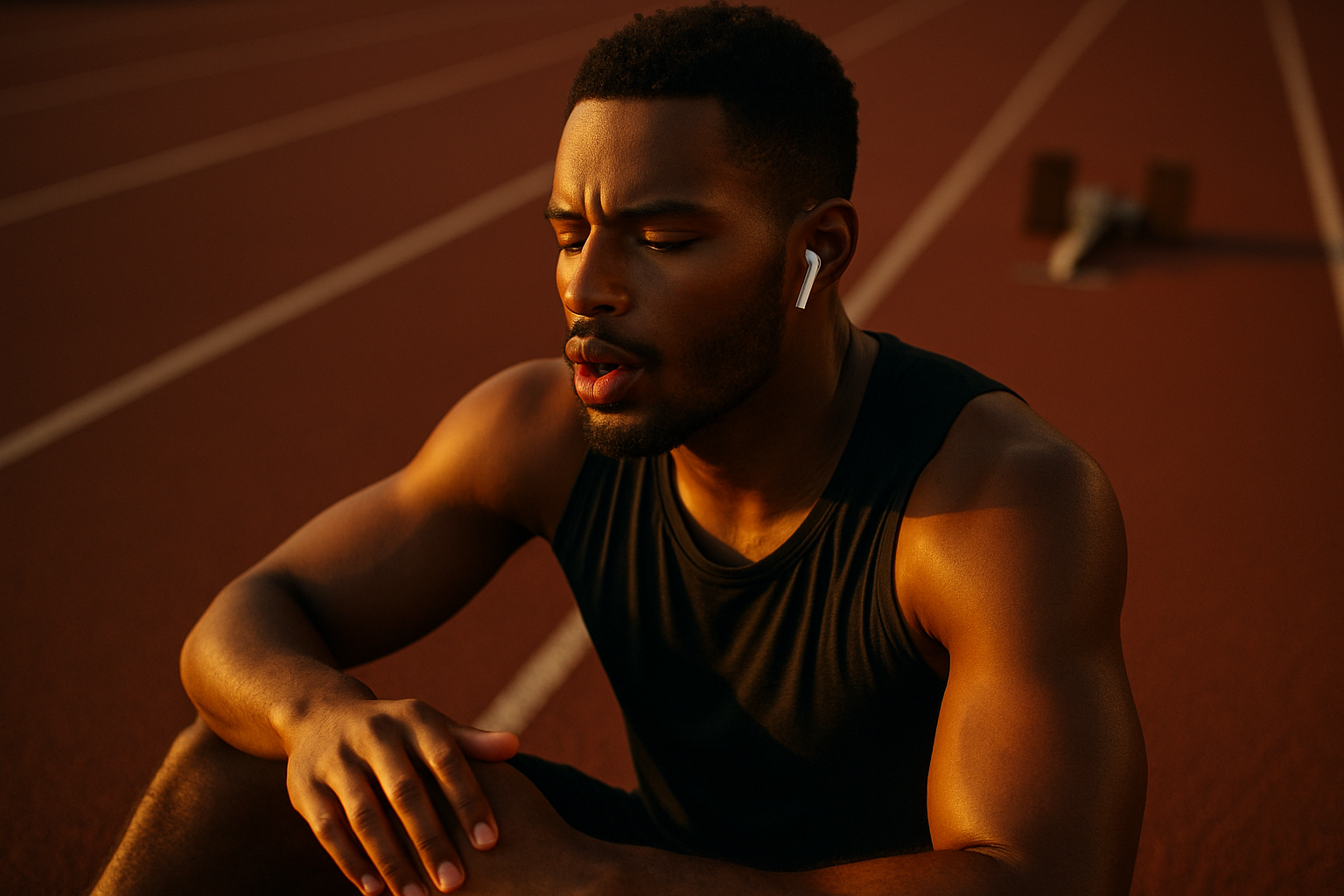
You don’t have to wait for race day or a PR attempt to practice success. Visualization—deliberately rehearsing a lift, run, or routine in your mind—lets you train the brain pathways you’ll use on the platform, in the lane, or on the field. Used well, it sharpens focus, steadies nerves, and nudges behavior toward consistent training. In this guide you’ll get nine practical, research-backed visualization techniques—scripts, cues, and step-by-step routines—built for real athletes with real schedules.
Quick definition: Visualization (also called mental imagery or mental practice) is the intentional creation of vivid, multi-sensory scenes to simulate performance and guide attention, emotion, and action. Done regularly, it complements—not replaces—physical training.
1. Build PETTLEP Imagery That Mirrors Reality
The fastest way to make imagery “stick” is to make it realistic. The PETTLEP model (Physical, Environment, Task, Timing, Learning, Emotion, Perspective) is a sport-psych framework for constructing scenes that closely resemble actual performance demands. Start by stating the movement and the context (your squat set at 85%, your 5K pace run in humid heat), then layer in cues you’ll actually use (breath count, grip, foot pressure), match the pace of the rep or the run, and adopt the same emotional tone you want under load. This isn’t daydreaming about trophies; it’s a rehearsal that feels like the real thing, so your nervous system treats it like practice rather than fantasy. When in doubt, ask: does my scene match what I do, where I do it, how fast I do it, and how it feels? If yes, you’re using PETTLEP well.
1.1 How to do it (5–7 minutes)
- Physical: Wear your lifters or racing flats; hold the bar or stand on the track.
- Environment: Face the rack or lane markers; replicate gym noise or wind.
- Task: Rehearse your exact warm-up set, opener commands, or race start.
- Timing: Run the scene in real time (no fast-forwarding).
- Learning: Update details weekly as your form cues evolve.
- Emotion: Dial in your target state (calm, assertive, playful).
- Perspective: Use first-person for execution; switch to third-person for form checks.
1.2 Mini case
Before heavy doubles, emulate chalk feel, belt tightness, and judge commands. Three PETTLEP reps often settle depth and bar path before the first real attempt.
Wrap-up: If your imagery looks, sounds, and feels like your sport, transfer improves; PETTLEP gives you a checklist to make that happen.
2. Visualize the Process (Not Just the Podium) with If-Then Plans
Outcome pictures (you breaking the tape) can inspire, but they can also backfire if they replace action. Process visualization focuses on the behaviors that lead to the outcome: your pre-run snack, your first 400 m split discipline, your mid-set bracing. Tie those scenes to implementation intentions—simple “if-then” plans that automate decisions under stress (e.g., “If I see 3:55/km at 1 km, then I relax shoulders and shorten stride.”). This pairing keeps imagery anchored to controllables and turns it into behavior change. Use it for the micro (first breath before unrack) and the macro (showing up for Tuesday tempo, even if it’s raining). Expect the plan to feel awkward at first; repetition makes the cue–action link feel natural.
2.1 Quick setup
- List 3 process steps for your next session.
- Write 3 matching if-then rules that trigger those steps.
- Run a 60-second scene for each rule.
2.2 Numbers & guardrails
- Keep if-then plans short (≤12 words).
- Attach to visible cues (watch split, chalk bowl, first whistle).
- Rehearse daily for one week; then evaluate adherence.
Wrap-up: Process imagery + if-then plans convert pictures into predictable actions when pace drifts, nerves spike, or fatigue hits. Prospective Psychology
3. Switch Perspective Intelligently: First-Person for Feel, Third-Person for Form
Perspective matters. First-person (internal) imagery—seeing through your own eyes—maximizes kinaesthetic sensations like bar path, foot pressure, and breathing rhythm. Third-person (external)—watching yourself as if on video—helps you check alignment, symmetry, and timing. Most lifters and runners benefit from starting in first-person to embed feel and finishing with a brief third-person pass to polish mechanics. If you struggle to “feel” movements, practice short, vivid bursts (10–20 seconds) of first-person imagery after a set, when kinaesthetic memory is fresh. If your technique drifts late in sets or races, add a quick third-person clip to reset the mental picture you’re chasing. Validated tools like the VMIQ-2 and MIQ-3 can also help you identify which perspective feels most natural and track progress over time.
3.1 Mini-checklist
- Open with two internal reps: feel grip, pressure, breath.
- Add one external rep: watch bar path or cadence.
- Close with one internal rep that locks in your best cue.
3.2 Tools/Examples
- VMIQ-2 (vividness across internal, external, kinaesthetic).
- MIQ-3 (brief ability screen you can re-take monthly).
Wrap-up: Use internal perspective to code “feel” and external perspective to audit “look”—you need both for consistent execution.
4. Train Multi-Sensory, Kinaesthetic-First Imagery
High-quality imagery isn’t just seeing; it’s feeling. Prioritize kinaesthetic details: the bar knurling’s texture, quad tension at sticking point, the bounce of the track at push-off. Add sound (judge commands, footfalls), temperature (humid evening air), and smell (chalk, rubber). This multi-sensory layering strengthens “functional equivalence”—the overlap between imagined and executed movement—and makes transfer more likely. Start small: one rep, one sense at a time, then stack. If vividness is low, build a “sensory library” during warm-ups by noting three sensations you’ll later replay. Over two to three weeks, most athletes report more stable cues and faster entry into a focused state.
4.1 How to practice
- Prime senses: After a warm-up set, immediately record 3 feel-cues.
- Stack senses: Add sound and breath count to the next scene.
- Rep dose: 3–5 reps × 20–40 seconds, 4–5 days/week.
4.2 Mini case (strength)
Week 1: felt bar roll in the hand; Week 2: added heel pressure + exhale timing; Week 3: added “knees forward” sound cue. Result: fewer soft knees at 90%.
Wrap-up: When imagery is kinaesthetic-first and multi-sensory, it behaves like practice instead of wishful thinking.
5. Script a Pre-Performance Routine (PPR) That Starts with the Breath
Visualization works even better when it’s nested inside a short pre-performance routine. Your PPR should be a consistent 20–60 second sequence of breath, cue words, and one PETTLEP mini-scene you run before a set, rep, or start line. Begin with one slow inhale and longer exhale (e.g., 4-in, 6-out) to settle attention. Add a micro-script (“brace-feet-drive”), then a 10–15 second real-time replay of the first rep or first 100 m. Keep the routine compact enough to repeat under pressure and flexible enough to fit chaotic environments (noisy meets, crowded parks). Rehearse the PPR in training until it feels like buckling your belt—automatic and soothing. Research on PPRs suggests they help regulate arousal and improve consistency for self-paced skills like free throws, golf shots, and heavy attempts; the same logic applies to powerlifting commands and race starts. KRIGOLSON TEACHING
5.1 PPR template (45 seconds)
- Breath: 4-in, 6-out × 2.
- Body scan: Jaw–shoulders–hands–feet release.
- Cue words: “Tall & tight” / “Quick feet” (choose 1–2).
- Mini-scene: First rep or first 50 m in real time.
- Commit: Nod + step in / step to line.
Wrap-up: A rehearsed PPR glues your imagery to a repeatable sequence, so you’re never guessing what to do before “Go.”
6. Record Guided Imagery Scripts You’ll Actually Use
Reading a script once won’t change much. Recording your own voice—short, specific, PETTLEP-aligned—and playing it during a quiet cooldown or commute increases consistency. Keep each audio file 2–4 minutes, present-tense (“I feel the belt tighten; I root my feet”), and end with one or two strong cue words you’ll use under load. Build a small library: opener squat, 10K negative split, meet day bench setup, 400 m race finish. Update scripts as technique evolves or goals change; old scripts become reference points. Guided imagery works best alongside motivational general-mastery content (confidence, calm, controllables) rather than hype—think “steady and exact” over “fired up.”
6.1 Script skeleton
- Scene: Where/when (meet, lane 4; Tuesday tempo; Rack 3).
- Sensory anchors: 3 feels, 2 sounds, 1 smell.
- Cues: Two technical, one mental.
- Outcome: Clear “done” signal (rack, split beep, finish line).
6.2 Pitfalls to avoid
- Overlong files (you’ll skip them).
- Vague adjectives (“stronger,” “better”) instead of cues (“elbows under”).
- Inconsistent tense (stick to present).
Wrap-up: Your voice + your details = scripts you’ll actually replay—and that’s when imagery starts shaping behavior.
7. Stress-Test with Coping Imagery (WOOP/MCII) So Setbacks Don’t Surprise You
Great imagery includes obstacles. Mental contrasting has you picture the wish and best outcome, then immediately confront the biggest present obstacle. Add an implementation intention plan for that obstacle (the MCII combo)—and rehearse the “moment of truth” until your response is automatic. Example: “Wish: finish strong; Outcome: proud controlled kick; Obstacle: heavy legs at 3.5 km; Plan: If my lap beeps slow, then I relax jaw and drive knees for 10 steps.” This is coping imagery: you practice recovering, not pretending you’ll never struggle. Use it for missed lifts, crowded start lines, heat, or negative thoughts. Over time, your brain links the obstacle with the ready response, so stress feels like a cue, not a threat. PMCSocial Psychology and Motivation
7.1 WOOP checklist
- Wish: Concrete (e.g., “Sub-50 10K”).
- Outcome: One sentence you can picture.
- Obstacle: Internal (fatigue, self-talk) or environmental (heat).
- Plan: If-then with a single action.
7.2 Mini example (strength)
“Wish: solid third deadlift; Outcome: clean lockout; Obstacle: grip slip past knees; Plan: If I feel slip, then crush pinkies + quick hook reset.”
Wrap-up: Coping imagery makes adversity boring and predictable; that’s a competitive advantage. Taylor & Francis Online
8. Blend Video and Imagery (AOMI) for Faster Learning
Combining action observation (watching a skill) with motor imagery (feeling yourself do it) boosts motor system activation and can speed up learning. The recipe: watch a high-quality clip (your own or a model whose build and style resemble yours), then immediately close your eyes and replay the movement internally in real time. For running, watch your side-on stride and then imagine the same cadence and hip position; for lifts, watch your top set and then rehearse the “best rep” feel before you repeat it physically. Keep clips short (5–15 seconds), focus on one technical element at a time, and alternate watch/feel cycles 3–5 times. This AO+MI (AOMI) sequence is especially useful when rebuilding technique after a layoff or injury.
8.1 Steps
- Film one angle in good light.
- Identify one cue (e.g., “shin angle at mid-stance”).
- Watch 10 sec → imagine 10 sec → perform 1–2 reps.
- Repeat 3–5 cycles.
8.2 Guardrails
- Avoid slow-mo for imagery (use real time).
- Mute hype music; you’re training focus, not arousal.
Wrap-up: Short, focused watch-feel cycles improve technical clarity and confidence between reps and sessions.
9. Measure, Log, and Progress Your Imagery Like Training
If you don’t measure it, it fades. Treat visualization like a skill block with progression and feedback. Set a weekly dose (e.g., 5 sessions × 3–5 reps of 20–40 seconds), pick one metric to track (imagery vividness 1–10, pre-set calm 1–10, rep quality), and review once a week. Use brief tools—the VMIQ-2 or MIQ-3—monthly to check vividness and perspective strengths. Pair imagery sessions with a short behavior (e.g., after mobility), and log outcome notes (“fewer soft lockouts,” “early pacing improved”). Adjust scripts based on logged sticking points and wins. Over 4–8 weeks you should notice faster entry into your target state, more consistent cues, and steadier pacing or bar path. Keep expectations realistic: like technique work, imagery progress is measured in weeks, not days. Dr Jenn Cumming
9.1 Mini tracking template
- Session: Date/time; scene (e.g., opener squat).
- Vividness (1–10): __
- Calm (1–10): __
- Cue locked: Y/N
- Note: One specific tweak for next time.
9.2 Progression ideas
- Add one sense per week (sound → feel → breath timing).
- Increase context complexity (quiet gym → meet noise).
- Shift focus (setup → sticking point → finish mechanics).
Wrap-up: Systematic logging and small progressions turn visualization from a nice idea into a tangible training block.
FAQs
1) How long should a visualization session last?
Most athletes do well with 3–5 reps of 20–40 seconds, which keeps focus high without mental fatigue. Longer sessions (2–4 minutes) work for guided scripts during cooldowns or rest days. Anchor sessions to something you already do—like post-warm-up mobility—so adherence stays high.
2) Should I visualize daily or only before big sessions?
Daily brief practice builds vividness and makes imagery easier to access under pressure. Aim for 4–6 short sessions/week, then add a slightly longer run-through the day before key efforts (long run, meet day openers). Treat it like mobility: frequent, small deposits.
3) Is first-person better than third-person?
Use first-person to encode feel and timing, and third-person to audit form. Many athletes sandwich one external “form check” between two internal reps. If you’re new, test both perspectives with tools like VMIQ-2 or MIQ-3 and track which correlates with better sessions.
4) Can visualization replace physical practice when I’m injured?
It can maintain neural readiness and confidence, but it won’t replace tissue loading. During deloads or rehab, visualize the exact movement you’ll return to, matching tempo and cues, and pair with any safe isometrics or mobility prescribed by your clinician.
5) Does outcome visualization harm performance?
It’s not harmful, but it can satisfy motivation if it isn’t paired with process imagery and plans. Keep the trophy scene short. Spend most time rehearsing what you’ll do when things get hard, and link obstacles to if-then responses (MCII).
6) What if my mental pictures are fuzzy?
Fuzzy images are common. Focus on kinaesthetic details (pressure, tension, breath), not cinematic visuals. Capture three feel-cues after real reps and replay those within a minute—vividness usually improves within 2–3 weeks.
7) Should I use music during imagery?
Use quiet or ambient sound that matches competition (gym clatter, stadium PA). Loud music pulls attention outward. If you rely on music to get “up,” try one breath-led routine that works in silence, so you’re covered when conditions don’t allow headphones.
8) How do I visualize pacing for distance events?
Build split-based scenes: see the watch click at the target split, feel the stride length and arm swing, and rehearse corrections if the split is fast/slow. Pair with if-then rules (“If +3s slow at 2 km, then quicken cadence for 10 steps”).
9) Is there evidence that imagery actually improves performance?
Yes. Meta-analyses find that mental practice and imagery produce small-to-moderate performance gains across skills and contexts, particularly when imagery is realistic and repeated. PETTLEP-style scenes, AO+MI blends, and good routines improve transfer from mind to movement.
10) What should I do the night before a race or heavy day?
Run one 4-minute guided script that covers your wake-up, warm-up, first rep/split, and one obstacle with a ready plan. End with two deep breaths and your cue word. Then stop—protect sleep and let the rehearsal consolidate.
Conclusion
Visualization is performance practice you can do anywhere: standing in chalk, waiting at a crosswalk, or sitting on a bus to the meet. When you make scenes realistic (PETTLEP), tie them to if-then plans, and rehearse both the best rep and the hard moment, imagery becomes more than motivation—it becomes a behavior script. Add a pre-performance routine so you always know what to do before “Go,” record short guided audios you’ll actually replay, and blend video with feel to sharpen technique between reps. Finally, treat it like training: set a weekly dose, log vividness and calm, and progress complexity slowly. Over a month or two, you’ll notice steadier pacing, cleaner positions, calmer nerves, and more reliable execution when it counts.
Start today: choose one lift or run, write two cue words, and run three 30-second PETTLEP scenes before your next session. Do that for a week, then build from there.
References
- Holmes, P. S., & Collins, D. J. (2001). The PETTLEP Approach to Motor Imagery: A Functional Equivalence Model for Sport Psychologists. Journal of Applied Sport Psychology. Taylor & Francis Online
- Driskell, J. E., Copper, C., & Moran, A. (1994). Does Mental Practice Enhance Performance? Journal of Applied Psychology. ResearchGate
- Rupprecht, A. G. O., et al. (2024). The effectiveness of pre-performance routines in sports. International Review of Sport and Exercise Psychology. Taylor & Francis Online
- Roberts, R., Callow, N., Hardy, L., Markland, D., & Bringer, J. (2008). Movement Imagery Ability: Development and Assessment of a Revised Version of the VMIQ-2. Journal of Sport & Exercise Psychology. Human Kinetics Journals
- Williams, S. E., Cumming, J., Ntoumanis, N., Nordin-Bates, S. M., Ramsey, R., & Hall, C. (2012). Further Validation and Development of the Movement Imagery Questionnaire. Journal of Sport & Exercise Psychology. rich-ramsey.com
- Eaves, D. L., Riach, M., Holmes, P. S., & Wright, D. J. (2016). Motor Imagery during Action Observation: A Brief Review of Evidence, Theory and Future Research. Frontiers in Neuroscience. Frontiers
- Chye, S., et al. (2022). The effects of combined action observation and motor imagery. Neuroscience & Biobehavioral Reviews. ScienceDirect
- Gollwitzer, P. M. (1999). Implementation Intentions: Strong Effects of Simple Plans. American Psychologist. KOPS
- Oettingen, G., Mayer, D., Sevincer, A., Stephens, E., Pak, H., & Hagenah, M. (2009). Mental Contrasting and Goal Commitment: The Mediating Role of Energization. Personality and Social Psychology Bulletin. SAGE Journals
- Consterdine, A., et al. (2020). The Effects of Imagery Interventions in Sports: A Meta-Analysis. [Preprint/Article] ResearchGate
- Cumming, J., et al. (2022). Improving the reporting of sport imagery interventions with a PETTLEP-Informed checklist. Case Studies in Sport and Exercise Psychology. ScienceDirect