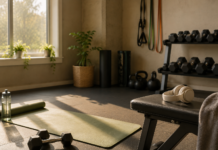
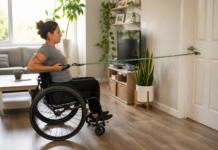


























To set up a home that encourages movement, remove friction between you and activity: place equipment in open sightlines, keep at least one clear walking path per floor, add a standing option to your main workspace, and put daily items on shelves or floors that require reaching, bending, or stairs. These small layout changes work with the body’s natural tendency toward the path of least resistance instead of against it.
By Laila Qureshi
Who This Is For
This guide is for anyone who works from a desk, spends long stretches sitting during the day, or has noticed that a full day can pass with almost no deliberate movement outside of a commute or a single workout. It’s written for renters and homeowners alike, people in studio apartments and people in houses with a yard, because the underlying principles (visibility, friction, and access) apply at any square footage. It is especially useful if you’ve already tried scheduling workouts and found that willpower alone doesn’t hold up against a home that’s built for sitting.
It is less useful as a substitute for structured exercise programming, physical therapy, or medical guidance for an existing injury or condition. Think of it as the environmental layer underneath your activity habits, not a replacement for them.
A note on scope: This article covers home layout, furniture choices, and environmental cues that make everyday movement more likely. It is not medical advice, and it does not replace guidance from a physician, physical therapist, or occupational therapist. If you have a chronic condition, a recent injury, joint pain, balance concerns, or you are new to exercise, talk with a qualified healthcare provider before changing your activity routine or your workspace setup, particularly around standing desk use and new equipment.
Why Your Home’s Layout Quietly Shapes How Much You Move
Most people think of physical activity as something that happens in blocks: a gym session, a run, a class. But a large share of daily energy expenditure comes from something researchers call non-exercise activity thermogenesis, or NEAT, which covers everything from standing at the counter to pacing during a phone call to walking to another room instead of shouting across the house. Physiologist James Levine and colleagues at the Mayo Clinic studied this directly, tracking ten lean and ten obese adults continuously for ten days using motion sensors built into their clothing. The lean participants stood and moved roughly 150 minutes more per day than the obese participants, a gap that persisted even after the obese group lost weight and the lean group gained it artificially as part of the study. The researchers estimated the difference in daily energy use at around 350 calories, driven almost entirely by posture and incidental movement rather than formal exercise.
Harvard Health’s coverage of NEAT research puts the variability in even starker terms: two people of similar size can differ by up to 2,000 calories a day in how much energy they burn through non-exercise movement alone. That is a wider swing than most workouts produce. The practical takeaway is that the layout of a home, which objects are visible, which paths are clear, and which activities require the least effort to start, has an outsized effect on how much a person moves without ever deciding to “work out.”
This matters because most homes are built for the opposite goal. Furniture is arranged around a television. The most comfortable chair is the closest one to hand. Remote controls, phone chargers, and snacks all live within arm’s reach of a couch. None of that is a moral failing; it is simply a home optimized for stillness. Setting up a home that encourages movement means deliberately reversing a few of those defaults, not overhauling the entire space.
What the Research Says About Sitting and Movement
The scale of the sedentary behavior problem is well documented. According to CDC data from the 2024 National Health Interview Survey, reported in April 2026, only 47.2% of U.S. adults met the federal aerobic physical activity guideline, with men at 52.3% and women at 42.4%. An earlier CDC data brief, published in August 2022, found the number drops further when both aerobic and muscle-strengthening guidelines are combined: just 24.2% of adults met both standards in 2020, and compliance fell sharply with age, from 41.3% of men aged 18 to 34 down to 15.3% of men 65 and older. Globally, the World Health Organization reported in June 2024 that 31% of adults, roughly 1.8 billion people, were not meeting recommended activity levels in 2022, up about 5 percentage points since 2010.
Sitting itself carries independent risk, separate from whether someone also exercises. A February 2024 study in the Journal of the American Heart Association followed 6,489 women aged 63 to 99 using hip-worn accelerometers for up to seven days and then tracked outcomes over eight years. Women who sat 11.7 hours or more per day had a 30% higher mortality risk, and sitting in long unbroken stretches of more than 30 minutes carried more risk than the same total time broken into shorter bouts. A separate November 2024 study in the Journal of the American College of Cardiology, led by researchers at Mass General Brigham using activity-tracker data from 89,530 UK Biobank participants, found that sedentary time above roughly 10.6 hours a day was linked to a 40% to 60% greater risk of heart failure and cardiovascular death, and that meeting the standard 150-minutes-a-week exercise target only partially offset that risk.
The consistent theme across this research: exercise and daily movement are related but not interchangeable. A home environment that lowers the effort required for the small, frequent movements of daily life addresses a risk factor that a single scheduled workout does not fully cover.
Sources: CDC/NHIS 2024 (reported April 2026); WHO, June 2024; Journal of the American Heart Association, February 2024; Journal of the American College of Cardiology, November 2024.
The Core Principles Behind an Activity-Encouraging Home
Setting up a home for movement comes down to four repeatable principles. They apply whether you’re arranging a studio apartment or a three-bedroom house, and they work together in sequence.
Put activity cues where you’ll see them daily
Remove steps between deciding and doing
Spread activity options across rooms
Keep at least one walkable route open
Visibility works because decisions made without conscious thought depend heavily on what’s in your field of view. A yoga mat rolled up in a closet gets used less often than one leaning against a visible wall. This is the same logic Harvard Health’s summary of NEAT research points to: people who cut sedentary time did so by replacing small chair-sitting moments with visible, easy alternatives, like pacing during a phone call instead of sitting through it.
Low friction means reducing the number of steps between wanting to move and actually moving. If resistance bands are in a drawer under folded towels, using them requires a small negotiation with yourself every time. If they hang on a hook next to the doorway, that negotiation disappears.
Multiple zones spreads activity opportunities through the home instead of concentrating them in one dedicated “workout room” that’s easy to avoid entirely. A stretch spot in the bedroom, a standing option in the office, and open floor space in the living room each lower the odds that an entire day passes with zero movement cues.
Clear paths reflects the walkability research on a smaller scale. A March 2026 study from Washington State University, published in the American Journal of Preventive Medicine and led by Glen Duncan, tracked more than 7,400 twins over 11 years and found that each 1% increase in neighborhood walkability corresponded to a 0.42% increase in walking, with a 55% jump in walkability translating to about 19 additional minutes of walking per week. Only 10.7% of Americans currently live in highly walkable neighborhoods, the study noted, even though most people say they’d prefer one. The same logic scales down to a single home: a room with an obstacle course of furniture discourages the short walks that add up over a day, while a clear route between rooms invites them.
A Room-by-Room Setup Guide
Below is a practical walkthrough of how the four principles apply in each part of a typical home. Adjust based on the space you actually have; none of these require a renovation.
Entryway
Keep walking shoes, a hat, and a water bottle staged by the door rather than in a closet. This lowers the friction for a spontaneous 10-minute walk between meetings or after dinner. If you have stairs to your entry, skip the habit of leaving a chair or bench that becomes a landing spot for bags; keep the first few steps clear.
Home Office or Desk Area
This is the most impactful room for most desk workers. A 2015 study in the American Journal of Preventive Medicine by University of Iowa researcher Lucas Carr and colleagues followed 69 office employees, comparing 31 who used sit-stand desks with 38 using conventional desks. The sit-stand group stood about 60 more minutes and walked about 6 more minutes per day, translating to roughly 87 additional calories burned daily, and the behavior held up well after the novelty wore off (participants had owned their desks for an average of 1.8 years). You don’t need a full electric standing desk to get this benefit; a desk converter placed on top of an existing desk produces a similar effect. Position the desk so a short walk, even just to a window or a printer in another room, is part of your normal routine rather than something that requires leaving your seat.
Living Room
Move the coffee table a few feet, or choose one with a smaller footprint, so there’s open floor space for stretching or floor exercises without rearranging furniture first. Store a mat, light dumbbells, or a resistance band in a basket next to the couch instead of in another room. If the television is the visual anchor of the room, consider whether the most comfortable seat needs to be the one closest to it.
Kitchen
Store everyday dishes, spices, and pantry items across a full range of shelf heights rather than clustering them all at eye level, so reaching and light bending become part of ordinary cooking. A kitchen island or open counter space also gives you room for standing-based tasks like chopping or folding laundry while a meal cooks, instead of finding a chair.
Bedroom
Keep a small patch of open floor for a two-minute stretch routine before bed or after waking. Placing a mat at the foot of the bed makes this close to automatic. Avoid using the only open floor space in the room as overflow storage; that single habit quietly removes a movement opportunity from the start and end of every day.
Stairs and Hallways
If you have stairs, keep them clear of storage. Households that use stairs as a shelf tend to avoid using them as stairs. In single-level homes, a hallway or long room can serve a similar purpose: keep at least one uninterrupted walking path from one end of the home to the other for pacing during calls, as Harvard Health’s NEAT coverage specifically recommends.
Activity-Permissive vs. Activity-Suppressing Home Features
The table below compares common home features by the effect they tend to have on daily movement, based on the visibility, friction, and access principles described above.
| Feature | Activity-Suppressing Version | Activity-Permissive Version |
|---|---|---|
| Desk setup | Fixed-height desk, chair within reach of everything needed all day | Sit-stand desk or converter, printer/water in another room |
| Exercise equipment | Stored in a closet, garage, or under a bed | Visible in a living space or hallway, ready to use |
| Living room layout | Furniture filling most of the open floor | A few feet of clear floor space reserved intentionally |
| Stairs | Used for storage or laundry piles | Kept clear and used as a matter of course |
| Kitchen storage | Everything clustered at eye level within one step | Items spread across shelf heights, some requiring reach or bend |
| Remote controls and chargers | All clustered at the primary seat | Some placed a short walk away from the main seat |
| Bedroom floor | Used as overflow storage | One clear patch reserved for stretching |
Standing Desks and Active Workstations: What the Research Actually Shows
Standing desks get a lot of attention in movement-focused home design, so it’s worth being precise about what the evidence supports and what it doesn’t. The Iowa study cited above found meaningful increases in standing and walking time, plus a modest calorie difference, but it also found no significant change in cardiometabolic markers like weight, body fat percentage, blood pressure, or heart rate over the study period. In other words, a standing desk changes behavior in a measurable, sustained way, but it is not, by itself, a substitute for structured exercise or a guaranteed path to weight change.
The more relevant point from the cardiovascular research described earlier is that total sedentary time across the whole day matters more than any single intervention. Dr. Carr’s observation about historical context is useful here: American desk workers today burn roughly 100 fewer calories per day at work than workers did in 1960, a shift driven by decades of labor moving from physical tasks to seated ones. A standing desk addresses part of that gap. Breaking up long sitting bouts throughout the rest of the day, not just at the desk, addresses the rest of it. The February 2024 accelerometer study found that unbroken sitting sessions longer than 30 minutes carried more risk than the same total sitting time split into shorter bouts, which is a strong argument for pairing a standing desk with reminders to change position every 30 minutes regardless of whether you’re sitting or standing.
If you’re considering a standing desk, a few practical points from ergonomics guidance are worth following: alternate between sitting and standing rather than standing all day, keep the monitor at eye level in both positions, and use an anti-fatigue mat if you’ll be standing on hard flooring for extended periods. Standing with poor posture for hours creates its own strain, so the goal is variation, not maximum standing time.
Common Setup Mistakes (and What to Do Instead)
| Mistake | Why It Backfires | Better Approach |
|---|---|---|
| Building one dedicated “workout room” and stopping there | Concentrates all movement cues in a room you can close the door on | Spread smaller activity cues across three or four rooms |
| Buying a standing desk but never adjusting it | A desk left in one position all day provides no more variation than sitting | Set a timer to alternate positions every 30 to 60 minutes |
| Optimizing the living room around the television | The most comfortable seat becomes the default resting place for hours | Angle seating so the screen isn’t the automatic focal point |
| Storing equipment “out of the way” | Out of sight reliably means out of use, even with good intentions | Keep at least one piece of equipment visible in a shared space |
| Treating stairs, hallways, or bedroom floors as storage | Removes the easiest built-in movement opportunities in the home | Keep at least one full walking path clear on every floor |
| Expecting layout changes to replace exercise entirely | NEAT and structured activity both matter and address different risks | Use home setup to support, not replace, a regular activity routine |
What Professionals Do Differently
Occupational therapists and ergonomics consultants who assess home and office setups tend to approach the problem differently than most DIY guides. Instead of starting with a shopping list of equipment, they start with a movement audit: they watch how a person actually moves through their existing space for a day or two and note where the person sits down without meaning to, where they hesitate before standing up, and which paths they avoid because something is in the way. Only after that observation do they recommend changes, and the changes are frequently about removing obstacles rather than adding new furniture or gadgets.
A second difference is that professionals rarely recommend an all-or-nothing standing desk approach. Physical therapists who work with office-based clients generally recommend alternating positions on a schedule, because static standing for long periods creates its own fatigue and lower-back or foot strain, particularly on hard flooring. The goal they describe is postural variety across the day, not maximizing time in any single position.
A third pattern: professionals tend to focus on the transition points in a home rather than the rooms themselves. The walk from the front door to the kitchen, the path from the desk to the water source, the route from the bedroom to the bathroom. These transitions happen many times a day regardless of intention, so a small change to a transition path (clearing it, extending it slightly, or placing something useful along it) compounds far more than a change confined to one room that’s visited once daily.
Safety Limits and When to Consult a Professional
The changes in this guide are low-risk for most healthy adults, but a few situations call for professional input before you rearrange your space or change your work posture.
- If you have a diagnosed balance disorder, a recent lower-body injury, or a condition affecting mobility, ask a physical therapist before introducing standing desk time or new walking routes at home.
- If you experience chest pain, unusual shortness of breath, dizziness, or joint pain when standing or walking, stop and speak with a physician before continuing to increase activity.
- If you’re new to exercise entirely, or returning after a long break, check with a healthcare provider before adding structured activity on top of these environmental changes, especially if you have a cardiovascular or metabolic condition.
- If a standing desk causes new lower-back, hip, or foot pain within the first two weeks, that’s a signal to check your setup (mat, shoe support, monitor height) rather than push through it.
- Households with young children or older adults at fall risk should prioritize clear, obstacle-free paths over any other recommendation in this guide, since fall prevention outweighs incidental activity gains.
None of the strategies here are intended to diagnose, treat, or manage a medical condition. They’re environmental adjustments, and they work best alongside, not instead of, guidance from a qualified healthcare provider.
Your Copy-Ready Home Movement Checklist
- ☐ Keep one full walking path clear on every floor of the home
- ☐ Move at least one piece of exercise equipment into a visible, shared space
- ☐ Add a standing option (converter or desk) to your primary workspace
- ☐ Set a timer to change position every 30 to 60 minutes while working
- ☐ Reserve a few feet of open floor space in the living room
- ☐ Spread kitchen and pantry storage across multiple shelf heights
- ☐ Clear stairs and hallways of stored items
- ☐ Stage shoes and a water bottle near the entryway for spontaneous walks
- ☐ Keep a mat or stretch space at the foot of the bed
- ☐ Reassess after two weeks and adjust based on what you actually use
Key Takeaways
- Non-exercise activity, or NEAT, can account for a difference of up to 2,000 calories a day between similarly sized people, according to Mayo Clinic-linked research covered by Harvard Health.
- Only 47.2% of U.S. adults met aerobic activity guidelines in 2024, and just 24.2% met both aerobic and strength guidelines as of 2020, per CDC data.
- Sitting more than roughly 11 to 12 hours a day carries independent health risk, separate from whether a person also exercises, according to 2024 research in the Journal of the American Heart Association and the Journal of the American College of Cardiology.
- Sit-stand desks reliably increase standing and walking time (about 60 and 6 extra minutes daily, respectively, in a University of Iowa study), though they don’t guarantee changes in weight or other health markers on their own.
- Home layout works through visibility, low friction, multiple activity zones, and clear walking paths, the same logic that explains why walkable neighborhoods increase walking time at a larger scale.
- Common mistakes include confining movement cues to one dedicated room, leaving a standing desk in a single position, and using stairs or floor space as storage.
- None of these changes replace medical guidance, structured exercise, or professional ergonomic assessment for existing pain or conditions.
Frequently Asked Questions
What is NEAT and why does it matter for home design?
NEAT, or non-exercise activity thermogenesis, covers movement outside formal workouts, like standing, pacing, and walking between rooms. Mayo Clinic research found it can vary by roughly 2,000 calories a day between similarly sized people. Since NEAT depends heavily on habit and surroundings, a home’s layout has a direct, measurable influence on it.
Do I need a standing desk to make my home more active?
No. A standing desk helps, adding roughly 60 minutes of standing and 87 calories a day in one study, but it’s one tool among several. Clear walking paths, visible equipment, and multi-height storage can meaningfully increase daily movement without any new furniture purchase at all.
How much space do I need for an activity-friendly living room?
Less than most people assume. A cleared patch of roughly 6 feet by 6 feet is enough for stretching, floor exercises, or a resistance band routine. The goal is a consistently open space you can use without moving furniture first, not a full home gym.
Will rearranging my home replace a structured workout?
No. Research on sedentary time and cardiovascular risk found that exercise only partially offsets the risks of long sitting, and vice versa. Home layout changes reduce sedentary time throughout the day; they work alongside structured exercise, not as a substitute for it.
What’s the fastest, cheapest change to make first?
Clear one full walking path through your home and move one piece of exercise equipment (a mat, bands, or light weights) into a visible, shared space. Both changes cost nothing and directly apply the visibility and low-friction principles that drive the rest of this guide.
Can small apartments still be set up to encourage movement?
Yes. The principles scale down: a single clear hallway becomes a pacing path, a wall hook replaces a closet for equipment storage, and a desk converter fits on an existing small desk. Square footage matters less than whether the space you do have is visible and unobstructed.
How long before I notice a difference after changing my home layout?
Behavior changes tend to show up within one to two weeks, which is a reasonable point to reassess what you’re actually using versus what’s being ignored. Measurable health outcomes take longer and depend on consistency, alongside factors like diet and structured exercise.
References
- CDC, Physical Activity Basics, “Adult Activity: An Overview” (guideline thresholds), cdc.gov/physical-activity-basics/guidelines/adults.html
- CDC 2024 National Health Interview Survey data on adult aerobic activity compliance, reported April 7, 2026, via AHA News
- CDC National Center for Health Statistics, Data Brief No. 443, “Physical Activity Among Adults Aged 18 and Over,” August 30, 2022
- World Health Organization, “Nearly 1.8 billion adults at risk of disease from not doing enough physical activity,” June 26, 2024
- Mayo Clinic (James Levine et al.) NEAT research on lean vs. obese activity patterns, reported via ScienceDaily, January 27, 2005
- Harvard Health Publishing, “Use the NEAT factor (nonexercise activity thermogenesis) to burn calories,” January 28, 2015
- Journal of the American Heart Association, sitting time and mortality risk in older women, UC San Diego, February 29, 2024
- Journal of the American College of Cardiology, sedentary behavior and cardiovascular risk, Mass General Brigham/UK Biobank, November 18, 2024
- American Journal of Preventive Medicine, Washington State University walkability and walking behavior study (Duncan et al.), March 31, 2026
- American Journal of Preventive Medicine, University of Iowa sit-stand desk study (Carr et al.), October 1, 2015