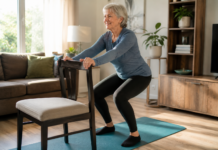




























Quick answer: Balance training works best as a staged progression: start with simple, well-supported static holds, then gradually shrink your base of support, remove visual input, add movement, and finally add unpredictable or unstable surfaces. Most healthy adults notice measurable improvement within four to eight weeks of practicing three to five times a week for ten to fifteen minutes, and the same staged approach applies whether you are a beginner, an athlete, or someone rebuilding confidence after an injury.
By Sophie Taylor
Who This Matters Most For
Balance is not a topic reserved for older adults recovering from a stumble. It is a trainable physical skill, similar to strength or flexibility, that underpins almost every movement pattern a body performs. This guide is written for a wide range of readers: the twenty-something runner whose ankle keeps rolling on trail routes, the desk worker who wants to move better in weekend sports, the yoga student trying to hold tree pose without wobbling, the middle-aged parent who wants sturdier footing while carrying a toddler on uneven ground, and yes, older adults who want to protect their independence. Wherever you fall on that spectrum, the same underlying progression framework applies, only the starting point and pace differ. If you are specifically looking for a program tailored to fall prevention in adults over 60, that is a distinct topic covered elsewhere; this article focuses on the general, all-ages skill of building balance from a beginner level to a confident, advanced level.
Why Balance Training Matters at Any Age
Balance quietly supports nearly everything the body does upright. Walking on a gravel path, stepping off a curb while looking at your phone, reaching for a top shelf while standing on one foot, catching yourself after tripping on a rug: all of these depend on a nervous system that can sense a shift in your center of mass and correct for it within a fraction of a second. Strength training builds the muscle to react, but balance training builds the sensing and coordinating system that decides when and how to react in the first place. Neglect one and the other becomes less useful.
The scale of the problem in the population that studies this most closely, older adults, is a useful illustration of why balance deserves dedicated practice rather than being left to chance. According to Johns Hopkins Medicine, more than a quarter of adults aged 65 and older experience a fall every year, and roughly three million are treated in emergency departments annually for fall-related injuries. The National Council on Aging notes that falls are the leading cause of both fatal and non-fatal injuries in that age group, and that about 30 percent of older adults who fall lose confidence and start restricting their own activity afterward, which then accelerates further physical decline. That confidence spiral is exactly why this article is titled around building toward being “confident,” not just capable. A balance program that only chases numeric improvement while leaving someone anxious about falling has not fully done its job.
Balance training is not only defensive, either. Athletes use single-leg stability work to reduce ankle and knee injury risk, dancers and gymnasts rely on refined proprioceptive control for precision, and casual exercisers who add balance drills to a routine often report better posture, steadier footing on stairs, and less fatigue during long periods of standing. The research base on structured balance and strength programs backs this up with real numbers. The Otago Exercise Program, one of the most extensively studied balance and strength interventions in the world, has been shown to reduce falls by 35 to 40 percent among frail older adults, according to a summary from the University of North Carolina’s Center for Aging and Health. The same summary notes that participants in Otago-based research showed statistically significant clinical improvement after as little as eight weeks of consistent practice, which is a helpful benchmark for how quickly a well-structured program can produce noticeable change.
The Three Systems Behind Every Balance Reaction
Balance is not a single sense. It is the output of three separate sensory systems constantly feeding information to the brain, which then blends the input and sends correction signals to your muscles, often before you are consciously aware anything shifted. Understanding these systems helps explain why balance training uses such a variety of drills instead of one single exercise.
The vestibular system, housed in the inner ear, detects head rotation through the semicircular canals and detects linear movement and head tilt through the otolith organs. Research summarized by The Physiological Society describes the vestibular system as one of the fastest of the three, generating a usable signal in roughly ten milliseconds. It answers a very specific question for the brain: which way is my head moving right now, and how fast?
The proprioceptive system is a network of receptors in muscles, tendons, and joints that reports the position of body parts relative to one another, again on a timescale close to ten milliseconds according to the same source. This is the system that tells you your ankle just rolled slightly on an uneven step without you having to look down and check.
The visual system contributes rich, detailed information about the environment, but it is comparatively slow, with a processing delay closer to one hundred milliseconds. Vision is enormously useful for anticipating a hazard (a curb, a patch of ice, a loose stair tread) before you reach it, but because it is slower than the other two systems, healthy balance training deliberately practices with reduced or removed visual input so the faster vestibular and proprioceptive systems get better at carrying the load on their own.
This is also why practices like tai chi and certain forms of Pilates show up repeatedly in balance research: The Physiological Society’s review notes both are believed to help “upweight” the brain’s reliance on the faster vestibular and proprioceptive channels rather than defaulting to vision, which is part of why their benefits transfer so well to real-world stability, such as recovering your footing on a dim staircase.
Balance, By the Numbers
The Beginner-to-Advanced Progression Framework
Physical therapists build balance programs by manipulating a small set of variables, one at a time, so the nervous system is challenged just enough to adapt without being overwhelmed to the point of failure or injury. A widely used framework, described in patient-facing progression material from Shirley Ryan AbilityLab, one of the country’s leading rehabilitation research hospitals, organizes progression around five levers: base of support, surface stability, vision, movement, and cognitive load. Static holds are generally progressed once a position can be held with good form for about sixty seconds, while dynamic movements are progressed once ten to twenty clean repetitions can be performed without loss of control. The same source is explicit about a key principle worth repeating here: change one variable at a time. Narrowing your stance and closing your eyes and standing on a pillow, all on day one, is not progression, it is a fall waiting to happen.
The Progression Ladder
Notice what is absent from that list: speed. Progression is defined by control and mastery at one level, not by how quickly someone races through the stages. Two people starting the same program might take four weeks or four months to reach stage five, and both outcomes are normal. What matters is that each step is genuinely mastered, meaning it can be performed with steady form and without gripping, swaying wildly, or needing to catch yourself, before the next variable is added.
How to Safely Progress Difficulty
The single biggest safety principle in balance training is proximity to support. Every stage of practice, even advanced stages, should happen within arm’s reach of a wall, sturdy countertop, or heavy chair back that will not slide or tip. This is not a beginner-only rule; even experienced practitioners occasionally misjudge a new surface or a new eyes-closed variation and need to catch themselves.
A practical, low-risk way to progress is to use the “one variable, one small step” rule described above. If you have mastered a staggered stance with eyes open for thirty seconds, the next session might extend the hold time toward sixty seconds before you touch a second variable such as closing your eyes. If a new variation causes wobbling that requires grabbing support more than once or twice in a set, that is a signal to stay at the current level for another few sessions rather than pushing forward. Soreness in the ankles and hips for a day after a session is common when starting out; sharp pain, dizziness, or a fall itself are signals to stop and reassess, not to push through.
Frequency and consistency matter more than intensity. The National Council on Aging’s review of evidence-based programs found effective community balance classes typically run two to three sessions a week, often an hour long in group formats, though home practice sessions of ten to fifteen minutes several times a week can produce meaningful change for a healthy, motivated individual working through a beginner progression. Consistency across weeks appears to matter more than the length of any single session, which is good news for anyone trying to fit balance work around a busy schedule.
A Four-Stage Progression Program
The table below lays out a sample four-stage program you can use as a template. Treat the hold times and repetitions as targets to work toward, not starting requirements. Always keep a support surface within reach, and only move to the next stage once the current one feels stable and controlled, not shaky or effortful to the point of losing form.
Starting Your Balance Practice Safely: A Checklist
- Clear a small practice area of rugs, cords, pets, and clutter before you begin.
- Position yourself within arm’s reach of a wall, heavy chair back, or countertop for every stage, including advanced ones.
- Wear supportive, flat, non-slip shoes, or practice barefoot on a non-slip floor.
- Warm up for three to five minutes with easy walking or marching in place before static holds.
- Master one stage before adding a second challenge variable (do not combine eyes closed with an unstable surface until each has been practiced separately).
- Practice three to five times a week in short sessions rather than one long weekly session.
- Stop a set if you feel dizzy, lightheaded, or notice sharp joint pain, and rest before continuing.
- Check in with a physician or physical therapist before starting if you have a relevant health condition (see the safety section below).
A Worked Example: Maya’s Eight-Week Progression
To make this concrete, consider a composite example based on common patterns seen in beginner balance programs. Maya is a 34-year-old marketing manager who plays weekend soccer and keeps twisting her ankle on uneven grass. She has no diagnosed balance disorder, just an untrained sense of stability. She commits to ten minutes of balance work, four days a week, alongside her regular workouts.
Weeks 1 and 2: Maya starts at Stage 1, holding a shoulder-width stance and a feet-together stance near her kitchen counter, and adding slow weight shifts. In the first few sessions she needs a hand on the counter almost the whole time. By the end of week two, she can hold feet-together for 30 seconds with just fingertips touching the counter.
Weeks 3 and 4: She moves to Stage 2, practicing a staggered stance and then a tandem stance with her hands off the counter but close enough to catch herself. She notices her right side, the ankle she keeps rolling on the soccer field, is noticeably less stable than her left, so she adds an extra set on that side.
Weeks 5 and 6: Single-leg stance work begins. She can hold about 15 seconds on her weaker right leg and 25 on her left at the start of week 5. She resists the urge to close her eyes immediately, waiting until she can comfortably hit 25 seconds on both sides with eyes open, which happens partway through week 6.
Weeks 7 and 8: She adds eyes-closed single-leg holds and begins heel-to-toe walking along a line of tape on her living room floor, followed by short sets standing on a folded towel. By week 8, her right-side single-leg hold with eyes open has grown from 15 to close to 40 seconds, and she reports far less ankle rolling during actual soccer matches. This timeline lines up closely with the eight-week mark at which Otago-based research recorded statistically significant clinical improvement, which suggests Maya’s experience, while fictionalized as an illustrative composite, reflects a realistic and achievable pace for a healthy adult training consistently.
Common Mistakes to Avoid
What Physical Therapists Say
Clinical guidance from the American Physical Therapy Association’s patient resource, ChoosePT, frames balance problems as one of the most common reasons older adults see a physician, and it treats balance training as an individualized process rather than a single fixed routine. A physical therapy evaluation typically screens strength, joint mobility, visual tracking, and coordination alongside balance itself, because a deficit in any one of those areas can masquerade as a “balance problem” even though the fix might be a strength program, a vision check, or a vestibular referral instead. Physical therapists frequently combine strengthening (especially of the core, hips, and ankles), flexibility work, vestibular retraining, and progressive dynamic and static balance drills into one plan, and ChoosePT points to systematic-review evidence supporting several specific approaches, including perturbation-based training (where a therapist introduces small, controlled destabilizations), yoga, and exergaming, as effective methods for improving mobility and lowering fall risk.
Guidance from Shirley Ryan AbilityLab, a rehabilitation hospital that trains clinicians nationally, reinforces the “one variable at a time” principle described earlier in this article and recommends periodic reassessment, roughly every six to twelve months for people managing an ongoing balance concern, so the program can be adjusted as ability changes. Reactive balance training, which practices recovering from an actual loss of balance rather than just holding a static position, has its own supporting evidence: a 2023 systematic review and meta-analysis published in Physical Therapy, covering 29 randomized controlled trials, found that people who did reactive balance training had a meaningfully lower risk of falling (a risk ratio of 0.76 compared to control groups) and a lower overall fall rate (a rate ratio of 0.61). That same review flagged a higher rate of mild-to-moderate adverse events during reactive training sessions themselves, which is part of why this style of training is usually introduced later in a progression and, ideally, under professional supervision rather than attempted alone from day one.
Safety Notes and Scope
This article is general educational information and is not medical advice, a diagnosis, or a substitute for individualized care from a qualified clinician.
If you have experienced a recent fall, current dizziness or vertigo, a diagnosed neurological condition such as stroke, Parkinson’s disease, or multiple sclerosis, or any other condition that affects your stability, talk with a physician or physical therapist before starting a balance program. They can help identify the underlying cause and design a plan matched to your specific situation.
Always keep a sturdy support surface, such as a wall, countertop, or heavy chair back, within reach while practicing, especially when trying a new exercise variation for the first time.
Key Takeaways
- Balance is a trainable skill built from three sensory systems: vestibular, proprioceptive, and visual, that feed the brain constant information about position and movement.
- A staged progression, changing base of support, surface, vision, movement, and cognitive load one variable at a time, is the framework physical therapists rely on.
- Structured programs like Otago show real fall-risk reductions of 35 to 40 percent, with measurable clinical improvement often appearing within about eight weeks of consistent practice.
- Frequency beats intensity: three to five short sessions a week produce more consistent gains than one long, infrequent workout.
- Always keep a support surface within reach and only add one new challenge at a time to keep practice both effective and safe.
- Anyone with dizziness, a recent fall, vertigo, or a neurological condition should be evaluated by a physician before starting a balance program.
Frequently Asked Questions
How often should I practice balance exercises as a beginner?
Most beginner programs recommend three to five short sessions a week, around ten to fifteen minutes each. Consistency across weeks tends to matter more than the length of any single session.
How long does it take to notice improvement?
Research on the Otago Exercise Program found statistically significant clinical improvement after as little as eight weeks of consistent practice. Many people notice subjective improvements in confidence and steadiness even sooner, often within two to four weeks.
Is balance training only useful for older adults?
No. Athletes use it to reduce ankle and knee injury risk, people with desk jobs use it to counter general deconditioning, and dancers and gymnasts use refined balance work for performance precision. The same progression framework applies across ages; only the starting stage and pace differ.
What is the difference between static and dynamic balance training?
Static balance training involves holding a still position, like standing on one leg, while dynamic balance training involves maintaining stability while moving, such as walking heel-to-toe or performing a lunge with rotation. A well-rounded program includes both, generally progressing from static to dynamic.
Do I need special equipment to start?
No. The foundation and narrow-base stages of the progression need nothing more than open floor space and a sturdy counter or wall to hold onto. A folded towel, pillow, or foam pad is enough to begin adding surface instability later in the program.
Why does closing my eyes make balance so much harder?
Vision processes information more slowly than the vestibular and proprioceptive systems, roughly 100 milliseconds versus about 10 milliseconds according to research summarized by The Physiological Society, but most people lean on vision heavily anyway. Removing it forces the faster systems to take over, which is exactly the training effect balance drills are trying to build.
When should I see a physical therapist instead of practicing on my own?
If you have had a recent fall, experience dizziness or vertigo, have a neurological condition, or notice a significant difference in stability between your two sides, a physical therapist can assess the underlying cause and build a program suited to your situation before you begin self-guided practice.
Can balance training help with sports performance, not just injury prevention?
Yes. Improved single-leg stability and faster sensory reaction time support quicker direction changes, steadier landings, and better body control in activities like soccer, basketball, skiing, and trail running, in addition to lowering injury risk.
References
- Johns Hopkins Medicine. “Fall Prevention: Balance and Strength Exercises for Older Adults.” hopkinsmedicine.org/health/wellness-and-prevention/fall-prevention-exercises
- Centers for Disease Control and Prevention. “STEADI — Older Adult Fall Prevention.” cdc.gov/steadi/index.html
- University of North Carolina Center for Aging and Health (CGWEP). “The Otago Exercise Program.” med.unc.edu/aging/cgwep/courses/otago-exercise-program
- The Physiological Society. “The Neuroscience of Balance.” physoc.org/magazine-articles/the-neuroscience-of-balance
- National Council on Aging. “Evidence-Based Falls Prevention Programs.” ncoa.org/article/evidence-based-falls-prevention-programs
- Physical Therapy (Oxford Academic), 2023. “Effect of Reactive Balance Training on Falls in Daily Life: An Updated Systematic Review and Meta-Analysis.” academic.oup.com/ptj/article/103/1/pzac154/6812867
- American Physical Therapy Association, ChoosePT. “Physical Therapy Guide to Balance Problems.” choosept.com/guide/physical-therapy-guide-balance-problems
- Shirley Ryan AbilityLab. “Balance Training: Progression.” sralab.org (Balance Training progression guide, PDF)