


























By Laila Qureshi
You already know exercise would help. That is not the problem. The problem is that between medication schedules, doctor calls, meal prep, and the hundred small tasks nobody else sees, the idea of a 45-minute workout can feel like a joke someone tells people who have free time. If you are caring for a parent, spouse, or another loved one, “just go for a run” is advice from a different life.
This article is not going to tell you to find an hour you do not have. It is going to walk through what the research on short exercise bouts actually shows, and how ten minutes at a time, done in the kitchen, next to a recliner, or during a nap, can fit into a caregiving day without adding guilt to an already full plate.
It also is not going to pretend that ten minutes solves caregiver exhaustion, financial strain, or the loneliness that so often comes with the role. Those are real problems that need real support, not a workout plan. What ten minutes can do is give your body and your nervous system a small, repeatable break inside a schedule that otherwise leaves almost no room for you.
The guilt is real, and it is not really about exercise
Caregiver guilt rarely shows up as “I should exercise more.” It shows up as “how could I spend ten minutes on myself when they need me.” That framing is worth naming directly, because it is the actual obstacle, not a lack of willpower or time-management skill.
According to the AARP and National Alliance for Caregiving’s 2025 Caregiving in the US report, an estimated 63 million Americans, nearly one in four adults, provided care to a family member or friend in the past year. That is an increase of about 20 million caregivers since 2015. Nearly one in four caregivers reports providing 40 or more hours of care per week, which is a full-time job layered on top of everything else in their lives. One in five caregivers rates their own health as fair or poor, and nearly one in four says they struggle to care for their own health specifically because of their caregiving responsibilities. Almost half report major financial impacts from caregiving, including debt or stopped savings, and six in ten employed caregivers say caregiving has disrupted their work in some way.
Those numbers describe a structural problem, not a personal failing. Time scarcity for caregivers is not a mindset issue to be solved with a better planning app. It is the predictable result of unpaid labor that averages dozens of hours a week with no built-in coverage, no sick days, and often no backup plan. Naming that matters, because it reframes the goal. You are not failing to find time that is obviously there. You are working within a genuinely tight constraint, and the useful question is what fits inside it, not what you are willing to sacrifice to make room for it.
This is also why generic fitness advice tends to land badly with caregivers. Most workout guidance assumes a person can block off a chunk of the day, leave the house, or at minimum guarantee they will not be interrupted. Caregiving rarely allows for any of that. A ten-minute frame works better not because it is more virtuous, but because it is realistic inside a day that can be reshuffled by a fall, a bad night, or an unexpected phone call from a doctor’s office.
Why ten minutes is not a consolation prize
For years, exercise guidance centered on continuous 30-minute sessions, which made short bursts feel like an inferior substitute: better than nothing, but not real exercise. Recent research has largely overturned that framing, and the findings are specific enough to be genuinely useful for someone with a fragmented day.
A 2024 scoping review published in the exercise physiology literature analyzed seven randomized controlled trials involving more than 400 previously inactive adults ranging from 18 to 80 years old, about 70 percent of them women. The trials tested “exercise snacks”: vigorous activity lasting under five minutes, performed at least twice a day on three or more days a week, over four to twelve weeks. Adults under 65 showed significantly improved cardiorespiratory fitness. Adults 65 and older showed significant gains in muscular endurance. Adherence was high, with 91 percent of general adults and 83 percent of older adults sticking with the routine, a notably better completion rate than most traditional exercise programs report. The activities used in these trials were ordinary: stair climbing showed up more often in younger participants, while tai chi and lower-body strengthening moves were more common among older adults.
Separately, a large 2022 study in Nature Medicine that used wearable activity trackers found that people who accumulated just three short bouts of vigorous activity a day, each lasting one to two minutes, things like a brisk stair climb or a fast uphill walk, had a 48 to 49 percent lower risk of cardiovascular death compared to people who did no vigorous activity at all. People who reached about 4.4 minutes of vigorous activity spread across the day showed roughly a 32 to 34 percent lower cardiovascular death risk, and the same study found vigorous activity was linked to a 38 to 40 percent lower risk of cancer-related death. A related 2023 analysis published in JAMA Oncology found that people who accumulated 3.4 to 3.6 minutes of intermittent vigorous activity daily had 17 to 18 percent lower cancer risk, rising to 31 to 32 percent lower risk at around 4.5 minutes daily.
There is also emerging evidence on brain health that matters for caregivers who worry about their own cognitive load on top of everything else. A 2025 study of older adults found that even minimal amounts of moderate-to-vigorous activity, as little as one to 35 minutes weekly, were associated with reduced dementia risk. A separate 2025 study found that older adults who did short two-to-five-minute exercise sessions showed measurable improvements in cognitive function. For a caregiver managing medications, appointments, and paperwork on someone else’s behalf, protecting your own cognitive sharpness is not a vanity concern. It is part of doing the job well over the long haul.
None of this says ten minutes is equivalent to an hour at the gym. It says the body responds to short, repeated bouts of movement in measurable ways, and that the all-or-nothing model of exercise was never well supported by the data in the first place. For a caregiver deciding whether ten minutes is even worth doing, the honest answer from the research is yes, it is.
Ten-minute options that work inside a caregiving day
These are grouped by where you likely are when you get a ten-minute window: in the house, near the person you are caring for, or in whatever room you happen to be standing in.
| Setting | Option | What it targets | Notes |
|---|---|---|---|
| Kitchen, waiting on something | Counter push-ups + calf raises, alternating minutes | Upper body, lower legs | Do it while water boils or the microwave runs |
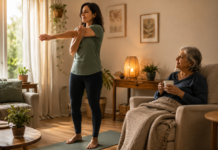
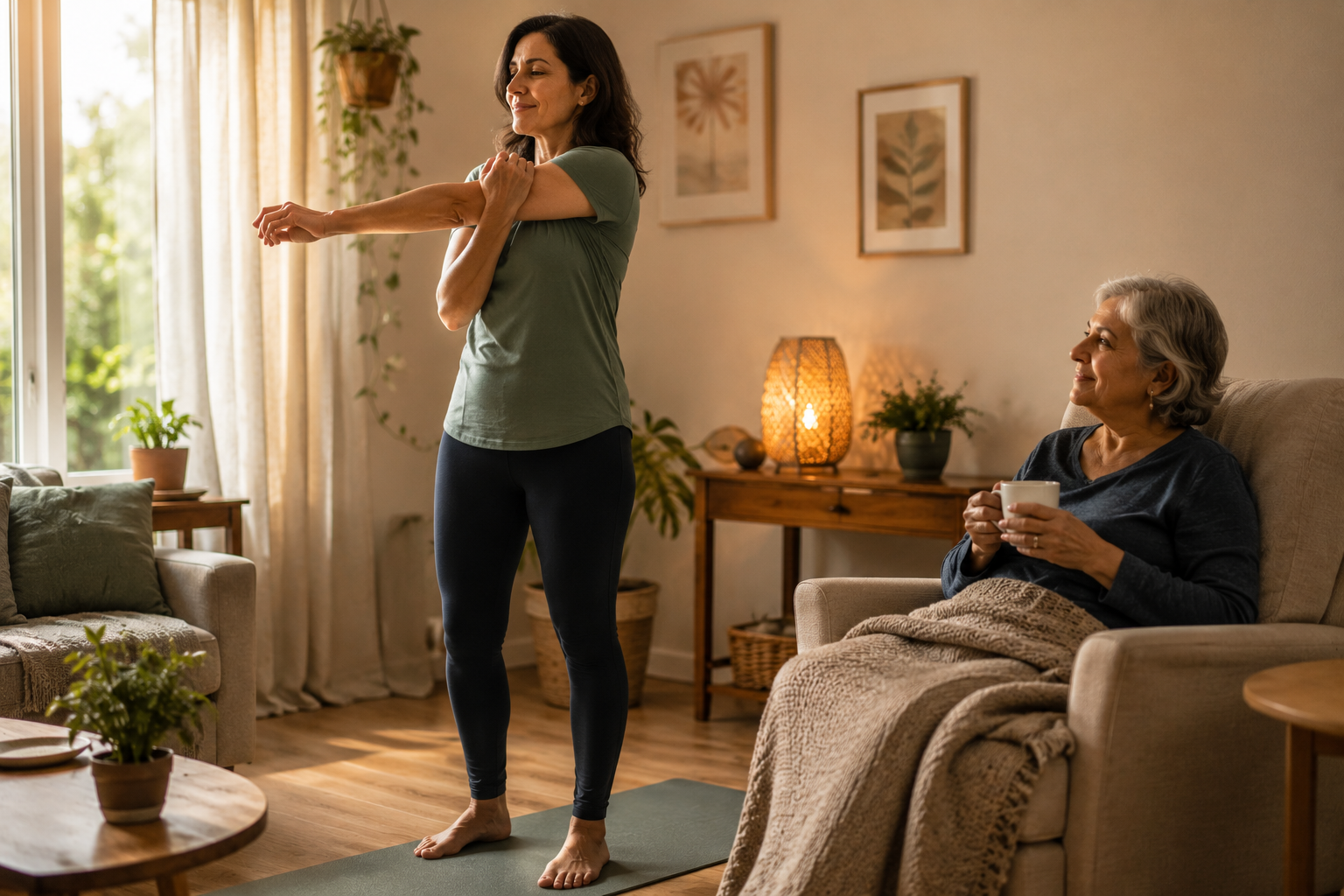
| Living room, near a recliner or bed | Seated marching + arm circles | Circulation, shoulders | Can be done at eye level with the person you’re caring for, side by side |
| Hallway or any open floor | Brisk walking laps, 60-90 seconds at a time | Cardiovascular fitness | Matches the “vigorous burst” pattern from the Nature Medicine findings |
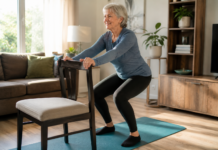
| Bathroom counter or sturdy chair back | Wall or counter push-ups, squats | Strength, muscular endurance | Useful right before or after helping with hygiene routines |
| Bedroom, during a nap or quiet stretch | Floor stretching sequence: hip flexor, hamstring, shoulder | Flexibility, tension release | Good for the stiffness that builds up from lifting and bending |
| Stairs, if available | Two to three short climbs, resting between | Cardiovascular fitness, leg strength | One of the most-studied exercise-snack activities |
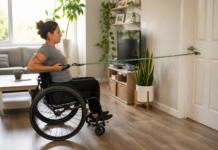
| Doorway | Resistance band rows or pulls | Back, posture | Counteracts the forward-hunched posture of caregiving tasks |
Folding movement into caregiving tasks themselves
Some of the most realistic exercise minutes are not separate from caregiving at all: they are built into it. This is not about turning caregiving into a workout, which risks trivializing the actual physical and emotional labor involved. It is about noticing where movement is already happening and adding slightly more intention to it.
This matters more than it might seem, because caregiving is physically demanding work even when nobody calls it exercise. Lifting, transferring, bending to help with shoes or socks, reaching for supplies on a high shelf: these tasks place real load on your back, shoulders, and knees, often with poor form because nobody trained you for them. Treating a handful of these moments as opportunities for better mechanics and a bit more strength work is not about squeezing in a workout. It is about protecting the body that is doing this labor day after day, since caregiver injuries, especially back injuries from lifting, are common enough that many home health agencies now build transfer training into their orientation for paid staff. Family caregivers rarely get that same training, which is part of why building strength and learning safer movement patterns matters as much as the cardiovascular benefits discussed above.
- Transfers and repositioning. If you regularly help someone stand, shift in bed, or move from a chair, ask a physical therapist or home health aide to check your form. Proper body mechanics during transfers double as functional strength training and reduce your own injury risk, which matters more the longer caregiving continues.
- Pushing a wheelchair or walker on a walk. A slow walk with the person you care for is both connection time and cardiovascular activity, even at a pace that would not register as “exercise” in a fitness app.
- Standing tasks. Folding laundry, prepping meals, and organizing medications can be done with calf raises, weight shifts, or a wider stance that engages the legs, rather than standing still.
- Waiting-room minutes. Appointments involve a lot of sitting and waiting. A few minutes of seated leg extensions or ankle circles in a waiting room chair adds up over a month of medical visits.
- Overnight or on-call stretches. If you are up checking on someone during the night, a two-minute stretch sequence before returning to bed can ease the physical toll of interrupted sleep, even if it does not replace the sleep itself.
- Grocery runs and errands. Carrying bags in from the car, taking stairs instead of an elevator at a pharmacy or clinic, and parking a little farther from the entrance all add small amounts of vigorous or moderate movement to a trip you were already making.
- Phone calls. Insurance calls, scheduling calls, and check-ins with siblings or other family members often run long. Standing and pacing during these calls, rather than sitting the entire time, turns dead time into low-effort movement.
None of these replace dedicated movement entirely, and that is fine. The point is not to squeeze every possible minute out of the day. It is to stop treating caregiving tasks and personal movement as two completely separate categories that compete for the same ten minutes, when in practice they often overlap.
A realistic weekly framework, not a rigid plan
Caregiving schedules are unpredictable by nature, so a framework that assumes a fixed daily slot will fail within a week. A better approach is a loose weekly target with built-in flexibility about when and how it happens.
A caregiver-friendly weekly framework
- Aim for movement most days, not every day. Helpguide’s caregiving guidance suggests roughly 30 minutes on most days, broken into three 10-minute sessions when a single block is not realistic. Missing a day is not a failure of the plan; it is the plan working as designed.
- Mix in at least one strength-focused block a week. Push-ups, squats, or resistance bands, tied to the muscular endurance gains seen in older-adult exercise-snacking research.
- Use “attached” movement daily. Calf raises while cooking, stretches during a nap, a short walk during a phone call: these count and do not require a dedicated slot.
- Protect one slightly longer window if one exists. A weekly respite window, a sitter’s visit, or a sibling’s shift can become 20-30 minutes instead of 10, but only if it is realistic, not a new obligation.
- Review weekly, not daily. Looking back at a week rather than judging a single day reduces the all-or-nothing thinking that leads to giving up entirely after one missed session.
Self-compassion is part of the exercise plan, not separate from it
It is worth stating plainly: skipping movement on a hard day is not a character flaw. Caregiver stress statistics make clear why some days simply will not have ten spare minutes. Reports compiled by caregiving researchers and organizations like the Family Caregiver Alliance describe rising emotional stress among caregivers since 2020, along with growing rates of social isolation, with nearly one in four caregivers now reporting feeling isolated. These are not abstract numbers. They describe the emotional weight caregivers carry alongside the physical demands, and that weight does not disappear because a workout got skipped.
Treating a missed ten-minute session as evidence of failure adds a second layer of stress on top of an already heavy one. The research on exercise snacking is encouraging specifically because it lowers the bar for what “counts,” not because it raises the standard for what caregivers are supposed to accomplish. If a week includes two ten-minute sessions instead of seven, that is still real, still measurable, and still worth something. Consistency over months matters more than perfection in any single week, and a framework that survives bad weeks is more useful than one that only works on easy ones.
Self-compassion research in general, separate from exercise research specifically, consistently finds that people who treat their own setbacks with the same kindness they would offer a friend tend to stick with healthy habits longer than people who rely on self-criticism to stay motivated. For caregivers, who are already primed to put someone else’s needs first, extending that same patience inward is not indulgent. It is what makes a ten-minute habit sustainable across months or years of caregiving rather than something abandoned after the first missed week.
If exercise consistently feels impossible rather than just difficult, that can be a sign worth mentioning to a doctor or a caregiver support group, separate from the exercise question itself. Persistent exhaustion, loss of interest in things that used to help, or feeling unable to function are signs of caregiver burnout, not signs that you need a stricter workout schedule. Burnout is a health condition, not a motivation problem, and it typically needs support beyond a movement routine, such as respite care, counseling, or connecting with other caregivers who understand the specific weight of the role.
Where to start this week
Pick one setting from the table above where you already spend time: the kitchen counter, the hallway, the chair next to the recliner, and attach one movement to something you already do there. That is the entire starting point. Not a program, not a streak, not a fitness goal. One movement, one location, repeated when it fits. The research on short activity bursts suggests the body notices consistency at this scale more than intensity, which is good news for anyone whose schedule is not their own to control right now.
You do not owe anyone, including yourself, a perfect exercise routine while you are also managing someone else’s medical care, mood, and daily needs. What the evidence actually supports is smaller and more forgiving than that: a few minutes here, a few minutes there, done on the days it is possible, adding up in ways that show up in cardiovascular health, muscular endurance, and mood over time. That is a standard almost any caregiver can meet on most weeks, and meeting it on most weeks is enough.
Frequently asked questions
Is ten minutes of exercise actually enough to matter?
Research on short vigorous activity bouts, including a 2022 study in Nature Medicine, found meaningful reductions in cardiovascular and cancer mortality risk from bouts as short as one to two minutes, accumulated a few times a day. Ten minutes, done consistently, fits well within the range shown to produce measurable benefits.
What if I can never leave the room the person I care for is in?
Many of the options above, seated marching, arm circles, chair-assisted squats, stretching, can be done in the same room, including next to a bed or recliner. Proximity does not have to rule out movement.
I feel guilty taking even ten minutes for myself. Is that normal?
Yes, and it is extremely common among family caregivers. Surveys report that a large share of caregivers struggle to prioritize their own health because of their caregiving responsibilities. That guilt is a predictable response to an imbalanced situation, not evidence that the guilt is justified.
Do I need equipment to do any of this?
No. Every option in the table above uses body weight, a countertop, a wall, a chair, or stairs already in the home. A resistance band is a low-cost optional addition, not a requirement.
What if I miss several days in a row?
That is expected, especially during medical crises or bad stretches. The weekly framework above is designed to be reviewed by the week, not the day, specifically so a few missed days do not derail the whole approach. Pick back up with one ten-minute session rather than trying to make up for lost time.
Should I talk to a doctor before starting?
If you have an existing health condition, have not exercised in a long time, or are recovering from an injury related to lifting or transferring the person you care for, a brief check-in with a doctor or physical therapist is a reasonable step before increasing activity, even in small amounts.
References
- AARP and National Alliance for Caregiving. “New Report Reveals Crisis Point for America’s 63 Million Family Caregivers.” 2025. aarp.org
- Islam, H., et al. “Exercise Snacks and Other Forms of Intermittent Physical Activity for Improving Health in Adults and Older Adults: A Scoping Review.” Scoping review, 2024. Summarized via PubMed. pubmed.ncbi.nlm.nih.gov
- NBC News. “Exercise Snacks: Short Activity Bursts Improve Heart Health and Muscle Strength.” 2025. nbcnews.com
- UPMC HealthBeat. “The Benefits of Exercise Snacking.” 2025. share.upmc.com
- HelpGuide. “Caregiver Stress and Caregiver Burnout.” helpguide.org