
























By Emily Harrison
Round your shoulders forward right now and notice what happens to your breath. It shortens. That small experiment is a preview of what years at a keyboard, a steering wheel, or a phone screen do to the front of the body: the chest muscles shorten, the shoulders roll inward, and the upper back gives up the fight to hold you upright. The fix isn’t a single miracle stretch. It’s a specific, repeatable way of opening the chest and front shoulders while asking the muscles behind them to wake back up.
This guide walks through why rounded posture develops, what’s actually tight versus what’s actually weak, and a step-by-step stretch sequence you can do in under ten minutes a day. Along the way you’ll find a real stretch-and-hold reference table, a breakdown of the most common mistakes people make when they try to “fix” their posture, and guidance on when stretching alone isn’t enough and a professional should take a look.
What Rounded Posture Actually Is
Rounded shoulder posture, sometimes called “mom posture” in casual conversation, describes a resting shoulder position that sits forward of where it should align over the ribcage. Clinically, it’s often discussed alongside forward head posture and increased thoracic kyphosis (an exaggerated forward curve of the upper back) as part of a broader pattern researchers have named upper crossed syndrome, a term coined by physician Vladimir Janda. In this pattern, one set of muscles tightens while its opposing set weakens and lengthens, forming a visual “X” across the upper body when you map it out.
This is not a rare cosmetic quirk. A frequently cited 1992 workplace study found that 73% of workers between the ages of 20 and 50 showed measurable right-side shoulder rounding, with about 66% showing it on the left. Whatever the exact number in any given population, rounded shoulders are common enough in seated, screen-based work that they’re closer to a default outcome of modern routines than an exception.
By the Numbers: Rounded Shoulders at a Glance
- ~73% of workers aged 20–50 showed measurable right-shoulder rounding in a widely cited 1992 workplace posture study.
- 20–40% of adults over 60 show increased thoracic kyphosis, per posture research summarized by Physiopedia.
- 60 seconds total stretch time per muscle group, 2–3 times weekly, is the flexibility benchmark Harvard Health cites from ACSM guidance.
- 10–30 seconds per hold, repeated 2–4 times, is the practical range the American Council on Exercise recommends for chest stretches.
Why the Chest and Front Shoulders Tighten in the First Place
Sustained Sitting and Screen Posture
When the arms stay out in front of the body for hours, whether on a keyboard, a phone, or a steering wheel, the pectoralis major and minor shorten in that shortened position. Muscles adapt to the length they’re held at most often. Sit hunched forward for eight hours a day and the chest muscles gradually “learn” that shortened range as their new normal, while the muscles between the shoulder blades stretch out and lose the ability to fire efficiently.
Muscular Imbalance, Not Just Tightness
Rounded posture is rarely just a tight-chest problem. It’s a paired imbalance. According to physical therapy references on upper crossed syndrome, the muscles that tend to tighten and overactivate include the upper trapezius, levator scapulae, pectoralis major and minor, and the sternocleidomastoid at the front of the neck. Meanwhile the deep neck flexors, serratus anterior, rhomboids, and middle and lower trapezius tend to weaken and lengthen. Stretching the front without also retraining the back half of that pair only addresses half the problem.
Stress and Protective Posturing
Persistent psychological stress activates a low-grade fight-or-flight response that tends to pull the shoulders up and forward, a protective posture that primates and humans share when feeling threatened. Held long enough, that temporary bracing becomes a habitual resting position.
Genetics and Structural Factors
Not every case of rounded posture comes from behavior. Inherited connective tissue laxity, natural variations in scapular shape, and structural spinal curvature can predispose some people to a more forward-shoulder resting position regardless of how they sit. Conditions such as scoliosis or ankylosing spondylitis can also present with a rounded-shoulder appearance and deserve a clinical look rather than a stretching routine alone.
Who Tends to Develop This Pattern
Rounded posture shows up across a wide range of routines, not just at office desks. A few groups see it especially often:
- Desk and computer workers. Hours with the arms reaching forward to a keyboard or mouse hold the chest in a shortened position for most of the waking day.
- Drivers and commuters. Gripping a wheel with the arms extended forward produces a similar shortened chest position, often for an hour or more daily.
- Phone and tablet users. Looking down and reaching forward to hold a device pulls the shoulders and head forward simultaneously, compounding the chest tightness with forward head posture.
- New parents and caregivers. Repeatedly cradling, feeding, or carrying an infant with rounded, forward-reaching arms creates the same shortened resting length in the chest, often for months at a stretch.
- Strength trainees who over-emphasize pressing. Heavy bench pressing, push-ups, and overhead pressing without a matching volume of rows, pull-ups, or rear-delt work can build a strong but shortened chest that pulls the shoulders forward even in someone who trains regularly.
- Cyclists. An aggressive, forward-leaning handlebar position keeps the chest flexed and the upper back rounded for the duration of every ride.
Recognizing which of these applies to your own routine matters because it points to the specific habit worth adjusting alongside the stretching routine, whether that’s a monitor height, a handlebar angle, or a training split that’s missing pulling volume.
What Actually Happens When You “Open” the Chest
Opening the chest and front shoulders means lengthening the shortened pectoralis major, pectoralis minor, and anterior deltoid, while cuing the shoulder blades to glide down and back along the ribcage. Done consistently, this can restore a few degrees of shoulder extension and external rotation, reduce the sensation of tightness across the collarbones, and make it easier to hold an upright position without consciously fighting for it.
The pectoralis minor deserves particular attention because of where it attaches. Rather than running to the arm bone like pectoralis major, it runs from the ribs up to the coracoid process, a small hook of bone on the front of the shoulder blade. When pectoralis minor shortens, it tips the shoulder blade forward and down, dragging the whole shoulder girdle into a rounded position independent of what the arm itself is doing. That’s part of why a stretch aimed specifically at the upper chest and front of the shoulder, rather than the mid-chest alone, tends to make a noticeable difference in resting shoulder position.
There’s a breathing angle here too. A collapsed, rounded chest position compresses the ribcage and can restrict how fully the lungs expand on inhalation. Clinical summaries on rounded shoulder posture list reduced lung capacity and breathing difficulty among the potential downstream effects of prolonged, untreated rounding, alongside chronic neck and shoulder pain and cervicogenic headaches. Stretching the front of the shoulder girdle is one piece of restoring room for the ribcage to move.
The Chest and Front-Shoulder Opening Routine
The five stretches below target the pectoralis major, pectoralis minor, and anterior deltoid from slightly different angles. Do them in order, ideally after a few minutes of light movement (a short walk, arm circles, or a warm shower) so the tissue is pliable. Move into each stretch on an exhale and never force it into a sharp or pinching sensation.
Doorway Pec Stretch (Low Arm)
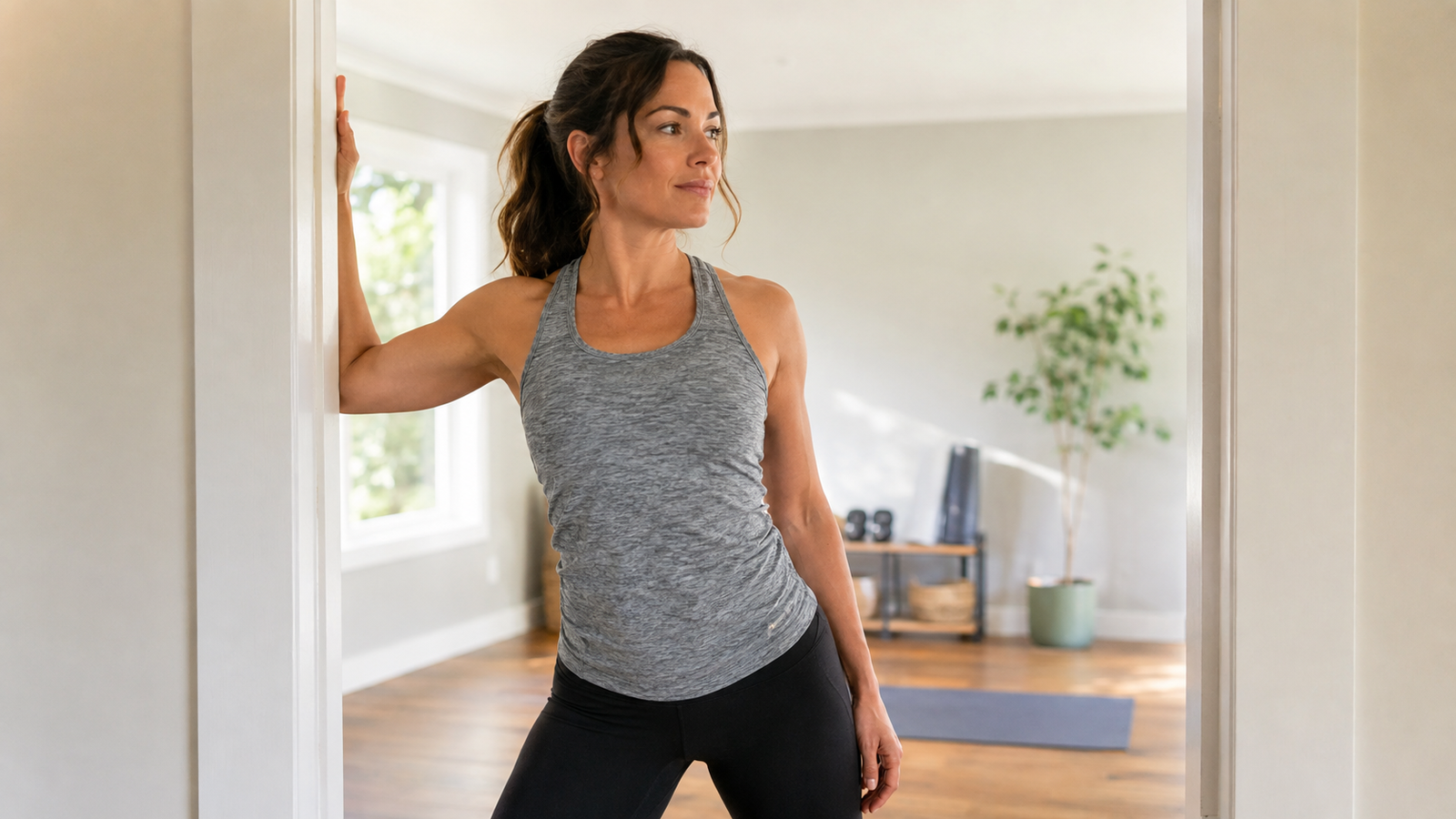
Stand in a doorway with one forearm resting against the frame, elbow bent to roughly 90 degrees and positioned slightly below shoulder height. Step through the doorway with the opposite foot until you feel a stretch across the lower chest. Hold 20–30 seconds, then switch sides. This angle biases the lower fibers of pectoralis major.
Doorway Lunge, Cactus Arms (High Arm)
Bend both elbows to 90 degrees in a “cactus” position and press both forearms against the door frame above shoulder height. Step one foot back and lean the torso forward through the doorway. Hold 20–30 seconds. Raising the arm changes the stretch angle toward the upper chest and front shoulder capsule.
Behind-the-Back Clasp Stretch
Stand tall, reach both hands behind your back, and clasp them together (or hold a towel between them if your hands don’t meet). Straighten the elbows and gently lift the arms away from the lower back while opening the chest upward. Hold 15–20 seconds for two to three rounds. This variation stretches the anterior deltoid along with the chest.
Wall Angels
Stand with your head, upper back, and hips against a wall, arms bent to 90 degrees like a football goalpost, backs of the hands touching the wall. Slowly slide the arms upward and back down, keeping as much contact with the wall as possible. Perform 8–10 slow repetitions. This is less a static stretch and more a mobility drill that trains the shoulder blades to move through the newly available range.
Supported Thoracic Extension (Optional Finisher)
Lie back over a foam roller placed horizontally beneath the shoulder blades, knees bent, feet flat on the floor. Support the head with your hands and allow the upper back to extend gently over the roller for 30–60 seconds, breathing slowly. This decompresses the front of the chest from a different plane than the standing stretches.
Stretch Reference Table
| Stretch | Primary Target | Hold Time | Suggested Reps |
|---|---|---|---|
| Doorway Pec Stretch (Low Arm) | Lower pectoralis major | 20–30 sec | 2–3 per side |
| Doorway Lunge, Cactus Arms | Upper chest, anterior shoulder | 20–30 sec | 2–3 total |
| Behind-the-Back Clasp | Anterior deltoid, chest | 15–20 sec | 2–3 total |
| Wall Angels | Scapular mobility, mid-back | N/A (dynamic) | 8–10 reps |
| Supported Thoracic Extension | Chest, thoracic spine | 30–60 sec | 1–2 total |
These ranges align closely with published guidance: the American Council on Exercise recommends holding chest stretches for 10 to 30 seconds or two to five breath cycles, repeated two to four times, while Harvard Health’s summary of ACSM flexibility guidelines calls for roughly 60 total seconds per muscle group, performed at least two to three times a week.
Common Mistakes That Undermine a Chest-Opening Routine
Stretching the Chest Without Strengthening the Back
Because rounded posture is a paired imbalance, stretching the tight side while ignoring the weak side leaves the shoulders with nowhere new to sit. Pair the routine above with rows, band pull-aparts, or scapular squeezes for the rhomboids and middle trapezius. Wall angels in the sequence already start this, but dedicated pulling strength work several times a week matters just as much as the stretch itself.
Bouncing Into the Stretch
Ballistic bouncing at end range increases the risk of micro-tearing in already-shortened tissue and can trigger a protective reflex that tightens the muscle further. A slow, sustained hold with steady breathing produces a more reliable change in length over time.
Chasing Sensation in the Wrong Spot
If you only feel a stretch at the front of the shoulder joint and never across the chest itself, the arm position likely needs adjusting inward, or the true limiter might be the shoulder capsule rather than the pectoral muscle. Small changes in elbow height and forearm angle change which fibers get loaded.
Expecting an Overnight Fix
Postural muscle length changes gradually. Years of shortened resting position won’t reverse in a single week of stretching. Consistency across weeks, not the intensity of any single session, is what produces a lasting change in resting shoulder position.
Ignoring the Workstation
Mayo Clinic’s ergonomics guidance recommends positioning the monitor about an arm’s length away, roughly 20 to 40 inches from the face, with the top of the screen at or slightly below eye level, and keeping the keyboard directly in front of the body with the upper arms close to the torso. A stretch routine fighting against eight hours of poor monitor height every day is working against a losing trade. Ten minutes of stretching cannot fully offset a chair, desk, or monitor setup that spends the rest of the day pulling the shoulders back into the same rounded pattern.
Skipping the Warm-Up
Cold tissue resists lengthening and is more prone to a sharp, unproductive pulling sensation rather than a smooth stretch. A short warm-up, even just a couple of minutes of arm circles, shoulder rolls, or a brisk walk to raise circulation, makes the same stretch feel more effective and reduces the odds of overstretching to compensate for stiffness.
Beyond Stretching: Building a Complete Approach
A chest-opening routine works best as one part of a broader plan rather than a standalone fix. Cleveland Clinic’s posture guidance lists several complementary movements worth rotating in: the “back to the wall” check to identify where your posture deviates from a neutral line at the ear, shoulder, and hip; chin retractions to counter forward head posture; and resistance-band standing rows to build the pulling strength that keeps newly opened shoulders from drifting forward again. Setting a reminder every 10 to 15 minutes to notice and reset your position, rather than relying on a passive posture brace, is also more effective for building a lasting habit, according to the same guidance.
A Sample Weekly Plan
A stretch routine sticks better with a simple weekly structure rather than a vague intention to “do it sometime.” One workable pattern:
| Day | Focus |
|---|---|
| Monday, Wednesday, Friday | Full five-step chest and front-shoulder routine (about 10 minutes) |
| Tuesday, Thursday | Strengthening: resistance-band rows, reverse flys, and wall angels for the mid-back and rear shoulder |
| Daily | A posture check every hour or so, plus the doorway pec stretch as a quick reset during breaks |
| Weekend | One longer session combining the full routine with the foam roller finisher |
This is a starting template, not a fixed prescription. Someone recovering from a shoulder injury or managing a diagnosed spinal condition should have a clinician review or adjust it before following the plan as written.
When to See a Physical Therapist or Doctor
Stretching is a reasonable first step for garden-variety postural rounding tied to sitting habits and screen time. Some situations call for a professional evaluation instead:
- Pain that persists or worsens despite several weeks of consistent stretching and strengthening.
- Numbness, tingling, or weakness radiating down an arm, which can point to nerve involvement rather than simple muscle tightness.
- A visibly asymmetric spine, rib cage, or shoulder blade, which may indicate scoliosis or another structural condition rather than muscular rounding.
- Chest tightness paired with breathing difficulty severe enough to limit daily activity.
- A history of shoulder dislocation, rotator cuff injury, or prior surgery, where self-directed stretching carries a higher risk of aggravating the joint.
A physical therapist can assess whether the limiting factor is muscle length, joint capsule stiffness, or a motor control issue where the muscles simply aren’t firing in the right sequence, and build a program around the actual cause rather than a generic routine.
Frequently Asked Questions
How long does it take to notice a difference in rounded shoulders?
Many people notice reduced tightness and easier upright sitting within two to four weeks of daily stretching paired with a few strengthening sessions per week. Visible changes in resting shoulder position tend to take longer, often eight to twelve weeks of consistent practice, since you’re changing a habitual muscle length rather than just working through soreness.
Do I need equipment for these stretches?
No. Every stretch in this routine uses a doorway, a wall, or your own body weight. A foam roller is helpful for the optional thoracic extension finisher but isn’t required; a rolled towel or firm cushion under the shoulder blades can serve as a substitute.
Is it normal for one side to be tighter than the other?
Yes. Handedness, sleeping position, and habitual sitting posture (crossing the same leg, angling the body toward a monitor) commonly create side-to-side differences. Spend slightly longer on the tighter side rather than forcing both sides to match a fixed time.
Can chest stretches alone fix rounded posture?
Stretching addresses only the shortened half of the imbalance. Lasting correction generally requires pairing chest and front-shoulder stretches with strengthening work for the mid-back and deep neck flexors, along with adjustments to how you sit and where your screen sits during the day.
Should stretching ever hurt?
A stretch should feel like tension or pulling, not sharp, burning, or pinching pain. If a position produces pain rather than a stretching sensation, ease off the range and consider whether the joint itself, rather than the muscle, needs a professional look.
How often should I do this routine?
Daily is reasonable for the standing stretches since they’re low-intensity, though the 2–3 times per week minimum from ACSM flexibility guidelines is the baseline to not fall below. Wall angels and strengthening work can follow a more typical 3–4 times per week training pattern.
Bringing It Together
Rounded posture builds up slowly through thousands of small choices about where the arms sit and how long the chest stays shortened. Reversing it follows the same pattern in the opposite direction: short, repeated doses of chest and front-shoulder opening, paired with strengthening for the muscles that have gone quiet between the shoulder blades. None of the five stretches above requires special equipment or more than ten minutes, and the reference table gives you exact hold times pulled from established flexibility guidelines rather than guesswork. Start with the doorway stretch today, add the wall angels this week, and give the pattern eight to twelve weeks before judging whether it’s working.
Track progress with something more concrete than a feeling. A photo taken from the side each week, standing relaxed against a wall, will show gradual changes in resting shoulder position long before you’d notice them in the mirror day to day. Pair that with a simple note of how far you can comfortably clasp your hands behind your back, and you’ll have an honest, low-effort record of whether the routine is doing its job.
References and Sources
- Mayo Clinic — Office Ergonomics: Your How-To Guide
- Harvard Health Publishing — The Ideal Stretching Routine
- Physiopedia — Upper Crossed Syndrome
- Wikipedia — Rounded Shoulder Posture
- American Council on Exercise — 5 Chest Stretch Variations
- Cleveland Clinic — Stretches and Exercises To Improve Poor Posture