


























By Ada L. Wrenford
Most advice about stretching before bed reads like a leftover gym routine with the lights turned down. Bend here, hold there, repeat on the other side. What that advice skips is the actual reason it works on some nights and does nothing on others: sleep onset is not a muscular event, it is a nervous system event. Your body has to shift out of an alert, sympathetic-dominant state and into the calmer, parasympathetic-dominant state that makes falling asleep possible. A stretch that is done quickly, with tight breathing and a phone in the other hand, barely touches that switch. A stretch that is slow, sustained, and paired with long exhales can nudge it a meaningful amount.
This piece is about that switch specifically. It is not a desk-break sequence for tight hips after a day at a keyboard, and it is not a recovery routine for stiff legs after a flight. It is a wind-down protocol built around one question: how do you use ten to fifteen minutes of stretching in the last hour before sleep to actually help your body believe it is safe to power down?
Why Evening Stretching Signals Your Nervous System to Power Down
Your autonomic nervous system runs on two competing branches. Harvard Health describes the relationship plainly: the sympathetic branch “functions like a gas pedal in a car,” triggering the fight-or-flight response and priming the body with alertness, while the parasympathetic branch “acts like a brake,” promoting the rest-and-digest state that calms the body once a perceived demand has passed. During a normal day, especially a stressful one, the gas pedal gets pressed a lot, through email notifications, traffic, deadlines, or an argument that replays in your head for hours. Heart rate climbs, breathing shortens, and muscles hold tension you may not consciously notice until you try to release it.
Sleep onset requires the brake to be applied. That is the whole mechanism worth understanding before you do a single stretch: you are not “loosening muscles” for its own sake, you are giving your body a physical cue that the threat-scanning part of the day is over.
The Sympathetic-Parasympathetic Switch
Two features of a stretch determine whether it nudges that switch toward rest or keeps it in alert mode: intensity and duration. A fast, bouncy stretch, or one pushed to the edge of discomfort, keeps the sympathetic system engaged, because discomfort itself is a low-grade alert signal. A slow stretch held well past the initial resistance, without straining, allows muscle spindles to gradually reset their tension threshold and gives the nervous system time to register that nothing dangerous is happening. This is why the same movement, a hamstring fold or a seated spinal twist, can either wind you up or wind you down depending entirely on pace and effort.
Breath as the Second Lever
Breathing is the more direct lever of the two. The Harvard Health overview notes that techniques such as deep abdominal breathing are core tools for activating the parasympathetic system and countering the physical effects of chronic stress. A 2021 study published in Scientific Reports found measurable benefits from even a single session of deep, slow breathing on vagal tone and self-reported anxiety in both younger and older adults, which matters here because vagal tone is one of the clearest physiological markers of parasympathetic activity. Pairing a slow exhale with the release phase of a stretch, rather than holding your breath through it, is what turns a static stretch into something closer to a breathing exercise with a body position attached.
What the Research Actually Shows
It is worth being honest about the strength of the evidence rather than overstating it. A 2024 scoping review in the European Journal of Applied Physiology examined 16 studies covering 1,281 participants with diagnosed sleep disorders and found genuinely mixed results: only five of the sixteen studies reported statistically significant improvements in sleep parameters. Where effects did appear, they were sometimes sizable, with weighted mean improvements of roughly 8.9 percent in sleep efficiency, 14.7 percent in total sleep time, and a 4.4 percent reduction in sleep onset latency across the studies that measured it. The review’s authors proposed several candidate mechanisms behind those improvements, including autonomic nervous system modulation, muscle tension relief, cortisol regulation, and general stress reduction, while also flagging that the field needs more standardized protocols and objective sleep measurement before anyone can say stretching is a proven insomnia treatment. That nuance matters: evening stretching is a plausible, low-risk lever to pull, not a guaranteed fix.
This Is Not a Posture Fix or a Recovery Routine
It is worth spelling this out because the internet tends to lump every stretch routine into one generic bucket. A sequence designed to correct rounded shoulders from a laptop, or one designed to loosen a stiff lower back after sitting in a plane seat for six hours, is judged on a completely different set of outcomes: did your range of motion improve, did the ache go away, can you sit up straighter. Those are worthwhile goals, they are just not this goal. Judge the sequence below on a single question instead: did your breathing slow down, did your shoulders drop, did the transition into lying down and eventually sleep feel easier than on a night you skipped it. Flexibility gained along the way is a side effect, not the target.
Key distinction: A desk stretch sequence is built to correct posture and relieve stiffness accumulated from sitting, done in work clothes, mid-day, with the goal of alertness. A post-flight stretch sequence is built to restore circulation and joint range after hours of immobility. This sequence has a different goal entirely: down-regulating arousal so your body is ready for sleep. The pace, breath pattern, and stretch selection below are chosen for that one purpose, not for flexibility gains or pain relief.
The 13-Minute Evening Wind-Down Sequence
This sequence is built around slow holds, paired breathing, and a deliberate absence of anything that spikes alertness, such as bright light, fast movement, or scrolling between stretches. Do it on the floor or in bed, in dim lighting, ideally after you have already turned off overhead lights.
Sit cross-legged or on the edge of the bed. Drop your right ear toward your right shoulder, exhale for a slow count of six, and hold for four full breath cycles before switching sides. Let your shoulders drop away from your ears on every exhale rather than trying to deepen the stretch on the inhale.
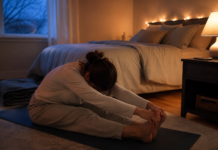
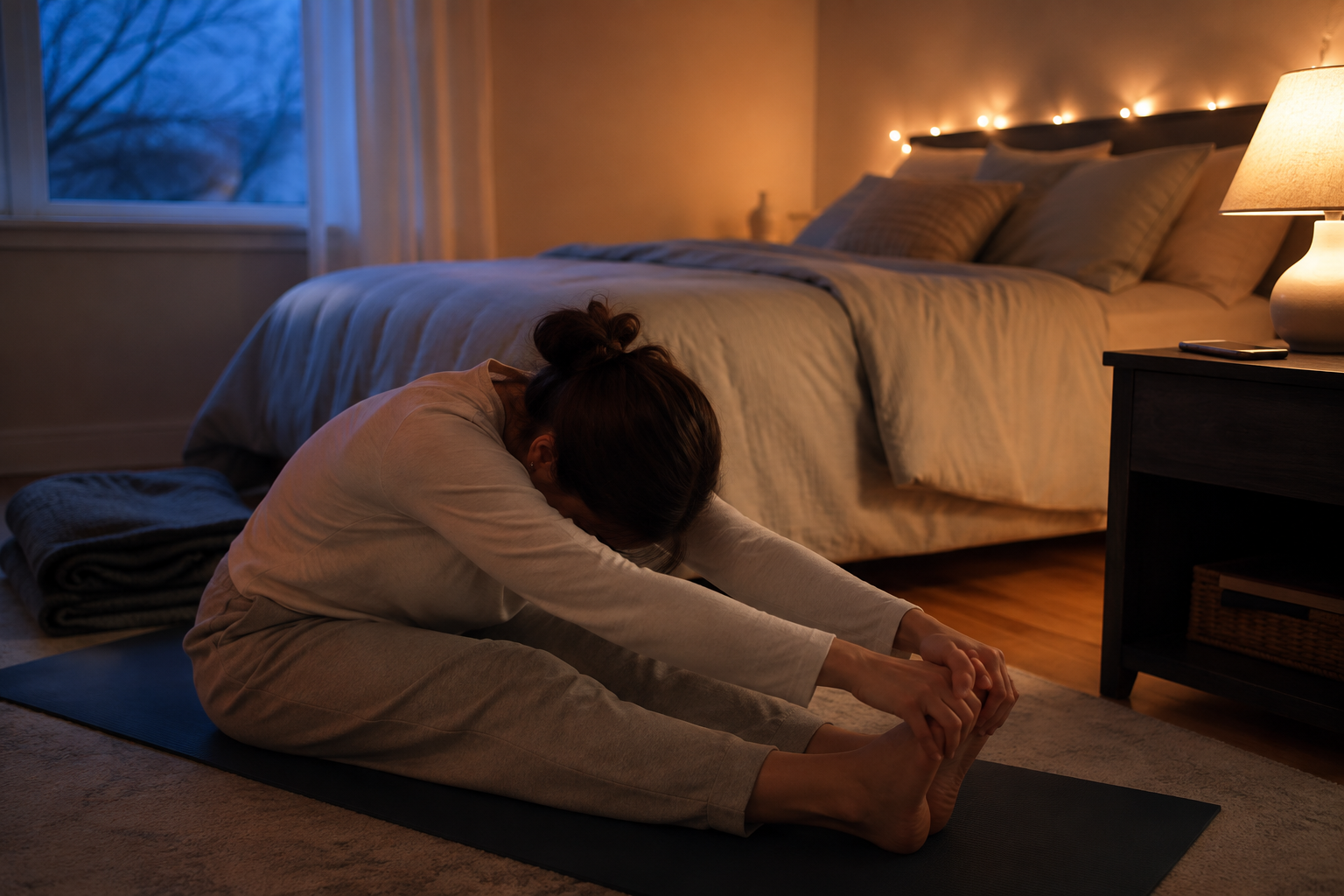
Extend both legs in front of you, or sit on a cushion with knees softly bent. Hinge from the hips and let your torso fold forward only as far as feels easy. Rest your hands on your shins or the floor. Breathe in for four counts, out for six, and let each exhale be the cue to soften slightly further, never to push.
Lie on your back, draw both knees toward your chest, then let them fall gently to one side while your arms rest open at shoulder height. Turn your gaze the opposite direction. Hold, breathing slowly, for six full cycles, then switch sides. This is one of the few positions where lying down itself starts lowering heart rate before you even begin the twist.
Lie on your back with your legs resting up against a wall or propped on a pillow stack. Let your arms rest palm-up at your sides. This passive position needs no active stretching effort, which makes it useful as a transition point where breath, not muscle, does all the remaining work.
Stay in place, close your eyes, and breathe in for a count of four, out for a count of eight. The longer exhale is the part doing the work here, since extending exhalation relative to inhalation is one of the simplest ways to bias the nervous system toward its parasympathetic branch.
Suggested Timing at a Glance
| Step | Duration | Breath Pattern |
|---|---|---|
| Neck and shoulder release | 2 minutes | In 4, out 6 |
| Seated forward fold | 2 minutes | In 4, out 6 |
| Reclined spinal twist (both sides) | 4 minutes | Slow, even |
| Legs-up-the-wall | 3 minutes | Natural, unforced |
| Extended exhale breathing | 2 minutes | In 4, out 8 |
The Sleep Foundation’s guidance on this topic lines up with the pacing above: static stretches held between 10 and 30 seconds are preferred before bed, dynamic stretching is discouraged because it raises alertness rather than lowering it, and the whole practice works best when it starts roughly an hour before your intended bedtime rather than in the final five minutes before you turn off the light.
Stacking It Into a Bedtime Routine
A stretch sequence that lives as a standalone task on your to-do list gets skipped the moment you are tired. It works far better as one link in a chain of habits you already do automatically. Habit-stacking, in practical terms, means anchoring the new behavior to an existing one so you do not have to rely on willpower or memory each night. The stretch sequence does not need its own slot on a calendar, and it works better when it does not have one, since a routine that depends on remembering to start it is a routine that gets dropped on the exact nights it would help most, the busy or stressful ones.
Think of the anchor point as the trigger and the stretch sequence as the automatic response that follows it, the same way brushing your teeth automatically follows washing your face for most people without any conscious decision involved. The goal is to get the stretch sequence to that same level of automaticity within two or three weeks of consistent repetition.
- Anchor it to something fixed. Right after you brush your teeth, right after you change into sleepwear, or right after you plug in your phone in another room, roll out a mat or sit on the bed and begin Step 1.
- Dim the lights first. The NHS’s sleep guidance points out that light from screens can make it harder to fall asleep, and the same logic applies to overhead lighting generally. Doing the sequence under a lamp rather than ceiling lights reinforces the same signal your breathing is sending.
- Keep the phone out of the room, or at least out of reach. Checking a notification mid-sequence resets the sympathetic system almost instantly, undoing several minutes of slow breathing in a few seconds.
- Pair it with a fixed bedtime. NHS guidance also notes that going to bed and waking at similar times each day helps the body anticipate sleep, and a consistent stretch sequence performed at a consistent time becomes part of that same anticipatory cue.
- Write down anything on your mind before you start. If your head is full of tomorrow’s tasks, jotting them down first, as NHS materials suggest, clears mental noise so the stretch sequence is not competing with a running to-do list.
Common Mistakes That Cancel the Wind-Down Effect
Several habits quietly undo the benefit of an otherwise well-designed sequence:
Stretching too vigorously. Pushing into deep discomfort, bouncing, or racing through a routine to “get it done” keeps the sympathetic system engaged rather than easing it off. If a position hurts, ease out slightly. The goal is calm, not depth.
Keeping a screen nearby. Watching a show or scrolling between stretches introduces bright light and cognitive stimulation at exactly the moment you are trying to reduce both. Even a muted phone screen face-up on the floor is a source of light and temptation.
Holding your breath. It is common to unconsciously hold the breath during a stretch, especially an unfamiliar one. This reflexively activates the sympathetic system rather than the parasympathetic one, working against the entire point of the sequence.
Doing it too close to a stimulant. Caffeine late in the day, a stressful phone call right beforehand, or a heated conversation right after can override several minutes of stretching almost immediately. Sequence timing around your evening matters as much as the stretches themselves.
Treating it as exercise. If you finish the sequence feeling like you completed a workout, breathing hard with a raised heart rate, something in the pacing needs to slow down. This is a wind-down practice, not a flexibility session.
Doing it in a bright or cluttered room. A sequence performed under harsh overhead light, next to a pile of unfinished work, sends mixed signals. The room itself becomes part of the cue. Clearing the space and dimming the light before you start is not decorative, it is part of what tells your body this block of time is different from the rest of the day.
Who This Routine Tends to Help Most
Not everyone needs the same dose of wind-down support. People who report the most noticeable benefit from a routine like this tend to share a few traits: evenings that are cognitively demanding right up until bedtime, a habit of exercising vigorously in the two or three hours before sleep, or a tendency toward physical tension that shows up as tight shoulders, a clenched jaw, or restless legs once the lights go out. If your evenings already wind down naturally, through a quiet commute, an early dinner, or a job that ends well before sleep, you may need less of this and can shorten the sequence or skip steps that do not add anything for you. The routine is a tool to match to your own evening pattern, not a fixed prescription everyone needs in full.
How Quickly You Can Expect to Notice a Difference
A single session of slow breathing has been shown to shift vagal tone measurably right away, which is one reason this kind of routine can feel calming the very first night you try it. That said, the deeper benefit, actually falling asleep faster and staying asleep longer, tends to show up over repeated nights rather than immediately, since your body is learning a new cue-response pattern rather than flipping a switch once. Give the sequence at least a week of consistent use, at a consistent time, before deciding whether it is doing anything for your sleep specifically.
When Stretching Won’t Fix Your Sleep
A wind-down stretch routine is a supportive habit, not a treatment for a sleep disorder. If you regularly struggle to fall asleep, wake repeatedly through the night, snore heavily, gasp for air while sleeping, or feel persistently exhausted despite a full night in bed, these can be signs of insomnia, sleep apnea, restless legs syndrome, or another condition that needs evaluation by a doctor or sleep specialist. The scoping review referenced earlier found that stretching helped some people with diagnosed sleep disorders but did not help most of them, underscoring that it works best as one supporting piece of a broader sleep hygiene approach rather than a stand-alone fix. If poor sleep is persistent, talk to a healthcare professional rather than relying on a stretch sequence alone.
Putting It Together
The version of evening stretching that actually helps you wind down is not about how flexible you become, it is about how deliberately you slow down the pace, lengthen the exhale, and remove the alerting inputs, such as screens and vigorous effort, that keep your nervous system in daytime mode. Ten to fifteen minutes, anchored to something you already do every night, done under dim light with long exhales, gives your body a repeatable, physical cue that the day’s demands are over. Some nights it will ease you into sleep noticeably faster. Other nights, especially if an underlying sleep issue is at play, it will simply be one small piece of a larger picture. Either way, the mechanism behind it, moving from a sympathetic-dominant state to a parasympathetic one through slow movement and paced breath, is real, well-documented, and worth building into a routine rather than reaching for only on the nights you cannot sleep at all.
Frequently Asked Questions
Is it better to stretch right before bed or earlier in the evening?
Starting roughly an hour before your intended bedtime works well for most people, since it gives your body time to transition gradually rather than expecting an instant switch from alert to relaxed in the final minutes before lights out.
How long should each stretch be held for a wind-down effect?
Static holds of around 20 to 30 seconds, paired with slow exhales, are generally more effective for relaxation than short or bouncy stretches, which tend to keep the nervous system more alert.
Can evening stretching replace medication or therapy for insomnia?
No. It can be a helpful supporting habit, but current research on stretching for sleep disorders shows mixed results, and persistent sleep problems should be evaluated by a healthcare professional.
Does it matter if I stretch on the floor versus in bed?
Either works. What matters more is keeping the movements slow, the room dim, and your breathing paced, rather than the specific surface you use.
What if I fall asleep during the legs-up-the-wall or breathing step?
That is a reasonable outcome, since the whole point of the sequence is to lower arousal enough that sleep becomes easy to slip into. If it happens on the floor, simply transition to bed once you notice.
Will this help if my main problem is a racing mind rather than muscle tension?
Often yes, because the breathing component is doing at least as much work as the stretching itself. The paced exhale is a direct lever on the nervous system regardless of whether your main issue is physical tension or mental noise.
References and Sources
- Sleep Foundation, “Stretching Before Bed: 13 Moves to Do for Better Sleep”
- Harvard Health Publishing, “Understanding the Stress Response”
- European Journal of Applied Physiology (2024), “A Scoping Review of the Effect of Chronic Stretch Training on Sleep Quality in People with Sleep Disorders”
- NHS Every Mind Matters, “Fall Asleep Faster and Sleep Better”
- Scientific Reports (2021), “Benefits from One Session of Deep and Slow Breathing on Vagal Tone and Anxiety in Young and Older Adults”