



























By Rowan P. Briarwick
A pair of minimal shoes looks harmless enough sitting in a box. Thin sole, wide toe box, almost no heel lift. The trouble starts once someone laces them up and goes for the same five-mile loop they’ve walked in cushioned trainers for years. Feet that spent decades supported by an inch of foam are suddenly asked to do the shock absorption themselves, and the bones, tendons, and connective tissue along the bottom of the foot need weeks, not days, to catch up.
This guide is a cautious, structured plan for walkers moving from conventional footwear to barefoot or minimal shoes. It is not a promise that minimal shoes fix foot pain, and it is not a dare to rush the process. It draws on published research about transition injuries, muscle adaptation timelines, and the specific groups who should talk to a podiatrist before making the switch at all.
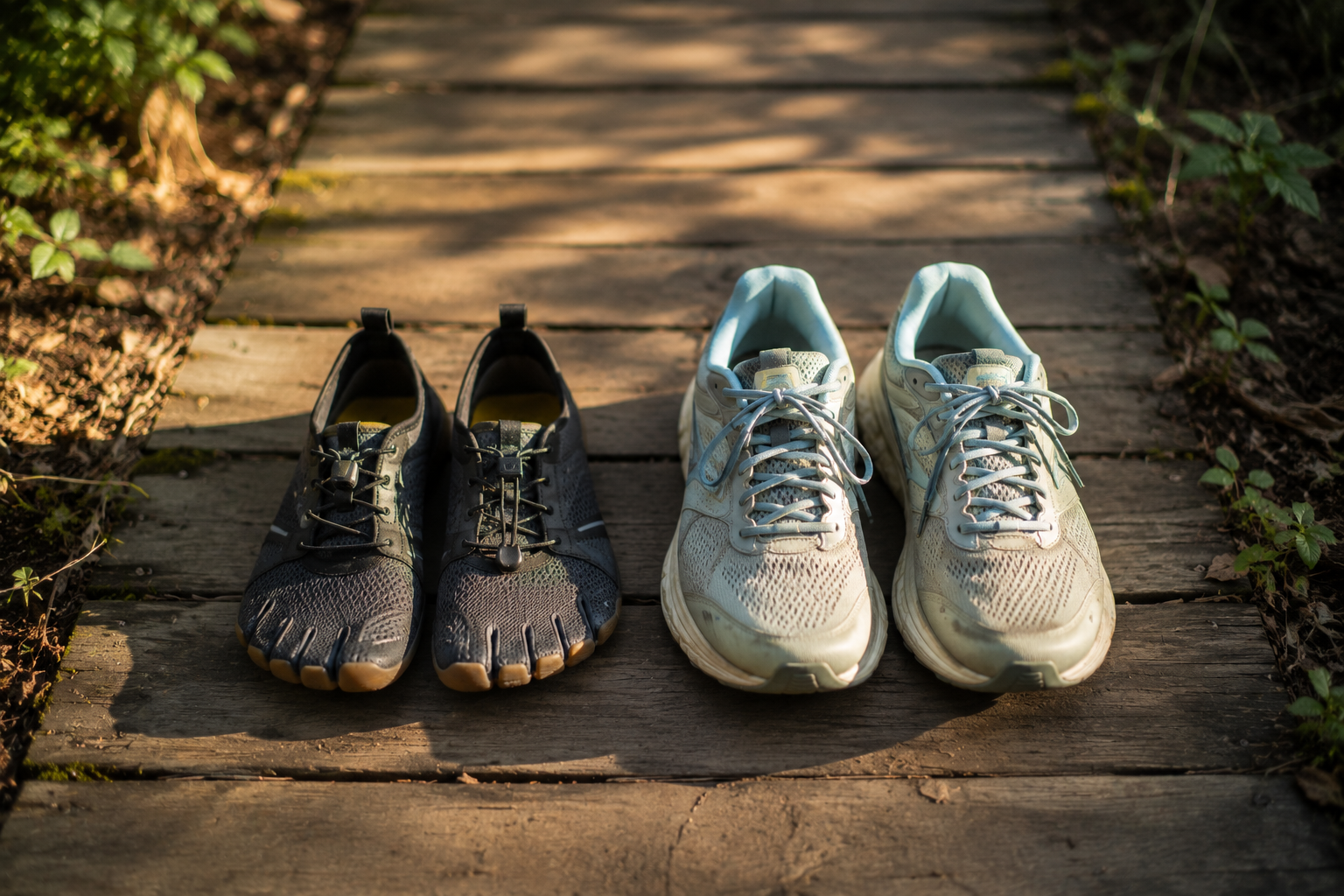
Minimal shoes are not a single product category. Some carry a thin foam midsole with a wide toe box but keep a slight heel-to-toe drop. Others, like five-toe designs, remove nearly every layer between skin and ground. The protocol in this article is written for the general case of a low-cushion, low-drop, flexible-sole shoe used for walking rather than running, since walking places lower peak forces on the foot per step but still accumulates load over the course of a day. Someone who spends eight hours on their feet at work in a new pair of minimal shoes is asking more of the transition timeline than someone who wears them for a thirty-minute evening walk, even though neither is running.
Why Gradual Transition Matters
The appeal of minimal footwear is straightforward: a wider toe box, a flexible sole, and little to no heel-to-toe height difference let the foot move the way it would if shoes didn’t exist. But the foot has spent years, sometimes a lifetime, relying on manufactured cushioning to blunt impact forces. Removing that cushioning overnight changes the loading pattern on the metatarsals, the calf muscles, and the Achilles tendon before those tissues have had a chance to adapt.
A study from Brigham Young University tracked 36 experienced runners over a 10-week transition to five-toe minimal shoes, using MRI scans to watch what happened inside the bones of the foot. Runners who switched to minimal shoes showed a measurable rise in bone marrow edema, an early marker of bone stress that precedes a stress fracture, and the effect was more pronounced in women. Researcher Sarah Ridge summarized the mechanism plainly: injury shows up when impact arrives too quickly or too forcefully for the bone to remodel between loading cycles. Bone doesn’t strengthen instantly; it strengthens through repeated, moderate stress followed by recovery time.
A systematic review published in Sports Medicine – Open looked across 20 separate transition studies and found injury rates of 17.9 per 100 participants in minimalist-shoe groups compared with 13.4 per 100 in conventional-shoe groups. That gap did not reach statistical significance in the pooled data, but five of the twenty studies individually reported higher injury counts in the minimalist group, while only four found no difference at all. The same review noted that just 8 of the 20 programs included dedicated strengthening work two to three times a week, and only 9 of 20 incorporated any gait retraining, meaning most published transition protocols were already leaving out two of the ingredients most likely to reduce risk.
Walking places lower peak forces on the foot than running, which is part of why a cautious walking transition is a reasonable starting point for people curious about minimal shoes. It does not mean the tissue adaptation timeline disappears. Weight-bearing time still needs to increase in small increments, and the calf and foot still need conditioning work before mileage climbs.
Foot and Calf Conditioning Prerequisites
Before adding walking distance in minimal shoes, it helps to know what the feet are being asked to do differently. Cushioned shoes absorb impact and often include arch support and a raised heel. Minimal shoes remove all three, shifting more work onto the intrinsic muscles of the foot (the small stabilizing muscles under the arch and between the metatarsals) and the extrinsic muscles that run from the shin and calf down into the foot.
Research on this adaptation is encouraging when the loading is progressive. A study following 38 runners over six months found that those who trained in minimal shoes saw extrinsic foot muscle volume increase by roughly 7.05%, while intrinsic foot muscle volume rose by about 8.8%, with the largest gains concentrated in the forefoot muscles, up nearly 11.9%, compared to smaller rearfoot changes. The control group wearing conventional shoes showed no measurable change over the same period. That data point matters for two reasons: it confirms the foot can build genuine strength in response to reduced-cushioning footwear, and it confirms that strength takes months to build, not weeks.
A conditioning phase before the walking protocol begins should run two to four weeks and include the following, done three to four times per week:
- Short foot exercises. Sitting or standing, draw the ball of the foot toward the heel without curling the toes, holding the arch lift for five seconds, for two to three sets of ten repetitions per foot.
- Towel scrunches. Use the toes to scrunch a towel across the floor, building the small muscles that stabilize the arch during single-leg stance.
- Calf raises, both straight and bent knee. Straight-knee raises target the gastrocnemius, bent-knee raises target the soleus, and minimal shoes demand more from both since there is no built-up heel to shorten the working range.
- Balance work on one leg. Thirty to sixty seconds per side, progressing to an unstable surface once flat-ground balance feels solid, since minimal shoes provide almost no lateral support of their own.
- Barefoot walking on soft ground. Short five- to ten-minute stretches on grass or carpet, done separately from the structured shoe-wearing protocol below, to accustom the sole’s skin and connective tissue to direct ground contact.
Anyone with existing calf tightness, a history of Achilles issues, or a naturally high arch should expect the conditioning phase to take longer than four weeks. There’s no penalty for extending it.
A useful way to progress the conditioning work itself, rather than jumping straight to added wear time, is to add repetitions before adding difficulty. Two sets of ten short foot holds in week one might become three sets of fifteen by week three, and only after that volume feels easy should balance work move from a flat floor to a folded towel or a foam pad. The calf raises follow a similar arc: flat-ground raises first, then raises performed slowly on a step edge with the heel dropping below the toes, which loads the Achilles tendon through a longer range and mirrors the extended ankle motion minimal shoes allow during a normal walking stride. Rushing this sequence defeats its purpose, since the entire point of a conditioning phase is to build capacity before the shoe itself starts asking for it.
It also helps to track how the feet feel the morning after conditioning work, not just during it. Muscle soreness in the arch or calf that resolves within a day or two is consistent with normal training adaptation. Soreness that spreads to the top of the foot, or that comes with visible swelling, is worth mentioning to a physical therapist or podiatrist before continuing, since it may indicate the exercises are being performed with poor form or progressed too quickly for the tissue involved.
The Transition Protocol
Once conditioning work is underway and comfortable, the actual footwear transition follows a wear-time model rather than a distance model. Walking speed and terrain both affect load more than raw mileage does, so tracking minutes in the shoe keeps the plan simple and conservative. The table below outlines a ten-week structure; each week’s total is a ceiling, not a target to hit immediately, and any week can be repeated before moving forward.
| Week | Minimal Shoe Wear | Surface | Notes |
|---|---|---|---|
| 1–2 | 10–15 min/day | Flat pavement or track | Short, even walks only; stop at first sign of forefoot or arch soreness. |
| 3–4 | 15–25 min/day | Flat pavement, add gentle inclines | Introduce one slightly hilly route once flat walks feel unremarkable. |
| 5–6 | 25–35 min/day | Mixed pavement and packed trail | Begin alternating minimal shoes with regular shoes every other day. |
| 7–8 | 35–50 min/day | Uneven trail, gravel | Reduce alternating days; wear minimal shoes most days if pain-free. |
| 9–10 | 50–70 min/day, or full daily walk | Regular walking routes | Keep one cushioned-shoe day per week for long errands or standing-heavy days. |
A few rules keep this timeline honest rather than aspirational. First, soreness that lingers into the next day, rather than fading within an hour of finishing the walk, is a signal to repeat the current week instead of advancing. Second, sharp or localized pain in the forefoot, especially near the second or third metatarsal, should stop the protocol entirely until it has been checked out, since that is the classic early location for a minimal-shoe stress fracture. Third, the protocol assumes daily conditioning work continues in parallel; skipping the strength exercises while still increasing wear time removes the safety margin the timeline is built around.
People starting from a sedentary baseline, recovering from a prior foot injury, or over age 55 should plan on stretching this ten-week structure to fourteen or sixteen weeks. Nothing about minimal footwear rewards speed.
Terrain Considerations
Surface choice changes the demand on the foot as much as wear time does. Smooth pavement is the most forgiving starting surface because it is predictable, but it also transmits more direct shock than a softer trail, so early weeks should stay short even on pavement. Packed dirt trails sit in the middle: softer than concrete, but often uneven enough to demand more ankle stabilization and toe-gripping response, which is exactly the kind of proprioceptive work minimal shoes are meant to encourage, just not in week one.
Gravel and loose rock surfaces should wait until at least week seven or eight of the protocol above. The unpredictable footing rewards strong intrinsic foot muscles and quick ankle reflexes, both of which take real time to develop. Wet or icy conditions deserve extra caution regardless of transition week, since thin soles offer less traction margin than a lugged trainer, and a slip during an already-adapting phase adds an acute injury risk on top of the overuse risk already being managed.
Temperature matters more with minimal shoes than with standard footwear. Thin soles conduct cold and heat from the ground more directly, so hot asphalt in summer and frozen ground in winter both call for shorter sessions than the base timeline suggests, independent of week number.
Stairs and curbs deserve a specific mention because they load the foot differently than flat walking. Descending stairs in a minimal shoe asks the forefoot and calf to control the body’s full weight through a much smaller contact area than a cushioned heel provides, and that eccentric calf loading is exactly the kind of stress the conditioning phase should have already introduced through step-edge calf raises. Someone whose daily walking route includes a lot of stairs should factor that into the wear-time totals in the timeline rather than treating stair time as separate from the minutes tracked in the table.
Sand is a special case worth calling out on its own. Dry, soft sand is gentle on impact forces but demanding on the calf and ankle stabilizers because the surface gives way with every step, while wet, packed sand behaves closer to a firm trail. Both are reasonable additions late in the protocol, generally after week eight, and both should start with shorter sessions than the equivalent pavement distance because the unstable footing recruits stabilizing muscles that fatigue faster than most people expect on a first outing.
Who Should Talk to a Podiatrist First
A structured protocol reduces risk, but it does not remove risk for everyone. Anyone in the following categories should get a podiatry evaluation before starting a minimal shoe transition, not after symptoms appear:
- Diabetic peripheral neuropathy or any condition involving reduced foot sensation, since a minimal sole offers less protection against unnoticed cuts, blisters, or thermal injury.
- A history of metatarsal stress fracture or current unresolved forefoot pain.
- Plantar fasciitis, particularly in an active flare, since altered loading patterns can aggravate the fascia before they help it.
- Significant structural differences such as bunions, hammertoes, or a rigid flat foot, where the sole’s shape and lack of support may not suit the individual foot.
- Recent foot or ankle surgery, or an unhealed ligament or tendon injury.
- Poor balance or a recent fall history, where reduced cushioning and support could raise fall risk before conditioning work has caught up.
Who Should Be Cautious
Beyond the categories that call for a professional evaluation before starting, some people can proceed with the protocol above but should build in extra caution. Anyone managing a chronic condition that affects circulation, such as peripheral artery disease, should monitor foot skin condition closely during the early weeks, since delayed healing compounds any minor abrasion. People with a naturally rigid, high-arched foot type tend to transmit more ground reaction force through the midfoot and may need a longer conditioning phase and a slower wear-time progression than the ten-week table assumes.
Older adults new to minimal footwear are not disqualified from trying it, but bone density and tissue elasticity both change with age, and the BYU research on bone marrow edema found the stress reaction more pronounced in a subgroup of the study population, a reminder that individual variation in bone response is real and not always predictable in advance. A slower timeline and closer attention to any lingering soreness serves this group well.
Weight-bearing exercise habits also factor in. Someone who already walks several miles a day in supportive shoes is not starting from zero conditioning, but they are still asking new tissue (the plantar fascia’s direct ground contact, the intrinsic foot muscles) to do new work, so their existing fitness does not shorten the tissue-adaptation timeline even if it shortens the cardiovascular adjustment.
Body weight is worth a separate mention because it changes the absolute load carried through the foot with every step, even though it does not automatically raise injury risk on its own. A heavier walker following the same wear-time increments in the table above is exposing the metatarsals and plantar fascia to a larger cumulative force than a lighter walker on the identical schedule, which argues for extending each stage by a few extra days and paying closer attention to next-day soreness rather than skipping ahead once a stage feels tolerable. The same logic applies to anyone who alternates minimal shoes with cushioned shoes on different days, a pattern the timeline builds in deliberately from week five onward: reserving cushioned footwear for long errands or standing-heavy work days keeps total daily foot stress inside a manageable range while the muscle and bone adaptation described earlier is still underway.
Final Thoughts
Minimal and barefoot shoes can be a reasonable long-term choice for many walkers, and the muscle-strengthening research is genuinely encouraging. What the research does not support is speed. A ten- to sixteen-week wear-time progression, paired with dedicated foot and calf conditioning and honest attention to soreness signals, gives the bones, tendons, and small stabilizing muscles of the foot the runway they need. Anyone with an existing foot condition, sensation loss, or a prior stress injury should treat a podiatry visit as the first step of the plan, not an afterthought triggered by pain. The shoes themselves are simple. The adaptation they ask of the body is not, and treating it with patience is the difference between a comfortable long-term habit and an avoidable injury.
Frequently Asked Questions
How long does a full transition to minimal shoes actually take?
Most structured programs in the research literature run somewhere between two weeks and six months, and a cautious walking-focused plan built on the timeline above runs ten to sixteen weeks for most people. Age, prior injury history, and starting activity level all shift that number.
Can I walk in minimal shoes every day from the start?
No. Starting with ten to fifteen minutes a day on flat pavement and increasing gradually, as outlined in the transition timeline, gives bones and connective tissue time to remodel between sessions rather than accumulating stress faster than it can recover.
What does foot soreness during the transition actually mean?
Mild soreness that fades within an hour after a walk is a normal adaptation signal. Soreness that persists into the next day, or any sharp, localized pain in the forefoot, means the current week’s wear time should be repeated rather than advanced, and persistent forefoot pain should be evaluated by a podiatrist.
Do minimal shoes actually make foot muscles stronger?
Research following runners over six months found measurable increases in both intrinsic and extrinsic foot muscle volume among those training in minimal shoes, with no such change in a conventional-shoe control group. The gains took months to appear, not weeks.
Is barefoot walking on grass a good substitute for minimal shoes?
Short barefoot sessions on soft, clean surfaces like grass are a reasonable complement to a conditioning phase, since they expose the sole to direct ground contact without the wear-time tracking a full transition protocol requires. They are not a full substitute for the structured shoe-wearing timeline once someone intends to walk regularly in minimal shoes on pavement or trail.
Who should not attempt this transition without medical guidance?
Anyone with diabetic neuropathy or reduced foot sensation, a history of metatarsal stress fracture, an active plantar fasciitis flare, significant structural foot differences, recent foot or ankle surgery, or a recent fall history should have a podiatry evaluation before starting, not after symptoms appear.
References
- Fuller, J.T., et al. “Transitioning to Minimal Footwear: A Systematic Review of Methods and Future Clinical Recommendations.” Sports Medicine – Open, 2017. link.springer.com/article/10.1186/s40798-017-0096-x
- Ridge, S.T., et al. Brigham Young University research on bone marrow edema following a 10-week transition to minimalist running shoes, reported via BYU News. news.byu.edu/news/whoa-there-quick-switch-barefoot-shoes-can-be-bad-bone
- BYU Magazine. “Bad to the Bone.” Additional reporting on the minimalist shoe bone-stress research. magazine.byu.edu/article/bad-to-the-bone
- Study on intrinsic and extrinsic foot muscle volume changes after six months of minimalist shoe training, reported via ScienceDaily. sciencedaily.com/releases/2016/10/161003110419.htm
- Firth, E.C., et al. “Effects of footwear and stride length on metatarsal strains and failure in running.” Journal of Biomechanics, via PubMed. pubmed.ncbi.nlm.nih.gov/28826012