



























By Priya Nandakumar
If you are a parent or guardian watching your teenager take an interest in the weight room, the school gym, or an at-home workout routine, you are probably holding two feelings at once: pride that they want to build a healthy habit, and a nagging worry about whether it is actually safe for a still-growing body. That worry is reasonable, and it deserves a straight answer grounded in research rather than gym folklore.
The short version is this: for most teenagers, structured strength and conditioning work is not only safe but genuinely beneficial, provided it is age-appropriate, technique-first, and supervised by someone qualified to teach it. The National Strength and Conditioning Association (NSCA) and the American Academy of Pediatrics (AAP) have each published detailed guidance on this exact question, and neither organization tells families to avoid resistance training during adolescence. What they do say is that how training is introduced matters far more than how much weight ends up on the bar.
This guide walks through what the research actually shows, what qualified organizations recommend at each stage of development, how to progress a teenager safely from bodyweight movement to light external load, and the warning signs that suggest a program has become too much. Where a pediatrician’s involvement is warranted, that is flagged clearly. Nothing here is a substitute for individualized medical advice for your own child.
The “Stunts Growth” Myth: What the Research Actually Shows
The belief that lifting weights stunts a child’s growth is one of the most persistent pieces of fitness folklore, and it is understandable why it took hold. Teenagers have open growth plates (the cartilage regions near the ends of long bones where new bone tissue forms), and it seems intuitive that stressing those areas with resistance could interfere with growth. Intuition is not the same as evidence, though, and the evidence points in a different direction.
Myth vs. Fact
Myth: Resistance training damages growth plates and stunts a teenager’s height.
Fact: The NSCA’s position stand on youth resistance training states plainly that “to date, injury to the growth cartilage has not been reported in any prospective youth resistance training research study.” The AAP’s 2020 clinical report similarly concludes that well-designed resistance training programs “have not been shown to have a negative effect on physeal health, linear growth, or cardiovascular health in youth.”
Neither organization is saying injury is impossible in every conceivable scenario. Growth plate injuries do occur in young people, but the research consistently traces them to acute trauma, such as a fall, a collision, or an attempt to lift a load far beyond a teenager’s current skill level, rather than to properly programmed strength training itself. A teenager is statistically far more likely to be hurt playing football or basketball than performing a supervised set of squats or rows. Comparative injury-rate data compiled in the NSCA position stand puts resistance training at roughly 0.7% of reported school sport injuries, compared with about 19% for football and 15% for basketball, with soccer around 2%. On an exposure basis, rates for resistance training and weightlifting worked out to roughly 0.012 and 0.0013 injuries per 100 participant-hours, versus roughly 0.8 for rugby.
It is also worth separating two very different things: youth resistance training as recommended by the NSCA and AAP, and maximal-effort competitive weightlifting or powerlifting performed without technique mastery. The guidance in this article is about the former. Extreme, poorly supervised, or ego-driven loading is where risk actually concentrates, and it is exactly what qualified coaching is designed to prevent.
There is a physiological explanation for why younger teens who train do not typically develop bulky muscles even when they get noticeably stronger. Early strength gains in youth largely come from neuromuscular adaptation, meaning the nervous system gets better at recruiting existing muscle fibers, rather than from significant muscle fiber hypertrophy, which depends heavily on the hormonal changes of later puberty. This is one reason a 12-year-old can get meaningfully stronger over a few months of training without a dramatic change in muscle size, and it is a normal, expected pattern rather than a sign that something is wrong.
What NSCA and AAP Guidance Actually Recommends, by Developmental Stage
Guidance from both organizations is built around readiness rather than a single fixed birthday. The NSCA position stand notes that if a child is ready to participate in organized sport, generally around age 7 or 8, that same readiness usually extends to some form of resistance training, provided instruction and supervision are appropriate to the child’s age. The AAP’s clinical report goes further, noting that children as young as 5 can begin simple, playful strength-building movements such as one-legged hops or frog jumps, long before any external load is involved.
The table below summarizes how training focus typically shifts across developmental stages, based on published AAP and NSCA guidance. It is meant as an orientation, not a rigid prescription. Every teenager matures at a different pace, and a qualified coach or physical therapist should individualize the plan.
| Stage & Approx. Age | Primary Training Focus | Typical Session Guidance | Supervision Level |
|---|---|---|---|
| Middle childhood (approx. 7-10 years) | Fundamental movement skills: running, jumping, landing, balance; bodyweight-only exercises framed as play | Short, game-based sessions; no external load | Continuous adult supervision (PE teacher, coach, or parent trained in basic technique cues) |
| Early adolescence (approx. 11-14 years) | Technique mastery of core patterns (squat, hinge, push, pull, carry) using bodyweight or very light implements | 1-2 sets of 10-15 controlled reps, 2-3 non-consecutive days per week | Qualified coach or certified trainer present for every session |
| Mid-to-later adolescence (approx. 15-18 years) | Progressive external loading once technique is consistent; sport-specific and general strength work | 2-3 sets of 6-12 reps, 2-3 non-consecutive days per week, gradual load increases | Qualified coach designs and periodically reviews the program; direct supervision still recommended, especially for new lifts |
Two threads run through every stage of this guidance. First, technique is taught and confirmed before load is added, at any age. Second, qualified supervision is not an optional extra; it is the mechanism through which the safety data above holds true.
Why Qualified Supervision Matters
The favorable injury statistics associated with youth resistance training are not a property of weightlifting in the abstract; they describe what happens when programs are designed and supervised by people trained to work with young, developing bodies. The NSCA position stand is direct on this point, stating that if qualified supervision, age-appropriate equipment, and a safe training environment are not available, youth should not perform resistance exercise. “Qualified” has a specific meaning here. It refers to instructors holding a recognized professional certification, such as the NSCA’s Certified Strength and Conditioning Specialist (CSCS) credential, or a comparable qualification tied to a certifying body with youth-specific competency standards. It also includes school PE teachers and licensed athletic trainers operating within their scope of practice. It does not describe a well-meaning parent working from a fitness influencer’s video, nor a teenager training alone from a phone app with no one present to correct form.
Practically, this means a few things for families evaluating a program or gym for a teenager:
- Ask what certification the coach or trainer holds and whether it includes youth-specific training.
- Confirm that a coach will be present for every session during the early technique-building phase, not just the first orientation visit.
- Look for a facility with equipment sized appropriately for a teenager’s height and limb length, rather than adult-only machines.
- Expect the coach to explain a progression plan, including how and when load will increase, rather than a vague promise to “see how it goes.”
If a teenager wants to train at home without a coach present, the safest path is to keep the early phase to bodyweight and light-resistance-band work with clear video-based or in-person instruction, and to involve a qualified coach, physical therapist, or athletic trainer for periodic technique checks before any barbell or heavy dumbbell work is introduced.
It also helps to watch for signs that a program is not appropriately supervised, even at a facility that markets itself as youth-friendly. A coach who never demonstrates or corrects technique, a gym floor with no age-appropriate equipment, a class ratio where one adult is trying to watch a dozen teenagers on free weights at once, or pressure to add load faster than a teen’s form allows are all reasons to look elsewhere. A good program will welcome questions from parents about certification and will be glad to explain its progression plan in plain language rather than treating the request as an inconvenience.
Nutrition, hydration, and sleep are part of a safe training plan as well, not an afterthought. The AAP’s guidance on youth strength training specifically notes the importance of a dynamic warm-up, a proper cool-down, adequate fluid intake, and enough rest between sessions for the body to adapt. A teenager who trains hard but consistently under-sleeps or under-eats relative to their activity level is at greater risk of fatigue-related technique breakdown and injury, regardless of how well the lifting program itself is designed. Parents are often better positioned than a coach to notice these patterns at home, which is another reason ongoing communication between family and coach matters.
Appropriate Progressions: From Bodyweight to Light External Load
A safe teen training progression is sequential rather than immediate. Skipping steps to chase faster results is where most avoidable risk enters the picture.
Phase 1: Movement competency (bodyweight only)
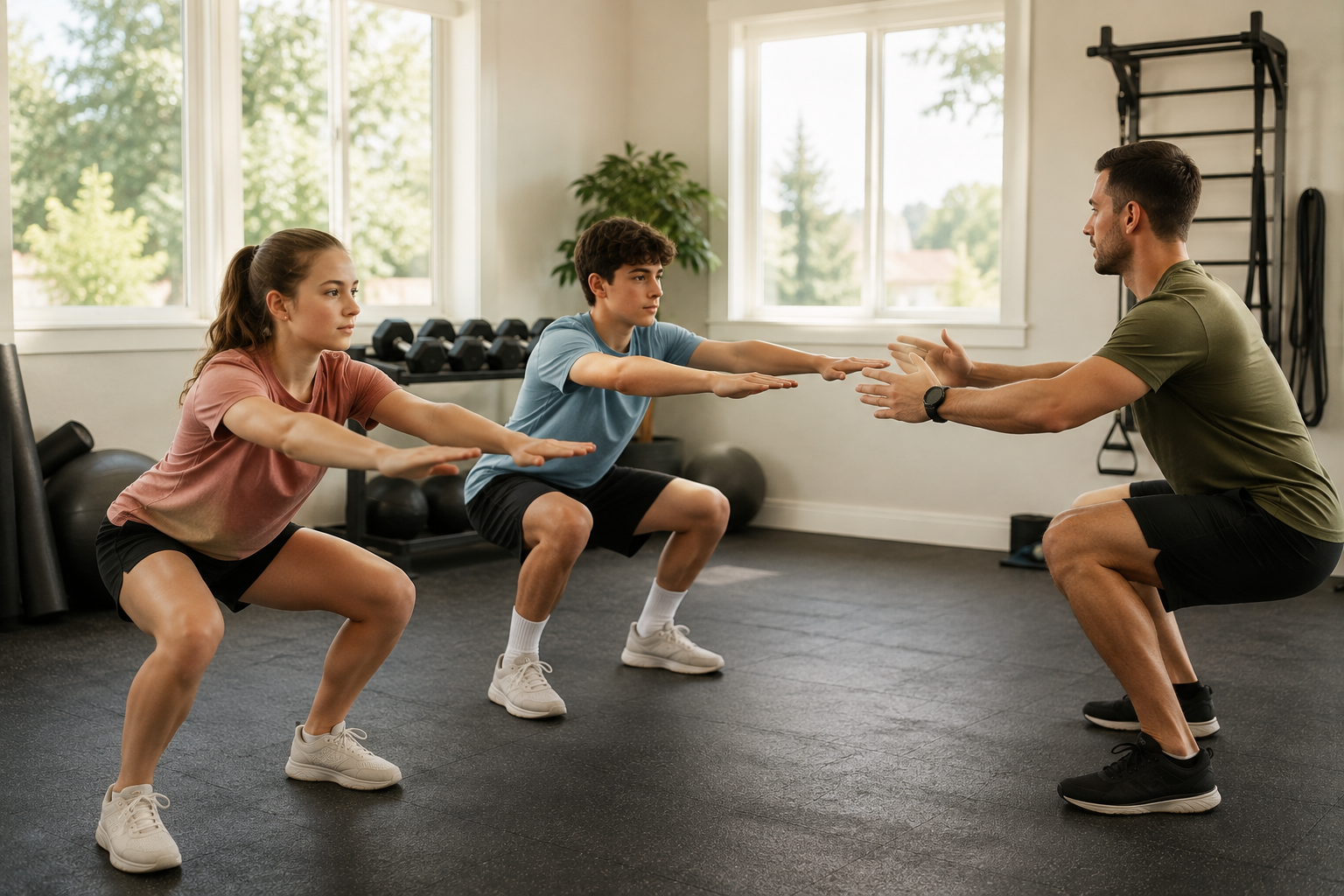
The starting point for any teenager, regardless of athletic background, is demonstrating control over fundamental movement patterns using only body weight: a full-depth squat with a neutral spine, a hip hinge without excessive lower-back rounding, a push-up with a stable core, and a controlled single-leg step. A coach should confirm these patterns look consistent across multiple repetitions before any external load is added. There is no fixed timeline for this phase; some teens move through it in a few weeks, others need longer, and that variation is normal.
Phase 2: Light external load and volume
Once movement patterns are consistent, light external load, such as resistance bands, light dumbbells, or a training bar, can be introduced. The NSCA guidance frames early loading around 1-2 sets of 10-15 repetitions at what feels like a moderate effort, never to the point of technique breakdown. The goal in this phase is to teach the body to handle load while preserving the movement quality established in phase one.
Phase 3: Gradual, planned load increases
As competency and consistency improve, load can increase in small increments, generally in the range of 5-10% at a time, alongside gradual changes in repetition ranges and set counts. Progress should be tracked against technique, not just the number on the plate. If form degrades under a new load, the appropriate response is to reduce the weight and rebuild technique, not to push through.
Phase 4: Individualized and sport-specific work
Later in adolescence, once a base of consistent technique and general strength is established, a program can incorporate more sport-specific elements or specialized equipment under continued qualified guidance. Even at this stage, non-consecutive training days and planned recovery remain part of a sound program, not an afterthought.
Across every phase, a pediatrician’s clearance is warranted before starting or significantly changing a program if a teenager has a pre-existing condition, including uncontrolled hypertension, a seizure disorder that is not well controlled, certain cardiovascular conditions, a history of chemotherapy, a recent injury, or any diagnosed musculoskeletal condition affecting the growth plates or spine. When in doubt, a brief conversation with the family pediatrician before enrollment costs little and closes an important safety gap.
It is worth having a separate, low-pressure conversation with your teenager about why they want to train, apart from the technical planning with a coach. Teens sometimes pursue training for reasons tied to body image or social comparison rather than health or performance, particularly during adolescence when appearance-related pressure from peers and social media can be intense. A program built around measurable, skill-based goals, such as mastering a movement pattern, adding a manageable amount of load, or improving performance in a sport they enjoy, tends to hold up better over time than one built around changing appearance. If a parent notices a teen fixating on physique, restricting food, or expressing distress about their body in connection with training, that is worth raising with a pediatrician promptly, separate from any conversation about the training program itself.
Red Flags: Signs of Overtraining in Teens
A well-designed program should leave a teenager feeling capable and energized over time, not perpetually exhausted. The AAP’s 2024 clinical report on overuse injuries, overtraining, and burnout in young athletes describes overtraining as a state where performance declines because training volume has outpaced recovery, and it links this state to persistent fatigue, disrupted sleep, and mood changes. The same report notes that roughly 70% of children and teens stop participating in organized sports altogether by age 13, and burnout is cited as a meaningful contributor to that drop-off.
Warning Signs Worth a Conversation (and Possibly a Pediatrician Visit)
- Persistent soreness or joint pain that does not resolve with a few days of rest
- Noticeable decline in performance despite continued or increased training effort
- Disrupted sleep, irritability, or mood changes tied to training days
- Loss of enthusiasm for a sport or activity the teen previously enjoyed
- Training on every team or program simultaneously, with no unstructured free time left in the week
- Skipping meals, restricting food, or fixating on physique in ways that seem tied to training
- Continuing to train through pain instead of reporting it to a coach or parent
Risk factors the AAP highlights include year-round training without seasonal breaks, participation on multiple teams at once, and excessive scheduling that leaves no room for unstructured play or rest. The report also points out that children’s bones are less resilient to repetitive stress than adult bones, which is part of why planned recovery days matter as much as the training itself. If any of the signs above show up, the appropriate response is to reduce training load, involve the teen’s pediatrician, and, if burnout or mood changes are significant, consider involving a mental health professional experienced with young athletes, exactly as the AAP recommends.
Putting It Together for Your Family
A teenager who wants to start training is not doing something risky by default. The research from the NSCA and AAP describes resistance training as a beneficial, low-injury activity when it is introduced in stages, supervised by someone qualified to teach it, and adjusted to the individual teenager’s readiness rather than a generic program built for adults. The role of a parent or guardian is not to police every rep, but to ask the right questions up front: who is supervising, what does the progression look like, and does our pediatrician need to weigh in first. Getting those three questions answered well before the first session sets the entire experience on solid ground.
Frequently Asked Questions
What age can a teenager safely start strength training?
There is no single required age. The AAP notes that even young children can begin simple bodyweight movements, and by the time a child is ready to participate in organized sport, generally around age 7 or 8 per NSCA guidance, some form of supervised resistance training is typically appropriate. For teenagers specifically, readiness depends more on the ability to learn and follow technique instruction consistently than on a specific birthday.
Does lifting weights stunt growth in teenagers?
No credible research supports this. The NSCA position stand states that growth cartilage injury has not been reported in any prospective youth resistance training study, and the AAP’s 2020 clinical report concludes that well-designed resistance training programs have not been shown to negatively affect physeal health or linear growth. Injuries linked to growth plates in young people are generally tied to acute trauma, not properly programmed training.
Can a parent supervise a teenager’s training at home, or is a qualified coach required?
A parent can absolutely support a teenager’s early bodyweight and light-resistance work at home, but for building technique in more complex lifts and for introducing external load, guidance from a qualified coach, certified trainer, or athletic trainer is recommended. Both the NSCA and AAP tie their favorable safety findings specifically to appropriately supervised programs.
How many days a week should a teenager train?
Guidance generally points to 2-3 non-consecutive days per week for structured resistance training, which allows adequate recovery between sessions. This fits within the UK Chief Medical Officers’ broader recommendation that children and young people accumulate an average of at least 60 minutes of moderate-to-vigorous activity daily, with a variety of activities across the week supporting movement skills, muscular fitness, and bone strength.
What pre-existing conditions require a pediatrician’s clearance before starting?
The AAP specifically flags uncontrolled hypertension, uncontrolled seizure disorders, certain cardiovascular conditions, and a history of chemotherapy as reasons to consult a doctor before beginning resistance training. A recent injury or any diagnosed musculoskeletal or growth-related condition also warrants a check-in with the family pediatrician first.
What are the clearest signs that a teen is overtraining?
Persistent soreness that does not resolve with rest, a decline in performance despite consistent effort, disrupted sleep or mood changes, and a loss of enthusiasm for training are among the signs the AAP associates with overtraining and burnout. A packed schedule with no unstructured downtime is a common contributing factor, and continuing to train through pain rather than reporting it is a signal that should prompt an immediate pause and a conversation with a coach or pediatrician.
References
- National Strength and Conditioning Association. Youth Resistance Training: Updated Position Statement Paper. nsca.com
- American Academy of Pediatrics. Resistance Training for Children and Adolescents. Pediatrics, 2020;145(6):e20201011. publications.aap.org
- HealthyChildren.org (American Academy of Pediatrics). AAP Provides Guidance on Resistance Training for Children. healthychildren.org
- American Academy of Pediatrics. Overuse Injuries, Overtraining, and Burnout in Young Athletes. Pediatrics, 2024;153(2):e2023065129. pubmed.ncbi.nlm.nih.gov
- UK Chief Medical Officers. UK Chief Medical Officers’ Physical Activity Guidelines. gov.uk
This article is for general educational purposes and does not replace individualized medical advice. Consult your teenager’s pediatrician before starting a new training program, particularly if a pre-existing health condition is present.