



























By Rowan P. Briarwick
Medical disclaimer: This article is for general education and is not medical advice. It does not diagnose or treat any condition. If you live with chronic lower back pain, get cleared by a physician or physical therapist before starting or changing a training program, especially to rule out a structural or neurological cause that needs different management. Stop and seek care immediately if you notice any of the red-flag symptoms listed below.
Why “Just Rest It” Usually Backfires
Chronic lower back pain is defined as pain lasting longer than twelve weeks, and it behaves very differently from a fresh strain. In acute pain, avoiding load while tissue heals is often sensible. In chronic pain, the tissue has usually finished healing, yet the nervous system keeps treating ordinary movement as a threat. Researchers call this the fear-avoidance model: pain triggers fear, fear drives avoidance, avoidance leads to deconditioning, and deconditioning makes the next attempt at movement hurt more and feel scarier. The cycle feeds itself.
The fear-avoidance model was formalized by Vlaeyen and colleagues and has since been tested in multiple clinical trials comparing exposure-based treatment to standard graded activity for chronic low back pain. In a randomized controlled trial of graded in vivo exposure versus graded activity, patients who worked through a hierarchy of feared movements showed significantly greater improvements in fear of movement, pain-related anxiety, and pain self-efficacy than those following a general activity program, with gains holding at one-month follow-up. Disability scores improved in both groups, with only a trend favoring exposure, a reminder that reducing fear and rebuilding capacity are related but separate jobs, and a training program has to do both.
This is the core idea behind training around chronic lower back pain rather than around a stretching routine alone: you are not just trying to loosen tissue, you are rebuilding a nervous system’s confidence that the spine can bend, load, twist, and carry weight without catastrophe. That requires progressive strength and movement work, not just mobility drills.
Pain Science 101: Hurt Does Not Always Mean Harm
One of the most useful ideas in modern pain science is the distinction between pain and tissue damage. In acute injury, the two usually track together: more damage tends to mean more pain, and pain fades roughly on the timeline of healing. In chronic pain, that relationship weakens. Pain can persist long after imaging shows a fully healed disc or joint, because the nervous system itself becomes more sensitive to input from the area, a process researchers describe under the umbrella of central sensitization or nociplastic pain. The spine is not necessarily more fragile; the alarm system around it has simply turned its volume up.
This distinction changes what a twinge during exercise means in practice. In someone newly injured, a sharp increase in pain during a movement is a reasonable signal to stop. In someone with chronic low back pain and a nervous system primed to over-respond, a mild, familiar ache during a controlled exercise is not automatically a sign of new damage. Pain neuroscience education, the practice of explaining this distinction to patients, is often paired with graded activity or graded exposure programs, since understanding why pain persists tends to reduce the fear that drives avoidance in the first place. None of this means pain should be ignored; it means pain intensity alone, without context, is an unreliable guide to whether a specific exercise is safe to continue.
Red Flags First: When Training Is Not the Answer
Before any exercise programming, rule out the small percentage of back pain cases that are not appropriate for a self-directed graded exposure approach. Clinical red-flag screening tools consistently point to the following warning signs as reasons to seek same-day or emergency medical evaluation rather than starting or continuing a training plan.
Seek Urgent Medical Care If You Notice:
- Saddle anesthesia — numbness or altered sensation around the groin, inner thighs, or buttocks
- New bowel or bladder dysfunction — retention, incontinence, or loss of control
- Progressive neurological deficits — worsening leg weakness, dragging a foot, or bilateral leg symptoms that are getting worse rather than better
- Unexplained weight loss alongside back pain, particularly with a history of cancer
- Fever, chills, or recent infection combined with new or worsening spinal pain
- Severe pain after significant trauma, or pain that started after a fall or accident
- Pain that is constant, worsening at night, and unrelieved by any position or rest
These signs can indicate cauda equina syndrome, spinal infection, fracture, or malignancy, all of which need prompt medical assessment rather than a graded exercise plan. Emergency medicine reviews of low back pain red flags note an important nuance: a large share of primary care patients report at least one red-flag item, and very few of them turn out to have serious pathology, while some patients with serious spinal pathology present with no red flags at all. That is precisely why a physician or physical therapist should be the one screening you before you commit to a structured strength program, rather than you self-screening from an article. Screening tools are aids to clinical judgment, not replacements for it.
Once serious pathology has been reasonably excluded, national guidelines are consistent that movement and exercise, not prolonged rest, are the appropriate path forward for chronic low back pain.
What the Guidelines Actually Say
Two of the most cited bodies of guidance on this topic are the UK’s National Institute for Health and Care Excellence (NICE) guideline NG59 on low back pain and sciatica, and the American College of Physicians (ACP) 2017 clinical practice guideline on noninvasive treatment of low back pain.
NICE recommends giving people tailored self-management advice at every stage of care, including “encouragement to continue with normal activities,” and it recommends considering a group exercise programme (biomechanical, aerobic, mind-body, or a combination) matched to the person’s needs and preferences. NICE frames exercise as one part of a stratified, multimodal care package rather than a stand-alone cure, with more complex support (exercise combined with manual therapy or psychological approaches) reserved for people at higher risk of ongoing disability.
The ACP guideline lists exercise among the first-line nonpharmacologic options for chronic low back pain, alongside multidisciplinary rehabilitation, motor control exercise, tai chi, yoga, progressive relaxation, and cognitive behavioral therapy. It is candid that the evidence for any single intervention shows only moderate quality data with modest average benefit over no treatment, which is less a knock against exercise than a signal that chronic pain responds to consistent, combined strategies rather than one perfect fix. Medication is positioned as a later step, only after nonpharmacologic approaches have been tried.
The throughline across both guidelines: movement belongs early in the plan, it should be dosed and progressed deliberately, and it works best paired with education about pain and, where needed, psychological or behavioral support.
The Graded-Exposure Training Framework
Graded exposure training applies the same logic clinicians use in exposure-based physical therapy to a structured strength and conditioning program. Instead of avoiding the movements that provoke apprehension, such as hinging, loading the spine, or rotating, you rank them from least to most provoking and work up the list deliberately, always staying inside a tolerable pain response.
You do not need a fully equipped gym to start this framework, though access to a few pieces of equipment makes progression smoother over time. A set of light to moderate dumbbells or kettlebells, a resistance band, and either a trap-bar or a barbell with small-increment plates cover most of the exercises referenced throughout this guide. A notebook or phone app for logging load, reps, and pain ratings is arguably more important than any piece of gym equipment, since the log is what tells you whether you are actually progressing and what is triggering flares. Many people begin stages one and two at home with bodyweight and bands, then move to a gym once they reach stage three or four and want more precise, incremental loading.
| Stage | Focus | Example Work | Goal |
|---|---|---|---|
| 1. Reconnection | Pain-free movement literacy | Cat-cow, glute bridges, dead bugs, walking | Restore confidence in basic spinal motion |
| 2. Isometric loading | Building tolerance to sustained tension | Bird dogs, planks, wall sits, suitcase carries | Prove the spine can hold load without a flare |
| 3. Light dynamic loading | Reintroducing hinge and squat patterns | Bodyweight hip hinges, goblet squats, band rows | Rebuild pattern quality under low external load |
| 4. Progressive resistance | Real strength adaptation | Trap-bar deadlifts, split squats, cable pulls, farmer’s carries | Increase capacity beyond daily-life demands |
| 5. Task-specific and rotational | Preparing for sport or specific job demands | Loaded carries with direction change, cable rotations, sport drills | Close the gap to the movements you actually fear or need |
Step-by-Step: Building Your Own Graded-Exposure Program
Step 1: Get Cleared and Build Your Feared-Movement List
Ask a physician or physical therapist to confirm there is no contraindication to progressive loading. With their input, write down five to ten movements or activities you currently avoid or dread: lifting a suitcase, bending to tie shoes, carrying a child, twisting to check a blind spot. Then rank them from least to most provoking. This list becomes your roadmap through the stages above, and it is worth revisiting every few weeks, since items near the bottom of the list often move up faster than expected once training begins.
Step 2: Establish Your Starting Load
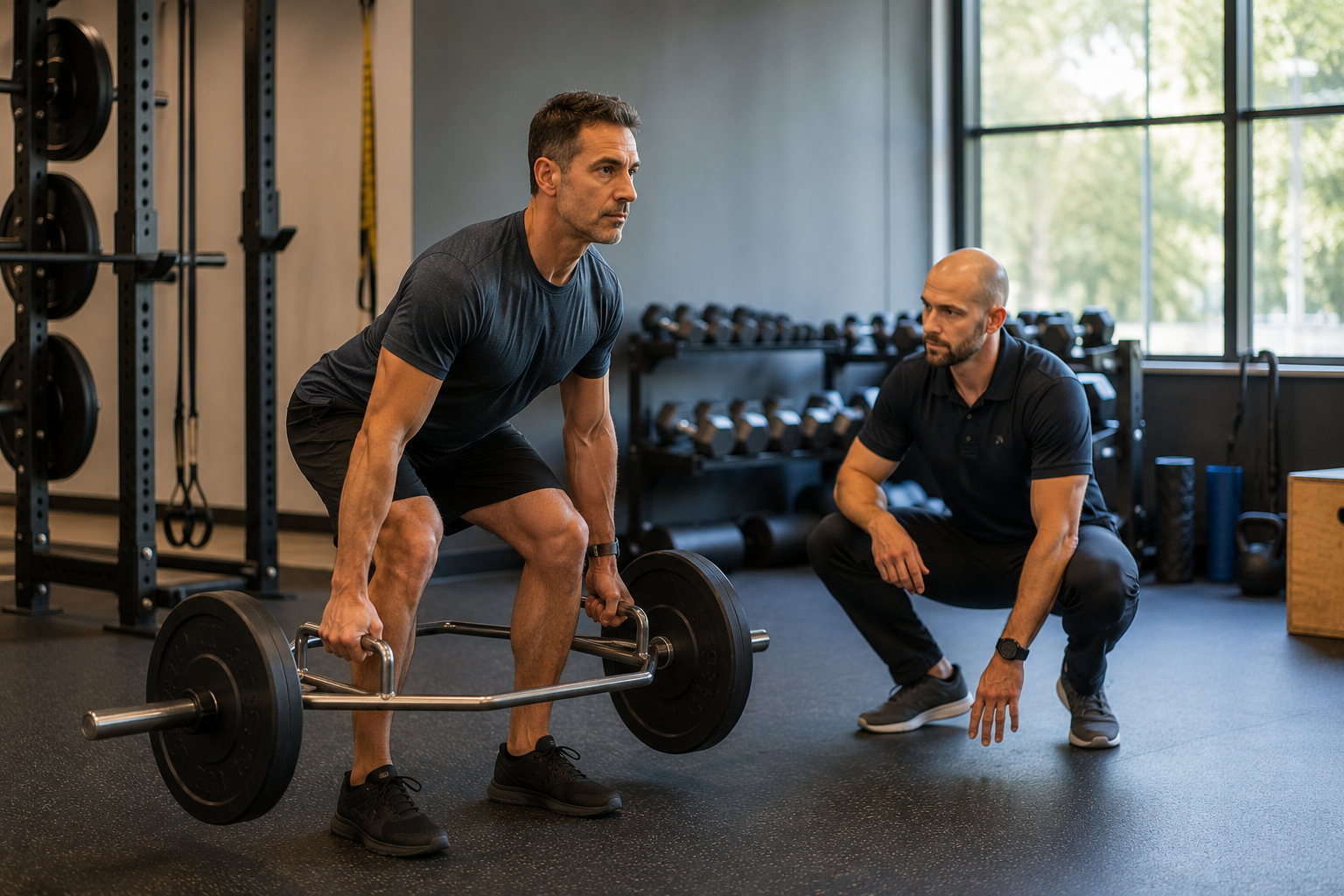
Start each new exercise at a load or range that produces no more than a mild, familiar ache that settles within an hour and does not worsen the next day. For many people recovering strength after a period of avoidance, this means starting with bodyweight or very light resistance: think goblet squats with a light kettlebell rather than a barbell, or a trap-bar deadlift with just the bar. The starting point is intentionally conservative. The point of week one is a successful, low-threat repetition, not a personal record.
A simple way to gauge intensity is a 0-to-10 pain scale combined with a rating of perceived exertion. Many clinicians who use graded exposure suggest staying at or below a 3 or 4 out of 10 on the pain scale during and immediately after a new exercise, and treating anything higher as a sign to reduce load or range for that session. This is a rough guide rather than a fixed rule, and your physical therapist can help you calibrate it to your own history.
Step 3: Progress by One Variable at a Time
Increase load, range of motion, or repetitions, but not all three at once. A common structure is small load increases every one to two weeks once a movement feels routine and produces no flare, following the same progressive-overload logic used in general strength training, adapted to a slower, monitored timeline. Trying to add weight, reps, and a new exercise variation in the same week makes it difficult to tell which change caused a flare if one occurs, so isolating variables protects both your progress and your ability to troubleshoot.
Step 4: Rebuild Movement Patterns, Not Just Muscles
Chronic pain often changes how people move long after any tissue damage is gone: a stiffened hip hinge, a held breath during bending, an arched-back squat. Spend real practice time on the hinge, squat, carry, and rotation patterns themselves at low load before chasing heavier weight. Motor control exercise, which retrains coordination between deep trunk muscles and movement, appears specifically in the ACP guideline’s list of effective first-line options for chronic low back pain. A short video of your own hinge or squat, reviewed with a coach or physical therapist, is often more useful for catching pattern issues than any amount of self-assessment in a mirror.
Step 5: Monitor Flare-Ups Without Stopping Entirely
A flare is not a failure signal that means stopping training altogether. It is data. If pain increases meaningfully after a session, drop back one stage or reduce load by roughly a third for the next one to two sessions, then resume progressing once symptoms settle to baseline. Complete rest during a flare tends to restart the deconditioning cycle described earlier. A scaled-down session that keeps the body moving is generally more useful than several days of nothing.
Keeping a short training log helps separate a genuine flare from ordinary day-to-day variation. Note the exercise, load, and a pain rating immediately after training and again the next morning. Over a few weeks, patterns tend to emerge: certain movements, certain loads, or certain amounts of sleep the night before may correlate with flares far more than the exercise itself does. That information is far more useful for adjusting a program than pain intensity on any single day.
Step 6: Layer in Conditioning and Real-Life Carryover
Once foundational strength work is consistent, add general conditioning such as walking, cycling, or swimming, and rehearse the specific tasks from your feared-movement list under supervision or with a coach’s feedback, so gym strength actually translates to lifting groceries or tying shoes without hesitation. This final step is often the one people skip, but it is what turns strength gained in a gym into confidence in daily life.
Sample Weekly Structure
| Day | Session |
|---|---|
| Monday | Full-body strength: goblet squat, band row, glute bridge, plank, walk 20 minutes |
| Tuesday | Light walk or bike, mobility and breathing work |
| Wednesday | Hinge-focused strength: trap-bar deadlift, split squat, bird dog, suitcase carry |
| Thursday | Rest or gentle activity of choice |
| Friday | Full-body strength with rotational carryover: farmer’s carry, cable row, dead bug, light cable rotation |
| Saturday | Conditioning: walk, swim, or bike 25 to 40 minutes |
| Sunday | Full rest |
This is a template, not a prescription. Your starting stage, exact exercises, and loading depend on your clearance from a physician or physical therapist and your response to each session.
When to Escalate to Professional Care
- Any red-flag symptom listed above appears at any point, past or present
- Pain intensity climbs over two to three consecutive weeks despite reducing load appropriately
- Numbness, tingling, or weakness spreads or becomes constant rather than intermittent
- You cannot identify a starting load that stays inside a tolerable pain response, even at the most basic exercises
- Fear of movement itself, rather than pain, is preventing you from attempting the program: this is a strong signal for a physical therapist experienced in graded exposure or a pain psychologist working alongside your PT
A physical therapist can also individualize the framework above, adjust it for concurrent conditions like disc herniation or spinal stenosis, and coach form on the specific lifts, which is difficult to replicate from a written guide alone.
Conclusion
Training around chronic lower back pain is less about finding one magic exercise and more about proving to a wary nervous system, one tolerable session at a time, that the spine can bend, carry, and rotate again. Guidelines from NICE and the ACP both point toward supervised, progressive movement rather than prolonged rest, and exposure-based research shows that working through a ranked list of feared movements reduces fear and rebuilds function more reliably than avoidance ever will. Get cleared, start conservative, track flares instead of fearing them, and build up through the stages at a pace your body actually tolerates.
Progress in this kind of program rarely looks like a straight line. Expect weeks where a stage feels easy and weeks where an unrelated stressor, a poor night of sleep, or a busy travel schedule makes the same load feel harder than it did before. None of that erases the underlying gains in strength and capacity that a consistent program builds over months. The goal is not a pain-free spine on a fixed timeline; it is a stronger, more capable body and a nervous system that has learned, through repeated evidence, that movement is safe.
Frequently Asked Questions
Is it safe to lift weights with chronic lower back pain?
For most people whose pain has been evaluated by a physician or physical therapist and found to have no red-flag cause, progressive resistance training is generally considered appropriate and is listed among first-line nonpharmacologic treatments in the ACP guideline. Loads should start conservative and progress gradually.
How is this different from just stretching my lower back?
Stretching targets short-term tissue and range-of-motion changes. This graded-exposure approach targets long-term strength, movement confidence, and load tolerance through progressive resistance training, which addresses the deconditioning and fear-avoidance side of chronic pain that stretching alone does not.
What if an exercise causes pain the next day?
A mild, short-lived increase that settles within a day is common during early stages and does not necessarily mean you should stop. If pain is sharp, spreading, or lasting more than a day or two, scale back load or range for your next session and consult your physical therapist if it continues.
How long before I notice improvement?
Exposure-based trials have shown measurable reductions in fear of movement and improvements in confidence within several weeks, with gains holding at follow-up. Strength and disability improvements tend to build more gradually over a period of months of consistent, progressed training.
Can I do this program without a trainer or physical therapist?
You can follow general structure and principles independently, but an initial clearance and periodic form checks from a qualified professional reduce risk and help individualize load and exercise selection, particularly if you have a diagnosed structural issue such as stenosis or spondylolisthesis.
Should I stop all exercise during a flare-up?
Guidelines generally favor staying active over complete rest. Scale the session down — lighter load, smaller range, fewer sets — rather than stopping entirely, unless a red-flag symptom appears, in which case seek medical care rather than continuing to train.
References
- National Institute for Health and Care Excellence. Low back pain and sciatica in over 16s: assessment and management (NG59). nice.org.uk/guidance/ng59
- Qaseem A, et al. Noninvasive Treatments for Acute, Subacute, and Chronic Low Back Pain: A Clinical Practice Guideline From the American College of Physicians. Annals of Internal Medicine, 2017. acpjournals.org/doi/10.7326/M16-2367
- American Academy of Family Physicians summary of ACP guideline. aafp.org/pubs/afp/issues/2017/0915/p407
- Leeuw M, et al. Evaluating the efficacy of graded in vivo exposure for the treatment of fear in patients with chronic back pain: a randomized controlled clinical trial. PubMed. pubmed.ncbi.nlm.nih.gov/17716819
- Comparison of Graded Exercise and Graded Exposure Clinical Outcomes for Patients With Chronic Low Back Pain. Journal of Orthopaedic & Sports Physical Therapy. jospt.org/doi/abs/10.2519/jospt.2010.3396
- Re-evaluating Red Flags for Back Pain. American College of Emergency Physicians, Sports Medicine Section. acep.org — Re-evaluating Red Flags for Back Pain