


























By Noah Sato
Medical disclaimer: This article is educational and is not a substitute for personal medical advice. Pregnancy affects every body differently, and a plan that is safe for one person can be inappropriate for another. Get individualized clearance from your OB-GYN or midwife before starting, changing, or continuing any exercise routine during pregnancy, and check in with them again at each prenatal visit as your pregnancy progresses.
Regular exercise during pregnancy is linked to real benefits: better mood, improved sleep, reduced back pain, lower odds of excess gestational weight gain, and easier recovery after birth, according to the American College of Obstetricians and Gynecologists (ACOG). But pregnancy also changes how your body responds to movement — joints loosen, blood volume rises, and balance shifts as your center of gravity moves. Safe exercise in pregnancy is not about pushing through discomfort. It is about adjusting intensity, choosing the right positions, and knowing exactly when to stop.
This guide walks through general safety principles, then breaks down step-by-step guidance for cardio and strength training in each trimester, followed by contraindications and warning signs drawn from ACOG, the NHS, the CDC, and Mayo Clinic. Read it as a starting framework, not a personalized prescription. Only your own prenatal care team knows your full history, and that conversation should come before any of the steps below.
A quick note on scope: this article covers general aerobic (cardio) and strength training safety across pregnancy, not a stretching or flexibility routine. If you are specifically looking for prenatal and postpartum stretching sequences, that is a separate topic with its own considerations around joint laxity and range of motion.
Why Exercise Guidance Changes During Pregnancy
Several physiological shifts explain why the advice below differs from a typical fitness plan. Blood volume increases by roughly 30 to 50 percent over the course of pregnancy, which changes cardiovascular response to effort. The hormone relaxin loosens ligaments throughout the body, including in the pelvis, knees, and ankles, which raises the chance of an ankle roll or a joint strained past its normal range. Your center of gravity moves forward and upward as the uterus grows, which changes balance during standing exercises, lunges, and anything performed on one leg. None of this means exercise becomes unsafe. It means the guidance adapts to a body that is doing different work than it was doing before pregnancy.
Just as important, exercise capacity does not need to be maximized during pregnancy to be beneficial. Consistency at a comfortable, sustainable intensity produces most of the documented benefits — better sleep, steadier mood, less lower-back pain, and a smoother recovery after birth. A cautious, well-paced routine still counts as a full and effective program.
General Safety Principles for Exercising While Pregnant
Before getting into trimester-specific steps, a few principles apply across all three trimesters. These form the foundation that every workout should be built on.
1. Use perceived exertion, not fixed heart rate targets
Older guidance relied on strict heart rate ceilings, but current ACOG guidance favors rating of perceived exertion (RPE) and the talk test instead. A simple rule from the NHS: you should be able to hold a conversation while exercising. If you are too breathless to talk, the intensity is too high. Cleveland Clinic frames this as the “talk, not sing” standard — comfortable enough to speak in full sentences, but not so easy that you could sing along to a song.
2. Watch heat and hydration closely
Pregnancy raises core body temperature and resting metabolic rate, so overheating risk is higher than before pregnancy. The NHS advises avoiding strenuous exercise in hot weather and drinking plenty of water and other fluids before, during, and after activity. Skip hot yoga, hot Pilates, and outdoor training during heat advisories. Exercise in a ventilated space, dress in breathable fabric, and stop if you feel flushed, faint, or unusually hot.
3. Avoid prolonged flat-on-your-back positions after the first trimester
From roughly the second trimester onward, lying flat on your back for extended periods can compress the vena cava, the large vein that returns blood to your heart, which can reduce blood flow to you and your baby. The CDC’s pregnancy activity guidance and the NHS both flag this directly: avoid exercises that require lying supine for long stretches once you are past the first trimester. Swap flat floor moves for inclined, seated, or side-lying positions instead.
4. Expect your capacity to shift, and adjust accordingly
Mayo Clinic’s guidance is straightforward on this point: start slowly, build up gradually, and skip any move that makes you feel unstable. Balance changes as pregnancy advances, so exercises that felt easy in month three can feel wrong in month seven. That is expected, not a sign you are doing something incorrectly.
Warming Up, Cooling Down, and Choosing Activities
A five to ten minute warm-up of easy walking or slow cycling helps loosen joints made more mobile by relaxin and gradually raises heart rate, which is gentler on the cardiovascular system than jumping straight into moderate effort. Cool down the same way, tapering intensity for several minutes rather than stopping abruptly, since blood can pool in the legs if you stop suddenly during pregnancy.
Good cardio choices throughout pregnancy generally include brisk walking, swimming, water aerobics, stationary or recumbent cycling, low-impact cardio machines such as ellipticals, and modified low-impact aerobics classes. Strength training options include bodyweight circuits, resistance bands, cable machines, light dumbbells, and supervised prenatal strength classes. Activities best avoided throughout pregnancy, per NHS guidance, include scuba diving, exercise at altitudes above 2,500 meters without prior acclimatization, and contact or collision sports with a real risk of abdominal trauma, such as kickboxing, judo, and squash.
Trimester-by-Trimester Guidance for Cardio and Strength Training
The steps below assume a healthy, uncomplicated pregnancy with no contraindications (see the list further down). Confirm this with your OB-GYN or midwife first.
First Trimester (Weeks 1–13): Step-by-Step
- Get clearance and disclose your baseline fitness. Tell your provider what you did before pregnancy — this shapes how much you can safely continue.
- Keep cardio at a moderate pace. Walking, swimming, stationary cycling, and low-impact cardio machines are good starting points. If you already ran or cycled outdoors before pregnancy, ACOG guidance generally supports continuing at a similar, moderate effort, adjusted for fatigue and nausea.
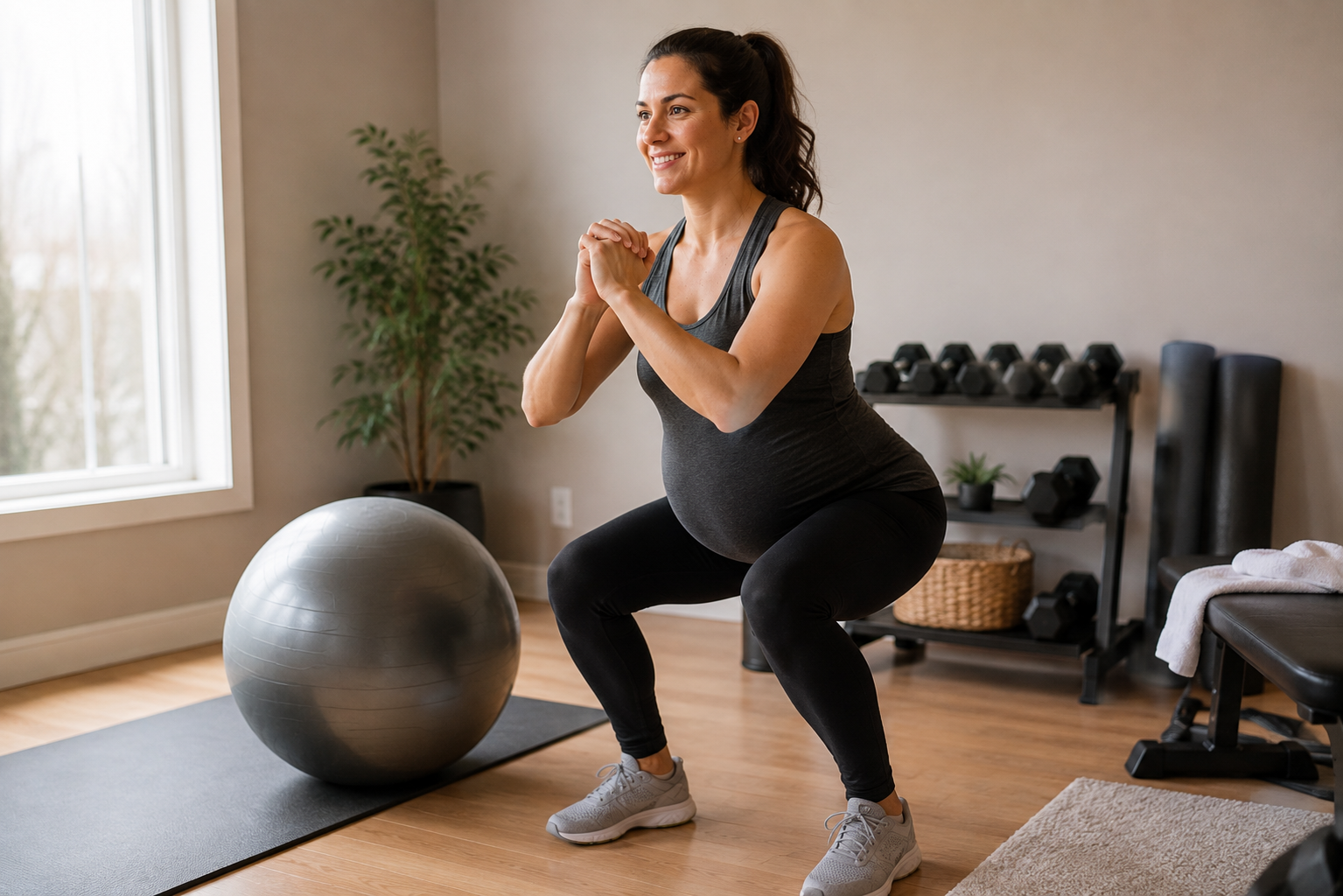
- Start strength training with bodyweight and light loads. Focus on form: squats to a chair, wall push-ups, seated rows with a resistance band, and step-ups. Skip heavy maximal lifts.
- Expect fatigue and nausea to affect your sessions. Shorter, more frequent sessions often work better than one long workout in the first trimester. There is no requirement to “push through” morning sickness.
- Avoid overheating and dehydration early. First-trimester organ development in the baby makes heat regulation especially important; hydrate well and skip hot studios.
Second Trimester (Weeks 14–27): Step-by-Step
- Move stationary cycling and balance-dependent cardio indoors or to stable equipment. A growing belly shifts your center of gravity, so outdoor cycling and anything with a real fall risk should be reassessed with your provider.
- Swap supine core and floor work for inclined or side-lying variations. Replace flat-back crunches and long floor holds with seated or side-lying core work, incline bench positions, or a wedge to keep your torso raised above horizontal.
- Reduce maximal loads in strength training and increase repetitions instead. Cleveland Clinic’s guidance is to lighten the weights you lift and add reps to maintain training stimulus without straining loosening joints and connective tissue.
- Avoid movements that compress or twist sharply across the belly. Skip deep twisting at the midline and sharp bends at the waist; choose rotational work that stays gentle and controlled.
- Reassess contact and collision sports. Soccer, basketball, and similar sports carry abdominal-impact risk that most guidance recommends discontinuing by this point.
- Keep a walking or swimming cardio base even on low-energy days. Thirty minutes of brisk walking most days remains one of the simplest ways to stay near the recommended weekly activity target.
Third Trimester (Weeks 28–Birth): Step-by-Step
- Prioritize stability over intensity. Balance continues to shift as the baby grows; trade higher-impact cardio for walking, swimming, water aerobics, or a recumbent bike.
- Shorten strength sessions and lean on supported positions. Use a chair, wall, or bench for support during standing exercises, and keep loads light with controlled reps.
- Watch for swelling, joint looseness, and shortness of breath. These are common late in pregnancy; scale back duration or intensity rather than pushing through discomfort.
- Keep sessions shorter and more frequent if fatigue is high. Two or three 10–15 minute sessions can replace one long workout without losing consistency.
- Stay close to home or a support person for late-pregnancy sessions. As your due date approaches, many providers recommend exercising where you can get help quickly if needed.
- Continue pelvic floor and gentle mobility work. These remain appropriate through the third trimester for most people and can support labor and postpartum recovery.
Trimester Comparison at a Glance
| Focus Area | First Trimester | Second Trimester | Third Trimester |
|---|---|---|---|
| Cardio intensity | Moderate; continue prior activity if tolerated | Moderate; shift to stable, indoor equipment | Lower-impact; walking, swimming, water aerobics |
| Strength training | Bodyweight and light loads, focus on form | Lighter loads, more reps, avoid belly compression | Light, supported, shorter sessions |
| Positioning | Standard positions generally fine | Avoid prolonged flat-on-back positions | Avoid flat-on-back; use inclined or side-lying |
| Key caution | Heat, dehydration, nausea-driven fatigue | Balance shifts, belly-compressing movements | Fall risk, swelling, shortness of breath |
Table reflects general guidance from ACOG, NHS, and Cleveland Clinic. Individual recommendations may differ based on your health history.
Contraindications to Exercise in Pregnancy
ACOG separates contraindications into two categories: conditions where aerobic exercise should generally be avoided altogether, and conditions where exercise may still be possible but requires individualized medical evaluation first.
Absolute contraindications (exercise generally not recommended)
- Hemodynamically significant heart disease
- Restrictive lung disease
- Incompetent cervix or cerclage
- Multiple gestation at risk for premature labor
- Persistent second- or third-trimester bleeding
- Placenta previa after 26 weeks of gestation
- Premature labor during the current pregnancy
- Ruptured membranes
- Preeclampsia or pregnancy-induced hypertension
Relative contraindications (requires individualized clearance)
- Severe anemia
- Unevaluated maternal cardiac arrhythmia
- Chronic bronchitis
- Poorly controlled type 1 diabetes
- Extreme morbid obesity
- Extreme underweight (BMI under 12)
- History of an extremely sedentary lifestyle
- Intrauterine growth restriction in the current pregnancy
- Poorly controlled hypertension
- Orthopedic limitations
- Poorly controlled seizure disorder
- Poorly controlled hyperthyroidism
- Heavy smoker
If any of these apply to you, do not start or continue an exercise program until your OB-GYN or midwife has reviewed your specific situation and given individualized guidance. What is appropriate for one person on this list can be entirely inappropriate for another, so this is never a do-it-yourself decision.
Warning Signs: Stop Exercising Immediately
Stop exercise right away and contact your OB-GYN or midwife (or seek urgent care) if you experience any of the following:
- Vaginal bleeding
- Shortness of breath before you even start exerting yourself
- Dizziness or feeling faint
- Severe headache
- Chest pain
- Muscle weakness that affects your balance
- Calf pain or swelling in one leg (needs to be checked to rule out a blood clot)
- Signs of preterm labor, including regular contractions
- A noticeable decrease in fetal movement
- Fluid leaking from the vagina
These warning signs come directly from ACOG’s clinical guidance on physical activity in pregnancy. None of them are symptoms to monitor and see if they pass — stop the activity, rest, and contact your care team the same day.
Strength Training Specifics Worth Knowing
Weightlifting is not off-limits during a healthy pregnancy. Cleveland Clinic notes that resistance training can continue throughout pregnancy for most people, with two adjustments: reduce the maximum weight you lift, and make up the training volume with additional repetitions at a lighter load. Avoid heavy maximal or near-maximal single-rep lifts, breath-holding strain (the Valsalva maneuver) during heavy sets, and exercises performed flat on your back after the first trimester. Machines, cables, and resistance bands can be easier to control safely than free weights as balance shifts later in pregnancy. A trainer or physical therapist experienced in prenatal fitness can help you adapt your specific program.
Two additional considerations are worth flagging with your provider. First, diastasis recti — a separation of the abdominal muscles along the midline — is common as pregnancy progresses, and certain heavy or high-strain core movements can worsen it; a prenatal-trained professional can help you check for doming or bulging along the midline during core exercises and adjust accordingly. Second, pelvic floor function matters during resistance training just as much as during dedicated pelvic floor work: exhale on exertion, avoid bearing down, and stop a set if you notice pelvic heaviness, leaking, or pressure. Mayo Clinic’s included core-strengthening exercises, such as modified side planks, seated rows, and wall push-ups, are designed with these adjustments already built in, which is part of why they are commonly recommended as a starting template.
Postpartum Return to Exercise
While this guide focuses on the three trimesters of pregnancy, many of the same principles carry into the weeks after birth. ACOG and the CDC both note that a gradual return to physical activity postpartum is appropriate for most people once cleared by their provider, typically starting with walking and gentle movement before progressing back toward pre-pregnancy intensity. Recovery from vaginal birth, a cesarean, or complications during delivery all affect timing, so the return-to-exercise conversation belongs in your postpartum checkup rather than on a fixed calendar date.
Building a Weekly Routine
For a healthy pregnancy without contraindications, both the CDC and current international guidance point to roughly 150 minutes of moderate-intensity aerobic activity per week, which can be split into shorter sessions like five 30-minute walks, or several 10-minute blocks on busier days. Add two or more days of muscle-strengthening activity that targets major muscle groups, plus pelvic floor and gentle mobility work as tolerated. This is a general target, not a strict quota; some weeks will be lighter, especially in the first and third trimesters, and that is normal.
A simple way to structure a week is three shorter cardio sessions, two strength sessions built around bodyweight or light-load circuits, and one or two rest or active-recovery days built around walking and pelvic floor work. Adjust the split based on energy, sleep, and how a session feels the following day. If a workout leaves you unusually sore, poorly rested, or dreading the next session, that is a signal to scale back volume or intensity rather than push through on schedule.
Working With Your Care Team
Bring specific questions to your prenatal visits rather than general ones. Useful examples include: is my current activity level appropriate given my bloodwork and any pregnancy complications so far, are there positions or movements I should avoid given my specific anatomy or history, and what symptoms would mean I should stop and call between appointments. If you work with a personal trainer, physical therapist, or group fitness instructor, look for one with specific training in prenatal and postpartum exercise, and share your provider’s guidance with them directly so your workouts and your medical care stay aligned.
Summary
Safe exercise across pregnancy comes down to a short list of habits: get individualized clearance before you start, use the talk test instead of chasing a fixed heart rate, manage heat and hydration carefully, avoid extended flat-on-your-back positions after the first trimester, adjust cardio and strength loads as each trimester changes your balance and capacity, and stop immediately if any warning sign appears. None of this replaces a conversation with your OB-GYN or midwife, who can weigh your specific health history against the general guidance above.
Frequently Asked Questions
Is it safe to start a new exercise routine during pregnancy if I was not active before?
Often yes, but check with your OB-GYN or midwife first. ACOG guidance generally supports starting light-to-moderate activity, such as walking, even for previously inactive people with an uncomplicated pregnancy. Start at a low intensity and build up gradually rather than beginning with a high-intensity program.
Can I keep running or lifting weights if I did those before pregnancy?
Many people who were already active can continue similar activities at a moderate, adjusted intensity, according to ACOG. The exceptions are the contraindications listed above and any new symptoms. Confirm with your provider, and expect to modify pace, load, and positioning as pregnancy progresses.
What is the talk test and why does it matter more than heart rate?
The talk test is a simple way to gauge intensity: if you can hold a conversation while exercising, the effort is likely appropriate; if you are too breathless to talk, it is too intense. The NHS and Cleveland Clinic both recommend it because it adjusts automatically to your changing fitness and heart rate during pregnancy, unlike a fixed heart rate number.
Why should I avoid lying on my back to exercise after the first trimester?
Lying flat on your back for extended periods can put pressure on the vena cava, the vein returning blood to your heart, which may reduce blood flow to you and your baby. Both the CDC and NHS recommend avoiding prolonged supine positions from around the second trimester onward. Side-lying, seated, or inclined positions are safer alternatives.
Is it safe to exercise in hot weather while pregnant?
Strenuous exercise in hot conditions raises the risk of overheating, and the NHS specifically advises against it. Choose cooler times of day, ventilated indoor spaces, breathable clothing, and steady hydration, and skip heated studio classes such as hot yoga during pregnancy.
When should I stop exercising and call my provider?
Stop immediately and contact your OB-GYN or midwife if you notice vaginal bleeding, shortness of breath before exertion, dizziness, severe headache, chest pain, muscle weakness, calf pain or swelling, signs of preterm labor, decreased fetal movement, or fluid leaking from the vagina. These come directly from ACOG’s warning-sign guidance.
References
- American College of Obstetricians and Gynecologists. Physical Activity and Exercise During Pregnancy and the Postpartum Period, Committee Opinion.
- American College of Obstetricians and Gynecologists. Exercise During Pregnancy, FAQ.
- NHS. Exercise in Pregnancy.
- Centers for Disease Control and Prevention. Pregnant and Postpartum Activity: An Overview.
- World Health Organization. WHO Guidelines on Physical Activity and Sedentary Behaviour, 2020.
- Mayo Clinic. Pregnancy Exercises.
- Cleveland Clinic. How to Exercise Safely if You’re Pregnant.