


























Cold mornings change the rules for anyone with asthma. Air that feels merely brisk on your skin can act very differently once it reaches your airways, and the drop in temperature and humidity is often enough to set off coughing, wheezing, or chest tightness within minutes of starting a workout. This reaction, known as exercise-induced bronchoconstriction (EIB), is one of the most common reasons people with asthma cut winter workouts short or avoid outdoor training altogether.
The good news is that cold-weather training with asthma is manageable for most people once a few habits are in place. This guide walks through a practical, step-by-step approach: using pre-exercise medication correctly, warming up in a way that actually protects your airways, breathing and covering your mouth to reduce cold-air exposure, knowing when to move indoors, and watching for the symptoms that mean it is time to stop. It closes with the emergency warning signs every person with asthma and every training partner should recognize immediately.
None of the steps below replace a conversation with your physician or pulmonologist. Asthma severity, triggers, and medication needs vary widely from person to person, and cold weather is only one variable among several that shape how a workout will feel on a given day. Treat this guide as a framework to bring to that conversation, not a substitute for a personalized asthma action plan.
Why Cold, Dry Air Triggers Bronchoconstriction
Under normal conditions, the nose warms and humidifies incoming air before it reaches the lungs. During exercise, breathing shifts from the nose to the mouth and speeds up dramatically. Minute ventilation, the total volume of air moved per minute, can climb toward 200 liters in vigorous exercise, according to a review published in the National Institutes of Health’s StatPearls resource. That volume of air moving quickly through the mouth arrives cold and dry, and the airway lining has to work hard to condition it.
That conditioning process pulls moisture from the cells lining the airways. As those cells lose water, their internal osmolality rises, and this change is believed to trigger the release of inflammatory mediators, including histamine, leukotrienes, and prostaglandins. The result is swelling and narrowing of the airway, which shows up as coughing, wheezing, chest tightness, or shortness of breath during or shortly after exertion. Exercise physiologists sometimes describe this as an airway drying and rewarming injury rather than a simple reaction to temperature alone, which is why humid, warm-air activities like swimming tend to provoke fewer symptoms than dry cold-air sports like cross-country skiing or outdoor hockey.
Exercise-induced bronchoconstriction is common. Estimates from StatPearls put the prevalence at 40 to 90 percent among people who already have asthma, and up to 20 percent even among people without a prior asthma diagnosis. Among elite athletes, especially those competing in winter sports, rates of 30 to 70 percent have been reported. The Asthma and Allergy Foundation of America notes that outdoor winter running, ice skating, and hockey are examples of activities that combine sustained exertion with continuous cold, dry air exposure, which is exactly the combination that raises risk.
Step 1: Build a Pre-Exercise Inhaler Routine With Your Doctor
The single most effective tool for preventing cold-weather asthma symptoms during exercise is a short-acting bronchodilator, typically albuterol, used ahead of time. The Asthma and Allergy Foundation of America describes doctors typically prescribing a quick-relief inhaler to be used 15 to 20 minutes before activity, and StatPearls similarly describes a common regimen of two puffs of albuterol taken 5 to 20 minutes before exercise as a preventive measure. This timing matters because the medication needs a short window to open the airways before the cold-air exposure begins, not after symptoms have already started.
This is not a routine to improvise on your own. A pulmonologist or primary care physician can confirm whether pre-treatment with a reliever inhaler is appropriate for you, how many puffs to use, and whether your current asthma control justifies training outdoors in the cold at all. If you find yourself reaching for a rescue inhaler before nearly every outdoor session, that is a signal for a medication review, not a sign to simply keep pre-dosing indefinitely. People with exercise symptoms that persist despite pretreatment are sometimes prescribed additional controller therapy, such as a long-acting bronchodilator or a leukotriene receptor antagonist like montelukast, a point echoed by the UK charity Asthma + Lung UK in its guidance on exercise and asthma.
Every person with asthma who exercises outdoors in winter should have a written asthma action plan that covers this exact scenario: which medication to take before exercise, what dose, what to do if symptoms appear anyway, and when a workout should be stopped entirely. Bring the plan to your next appointment and ask your doctor to walk through the cold-weather section specifically, since a plan written for spring allergy season does not automatically cover a January run.
Step 2: Warm Up With Intention, Not Just Habit
A warm-up is not just about loosening muscles before a cold-weather workout with asthma. StatPearls notes that variable-intensity and high-intensity warm-up protocols have been shown to reduce the drop in FEV1 (the amount of air a person can exhale in one second) that would otherwise occur once the main exercise session begins. In practical terms, a warm-up appears to induce a temporary refractory period in the airways, so the body is somewhat less reactive when the harder effort starts.
A useful warm-up structure for cold-weather training looks like this:
- Spend 8 to 10 minutes at an easy, conversational pace indoors or in a sheltered spot before stepping into open cold air.
- Include several short bursts of faster effort, 30 to 60 seconds each, separated by easy recovery periods, rather than one long steady warm-up.
- Keep the first several minutes outdoors deliberately easy, allowing the airways to adjust gradually to the temperature change.
- Save any hard intervals or race-pace efforts for once the body feels fully warmed up, both muscularly and in terms of breathing comfort.
Warming up indoors before stepping outside, even for five minutes on a treadmill, stationary bike, or simply walking briskly in a hallway or garage, reduces the shock of a sudden temperature drop hitting airways that are still at rest.
Layering matters here too, though not for the reasons people often assume. Dressing warmly protects the skin and muscles, but it does very little on its own to change the temperature or dryness of the air reaching the lungs. That protection comes from the breathing and covering habits described in the next step, not from an extra jacket. Still, staying warm overall helps the body direct less energy toward temperature regulation and more toward the workout itself, which can make the whole session feel more comfortable.
Step 3: Control Your Breathing and Cover Your Mouth
Two related habits reduce how much cold, dry air reaches sensitive airways: breathing through the nose whenever pace allows, and physically covering the nose and mouth with fabric.
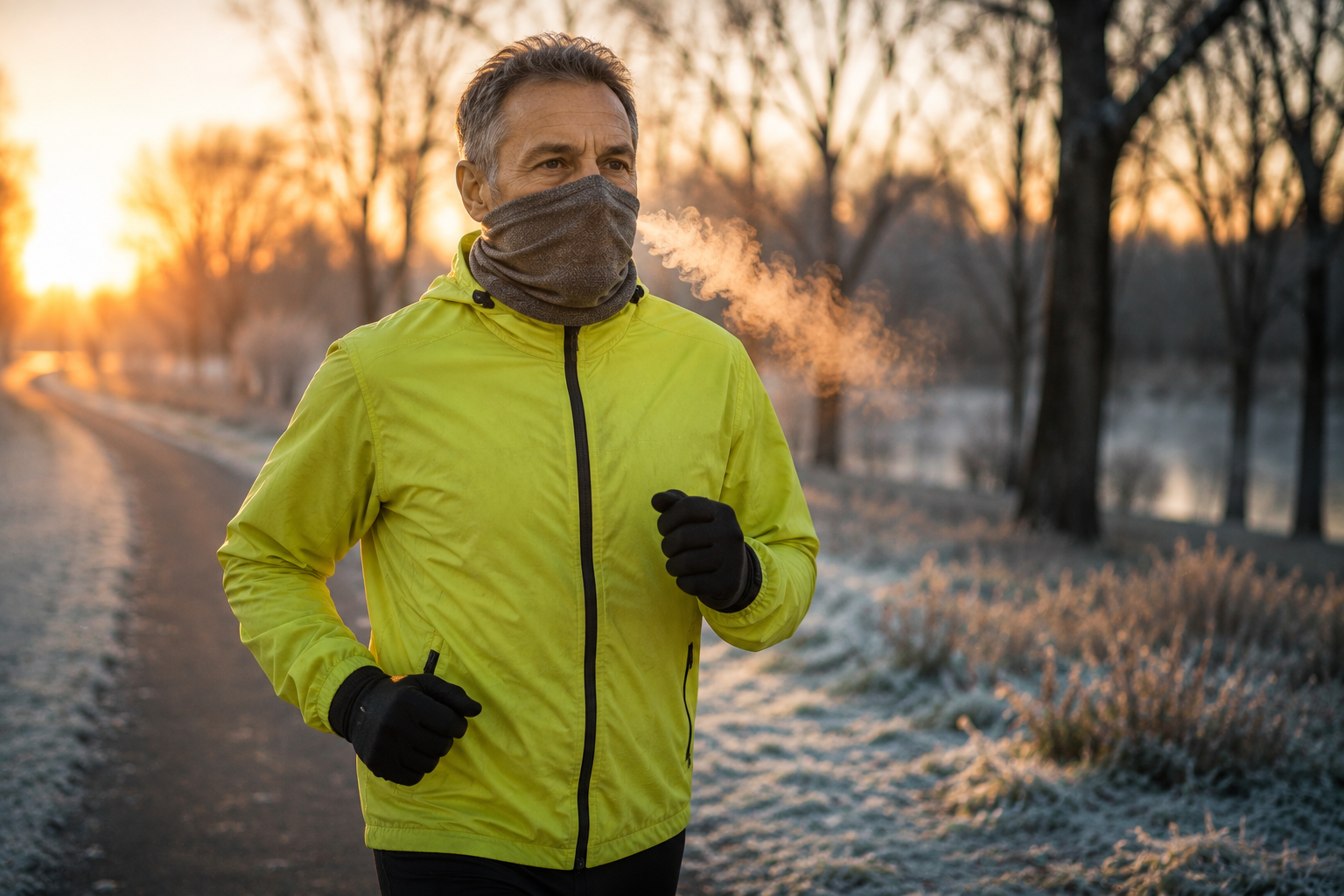
Nasal breathing is not always possible once effort increases, but during easier segments of a workout, warm-up, or recovery jogging, breathing through the nose gives the air more time to be warmed and humidified before it reaches the lungs. When mouth breathing becomes necessary at higher effort, a covering helps take over some of that conditioning work.
Both the American Lung Association and the Asthma and Allergy Foundation of America recommend covering the nose and mouth with a scarf, buff, or specialized face mask while exercising outdoors in cold weather. A loosely knit scarf or a fleece neck gaiter pulled up over the lower face traps a small pocket of warmer, more humid air close to the mouth, which the next breath then draws in rather than pulling in ambient winter air directly. Some people find a purpose-made cold-weather training mask more comfortable for sustained hard breathing than a scarf that can slip or bunch up.
A few practical notes on this habit:
- Choose breathable fabric. A mask or scarf that is too thick can feel restrictive and may be uncomfortable during hard breathing.
- Keep a backup rescue inhaler somewhere insulated. Extreme cold can affect how a metered-dose inhaler performs, so keeping it in an inner pocket rather than an outer layer helps keep it closer to body temperature.
- Reapply the covering after it becomes damp from condensation, since wet fabric against the face in freezing temperatures is uncomfortable and less effective at warming incoming air.
Step 4: Know When to Choose an Indoor Alternative
Some days, the safest step-by-step choice is choosing not to train outdoors at all. The American Lung Association advises skipping outdoor exercise entirely when air quality alerts reach the red, purple, or maroon categories, since poor air quality compounds the irritation already caused by cold, dry air. Extreme cold, very high wind chill, or a recent respiratory infection are additional reasons to move a session indoors rather than push through.
Reasonable indoor alternatives on a severe-weather or high-alert day include:
- Treadmill running or an indoor track, where temperature and humidity are far more stable
- Stationary cycling or an indoor spin class
- Swimming, which the Asthma and Allergy Foundation of America and other asthma organizations frequently note is generally well tolerated because the air above a pool is warm and humid
- Indoor group fitness classes, bodyweight circuits, or resistance training on days when cardiovascular outdoor work is not advisable
None of this means outdoor winter training is off-limits for people with asthma. Many competitive winter-sport athletes train and compete successfully in cold conditions. The point of this step is simply to treat “outdoors today” as a decision made fresh each session, based on temperature, air quality, wind, and how your airways felt during the last similar workout, rather than a fixed habit followed regardless of conditions.
A rough guide some athletes and coaches use is to treat sustained outdoor cardio with extra caution once the temperature drops well below freezing, particularly when wind chill is factored in, or whenever the local air quality index is flagged as unhealthy. These are general starting points rather than fixed rules, and they do not replace guidance from your own doctor about your specific triggers and current level of asthma control. On days that fall outside your personal comfort range, shifting the same workout indoors is a reasonable substitution rather than a workout missed.
Step 5: Monitor Symptoms During and After Exercise
Exercise-induced bronchoconstriction has a fairly predictable timeline, which makes it easier to know what is normal and what is not. According to StatPearls, some people experience a brief period of mild bronchodilation in the first 5 to 8 minutes of exercise, followed by peak bronchoconstriction around 10 to 15 minutes after exercise ends. Symptoms typically resolve within 30 to 90 minutes, and there is often a refractory period of roughly 1 to 3 hours afterward during which a second bout of exercise is less likely to trigger the same reaction.
Knowing this pattern helps distinguish an expected, manageable response from one that needs medical attention. Track how you feel during the session, in the fifteen minutes after you finish, and again about an hour later. Coughing that appears only in the first few minutes and fades quickly is a different situation from wheeze and chest tightness that build steadily and do not ease with rest and a rescue inhaler.
Simple monitoring habits worth building into a cold-weather training routine include keeping a peak flow meter in your kit bag if your doctor has recommended one, noting the outdoor temperature and how you felt afterward in a training log, and paying attention to whether symptoms are becoming more frequent or more severe over several weeks, which is a reason to schedule a check-in with your physician rather than waiting for the next scheduled visit.
A training partner or coach who knows your history is also worth including in this monitoring step. Someone running or skating alongside you may notice labored breathing, a change in pace, or visible distress before you fully register it yourself, especially once fatigue sets in during the later part of a session. Sharing the basics of your asthma action plan with a regular training partner, including where your rescue inhaler is kept and what your symptoms typically look like, adds a second set of eyes to a habit that otherwise depends entirely on self-monitoring.
Pre-Exercise Checklist for Cold-Weather Training
Use this checklist as a quick reference before heading out. It is not a substitute for your written asthma action plan, but it summarizes the habits described above in one place.
| Step | Timing | Why it matters |
|---|---|---|
| Confirm today’s plan is appropriate with your action plan | The night before or morning of | Matches the workout to your current asthma control and the day’s conditions |
| Check outdoor temperature and air quality index | 30 to 60 minutes before | Decides whether today is an outdoor day or an indoor-alternative day |
| Use prescribed reliever inhaler as directed | 15 to 20 minutes before exercise | Opens airways ahead of cold-air exposure, per your doctor’s instructions |
| Warm up indoors or at an easy pace | 8 to 10 minutes before harder effort | Reduces the drop in airway function once intensity increases |
| Put on a scarf, buff, or cold-weather mask | Before stepping outside | Traps warmer, more humid air near the nose and mouth |
| Pack rescue inhaler in an insulated inner pocket | Before leaving the house | Keeps the inhaler closer to body temperature and within easy reach |
| Note temperature and symptoms afterward in a training log | Within an hour after finishing | Builds a record to share with your doctor and spot worsening patterns early |
Emergency Red Flags: Stop and Seek Help Immediately
Call your local emergency number right away, or have someone call for you, if any of the following occur during or after cold-weather exercise:
- Your rescue inhaler does not relieve symptoms, or symptoms return quickly after using it
- You are too breathless to speak in full sentences, walk, or complete simple tasks
- Lips or fingertips look blue or grey
- Breathing is fast, shallow, or requires visible extra effort, with the chest or neck muscles pulling in with each breath
- You feel confused, extremely drowsy, or exhausted rather than simply out of breath
- You have no reliever inhaler available
The NHS advises that if symptoms have not improved after 10 minutes and an ambulance has not arrived, the reliever inhaler can be used again at the maximum recommended dose while waiting for help. Do not drive yourself to the hospital during a severe attack. Asthma attacks can become life-threatening quickly, so treat any of the signs above as a reason to act, not to wait and see.
Bringing It Together
Training through winter with asthma comes down to a short sequence repeated consistently: confirm the plan with your doctor, check conditions before you head out, pre-treat with medication as prescribed, warm up deliberately, cover your mouth against the cold, and stay alert to how your breathing responds during and after the session. None of these steps require complicated equipment, and most take only a few extra minutes around a workout that you were already planning to do.
Cold air will likely always affect asthma more than mild, humid conditions do, and that is simply part of managing the condition rather than a reason to give up outdoor training. Runners, skaters, and skiers with well-controlled asthma train through winter every year. The difference between a good winter season and a string of cut-short workouts is usually not fitness, it is preparation: a current action plan, the right medication timing, and a willingness to move indoors on the days conditions call for it.
Frequently Asked Questions
Is it safe to run outside in cold weather with asthma?
For many people with well-controlled asthma, yes, with preparation. This typically means pre-treating with a reliever inhaler if your doctor has prescribed that approach, warming up gradually, and covering the mouth with a scarf or mask. Anyone with poorly controlled symptoms or a recent flare-up should check with their physician before planning outdoor cold-weather workouts.
How cold does it need to be before asthma symptoms are triggered?
There is no single temperature that applies to everyone. Dryness of the air matters as much as the thermometer reading, and factors like wind, exertion level, and how well your asthma is currently controlled all affect your personal threshold. Tracking your own symptoms against the day’s temperature in a training log is the most reliable way to learn your pattern.
Should I use my inhaler even if I feel fine before exercising?
Only if your doctor has specifically prescribed pre-exercise dosing as part of your asthma action plan. Pre-treatment with a short-acting bronchodilator before activity is a common, doctor-guided strategy, but the timing, dose, and whether it is appropriate for you should come from your physician or pulmonologist, not from a general guide like this one.
What should I do if I start wheezing partway through a cold-weather workout?
Stop the activity, use your rescue inhaler as directed on your asthma action plan, and try to breathe calmly while resting somewhere sheltered from the cold. If symptoms do not ease, worsen, or your inhaler is not helping, treat it as an emergency and seek immediate medical care.
Are indoor workouts really that much safer for asthma than outdoor ones?
Indoor environments are typically warmer and more humid, which reduces one of the two main triggers behind cold-air bronchoconstriction. Indoor air is not automatically free of triggers, since pollutants like strong cleaning products or heavily chlorinated pool air can also affect some people, but for most people with cold-triggered symptoms, a climate-controlled indoor session is noticeably easier to tolerate than the same workout outside on a cold day.
Can children with asthma safely play winter sports?
Many children with asthma play hockey, ski, and take part in winter physical education with appropriate medical guidance. A pediatrician or pediatric pulmonologist can help set up an age-appropriate action plan, confirm inhaler technique, and advise coaches or school staff on precautions for cold-weather practice and games.
References
- American Lung Association. “Asthma and Exercise.” lung.org
- Asthma and Allergy Foundation of America. “What Is Exercise-Induced Asthma?” aafa.org
- Asthma and Allergy Foundation of America. “Winter Weather Advisory: Asthma, Cold Air, and Exercise.” community.aafa.org
- Asthma + Lung UK. “Exercise, Physical Activity and Asthma.” asthmaandlung.org.uk
- Asthma + Lung UK. “When to Call 999 or 111.” asthmaandlung.org.uk
- NHS. “Asthma.” nhs.uk
- National Center for Biotechnology Information, StatPearls. “Exercise-Induced Bronchoconstriction.” ncbi.nlm.nih.gov
By Amara Williams