




























Indoor CO2 rises whenever a room is occupied and under-ventilated, and some research links levels above roughly 1,000 ppm to measurably slower thinking. The honest picture is messier than most headlines suggest: the strongest study used just 24 people, and the industry’s own standards body says the evidence isn’t solid enough to set a hard cognitive threshold yet.
By Priya Nandakumar
This is for anyone who’s bought a smart air quality monitor, watched the CO2 number creep up during a long afternoon at a desk, and wondered whether it actually matters. It’s also for parents wondering about a closed nursery door, and remote workers who’ve noticed their focus fading a couple of hours into back-to-back video calls.
What CO2 Actually Measures Indoors
Carbon dioxide is a natural byproduct of breathing. Outdoor air runs a little above 430 parts per million (ppm) as of May 2026, according to NOAA’s Mauna Loa Observatory. Close a door, fill a room with people, and that number climbs steadily indoors, because ventilation isn’t clearing exhaled CO2 as fast as it’s produced.
CO2 itself isn’t the dangerous part at typical indoor levels. It’s a stand-in, a proxy, for how much fresh outdoor air is actually reaching a room. A high CO2 reading tells you ventilation is falling behind occupancy. It doesn’t directly tell you what else is building up alongside it: volatile organic compounds, allergens, or in some buildings, particulate matter.
Genuine CO2 toxicity is a separate, much higher-dose phenomenon than anything discussed in this article. Occupational safety limits for direct CO2 toxicity sit in the thousands of ppm, encountered in confined industrial spaces, submarines, or certain agricultural settings, not in a bedroom or an office. Nothing here is about that kind of exposure.
A note on scope: This article covers everyday indoor CO2 and typical office or home levels, not industrial exposure or medical conditions. It’s educational information, not medical advice. If you have a respiratory condition and notice symptoms indoors, talk to a clinician about your specific situation.
What Counts as a High CO2 Reading?
There’s no single official cutoff, which surprises most people who assume a number like this would be standardized. Here’s roughly how indoor air quality monitors and researchers tend to bucket it.
Outdoor-like, well-ventilated
Typical occupied room
Poor ventilation; stuffiness common
Drowsiness, headaches reported
General reference ranges drawn from ASHRAE’s 2023 public policy brief on indoor CO2. ASHRAE does not endorse a fixed cognitive threshold; ranges above are descriptive, not regulatory.
Here’s the important caveat: ASHRAE, the professional body that writes U.S. ventilation standards, explicitly says its own guidelines do not use CO2 concentration to define acceptable air quality. Its 2023 brief states plainly that evidence for CO2’s effects on health, learning, and work performance is “inconsistent” and doesn’t currently justify rewriting ventilation standards around a specific ppm cutoff.
What the Harvard CogFX Studies Actually Found
The most-cited research on this topic comes from Harvard’s T.H. Chan School of Public Health, known as the CogFX studies. The first study put participants through cognitive testing under three simulated building conditions, tracking CO2 alongside ventilation rate and VOC levels.
Compared with a conventional-building condition, a “green” building environment, with CO2 around 950 ppm, showed sizeable gains across cognitive domains: crisis response scores rose 97%, information usage scores rose 172%, and strategy scores rose 183%. An enhanced “green+” condition, with CO2 down near 600 ppm, pushed several of those gains even higher, including a 299% increase in information usage.
| Cognitive Domain | Green (~950 ppm) | Green+ (~600 ppm) |
|---|---|---|
| Crisis response | +97% | +131% |
| Information usage | +172% | +299% |
| Strategy | +183% | +288% |
| Focused activity level | +51% | +48% |
Source: Harvard T.H. Chan School of Public Health, “The COGfx Study,” Study 1 results. Percentages compare each condition against a simulated conventional-building baseline.
Those numbers get quoted constantly, and they’re real. What gets left out is scale: Study 1 tested 24 participants across a handful of simulated office days. It’s a genuinely interesting signal, not a population-level proof. Ventilation rate and VOC levels moved together with CO2 in these studies, so it’s hard to isolate CO2 as the sole cause rather than a marker for cleaner air generally.
The honest summary: better-ventilated rooms consistently correlate with better cognitive test scores, but no one has proven CO2 itself is the mechanism at the concentrations most people encounter day to day. Treat the finding as a solid reason to care about ventilation, not as license to panic over a monitor reading 1,100 ppm during a long meeting.
Evidence Strength, Claim by Claim
| Better ventilation correlates with higher cognitive test scores in small studies | Moderate |
| CO2 itself, isolated from VOCs and ventilation rate, directly causes the effect | Limited |
| A specific ppm number defines a safe versus unsafe cognitive threshold | Not supported |
Assessment reflects ASHRAE’s 2023 public policy brief and the scope of the published CogFX Study 1 sample.
It’s also worth naming what the CogFX studies couldn’t control for. Participants knew, at some level, they were in a study, and simulated office days aren’t the same as a real workweek with its own stressors and interruptions. None of that erases the finding. It just means “ventilation helps people think more clearly” is a more defensible takeaway than “1,000 ppm is a hard line between fine and impaired.”
Why This Matters More Than It Used To
Homes and offices have gotten tighter over the past two decades. Better insulation and air sealing cut energy bills, and they also cut the accidental air leaks that used to ventilate buildings whether anyone planned for it or not. A well-sealed home holds heat efficiently and holds CO2 efficiently too, unless mechanical ventilation makes up the difference.
Remote and hybrid work adds another layer. A home office built for one adult, closed off from the rest of the house for a video call, is exactly the kind of small, occupied, under-ventilated space where CO2 accumulates fastest. Add a second person, a closed door, and a two-hour meeting block, and it’s common to watch a monitor climb from a baseline near 500 ppm past 1,500 ppm without anyone noticing anything more than a vague sense of staleness.
Older homes leaked constantly by accident. Newer construction, and older homes after a weatherization retrofit, can hold a room’s air remarkably still. That’s genuinely good for a heating bill. It just means ventilation stops being automatic and starts being something a household has to actively manage, the same way it manages temperature.
How CO2 Compares to Other Indoor Air Metrics
CO2 gets outsized attention partly because it’s cheap and easy to measure continuously. It’s worth placing it next to the other numbers a full indoor air quality picture actually needs.
| Metric | What It Tells You | What It Misses |
|---|---|---|
| CO2 (ppm) | Ventilation rate relative to occupancy | Particle pollution, allergens, humidity |
| PM2.5 | Fine particle pollution from cooking, candles, outdoor infiltration | Gas-phase pollutants like VOCs |
| VOCs (total) | Chemical off-gassing from furniture, paint, cleaning products | Which specific compound is present |
| Relative humidity | Mold and dust mite risk, comfort | Anything about ventilation rate itself |
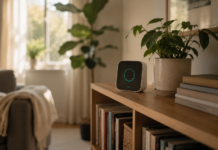
A monitor that tracks all four gives a genuinely useful picture. One that shows only CO2 is still useful, just narrower than it might appear. It’s a ventilation gauge wearing a health-metric costume.
A Worked Example: Testing Your Own Bedroom
This is the single most useful thing a household can do with a $40 CO2 monitor, and it takes one night.
Night one, door and window closed: A typical bedroom with two adults and a closed door commonly climbs from a starting point near 500–600 ppm to somewhere between 1,800 and 2,800 ppm by morning, depending on room size.
Night two, window cracked an inch: The same room, same occupants, often plateaus in the 900–1,400 ppm range instead, because outdoor air is continuously exchanging with indoor air all night.
Neither number is a medical verdict. But the comparison shows, in a household’s own space, exactly how much a single small change moves the number the CogFX studies were built around. That’s more convincing than any ppm chart borrowed from a research paper. Run the same test in a nursery, a home office, or a shared kids’ bedroom, and the pattern usually holds: whichever room stays closed the longest climbs the highest, and the fix is the same small crack of outdoor air each time.
CO2 in Schools and Open-Plan Offices
Classrooms and open-plan offices pack more people into a given volume of air than almost any other everyday space, which makes them the places most likely to run high. Some school districts have started installing CO2 monitors in classrooms specifically as a ventilation check, not because CO2 itself is considered hazardous at those levels, but because a rising reading is an easy, continuous signal that outdoor air supply isn’t keeping pace with a full room of kids.
The same logic applies to a packed conference room during a long planning session. If people start reaching for coffee and complaining of a headache around hour two, ventilation is a more likely culprit than the meeting agenda.
What Actually Brings CO2 Down
The fixes are simpler than the science debate around them.
- Crack a window. Even a small opening exchanges indoor air with outdoor air continuously, and it’s the fastest single fix in most homes.
- Run exhaust fans during and after activities that add moisture or occupancy load, not just while cooking.
- Take a five-minute break between back-to-back meetings in a small closed room, and open the door or window during it.
- Check your HVAC’s outdoor air intake setting if you have one; some systems can be adjusted to bring in more fresh air, at a modest energy cost.
- Use a portable CO2 monitor as a rough ventilation gauge, not a health alarm. A steady climb over a meeting or a sleeping night tells you more than any single number.
- Rotate a stale room out of use for ten minutes between long stretches of occupancy, if opening a window isn’t practical, letting the door stand open to the rest of the house instead.
None of these require buying anything beyond, at most, a modest CO2 monitor. The single highest-leverage change for most households is also the free one: leaving a window cracked during the hours a room is actually occupied.
How a Closed Room Fills Up
The Outdoor Baseline Is Rising Too
Every indoor CO2 number in this article sits on top of a moving outdoor baseline. NOAA’s Mauna Loa Observatory, which has measured atmospheric CO2 continuously since 1958, recorded 432.34 ppm in May 2026, up from 430.51 ppm the same month a year earlier. That baseline has climbed for decades and shows no sign of leveling off.
This doesn’t change the indoor guidance here. Even at 432 ppm outdoors, a well-ventilated room will still track close to outdoor levels, while a closed, occupied room will still climb into the thousands. But it does mean the “well-ventilated” baseline itself creeps upward slowly, year over year, which is worth knowing if you compare a CO2 reading against an older article or an older monitor’s factory calibration.
Room by Room: Where Ventilation Matters Most
Not every room in a home carries equal urgency. Occupancy, room size, and how long people stay put all change how fast CO2 builds.
| Room | Why It Builds Up Fast | Priority Fix |
|---|---|---|
| Bedroom (door closed, 7–9 hrs) | Long, continuous occupancy with no air exchange overnight | Crack a window or use a trickle vent |
| Home office / closed-door calls | Small volume, door shut for privacy or quiet | Open the door between calls; crack a window during long ones |
| Nursery or kids’ bedroom | Often smaller room, door closed for sleep training | Use a monitor to confirm ventilation, not just a sound machine |
| Home gym | Elevated breathing rate during exercise raises CO2 output per person | Ventilate before and during, not just after |
Bedrooms deserve special attention precisely because nobody is awake to notice the air quality slowly degrading. A cracked window or a door left slightly open overnight is a small trade against warmth that many people decide is worth it once they’ve actually watched their own bedroom’s numbers on a monitor.
Mini-Glossary
- ppm (parts per million): The unit CO2 concentration is measured in; 1,000 ppm means one CO2 molecule per 1,000 air molecules.
- ACH (air changes per hour): How many times a room’s entire air volume is replaced with outdoor air each hour.
- VOCs: Volatile organic compounds released by furniture, paint, and cleaning products; often rise alongside CO2 in poorly ventilated rooms.
- NDIR sensor: The sensor type used in accurate consumer CO2 monitors; cheaper “eCO2” sensors estimate rather than directly measure CO2 and are less reliable.
Common Misreadings of This Research
| Misreading | More Accurate Read |
|---|---|
| “1,000 ppm is a proven danger threshold” | ASHRAE explicitly rejects a fixed threshold; evidence is suggestive, not conclusive. |
| “CO2 itself is toxic at office levels” | At 600–2,000 ppm, CO2 is a ventilation marker, not a direct toxin. Toxicity concerns start far higher, above 5,000 ppm in occupational settings. |
| “The Harvard study proves CO2 causes worse thinking” | It shows a correlation in a small sample where ventilation, VOCs, and CO2 all moved together. |
| “A cheap CO2 monitor is precise” | Budget sensors often estimate rather than measure directly. Look for NDIR sensors for real accuracy. |
What Building Scientists Do Differently
People who work in indoor air quality rarely fixate on hitting a specific ppm number. They watch the trend across a day rather than one reading, and they treat a CO2 monitor as a ventilation diagnostic, a way to catch a stuck damper or a closed vent, rather than a health meter to be kept below an arbitrary line.
They also separate discomfort from harm. Stuffiness, a mild headache, or trouble concentrating in a packed, under-ventilated conference room is real and worth fixing. It doesn’t mean the same room at half the occupancy poses any measurable risk.
One habit shows up again and again among people who actually manage building air for a living: they design ventilation around peak occupancy, not average occupancy. A living room that’s fine with two people can turn stuffy fast with ten guests over for a holiday dinner, and the fix isn’t a bigger HVAC system, it’s opening a door or window for the two or three hours that actually matter.
Copy-Ready Ventilation Checklist
- ☐ Crack a window during long meetings or focused work sessions in small rooms
- ☐ Run exhaust fans beyond just active cooking or showering
- ☐ Take a short break with the door open between back-to-back closed-room meetings
- ☐ Check whether your HVAC has an adjustable outdoor-air intake setting
- ☐ If using a CO2 monitor, choose one with an NDIR sensor for real accuracy
- ☐ Watch the trend across a day, not a single snapshot reading
Key Takeaways
- Indoor CO2 is a proxy for ventilation, not a direct toxin, at the concentrations most people encounter.
- Harvard’s CogFX studies found large cognitive score improvements in better-ventilated rooms, but the sample sizes were small.
- ASHRAE, the standards body, says current evidence doesn’t justify a fixed cognitive CO2 threshold.
- Outdoor air sits a little above 430 ppm; occupied, poorly ventilated rooms commonly exceed 1,000 ppm.
- Cracking a window is still the fastest, cheapest fix available in most buildings.
- Cheap “eCO2” sensors estimate rather than measure directly; look for NDIR sensors for reliable readings.
Frequently Asked Questions
What CO2 level should worry me at home?
There’s no officially recognized danger threshold at typical indoor levels. Many people start noticing stuffiness or drowsiness somewhere above 1,500 to 2,000 ppm, which is a reasonable personal cue to improve ventilation, even without a formal health guideline behind that number.
Do plants meaningfully lower indoor CO2?
Not at a scale that matters. A typical houseplant absorbs a small fraction of the CO2 a single adult exhales in a day. Opening a window or improving mechanical ventilation does far more than any realistic number of plants.
Is a cheap CO2 monitor from an online marketplace accurate?
Often not. Many budget devices use “eCO2” sensors that estimate CO2 from other readings rather than measuring it directly. For genuine accuracy, look for a monitor that specifies an NDIR (non-dispersive infrared) sensor.
Does high CO2 in a bedroom affect sleep quality?
Some smaller studies link poorly ventilated bedrooms with more reported grogginess on waking, though the research base is thinner than the office-cognition studies. Cracking a bedroom window or running a fan is a low-cost step regardless of how the science eventually settles.
Why doesn’t ASHRAE just set a CO2 limit if Harvard’s research shows an effect?
Standards bodies typically wait for a broader, more consistent body of evidence before rewriting binding ventilation codes. ASHRAE has said publicly that current research on CO2’s cognitive effects is inconsistent across studies, which is a higher bar than a single well-designed but small trial.
Does opening a window in winter undo the energy savings from good insulation?
A small trickle of fresh air costs far less in heating than most people assume, especially compared to the energy waste of a fully open window. Cracking a window a finger’s width for part of the day, or during and after high-occupancy periods, is a modest trade most household budgets absorb easily.
Can high CO2 trigger headaches even if it isn’t dangerous?
Many people report headaches, fatigue, or trouble concentrating in stuffy, high-occupancy rooms. Whether CO2 itself or the accompanying heat, humidity, and VOC buildup is the direct cause is still debated, but the practical fix is the same either way: bring in fresh air. If symptoms persist after ventilation clearly improves, it’s worth ruling out other causes with a healthcare provider rather than assuming air quality is automatically to blame.
References
- Harvard T.H. Chan School of Public Health, “The COGfx Study,” Study 1 findings.
- ASHRAE, “Indoor Carbon Dioxide, Ventilation and Indoor Air Quality,” public policy brief, 2023.
- ASHRAE Standard 62.1, ventilation for acceptable indoor air quality (referenced via ASHRAE’s 2023 brief).
- NOAA Global Monitoring Laboratory, Mauna Loa Observatory atmospheric CO2 trend data, May 2026.