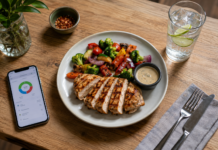




























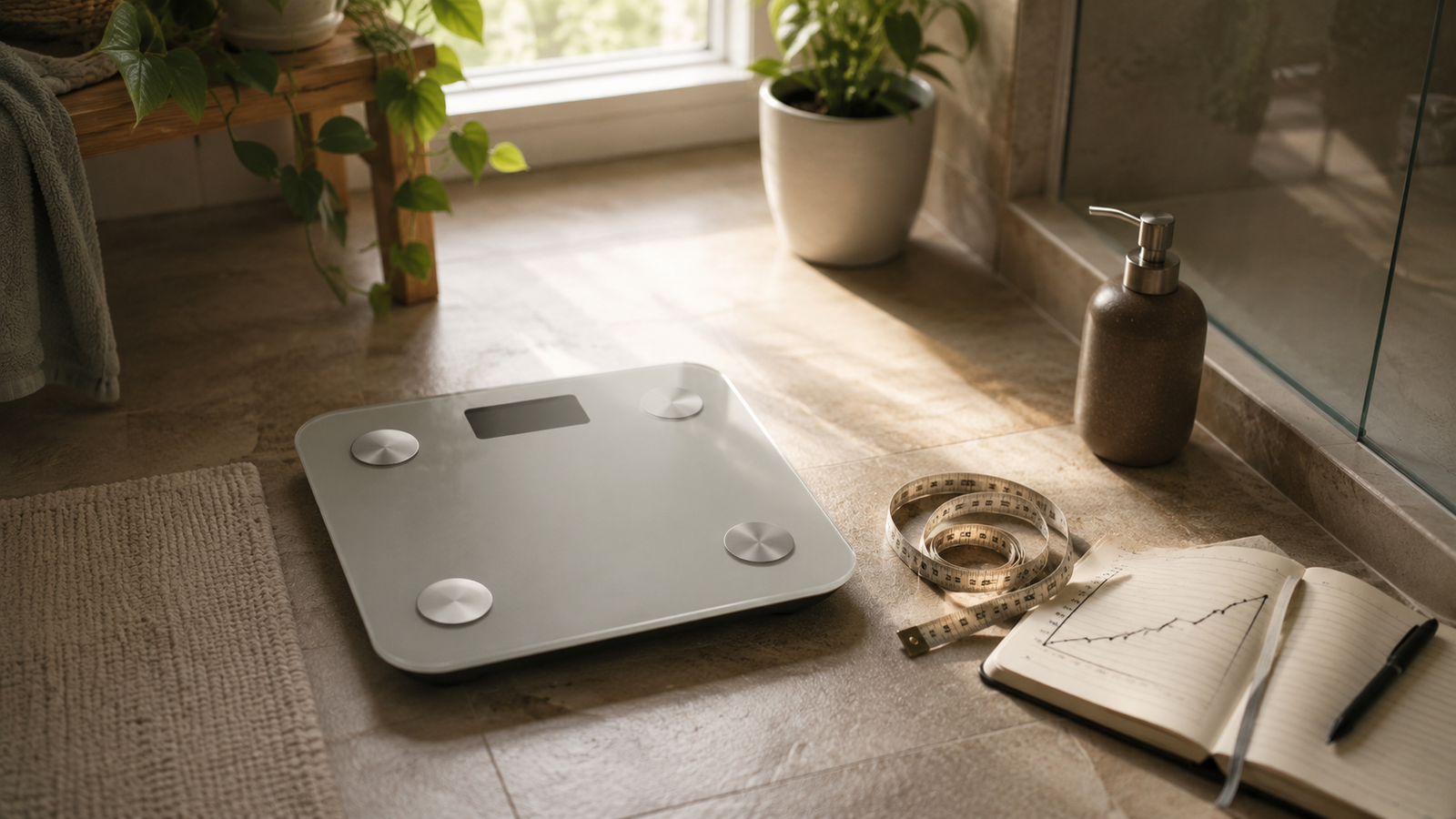
A bathroom scale that promises a body fat percentage, a set of calipers ordered on a whim, a stack of progress photos taken in the same spot every week: home body composition tracking has become one of the most common ways people try to understand what is happening beneath the number on the scale. The appeal is obvious. Weight alone hides a lot. Two people at the same weight can carry very different amounts of muscle and fat, and a number that only measures gravity’s pull on your whole body cannot tell you whether a strength program is working or whether a cut is costing you muscle along with fat.
The trouble starts when tracking stops being information and turns into a ritual you cannot skip. Daily weigh-ins, repeated scale readings within the same hour to see if the number “settles,” tape measurements taken from three angles before breakfast: these habits often begin as curiosity and end as compulsion. The data itself is not the problem. The way it gets collected and interpreted usually is.
This guide walks through what home body composition tools can and cannot tell you, how to build a measurement routine that produces a usable trend instead of a stream of anxiety-inducing noise, and what guardrails help keep tracking in the category of “useful habit” rather than “thing I think about all day.”
Why Home Tracking Is So Appealing, and Where It Goes Wrong
Body composition tracking sells itself on a fair premise: the scale is a blunt instrument. Someone who starts lifting weights while eating in a slight surplus may see the number on the scale go up even while their waist gets smaller and their clothes fit better. A method that separates fat mass from lean mass, even imperfectly, promises to answer the question that the scale cannot: is this working, and for what.
Consumer devices have made that promise cheap and accessible. A bioelectrical impedance (BIA) scale costs about as much as a decent bath towel set. Skinfold calipers cost less than a gym membership co-pay. A tape measure and a phone camera cost nothing extra at all. That accessibility is exactly why the pitfalls matter: cheap, frequent measurement invites frequent checking, and frequent checking is where the psychological cost starts to outweigh the informational benefit.
Three patterns show up again and again in people who track body composition at home:
- Single-reading panic. One BIA reading swings two or three percentage points from the day before, and the person concludes the diet or program has failed, when the swing is almost certainly hydration noise.
- Method-shopping. After an unwelcome number, the person switches methods (scale, then calipers, then a different scale) looking for one that gives a more flattering answer, which produces an incoherent dataset rather than a trend.
- Checking as reassurance-seeking. Measurement stops answering “is my program working” and starts functioning as a compulsive check against anxiety, similar to repeatedly checking a lock. The action briefly reduces distress and then, over time, increases the urge to check again.
None of these patterns require a flawed tool. They require a flawed protocol around a decent tool. Fixing the protocol is most of the work in this guide.
It also helps to be honest about what a body composition number is actually for. For most people tracking at home, the number exists to answer one practical question: is the current combination of training and eating moving fat mass and lean mass in the direction intended. It is not a verdict on discipline, attractiveness, or worth, and it was never designed to answer those questions. Keeping that boundary explicit from the start makes the frequency limits and review schedule in the sections below much easier to actually follow, rather than something you agree to and then quietly abandon the first week a reading disappoints you.
How Accurate Are Home Measurement Methods, Really?
Every home method trades some accuracy for convenience. Understanding where each one is weakest is what allows you to read the numbers correctly instead of over-trusting or dismissing them entirely.
Bioelectrical Impedance (BIA) Scales
BIA scales pass a small, imperceptible electrical current through the body and estimate fat-free mass from the resistance, since fat-free tissue conducts current more readily than fat tissue. The core problem is that resistance is heavily influenced by water content, and water content moves around for reasons that have nothing to do with fat loss or gain.
Consumer-grade BIA devices have been shown to under-read body fat percentage by roughly 5 kilograms on average when checked against MRI-based reference measurements, with a spread of about plus or minus 7 kilograms depending on the individual and device. That is a wide enough margin that a single reading should never be treated as a precise number, only as a rough estimate. Several conditions distort a reading further:
- Dehydration can produce an underestimation of fat-free mass of around 5 kilograms, which shows up as an artificially high body fat percentage.
- Moderate-to-vigorous exercise in the 90 to 120 minutes before a reading can shift fat-free mass estimates by close to 12 kilograms in the other direction, which is why most manufacturers recommend waiting several hours after a workout before testing.
- Eating and drinking earlier in the day can shift a same-day body fat reading by up to about 4.2 percentage points from morning to evening.
Four-electrode (tetrapolar) scales, where current enters and exits through separate contact points at the hands and feet, are more consistent than cheaper two-electrode models. Multi-frequency devices correlate with DXA scans at up to 99 percent for fat-free mass in some studies, but correlation describes how well two measures move together, not whether they agree in absolute terms. A device can track changes reasonably well while still being off by several percentage points on any single day.
Skinfold Calipers
Calipers pinch a fold of skin and subcutaneous fat at standardized sites (commonly the triceps, suprailiac, abdomen, and thigh) and plug the measurements into an equation to estimate total body fat. When the same trained person takes the measurement at the same sites with the same technique, results can be reproducible to within about 1 percent.
That reproducibility depends entirely on consistent technique, which is difficult for a home user working alone. Caliper measurements only capture subcutaneous fat, the layer just under the skin, and say nothing about visceral fat around the organs. Two people can have identical skinfold readings and meaningfully different total body fat because one carries more fat internally. Site location, pinch depth, and the specific caliper brand all introduce variability that a solo, at-home user rarely controls for consistently from week to week.
Tape Measurements: Waist and Waist-to-Hip Ratio
A cloth tape measure is the cheapest and, in some ways, the most stable home tool available, provided the same protocol is used every time. The World Health Organization’s standard protocol measures the waist at the midpoint between the bottom of the lowest rib and the top of the hip bone, and the hips at the widest point of the buttocks, with the tape held parallel to the floor and snug but not compressing the skin. The recommended practice is to measure twice and repeat if the two readings differ by more than 1 centimeter.
Waist-to-hip ratio becomes less reliable in people with a BMI at or above 35, and it cannot distinguish an increase caused by added abdominal fat from a decrease in lean muscle around the hips, so the number can move for more than one reason. In older adults, waist-to-hip ratio has been shown to predict mortality risk somewhat better than waist circumference or BMI alone, which suggests the measurement carries real health information even though it says nothing about fat versus muscle directly.
Progress Photos
Photos taken in consistent lighting, pose, and clothing at a fixed interval are not a body composition number at all, but they capture something the scale and tape cannot: visible shape change over time. Photos are also the method least prone to day-to-day noise panic, since there is no number to obsess over between shoots, only a comparison every few weeks.
The limitation is subjectivity. Lighting, posture, camera distance, and even bloating on a given day can make the same body look meaningfully different, and people are notoriously bad at judging their own physique changes in the mirror. Photos work best as a supplement to a numeric method, not a replacement for one.
| Method | What it estimates | Typical error/consistency | Biggest distortion risk |
|---|---|---|---|
| BIA scale | Body fat % via fat-free mass estimate | ~5 kg average bias, ±7 kg spread vs. MRI | Hydration, recent food, recent exercise |
| Skinfold calipers | Subcutaneous fat at select sites | ~±1% with same trained tester | Technique drift between sessions |
| Waist tape / WHR | Central fat distribution | High if protocol followed exactly | Inconsistent landmark or tape tension |
| Progress photos | Visible shape change | No numeric error, but subjective | Lighting, pose, and bloating differences |
A Step-by-Step Protocol for Low-Obsession Tracking
The goal of this protocol is to produce a trend line reliable enough to act on, while keeping the act of measuring small enough that it does not become the center of your day. Each step below narrows the noise from the previous one.
Pick one primary method and one backup method
Choose a BIA scale or skinfold calipers as your primary numeric method, and pair it with either waist tape measurements or progress photos as a backup. Two methods that measure different things (a body fat estimate and a visible or circumference change) tell you more together than either one repeated obsessively alone.
Fix the conditions and write them down once
Measure first thing in the morning, after using the bathroom, before eating or drinking, and before any exercise. Write the protocol on a sticky note or phone reminder so you are not re-deciding it each time. Consistency in conditions matters more than the precision of the device itself.
Set a measurement frequency limit and stick to it
Weigh in and take a BIA reading no more than two to three times per week, on set days. Take waist measurements or photos every two to four weeks, not weekly. If you catch yourself stepping on the scale a second time in the same morning, that is the behavior to interrupt, not the number to record.
Record numbers, but only review the average
Log every reading somewhere, then judge progress only by a 7 to 14 day rolling average, never by comparing one day to the previous day. A single reading is mostly hydration and food timing; an average across a week or two flattens that noise into something closer to a real trend.
Review on a fixed schedule, not on impulse
Set a specific day, such as the first Sunday of the month, to actually look at the trend, compare photos, and decide whether anything about the program needs to change. Outside of that scheduled review, collect data and otherwise leave it alone.
Decide in advance what would make you stop or adjust
Before you start, write down what result would mean “keep going,” what would mean “adjust calories or training,” and what would mean “stop tracking numbers for a while and focus on behavior instead.” Deciding this ahead of time removes the temptation to reinterpret every fluctuation in the moment.
Psychological Guardrails Against Obsessive Checking
A measurement protocol only works if the person following it can actually stick to the limits rather than quietly ignoring them the first time a number feels disappointing. A few guardrails make that easier.
Notice the difference between checking for information and checking for reassurance
Information-seeking measurement happens on schedule and gets recorded regardless of the result. Reassurance-seeking measurement happens right after a stressful meal, a missed workout, or a look in the mirror that felt off, and it is driven by a need to feel better in the next thirty seconds rather than a need for data. If you notice yourself stepping on the scale specifically because you feel anxious, that is the moment to put it away rather than step on it.
Separate the measurement from your mood for the day
Research on body checking behavior, drawn from work on body image and disordered eating, describes a pattern where repeated self-scrutiny of weight or shape temporarily reduces anxiety but reinforces the checking habit and, over time, increases baseline body dissatisfaction rather than resolving it. The same mechanism applies to numeric body composition tracking. A useful rule: no single measurement, taken alone, is allowed to set your mood, your food choices, or your workout intensity for the rest of the day. That authority belongs only to the rolling average, reviewed on the schedule you set.
Watch for identity creep
Health and fitness monitoring can start to feel tied to self-worth in a way that goes beyond tracking a habit; a person’s sense of doing well or failing becomes wrapped up in compliance with a self-defined standard of measurement or eating. If a missed measurement day, or one unfavorable reading, produces guilt disproportionate to its actual importance, that is a sign the tracking has shifted from a tool into an identity marker, and it is worth stepping back from numbers for a stretch and tracking behaviors (workouts completed, meals planned) instead.
Build in a no-measurement period
Taking four to six weeks off from any numeric tracking, at least once or twice a year, resets the relationship with the data. During that period, judge progress by performance in the gym, how clothes fit, energy levels, and sleep, then return to measurement afterward with a specific question in mind rather than a vague need to check.
Get outside input if checking feels compulsive
If measurement frequency keeps creeping upward despite a written rule, if a number can ruin your day, or if food or exercise decisions are being made to control the next reading rather than to support long-term health, that pattern is worth discussing with a doctor, registered dietitian, or therapist rather than solving with a stricter personal rule. Compulsive checking behaviors respond better to outside support than to willpower alone.
Putting It Together
A workable home routine, for most people, looks like this: a BIA reading and body weight two to three mornings a week under fixed conditions, a waist measurement and a set of photos once a month, a rolling average reviewed on one scheduled day, and a firm agreement with yourself that no single number gets to dictate the day. None of the home tools discussed here are precise instruments. All of them are good enough to show a direction over weeks and months when the protocol around them is disciplined. The discipline is in the schedule and the review, not in buying a more expensive scale.
Body composition tracking, done this way, answers the question it was meant to answer: is the current approach working. It stops being useful the moment it starts answering a different question entirely, one about whether you are allowed to feel good about yourself today. Keeping those two questions separate is the actual skill this guide is trying to teach.
It is worth repeating that no home method, however carefully used, replaces a clinical assessment when there is a specific medical reason to know body composition precisely, such as monitoring muscle loss during illness or tracking a diagnosed eating disorder in recovery. For general fitness and body recomposition goals, the combination of a consistent primary method, a fixed schedule, and a rolling average is sufficient. The point of this entire protocol is to make the measuring boring: the same device, the same morning routine, the same monthly review, so that the only thing left to react to is a slow, real trend rather than a jumpy number that was never meant to be read one day at a time.
Frequently Asked Questions
How often should I actually weigh myself or take a BIA reading?
Two to three times per week, at the same time of day and under the same conditions, is enough to build a usable rolling average without inviting daily obsession. Daily weighing can work for some people if they are strictly looking at a weekly average and not reacting to single days, but it raises the risk of reassurance-seeking checking for many others.
Are home BIA scales accurate enough to trust at all?
They are accurate enough to show a trend over several weeks if conditions are kept consistent, but not accurate enough to trust a single reading. Expect several percentage points of day-to-day swing driven by hydration, food, and recent exercise rather than actual fat change.
Should I use calipers or a BIA scale?
Either works as a primary method, and the more important factor is consistency: the same device, the same sites (for calipers), and the same conditions every time. Calipers require more practiced technique but only measure subcutaneous fat; BIA scales are easier to use consistently but are more sensitive to hydration.
Why does my body fat percentage jump around so much day to day?
Hydration status, recent meals, sodium intake, and exercise in the hours before a reading all shift the number independently of any real change in fat mass. This is expected and is the reason single readings should not be interpreted on their own.
How do I know if my tracking has become obsessive?
Warning signs include checking more than once in the same day, a single number affecting your mood or food choices for the rest of the day, feeling anxious about an upcoming scheduled measurement, and struggling to skip a measurement day even when you know it would be reasonable to. If these show up, it is worth pausing numeric tracking and speaking with a professional if the pattern persists.
What should I track instead if I take a break from numbers?
Workout performance (weight lifted, reps completed, run pace), how specific clothes fit, sleep quality, and energy levels all provide real signal about whether a program is working without requiring a scale, calipers, or a tape measure at all.
References
- Wikipedia contributors, “Bioelectrical impedance analysis,” Wikipedia, The Free Encyclopedia.
- Wikipedia contributors, “Body fat percentage,” Wikipedia, The Free Encyclopedia.
- Wikipedia contributors, “Waist-hip ratio,” Wikipedia, The Free Encyclopedia.
- Wikipedia contributors, “Orthorexia nervosa,” Wikipedia, The Free Encyclopedia.
- World Health Organization, waist circumference and waist-hip ratio measurement protocol, WHO STEPS surveillance guidance.