



























By Noah Sato
A desk job does not cause fat gain by itself, but it removes a layer of daily movement that used to happen automatically, and most people never rebuild it on purpose. Commuting by car instead of on foot, sitting through eight or nine hours of meetings and screen time, then unwinding on a couch in the evening adds up to a day where the body barely has to move at all. Fat loss is still possible under these conditions, but it requires a different approach than the generic “eat less, move more” advice usually offers.
The good news is that the fix is not a punishing workout schedule bolted onto an already full day. It is a set of specific, small, repeatable adjustments to how you move, eat, and train around the hours you spend sitting. This guide walks through why a sedentary job changes the fat loss equation, then gives a concrete step-by-step plan you can start using this week.
It helps to be clear about what “sedentary job” actually means for this purpose. It is not limited to office work behind a computer. Long-haul driving, call center work, data entry, remote customer support, and many creative or administrative roles all involve six or more hours of sitting on a typical day, often with a commute that adds more sitting on either end. Anyone in that category runs into the same core problem: the body has far fewer natural opportunities to burn energy than it used to, and no amount of willpower at the dinner table fully makes up for that on its own.
The Real Reason a Desk Job Stalls Fat Loss: NEAT
Most people trying to lose fat focus on two levers: the food they eat and the workouts they do. Both matter, but there is a third factor that often decides whether those first two levers actually work, and it has almost nothing to do with the gym.
What NEAT Actually Is
Non-exercise activity thermogenesis, usually shortened to NEAT, is the energy your body burns doing everything that is not sleeping, eating, or structured exercise. It includes standing up from your chair, walking to a printer, fidgeting while on a call, carrying groceries, gardening, pacing during a phone conversation, and every other small movement scattered across a normal day.
A landmark study led by Dr. James Levine at the Mayo Clinic Endocrine Research Unit, published in the journal Science in 1999, overfed 16 nonobese volunteers by 1,000 extra calories a day for eight weeks and tracked what happened to their energy expenditure. The researchers found that two-thirds of the increase in total daily energy expenditure came from increased NEAT, not from a rise in exercise or resting metabolism. Participants who ramped up their NEAT the most gained the least fat, with a strong statistical correlation (r = 0.77) between NEAT activation and resistance to fat storage. The researchers concluded that activating NEAT helps dissipate excess energy and preserve leanness, while failing to activate it tends to result in fat gain.
Why NEAT Matters More Than People Think
NEAT can account for anywhere from roughly 6 to 10 percent of daily energy expenditure in a sedentary person up to as much as half of total daily energy expenditure in someone with a physically demanding job. That is a spread of well over a thousand calories a day between two people who might eat similar meals and even go to the same gym in the evening. A desk job compresses that range toward the low end by default, which is exactly why the same diet and the same workout plan can produce very different results depending on how much incidental movement fills the rest of the day.
This is not an argument against structured exercise. It is a reminder that a single 45-minute workout, however hard, sits inside a 24-hour day, and the other 23-plus hours still count. If a sedentary job strips out hundreds of calories of casual daily movement, a workout has to work much harder to close that gap, and the food side of the equation has less room for error.
NEAT Activity Reference Table
Rough calorie estimates for common low-intensity movements, based on a person weighing around 70 kg (154 lb). Actual numbers vary by body weight, pace, and individual metabolism.
| Activity | Duration | Approx. calories burned |
|---|---|---|
| Standing instead of sitting | 1 hour | 10 to 20 more than sitting |
| Walking at an easy pace | 10 minutes | 30 to 50 |
| Taking the stairs instead of the elevator | 2 minutes | 10 to 15 |
| Pacing during phone calls | 30 minutes | 60 to 90 |
| Household chores (vacuuming, tidying) | 20 minutes | 70 to 100 |
| A brisk 20-minute walk at lunch | 20 minutes | 90 to 130 |
None of these numbers look dramatic on their own. Stacked across a full workday and repeated five days a week, they can add up to 300 to 500 extra calories burned daily without setting foot in a gym, which over a month is a meaningful contributor to a fat loss target.
A Step-by-Step Plan to Approach Fat Loss With a Sedentary Job
The plan below is built around five steps. Each one targets a specific gap that a desk job creates, and each is designed to fit inside a normal workday rather than compete with it.
Movement Snacking
Break sitting time into short bursts of standing or walking every 30 to 60 minutes, rather than waiting for a single daily workout to do all the work.
Walking Targets
Set a daily step target that fits your starting point, then raise it gradually over several weeks instead of jumping straight to 10,000.
Desk-Based Activity
Redesign small parts of the workday, like calls, breaks, and meetings, so they involve standing or walking by default.
Calorie and Protein Adjustment
Set a calorie target that reflects your actual activity level, and prioritize protein to protect muscle and manage hunger.
Strength Training Schedule
Fit two to four short strength sessions around your work hours rather than trying to find one long, perfect block of free time.
Step 1: Start With Movement Snacking
Movement snacking means taking short, deliberate breaks from sitting throughout the day rather than saving all your activity for one workout. Set a recurring timer or use a smartwatch reminder for every 30 to 60 minutes, and when it goes off, stand up and move for two to five minutes. This can be a lap around the office, ten bodyweight squats, a walk to refill your water bottle, or simply standing while you finish reading an email.
The point is not the intensity of any single break. It is the cumulative effect of interrupting long sitting stretches many times a day, which research on sedentary behavior consistently associates with better metabolic markers than the same total activity performed in one continuous block. If your job includes back-to-back meetings, try taking at least one call standing up or walking around a quiet space, and build the habit of standing during the first minute of any video call while you are muted.
Step 2: Set a Real Walking Target
Walking is the simplest lever a desk-bound person has, because it requires no equipment, no gym membership, and very little planning. The World Health Organization notes that 31 percent of adults worldwide, roughly 1.8 billion people, do not meet recommended activity levels, and insufficient activity raises mortality risk by an estimated 20 to 30 percent compared with more active populations. Walking more is one of the most direct ways to close that gap.
Start by tracking your current average daily steps for three or four days using your phone or a wearable, without changing anything. Whatever that number is, add 1,500 to 2,000 steps to it as your first target, and hold that new target for one to two weeks before raising it again. This gradual approach avoids the common mistake of jumping from 3,000 steps to a 10,000-step goal overnight, which usually feels unsustainable and gets abandoned within a week. Practical ways to add steps around a desk job include parking further from the entrance, taking a 10 to 15 minute walk after lunch, getting off public transit one stop early, and pacing during phone calls instead of sitting through them.
Step 3: Build Desk-Based Activity Into the Workday
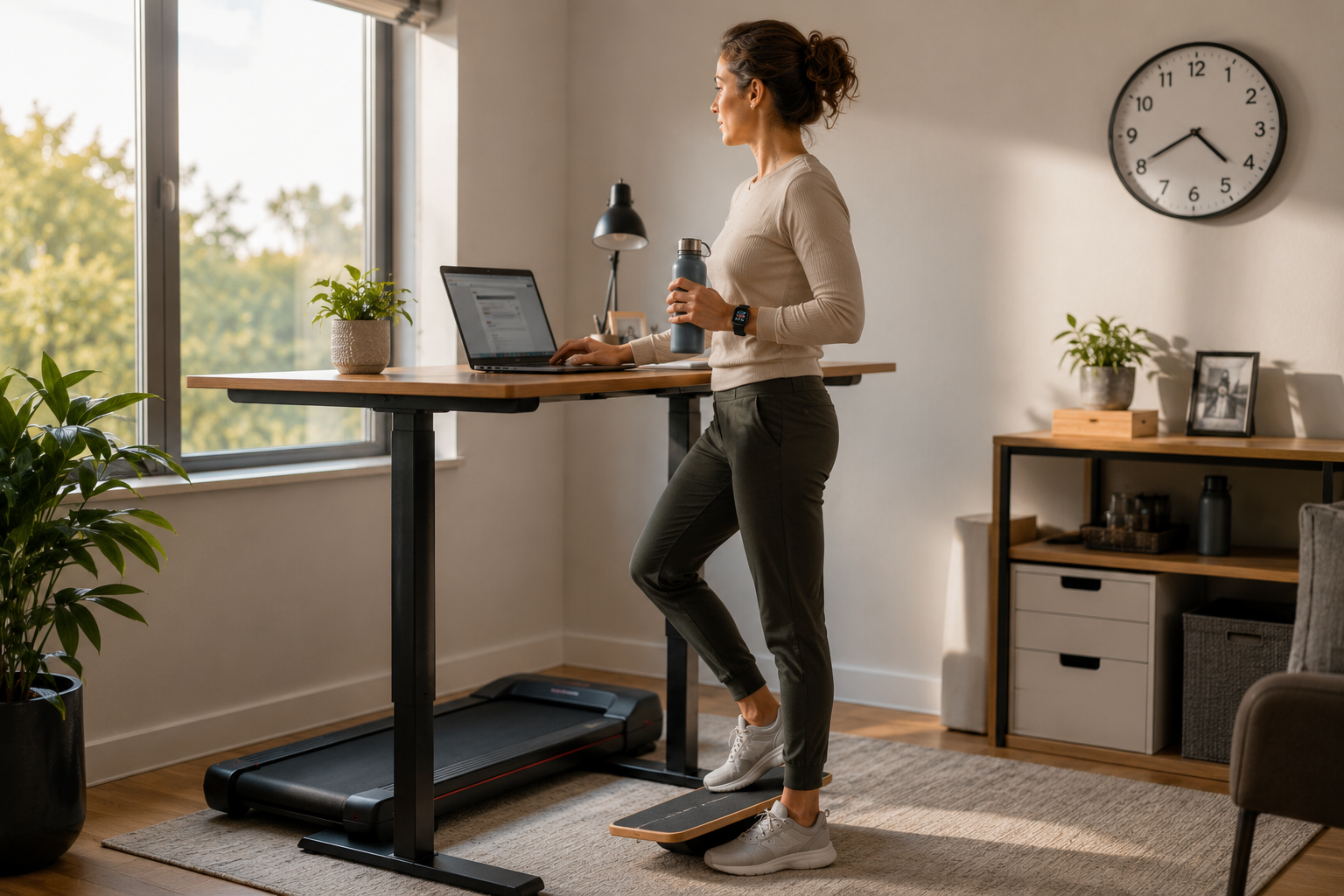
Beyond walking, there is a category of activity that fits directly inside desk hours without requiring you to leave your workstation for long. A sit-stand desk, even a basic adjustable riser, makes it easier to alternate positions every hour rather than staying seated from 9 to 5. Under-desk pedal exercisers or a compact balance board can add light continuous movement during reading-heavy or low-focus tasks, such as reviewing documents or listening to a webinar.
Simple posture and mobility resets also count. Every hour or two, stand up and do a short sequence: a few shoulder rolls, a standing hip hinge, a couple of calf raises, and a brief overhead reach. This takes under a minute, costs nothing, and directly counters the stiffness that builds up from prolonged sitting. Scheduling walking meetings for one-on-one conversations, when the discussion does not require a screen, is another practical option that many remote and hybrid workers can adopt immediately.
Small environmental changes make these habits easier to sustain. Keeping a water bottle at your desk means more bathroom trips, which is a built-in excuse to stand and walk a short distance several times a day. Placing a printer, filing cabinet, or supply closet slightly further from your desk than strictly necessary, if you have any control over office layout, adds a few extra steps every time you use it. None of these tricks feel significant in isolation, but a workday built from a dozen small nudges toward standing and walking looks very different by 5 p.m. than one built entirely around sitting still.
Step 4: Adjust Calorie and Protein Targets for Low Activity
A calorie target built for an active lifestyle will not fit a sedentary one, and using a generic online calculator without adjusting the activity multiplier is a common reason fat loss stalls for desk workers. If your job involves sitting for most of the day and your only structured activity is three or four gym sessions a week, select a “sedentary” or “lightly active” activity level when estimating your maintenance calories, rather than “moderately active.” Overestimating activity level is one of the most common calculation errors in fat loss planning, and it can lead to a calorie target that is 300 to 500 calories too high to produce a deficit.
Protein deserves particular attention in a low-activity fat loss plan. Adequate protein intake, generally in the range of 1.6 to 2.2 grams per kilogram of body weight per day for people in a calorie deficit who are also doing some resistance training, helps preserve lean muscle mass while body fat decreases, and it tends to be more filling per calorie than carbohydrate or fat, which helps manage appetite across a long sitting-heavy day. Building each main meal around a clear protein source, such as eggs, poultry, fish, legumes, tofu, or dairy, before adding carbohydrates and fats around it, is a simple structural rule that works well for people with limited time to plan elaborate meals.
Tracking food intake, at least loosely, for two or three weeks is worth the effort for anyone with a desk job who has stalled on fat loss before. A simple food log, even a rough one kept on a phone app, tends to reveal patterns that are easy to miss otherwise: a habitual afternoon snack pulled from a break room, larger portions during stressful meeting-heavy days, or drinks and coffee add-ins that quietly contribute several hundred calories. Sedentary days also tend to compress hunger and boredom together, since there is little physical fatigue to distinguish real hunger from the urge to break up monotony with food. Building in a planned mid-afternoon snack that includes protein or fiber can reduce the pull toward less useful options later in the day.
Step 5: Schedule Strength Training Around a Desk Job
The Centers for Disease Control and Prevention recommends at least 150 minutes of moderate-intensity aerobic activity a week, or 75 minutes of vigorous activity, along with muscle-strengthening activity on at least two days a week that targets the major muscle groups, including the legs, hips, back, abdomen, chest, shoulders, and arms. For a desk job, the challenge is rarely knowing this guideline; it is finding a repeatable time slot for it.
Rather than searching for one long, uninterrupted hour, most people with full-time desk jobs do better scheduling two to four sessions of 30 to 45 minutes, placed either first thing in the morning before work starts, during an extended lunch break, or immediately after logging off before the transition into home responsibilities. Training immediately before or after a block of sitting also gives the body a clear signal to use stored energy for the muscles being worked, rather than adding another sedentary stretch on top of the workday. A simple split of two full-body strength sessions and one or two shorter cardio or walking-focused sessions per week covers the CDC’s minimum recommendation without requiring a daily time commitment.
Common Mistakes People Make When Trying to Lose Fat at a Desk Job
A few patterns show up repeatedly among people trying to lose fat while working a sedentary job, and recognizing them early can save months of frustration.
- Treating one workout as compensation for a full day of sitting. A 45-minute gym session is valuable, but it cannot offset ten hours of near-total stillness on its own. The steps and desk-based activity described above are what close that gap.
- Setting a step goal that is too aggressive too soon. Jumping from a 3,000-step baseline to a 10,000-step target in one week usually leads to sore feet, frustration, and the goal being dropped within days.
- Using an activity multiplier that does not match reality. Selecting “moderately active” or “very active” in a calorie calculator when your actual day involves sitting for eight-plus hours will produce a calorie target that is too high for fat loss.
- Under-eating protein while cutting calories. Low protein intake during a deficit makes muscle loss more likely, which lowers resting metabolism over time and makes maintaining fat loss harder later.
- Ignoring recovery and sleep. Long sitting hours combined with poor sleep raise stress hormones and hunger cues, which can undo the benefit of an otherwise solid plan.
- Waiting for a “free weekend” to start. The steps in this guide are designed to fit inside a normal workday. Waiting for an ideal week with more free time usually just delays getting started.
- Chasing intensity instead of consistency. A brutal, unsustainable workout twice a month does less for fat loss than three modest sessions a week held over several months. Consistency at a moderate level beats sporadic maximum effort almost every time.
- Judging progress only by the scale. Body weight fluctuates daily with water, food volume, and sleep. Tracking waist measurement, progress photos, or how clothes fit alongside the scale gives a more accurate picture of fat loss for someone who is also gaining strength.
Putting the Plan Into Practice
Approaching fat loss with a sedentary job comes down to rebuilding the daily movement that a desk removes, adjusting food intake to match actual activity rather than a wished-for activity level, and fitting strength training into slots that already exist in a workday instead of hunting for extra free time. None of the five steps above require special equipment or a schedule overhaul. Movement snacking, a realistic step target, small changes to how meetings and calls happen, a calorie and protein plan sized to a sedentary baseline, and two to four short strength sessions a week are enough to shift the balance meaningfully within a few months.
Pick one step to start this week rather than all five at once. Most people who stick with this kind of plan report that the walking target and movement snacking habit are the easiest entry points, since both slot directly into an existing workday without requiring a change in gym routine or diet on day one.
Frequently Asked Questions
Can I lose fat with a desk job without joining a gym?
Yes. Walking, movement snacking, desk-based activity, and calorie and protein adjustments can produce meaningful fat loss on their own. Strength training accelerates results and helps preserve muscle, but a full gym membership is not required to start.
How many steps a day should someone with a sedentary job aim for?
There is no single number that works for everyone. A more reliable approach is tracking your current baseline for a few days, then adding 1,500 to 2,000 steps to that baseline as an initial target, and increasing gradually every one to two weeks.
Does standing at a desk actually burn meaningful calories?
Standing burns modestly more calories than sitting, roughly 10 to 20 more per hour depending on body weight, and it is not a substitute for walking or exercise. Its main value is breaking up long sitting periods, which supports the movement snacking approach described above.
How much protein do I need if I am trying to lose fat with a low-activity job?
A common target for people in a calorie deficit who are doing some resistance training is 1.6 to 2.2 grams of protein per kilogram of body weight per day. This range supports muscle retention and tends to improve satiety across a long, low-movement workday.
Is it better to exercise before work or after work with a desk job?
Either can work, and the best time is the one you can repeat consistently. Morning sessions avoid schedule conflicts that build up during the day, while after-work sessions can help transition out of a long sitting stretch. Testing both for two weeks each is a reasonable way to decide.
What is the single most important change for fat loss with a sedentary job?
If only one change is possible, increasing daily steps and breaking up sitting time through movement snacking usually has the largest and most immediate impact, since it directly targets the NEAT gap that a desk job creates.
References
- Centers for Disease Control and Prevention. Physical Activity Guidelines for Adults. cdc.gov/physical-activity-basics/guidelines/adults.html
- World Health Organization. Physical Activity Fact Sheet. who.int/news-room/fact-sheets/detail/physical-activity
- Levine JA, Eberhardt NL, Jensen MD. Role of nonexercise activity thermogenesis in resistance to fat gain in humans. Science. 1999. pubmed.ncbi.nlm.nih.gov/9880251
- Non-exercise activity thermogenesis (NEAT) overview, summarizing research on daily energy expenditure from non-exercise movement. en.wikipedia.org/wiki/Non-exercise_activity_thermogenesis