



























By Amara Williams
If you have spent years unable to touch your toes, if your hamstrings feel like steel cables, or if every yoga class leaves you the stiffest person in the room, you have probably wondered whether some bodies are simply built to stay tight. The honest answer is partly yes. Flexibility has a real genetic component, and no amount of willpower will turn a naturally stiff frame into a gymnast’s frame overnight.
None of that means progress is out of reach. Genuinely inflexible adults, including people who have never once been able to sit comfortably cross-legged, regularly gain meaningful range of motion when they train with patience and consistency instead of forcing a stretch that isn’t ready. This guide walks through why some bodies resist stretching more than others, what a realistic timeline looks like, and a step-by-step protocol built specifically for people starting from a very stiff baseline, not for already-bendy beginners.
Most mainstream stretching advice is written for people who are already reasonably mobile, someone who can already sit flat on the floor with straight legs, or fold forward far enough to wrap their hands around their feet. That advice tends to fail the genuinely stiff reader, not because the underlying science is wrong, but because the starting depth assumed by the instructions is simply unreachable on day one. The approach below starts from a different assumption: that comfort at a shallow depth, repeated often, matters more in the early weeks than reaching any particular pose.
Why Some People Are More Inflexible Than Others
Stiffness is rarely a character flaw or a sign of laziness. Several overlapping factors determine how much natural range of motion a joint has before any training begins.
Genetics and Collagen
Researchers estimate that flexibility is roughly 50 percent heritable, meaning genes account for about half of the differences between one person’s range of motion and another’s, while lifestyle and training explain the rest. A gene called COL5A1, sometimes nicknamed the flexibility gene, produces type V collagen, a structural protein found in tendons, ligaments, and skin. Certain COL5A1 variants are associated with quadriceps stiffness and a higher risk of muscle strain, while other variants are linked to unusually loose joints, as seen in conditions like Ehlers-Danlos syndrome. A separate gene, ACTN3, affects a muscle structure protein, and one common genetic variant of ACTN3 is associated with lower flexibility scores. Estrogen receptor genes also play a role, since estrogen helps regulate collagen production, which is one reason flexibility can shift during hormonal changes across the lifespan.
Connective Tissue and Joint Structure
Beyond genes, the physical architecture of a joint sets a hard ceiling on range of motion. Bone shape, the depth of a hip socket, and the thickness of surrounding ligaments all vary from person to person. Someone with a naturally deep hip socket will never achieve the same split range as someone with a shallow one, no matter how much either person stretches. Fascia, the connective tissue sheath surrounding muscles, also varies in density and hydration, and drier or thicker fascia tends to resist elongation more than well-hydrated tissue.
Lifestyle and Sedentary Habits
Years of sitting at a desk, driving, or standing in one posture teach muscles to shorten toward their most-used length. Hip flexors that spend eight hours a day in a bent position adapt to that shortened state, and calves that rarely dorsiflex past a shoe heel lose range accordingly. This kind of stiffness is not permanent hardware, it is closer to a habit the tissue has learned, which is good news because learned patterns can be retrained.
Age-Related Changes
Collagen production naturally slows as people age, and the decline becomes more noticeable after roughly age 55. Without regular stretching, muscles gradually shorten and tighten, and joints lose lubrication and elasticity over the decades. This is why an unstretched 45-year-old typically feels stiffer than an unstretched 25-year-old doing the identical amount of activity, though the good news is that stretching remains effective at restoring lost range at any age.
What Realistic Progress Actually Looks Like
Genuinely inflexible people often quit stretching programs within a few weeks because they expected dramatic change and saw none. According to Harvard Health, it typically takes weeks to months of consistent work to notice a real improvement in flexibility, and gains have to be maintained with continued practice or they fade. That timeline is normal, not a sign that a program has failed.
A more realistic framework looks like this. In the first one to two weeks, expect the sensation of stretching to change before the actual range changes, tight spots that used to feel sharp start to feel like a dull pull instead. Between weeks three and six, small measurable gains typically appear, such as fingertips reaching a few centimeters further toward the floor or a hip opening enough to sit slightly more comfortably cross-legged. Meaningful, visible change generally shows up somewhere between two and four months of near-daily practice, and further gains continue slowly for as long as the practice continues. People who compare themselves to naturally flexible friends during those first weeks tend to give up early, right before the stage where progress becomes noticeable.
A Beginner-Safe Progressive Stretch Protocol
The protocol below is built around the guidance most commonly repeated by major health organizations: warm the body first, stretch to a gentle pull rather than pain, hold each position for roughly the same duration every session, and repeat several times a week rather than pushing hard once and stopping. The goal in the early stages is not depth, it is teaching the nervous system that these positions are safe.
The Four-Stage Progressive Protocol
Stage 1 · Weeks 1-2
Warm-up only, no forcing
- 5-10 minutes of light walking or marching in place before every stretch session
- Hold each stretch 15-20 seconds, stop well before any pulling sensation feels sharp
- 3 sessions per week, one muscle group family per session
Stage 2 · Weeks 3-4
Building consistency
- Increase to 4 sessions per week
- Hold each stretch 20-30 seconds, 2 repetitions per side
- Add slow breathing, exhale as you settle into the stretch rather than holding your breath
Stage 3 · Weeks 5-8
Extending range gradually
- Near-daily short sessions, 10-15 minutes each
- Hold 30 seconds, 3-4 repetitions per side, per major muscle group
- Introduce gentle active stretches (slow controlled leg raises) alongside static holds
Stage 4 · Month 3+
Maintaining and refining
- Daily or near-daily maintenance stretching, 10-20 minutes
- Hold 30-60 seconds on tighter areas, especially hips, hamstrings, and calves
- Reassess every few weeks and only add depth when the previous depth feels routine, not effortful
Within each stage, warm up first with light movement, since stretching cold muscle is a common cause of strain. Stretch to the point of a slight pull, never pain, and breathe steadily instead of holding tension in the chest. Consistency across the week matters far more than the intensity of any single session, a stiff body responds better to ten short sessions than to one long, aggressive one.
Beginner vs. Advanced: How the Approach Should Differ
A genuinely inflexible beginner and an already-mobile advanced practitioner should not be following the same stretching routine, even if they are technically doing the same poses. The table below outlines how the approach should shift.
| Factor | Genuinely Inflexible Beginner | Advanced Practitioner |
|---|---|---|
| Hold time | 15-30 seconds, building slowly | 30-60+ seconds, sometimes with added load |
| Frequency | 3-4 sessions per week, short duration | Daily, often combined with training sessions |
| Depth cue | Stop at the first hint of pulling | Can work closer to end range with control |
| Stretch type | Mostly static stretching after warm-up | Static, dynamic, and assisted (partner or PNF) stretching |
| Progress marker | Comfort at the current depth, not new depth | Incremental increases in end-range angle |
| Common risk | Forcing range before tissue is ready, causing strain | Overtraining an already mobile joint into instability |
The Areas That Tend to Stay Tightest
Not every joint resists stretching equally. A handful of regions account for most of the frustration genuinely inflexible adults report, and understanding why each one behaves the way it does makes the protocol above easier to apply.
Hips and Hip Flexors
The hip is a deep ball-and-socket joint surrounded by some of the thickest connective tissue in the body, and it is also the joint most affected by long hours of sitting. A desk job or a long commute trains the hip flexors to stay in a shortened position for most of the day, so by evening they resist any attempt to lengthen. Kneeling lunge stretches and gentle seated figure-four positions, held well within the pain-free range described in Stage 1 of the protocol, are usually the safest entry point.
Hamstrings
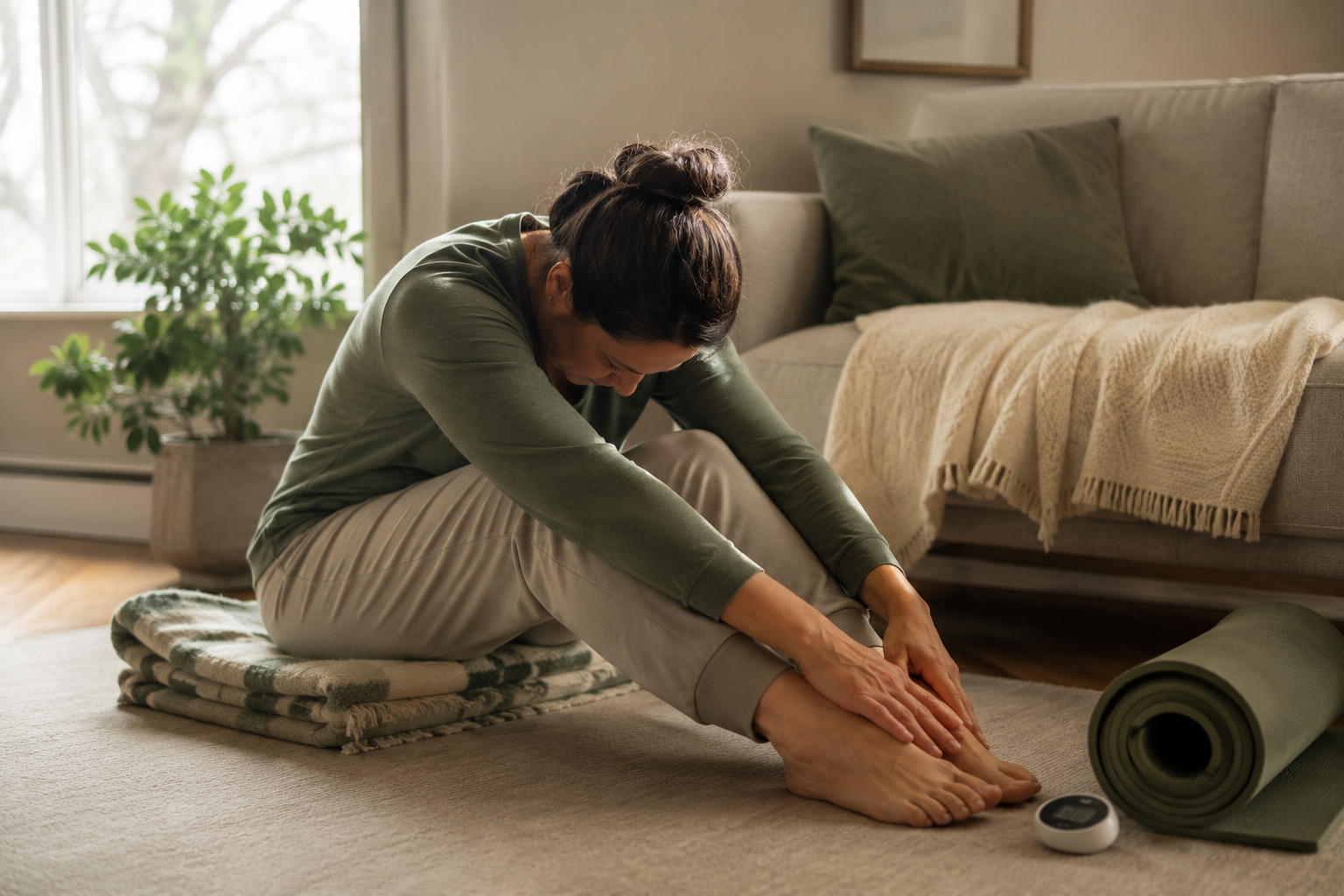
Hamstring tightness is one of the most common complaints among adults who cannot touch their toes, and it is frequently a mix of genuine muscle shortness and simple nervous system guarding, where the body limits range as a protective measure rather than because the tissue itself cannot lengthen. This is part of why hamstring flexibility often improves faster in the first few weeks than joints with more structural limitation, such as the hips. Bent-knee variations of a forward fold, where the knees stay soft rather than locked straight, tend to work well for a stiff beginner because they reduce strain on the lower back while still loading the hamstring.
Calves and Ankles
Calves rarely get stretched through daily movement, since most walking and standing keeps the ankle in a narrow range. A simple wall calf stretch, with the back heel pressed down and the front knee bent, is one of the lowest-risk stretches available and is a reasonable daily addition even during Stage 1.
Shoulders and Upper Back
Rounded posture from screens and phones shortens the chest muscles and lengthens, but weakens, the muscles between the shoulder blades, which can create a false sense of upper-body stiffness that is partly postural rather than purely a flexibility problem. Doorway chest stretches and gentle cross-body shoulder stretches, held for the same durations recommended in the protocol, address most of this over time.
Spine
Rotational stiffness through the mid-back is often the slowest area to change, partly because the rib cage limits how far the spine can rotate regardless of training. Seated spinal twists, done slowly and without forcing the end range, are appropriate, but expectations here should stay modest, since spinal rotation gains tend to be smaller and slower than gains in the hips or hamstrings.
Tools That Can Help a Stiff Beginner
A genuinely inflexible body often benefits from simple equipment that makes a stretch achievable without forcing range the tissue is not ready for. A yoga strap or even a long towel looped around the foot allows a seated hamstring stretch to be held with the back straight, rather than rounding forward to reach toes that are simply out of reach at this stage. Yoga blocks placed under the hands during forward folds shorten the distance to the floor, which keeps the spine safer and the stretch more sustainable. A folded blanket under the hips during seated cross-legged positions reduces strain on tight hips by tilting the pelvis into a more neutral position. None of this equipment speeds up tissue adaptation on its own, but it does make early-stage positions accessible and repeatable, which is what actually drives progress over the following weeks.
Common Mistakes That Slow Progress
Most stalled stretching routines fail for one of a small number of predictable reasons, rather than any unique flaw in the person doing them.
Forcing range too fast. Pushing into a deeper position before the tissue has adapted does not speed up flexibility gains, it usually triggers a protective muscle contraction that makes the area tighter for the next few days, along with a real risk of strain.
Comparing progress to naturally flexible people. Someone who could touch their toes at age ten is working from a different genetic and connective-tissue starting point. Measuring your week-three progress against their lifetime baseline is a comparison that guarantees disappointment and tells you nothing useful about your own trajectory.
Skipping the warm-up. Stretching cold muscle, straight out of bed or before any movement, increases the chance of strain and reduces how far tissue can safely lengthen. A short warm-up changes how the entire session feels.
Bouncing into the stretch. Ballistic bouncing can trigger a reflexive tightening response and raises injury risk, particularly in already-stiff tissue. A slow, controlled entry into the position is safer and more productive.
Stretching only once in a while. A single long session on a Sunday does far less for lasting range of motion than several short sessions spread across the week, because adaptation depends on consistent, repeated signals rather than occasional intense ones.
Ignoring pain signals. A slight pulling sensation is expected. Sharp, stabbing, or nerve-like pain is not, and continuing to stretch through it can turn a temporary stiffness problem into an actual injury that sets progress back for weeks.
Holding the breath. Tensing up and holding the breath during a stretch tends to increase overall muscle guarding, which works against the goal of the stretch. Slow, steady breathing signals to the nervous system that the position is safe, which allows the muscle to release more readily.
Expecting a straight line of progress. Flexibility does not improve on a perfectly smooth curve. Some weeks bring a noticeable opening, other weeks feel identical to the week before, and occasional stress, poor sleep, or a missed session can even produce a temporary step backward. None of that means the approach has stopped working, it is simply how adaptation in connective tissue tends to behave.
Building a Routine That Actually Sticks
Consistency beats intensity for anyone starting from a genuinely stiff baseline. Attaching stretching to an existing habit, such as right after brushing teeth or right before bed, removes the need to rely on motivation every single day. Tracking sessions on a simple calendar, even with nothing more than a checkmark, gives visible proof of consistency during the early weeks when the body itself hasn’t changed much yet. It also helps to pick two or three target areas, commonly hips, hamstrings, and calves, rather than trying to stretch the entire body every session, since a shorter, focused routine is far easier to repeat several times a week than a long one that starts to feel like a chore.
People who train alongside a physical therapist or qualified trainer, especially in the presence of an existing injury, joint condition, or diagnosed connective tissue disorder, tend to progress more safely than those working entirely from general guidance. A professional can identify which specific joints are structurally limited versus which are simply undertrained, a distinction that changes what a reasonable long-term goal should even look like.
Progress is also easier to see with a simple, low-effort measurement rather than relying on memory. Photographing a seated forward fold once every two weeks, or noting how far the fingertips reach relative to a fixed marker like a shoebox, gives an honest record that memory alone tends to distort. Genuinely inflexible adults often underestimate how much they have gained precisely because the change happens gradually enough that day-to-day differences are hard to notice without a fixed reference point.
It is worth setting the comparison point correctly from the start. The relevant benchmark is not a naturally flexible coworker or an influencer demonstrating a full split, it is this same body two, four, or eight weeks earlier. Adults who anchor their expectations to their own baseline tend to stay consistent for far longer than those anchoring to someone else’s genetics, and staying consistent is the single largest factor separating people who eventually gain real range of motion from those who quit during the slow early weeks.
Genuine inflexibility is a starting point, not a life sentence. The genetics that predispose someone to stiffer tissue do not prevent adaptation, they simply mean the adaptation happens on a slower, steadier curve than it might for someone else. Give the process the weeks and months it actually requires, keep sessions short and frequent, and let comfort at each stage, rather than depth, be the signal that it’s time to progress.
Frequently Asked Questions
Can a genuinely inflexible adult ever become as flexible as someone naturally bendy?
Not always to the same absolute range, since joint shape and genetics set a ceiling that training cannot fully override. Most inflexible adults can still gain substantial, functional range of motion, often enough to move comfortably and pain-free, even if their end range never matches a naturally hypermobile person’s.
How many days a week should a beginner stretch?
Three to four short sessions per week is a reasonable starting frequency, progressing toward near-daily short sessions after the first month, based on general flexibility training guidelines from major health organizations.
Should stretching happen before or after exercise?
Static stretching is generally recommended after a workout or after a short warm-up of light activity, since stretching cold muscle increases strain risk. Gentle dynamic movement is a better fit before exercise.
Is it normal to feel no improvement after two weeks?
Yes. Most guidance suggests it takes weeks to months of consistent practice before flexibility gains become noticeable, and the earliest changes are often a shift in how the stretch feels rather than a visible increase in range.
Can stretching too hard make someone less flexible?
Overstretching or forcing range past a sharp pulling sensation can trigger a protective tightening reflex and cause micro-strain, both of which can leave a muscle feeling tighter and more guarded for days afterward.
Does age make it impossible to improve flexibility?
No. While collagen production slows with age and unstretched muscles shorten over time, stretching remains effective at restoring lost range of motion at any age, though older adults may benefit from slightly longer stretch holds.
References
- American Heart Association, “How much and how often should people stretch? Experts say there’s no one answer” (2024) heart.org
- Mayo Clinic, “A guide to basic stretches” mayoclinic.org
- Harvard Health Publishing, “The importance of stretching” health.harvard.edu
- Xcode Life, “Is Flexibility Genetic?” xcode.life