
























By Priya Nandakumar
Step off a nine-hour flight and your body feels like it belongs to someone else. Your lower back has fused into the shape of an economy seat, your ankles have quietly puffed up, and your neck creaks in a direction it was never designed to move. None of that is in your head. Sitting still for hours in a pressurized metal tube changes how your blood moves, how your joints hydrate, and how your muscles fire, and the discomfort you feel at baggage claim is your body’s honest report of what just happened to it.
The good news is that most of that stiffness is reversible in minutes, not days. This guide walks through why long flights leave the body tight and sluggish, then gives a complete stretch and mobility sequence you can run through at the gate, at baggage claim, or in your hotel room within the first hour of landing. It also covers what to do in the air itself, how to support recovery once you have landed, and where the line sits between ordinary travel stiffness and a warning sign that needs medical attention.
Why Long Flights Leave Your Body Stiff and Swollen
Air travel combines three stressors your body does not usually face together: prolonged immobility, low cabin humidity, and reduced air pressure. Each one contributes to that specific, unmistakable “long-haul” feeling in a different way.
Prolonged Sitting Slows Circulation
Your calf muscles work as a secondary pump for venous blood, squeezing the veins in your lower legs each time you take a step and helping push blood back up toward your heart. When you sit motionless for hours, that pump stops working. According to the Mayo Clinic, when the calf muscles do not contract for an extended period, blood can pool in the lower legs and the risk of clot formation rises (Mayo Clinic, Deep Vein Thrombosis). This is exactly why flight attendants encourage passengers to flex their feet periodically instead of staying still for the entire cruise.
The Centers for Disease Control and Prevention notes that anyone traveling more than four hours by air, car, or bus can be at higher risk for blood clots, because prolonged immobility is the common thread across all three modes of travel (CDC, Understanding Your Risk for Blood Clots with Travel). The risk climbs further for travelers who already carry other risk factors, including age over forty, recent surgery, pregnancy, obesity, or a personal or family history of clotting disorders.
Cabin Air Is Unusually Dry
Commercial cabins are pressurized to roughly the equivalent of 6,000 to 8,000 feet of altitude, and the air circulating through them is drawn partly from outside the aircraft, where it is almost completely devoid of moisture at cruising altitude. Cleveland Clinic explains that this combination leaves throat, nasal passages, and skin feeling dry within a few hours of takeoff (Cleveland Clinic, How Airplane Travel Affects Your Body). Dehydration thickens the blood slightly and can make muscles feel tighter and joints feel less lubricated, compounding the stiffness that comes from sitting still.
Lower Oxygen and Cabin Pressure Add Fatigue
Because cabins are not pressurized to full sea-level conditions, the body absorbs somewhat less oxygen during flight than it would on the ground. Combined with dry air, cramped seating, and often disrupted sleep, this leaves many travelers feeling drained well beyond what the hours in the air alone would explain. Gas trapped in the digestive tract also expands at altitude, adding a layer of bloating and discomfort that makes forward folds and torso twists feel especially good after landing.
Sleep Disruption and Time Zones Add to the Toll
On overnight or multi-time-zone flights, disrupted sleep compounds all of the above. A body that has not had proper rest tends to hold more tension in the neck, shoulders, and jaw, and travelers often notice that stiffness feels worse after a red-eye than after a daytime flight of similar length even when the seat and posture were identical. This is one more reason the post-flight stretch sequence below is worth doing even when you feel more tired than sore. Loosening the major muscle groups can make the difference between arriving groggy and arriving upright and functional for the rest of your day.
Layered together, these four factors: slowed circulation, dry cabin air, reduced oxygen, and disrupted sleep, explain why a long flight leaves you feeling like you did far more physical work than you actually did. Understanding the cause makes the fix more intuitive: restore movement, restore fluids, and give your joints a reason to move through their full range again.
The Post-Flight Stretch and Mobility Sequence
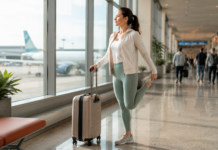
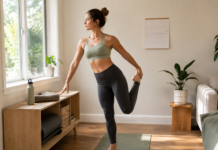
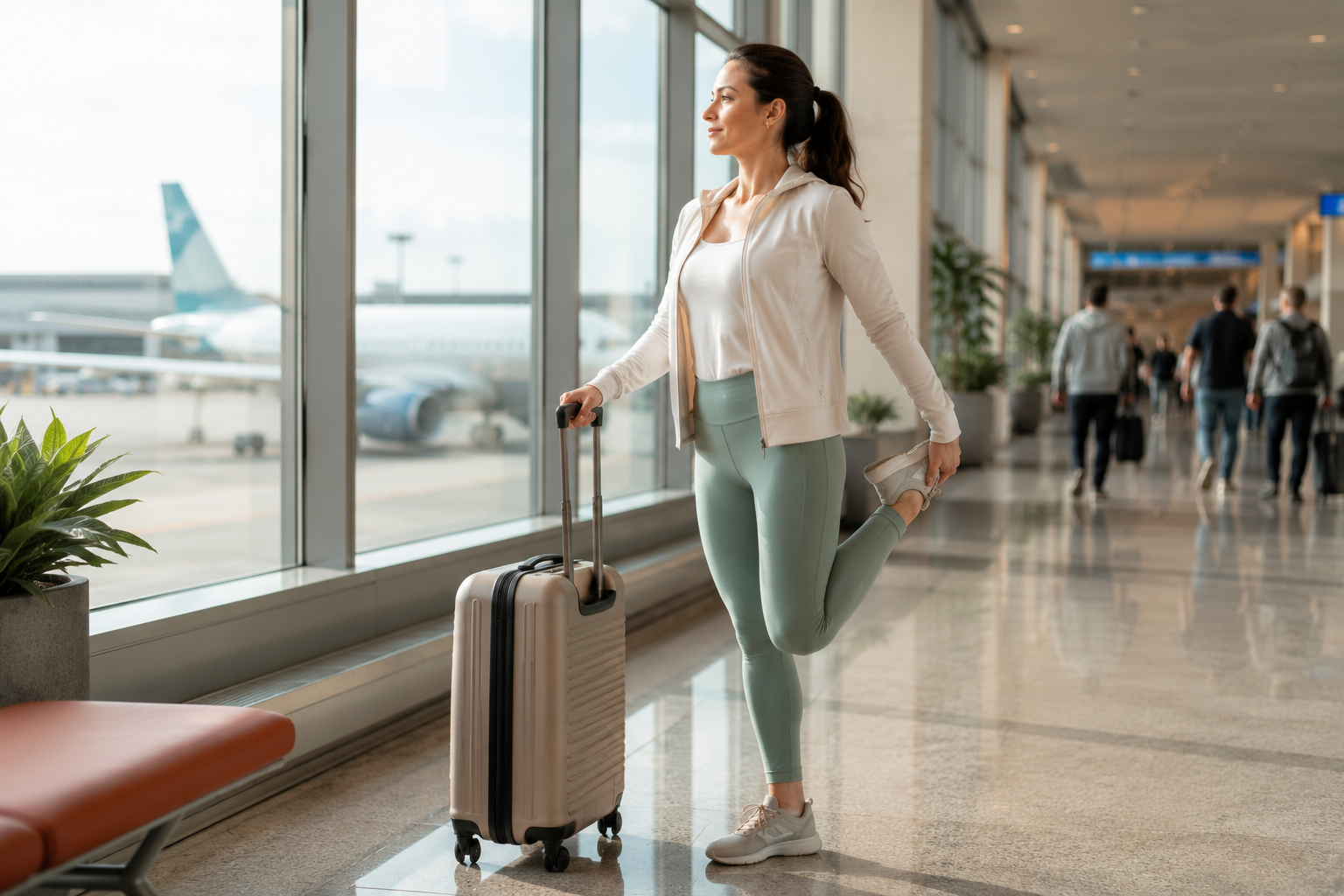
The sequence below is designed to be done standing, so you can run through it at your gate, in the aisle before disembarking, at baggage claim, or in your hotel room. Each step targets a specific area that stiffens during flight: hips, hamstrings, calves, spine, neck, and shoulders. Hold each stretch for 20 to 30 seconds and breathe steadily rather than bouncing.
A few general pointers make the sequence more effective. Move into each position slowly rather than dropping into it, since a joint that has been still for hours responds better to a gradual approach than a sudden one. Keep your breathing slow and even throughout, since holding your breath tends to make muscles tense up rather than release. If a stretch produces sharp pain rather than a mild pulling sensation, ease off immediately rather than pushing through it, and skip any step that conflicts with a known injury. Finally, do not rush. Even in a crowded airport, taking eight to ten unhurried minutes for this sequence will leave you in noticeably better shape for the rest of your travel day than skipping it to save a few minutes at the gate.
Standing hip flexor stretch
Step one foot back into a shallow lunge, tuck your pelvis slightly, and press your hips forward until you feel a stretch along the front of the back hip. Hold, then switch sides. Hip flexors shorten quickly after long sitting, and this single move undoes much of that tightening.
Standing hamstring reach
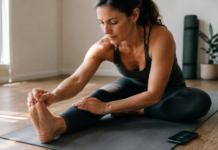
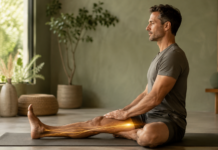
Place one heel on a low bench, chair, or your suitcase, keep the knee soft, and hinge forward from the hips until you feel a stretch down the back of the leg. Hold, then switch. This counters the shortened hamstring position created by a bent-knee seated posture for hours.
Calf and ankle pump against a wall
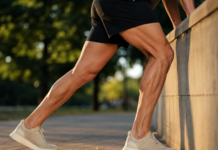
Facing a wall, place both hands on it and step one foot back with the heel pressed flat to the floor, then bend the front knee until you feel the calf lengthen. Follow with 15 to 20 slow ankle pumps per side to restart circulation in the lower leg.
Standing spinal twist
Feet hip-width apart, rotate your torso slowly to one side while letting your arms swing loosely, then rotate to the other. Keep the motion controlled rather than fast. This restores mobility to a spine that has been locked in one position for hours.
Standing forward fold
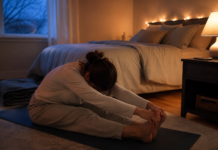
With knees softly bent, hinge forward and let your head, neck, and arms hang toward the floor. Sway gently side to side. This decompresses the lower back and releases tension built up from the seated slump.
Neck rolls and shoulder circles
Drop one ear toward one shoulder and hold, then repeat on the other side. Follow with slow shoulder circles, rolling up, back, and down. Cleveland Clinic recommends this exact combination for travelers to release neck and shoulder tension built up from hunching over a tray table or pillow (Cleveland Clinic, Yoga for Traveling).
Overhead reach and side stretch
Raise both arms overhead, interlace the fingers, and reach up through the fingertips before leaning gently to one side, then the other. This lengthens the ribcage and lower back muscles compressed by sitting.
Walk it out
Finish with two to five minutes of easy walking, whether through the terminal, to your hotel room, or around the block. Walking reactivates the calf muscle pump far more effectively than static stretching alone and is the single most protective move against post-flight leg swelling.
If you are short on time or space, steps 1, 3, 5, and 8 give you the highest return for the least effort. The full sequence takes roughly eight to ten minutes and can be repeated again a few hours after landing if you are still feeling tight.
Movement Tips for Managing the Flight Itself
Post-flight stretching matters, but what you do in the air changes how stiff and swollen you feel when you land. The table below separates habits that support circulation and comfort from ones that quietly work against you.
| Do | Don’t |
|---|---|
| Get up and walk the aisle every 1-2 hours on flights over four hours | Stay seated for the entire flight without moving your legs |
| Do seated ankle circles and foot pumps every 20-30 minutes | Cross your legs at the knee for long stretches, which can restrict blood flow |
| Drink water regularly throughout the flight | Rely on coffee, alcohol, or soda as your main fluids, since they add to dehydration |
| Wear loose, comfortable clothing and shoes you can slip off | Wear tight waistbands or restrictive footwear that compresses circulation |
| Ask about compression stockings if you have known clot risk factors | Ignore existing risk factors such as recent surgery, pregnancy, or prior clots |
| Take a short walk before boarding to loosen up beforehand | Sit for hours in a terminal chair before an already-long flight with no movement |
The National Blood Clot Alliance recommends a short menu of seated in-flight exercises that require no extra space: ankle circles for about 15 seconds in each direction, foot pumps alternating toe raises and heel raises, and knee lifts bringing each knee toward the chest in sets of 20 to 30 (stoptheclot.org, In-Flight Fitness). None of these require leaving your seat, which makes them easy to repeat every time a movie ends or a drink service passes.
Red Flags: When Post-Flight Discomfort Needs a Doctor
Ordinary post-flight stiffness improves steadily with movement, stretching, and rehydration over a few hours. A different pattern of symptoms deserves medical attention rather than a stretch routine.
The CDC notes that roughly half of deep vein thrombosis cases produce no obvious symptoms at all, which is part of why the condition is easy to miss (CDC, Understanding Your Risk for Blood Clots with Travel). When symptoms are present, they typically show up in one leg rather than both, and include swelling, pain or cramping that does not match a stretch you know you did, warmth over the area, and skin discoloration. Mayo Clinic describes these same warning signs and adds that DVT can develop silently before any of them appear (Mayo Clinic, Deep Vein Thrombosis).
Some symptoms are urgent rather than merely worth a phone call. Sudden shortness of breath, chest pain or tightness, a rapid or irregular heartbeat, coughing up blood, or fainting can indicate that a clot has traveled to the lungs as a pulmonary embolism, and both the CDC and Mayo Clinic identify these as reasons to seek emergency care immediately rather than waiting to see a regular doctor (CDC, Understanding Your Risk for Blood Clots with Travel; Mayo Clinic, Deep Vein Thrombosis). If you have known risk factors, including recent surgery, active cancer treatment, pregnancy, hormone-based birth control, or a personal or family history of blood clots, it is worth talking with your doctor before you travel about whether compression stockings or additional precautions make sense for your itinerary.
None of this is meant to cause alarm about ordinary travel. The overwhelming majority of stiffness after a flight is simply muscular and circulatory fatigue that responds well to the stretch sequence above. The distinction to hold onto is location and pattern: general full-body achiness that eases with movement is typical, while one-sided leg swelling, pain, or warmth that persists or worsens is not something to stretch through.
Building a Simple Post-Travel Recovery Routine
The travelers who feel best after a long flight tend to treat recovery as a short, repeatable routine rather than a single stretch done once. A practical version looks like this: move through the eight-step sequence within the first hour of landing, drink a full glass of water before you do anything else, take a short walk once you reach your hotel or destination, and repeat a shortened version of the stretches before bed if you are still feeling tight. Propping your feet up on a pillow or suitcase for ten to fifteen minutes once you are settled also helps drain fluid that has pooled in the lower legs during the flight.
None of these steps require special equipment, a gym, or extra time carved out of a travel day. They fit into the gaps that already exist between landing, collecting luggage, and reaching your accommodation. Building the habit once means you stop dreading the physical toll of long-haul travel and start treating it as a predictable, manageable part of the trip.
Frequent flyers often find it useful to keep a mental checklist rather than trying to remember every detail. Move first, hydrate second, walk third, prop your feet up fourth, and repeat the shortened version before bed. Written down on your phone or tucked into a travel notes app, this short checklist takes the guesswork out of recovery and turns what used to feel like an unavoidable few days of stiffness into a routine you complete once, right after landing, and mostly forget about for the rest of the trip.
Hydration and Recovery Nutrition After Landing
Stretching addresses the muscular and circulatory side of post-flight stiffness, but what you drink and eat in the hours after landing plays a supporting role too. Because cabin air is so dry, most travelers land at least mildly dehydrated even if they drank water steadily during the flight. Dehydrated muscle tissue feels tighter and less pliable, so rehydrating is not just a comfort measure, it is part of what makes the stretch sequence above actually work.
A practical approach is to drink a full glass of water immediately after leaving the aircraft, then continue sipping steadily rather than drinking a large amount all at once. Herbal tea or an electrolyte drink can help if you flew for more than six hours or crossed several time zones, since sweating less does not mean you have lost less fluid at altitude. Salty airport snacks and airline meals can also contribute to the puffiness many travelers notice in their hands and face after landing, so pairing rehydration with a lighter, less processed meal once you reach your destination tends to help the swelling resolve faster.
None of this requires special products or supplements. Water, movement, and a normal meal cover most of what your body needs to reset after a long flight. The stretch sequence and the hydration habit work best together rather than as separate fixes, since tight, dehydrated tissue responds to stretching more slowly than tissue that has had a chance to rehydrate first.
Frequently Asked Questions
How soon after landing should I stretch?
As soon as you reasonably can, ideally within the first hour. Circulation and joint stiffness both improve fastest when movement resumes soon after prolonged sitting rather than being delayed for several more hours.
Is it normal for my feet and ankles to swell after a flight?
Mild swelling in both feet and ankles is common after long periods of sitting and usually resolves within a day with walking, elevation, and hydration. Swelling that appears in only one leg, or that comes with pain or warmth, is different and warrants medical attention.
However, if swelling in both legs does not improve within a day or two of normal movement, it is reasonable to mention it to a doctor at your next visit.
Can I do these stretches in the airport instead of waiting until my hotel?
Yes. Every stretch in the sequence above is designed to be done standing with no equipment, which makes gate areas, jet bridges, and baggage claim all reasonable places to run through it before you even leave the airport.
Do compression socks replace the need to stretch or move?
No. Compression stockings support venous return in the lower legs, but they work best alongside regular movement, not as a substitute for it. Walking and calf activation are still what restart the muscle pump that compression garments assist.
What if I have a connecting flight and only a short layover?
Prioritize steps 3 and 8 from the sequence, calf and ankle activation plus a short walk, since these directly target circulation and take only a few minutes. A full stretch routine can wait until your final destination.
Are long car rides and long flights equally risky for stiffness and clotting?
The CDC groups air, car, and bus travel together for clot risk once a trip passes about four hours, since the common factor in all three is prolonged immobility rather than the mode of transport itself.
Should I stretch before boarding as well as after landing?
It helps. A short walk and a few minutes of the same standing stretches before you board can loosen tight muscles from getting to the airport and set your body up in a better starting position, which tends to make the stiffness after landing noticeably milder.
Is it safe to do these stretches with a sore back or existing joint condition?
The movements in this guide are gentle and low range, but anyone with a diagnosed back, hip, or joint condition should check with a physical therapist or doctor about which stretches suit their situation before adding a new routine, especially after recent surgery or injury.
References and Sources
- Centers for Disease Control and Prevention, “Understanding Your Risk for Blood Clots with Travel,” cdc.gov/blood-clots/risk-factors/travel.html
- Mayo Clinic, “Deep vein thrombosis (DVT) – Symptoms and causes,” mayoclinic.org/diseases-conditions/deep-vein-thrombosis/symptoms-causes/syc-20352557
- Cleveland Clinic, “How Airplane Travel Affects Your Body,” health.clevelandclinic.org
- Cleveland Clinic, “Yoga for Traveling: Simple, Seated Stretches to Try,” health.clevelandclinic.org/yoga-for-travel
- National Blood Clot Alliance, “In-Flight Fitness,” stoptheclot.org/in-flight-fitness