



























By Mateo Rivera
A tight lower back sends most people straight to the floor for a few quick stretches. That instinct is not wrong, but it is incomplete. Stretching the wrong tissue, at the wrong angle, or too aggressively can turn a dull ache into a flare-up that lasts for days. The lower back is not a single muscle you can pull like a hamstring; it is a stacked system of discs, small joints, nerve roots, and several muscle groups that all respond differently to load and position.
This guide walks through why certain stretches backfire, which movements are generally considered safer starting points, a slow and controlled routine you can try, and the specific warning signs that mean stretching is not the right tool for the job. None of this replaces an in-person evaluation. If pain is severe, persistent beyond a couple of weeks, or paired with any of the red-flag symptoms described below, the next step is a physician or physical therapist, not another round of stretches.
Why Lower Back Stretching Can Make Things Worse
Tightness in the lower back is often a symptom, not the actual problem. Muscles around the lumbar spine frequently tighten as a protective response to an irritated disc, a compressed nerve root, an unstable joint, or simple muscle fatigue from prolonged sitting. When someone stretches aggressively into that protective tightness, they can increase pressure on the structure the body was trying to guard in the first place.
According to Harvard Medical School’s Harvard Health Publishing, low back pain is one of the most common medical complaints worldwide, and chronic low back pain is considered a leading cause of disability globally. The same guidance notes that pushing muscles and joints too far, too quickly, can lead to injury rather than relief, and recommends a gradual, cautious approach rather than forcing a stretch through pain.
A physical therapist quoted by the Hospital for Special Surgery (HSS) put it plainly: roughly eight in ten Americans experience back pain at some point in their lives, and the guidance for two very common causes of chronic tightness points in opposite directions. For a herniated disc, forward-bending stretches can increase pressure on the disc and should generally be avoided in favor of movements that keep the spine in a neutral or slightly extended position. For spinal stenosis, the opposite is often true: gentle flexion, such as bringing the knees toward the chest, tends to feel better than extension, because extension can narrow the space around compressed nerves. Because these two common conditions respond to opposite movements, a stretch that helps one person can aggravate another, which is exactly why a one-size-fits-all stretching routine found online carries real risk.
The Role of Nerve Irritation
When tightness is tied to a nerve root rather than a muscle, stretching sensations can be misleading. A stretch that seems to relieve local tightness can simultaneously pull on an irritated nerve, producing tingling, numbness, or pain that radiates into the buttock, thigh, or below the knee. HSS guidance is direct about this: any exercise that triggers nerve symptoms down the leg should be stopped, and that person should seek medical attention rather than push through it.
Compensation From Surrounding Muscles
Hip flexors, hamstrings, and glutes all attach near the pelvis and directly influence how much tension sits on the lower back. Tightness that feels like it lives in the lumbar spine is frequently referred from these surrounding muscle groups. Stretching only the low back itself, while ignoring tight hip flexors or hamstrings, often produces short-lived relief because the underlying pull on the pelvis never changes.
Why Timing and Setup Matter
The same stretch can feel completely different depending on when it is performed. A lower back that has been sitting still for three hours responds differently to a knee-to-chest stretch than one that has just finished a walk. Cold, stiff tissue tends to resist a stretch and can protest with sharper discomfort, while tissue that has had a small amount of gentle movement beforehand, such as a short walk or a few minutes of easy marching in place, generally tolerates gentle stretching better. Setup matters as well. Stretching on a firm, supportive surface with the head and neck comfortably supported keeps the rest of the spine in a neutral position, so the lower back is not compensating for an awkward angle somewhere else in the body.
Common Causes of a Tight Lower Back
- Prolonged sitting. Sitting shortens hip flexors and places sustained load on lumbar discs, which is one reason HSS guidance specifically calls out prolonged sitting as an aggravating factor for disc-related pain.
- Muscle spasm and guarding. The lower back muscles contract to protect an irritated joint or disc, which produces the classic “locked up” feeling.
- Deconditioning. A sedentary lifestyle weakens the core and gluteal muscles that normally support the spine, shifting more load onto the lumbar muscles themselves.
- Poor lifting mechanics or a recent strain. A single awkward lift or twist can strain the muscles or ligaments around the lumbar spine.
- Underlying structural issues. Disc herniation, spinal stenosis, and degenerative changes in the facet joints can all present as chronic tightness rather than sharp pain.
- Stress and poor sleep. Chronic stress increases baseline muscle tension throughout the back, and poor sleep quality is associated with more reported pain sensitivity.
- Sudden changes in activity level. A big jump in training volume, a long drive, or an unusually long day of yard work can all overload muscles that were not conditioned for that load, producing tightness that shows up the following day.
- Footwear and sleep surface. Worn-out shoes and an unsupportive mattress do not cause structural back problems on their own, but both can shift how weight travels through the pelvis and spine over the course of a day, adding to cumulative tightness.
Because so many of these causes overlap, it is common for more than one factor to contribute at once. A person who sits most of the day, sleeps poorly, and recently increased their workout intensity may be dealing with deconditioning, muscle guarding, and simple overload at the same time, which is one reason a single stretch rarely resolves tightness on its own.
Which Stretches Are Generally Safer, and Which Carry More Risk
There is no universal list of “good” and “bad” stretches that applies to every back. The table below reflects general patterns described in physical therapy and orthopedic guidance for a typical, non-specific tight lower back, meaning pain without a confirmed diagnosis of disc herniation, stenosis, fracture, or nerve compression. Anyone with a diagnosed condition should follow guidance specific to that condition instead.
| Category | Generally Lower-Risk Starting Points | Higher-Risk or Advanced Moves to Approach Carefully |
|---|---|---|
| Flexion (bending forward) | Knee-to-chest stretch, pelvic tilt, gentle knee rolls side to side | Standing toe touches, seated forward folds held for a long time, especially with a suspected disc issue |
| Extension (bending backward) | Gentle press-up on the elbows (prone), performed slowly and only partway | Full cobra pose, deep backbends, wheel pose, especially with suspected spinal stenosis |
| Rotation and twisting | Supine knee cradle, slow lying-down knee rolls with shoulders flat | Forceful spinal twists, seated twists that force the shoulders far past the hips |
| Hip and hamstring work | Hip flexor stretch in a supported half-kneel, hamstring stretch with a strap or towel | Straight-leg toe touches from standing, ballistic bouncing stretches |
| Core support | Bridge (raising hips a few inches), bird-dog performed slowly | Full sit-ups, heavy weighted spinal flexion |
Two general principles show up across the sources cited at the end of this article. Movements are usually gentler when they are performed lying down rather than standing, because lying down removes gravity’s compressive load on the spine. Slow and partial range of motion is generally safer than a fast or maximal stretch, since the goal is to test how the back responds before asking for more.
A Careful, Step-by-Step Gentle Stretch and Mobility Routine
This routine draws on movements described in Harvard Health Publishing and HSS guidance for general, non-specific low back tightness. Go slowly, stay well within a comfortable range, and stop immediately if any step increases pain or produces tingling, numbness, or pain running down a leg.
Step 1: Pelvic Tilts (Warm-Up)
Lie on your back, knees bent, feet flat on the floor. Gently flatten your lower back toward the floor by tightening your abdominal muscles slightly, then release. Hold each flattened position for 5 to 10 seconds.
Reps: 5 to 10. This warms up the lumbar muscles before deeper stretching.
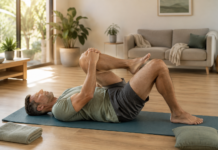
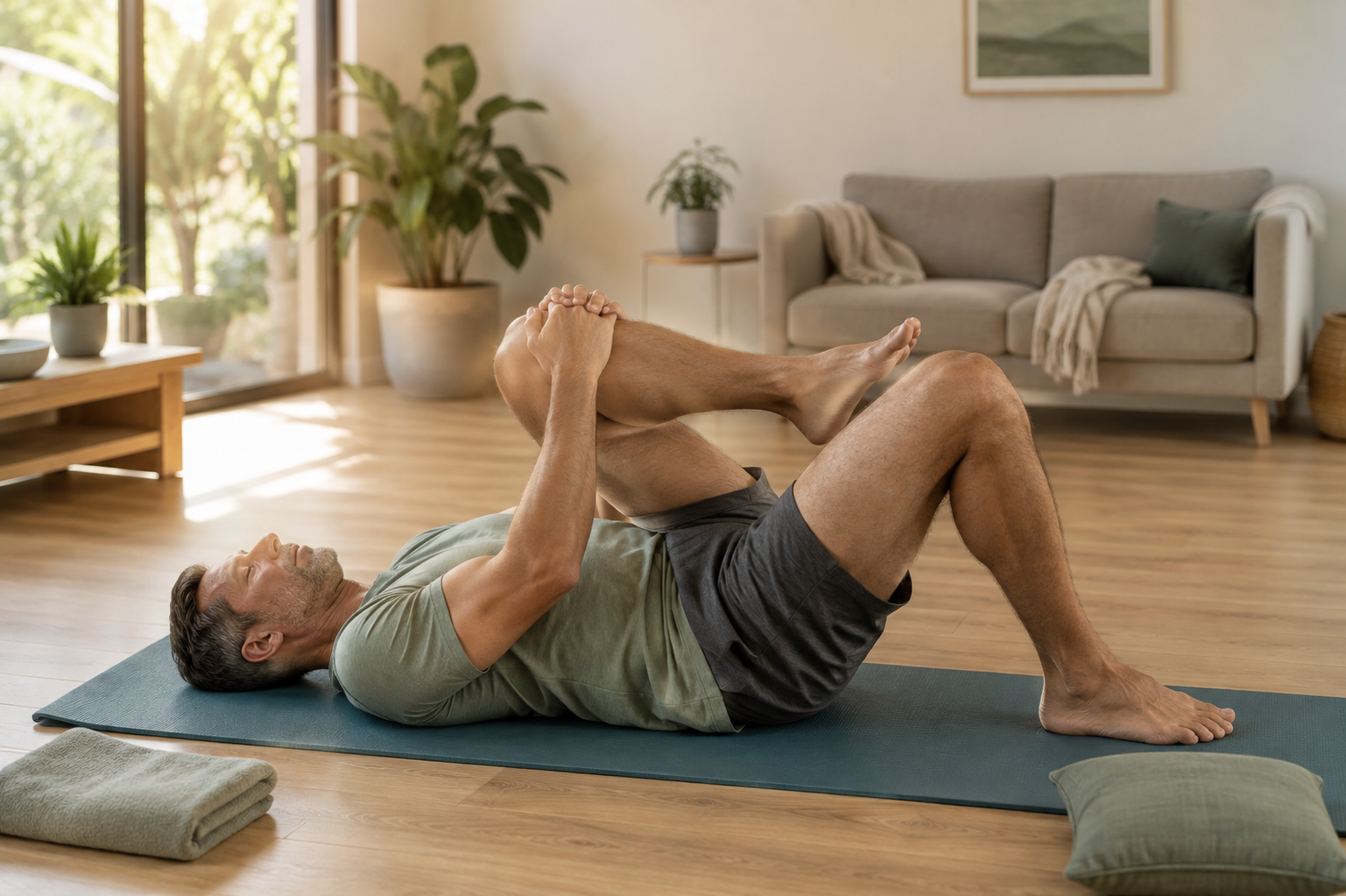
Step 2: Single Knee-to-Chest Stretch
Still lying down, keep one knee bent with the foot flat on the floor. Bring the other knee toward your chest, holding behind the thigh or shin, without pulling forcefully. Keep the movement gentle.
Hold: 20 to 30 seconds per side. Repeat 2 to 3 times per leg.
Step 3: Knee Cradle (Gentle Hip Rotation)
From the same lying position, gently pull one knee up and slightly across your body toward the opposite shoulder, feeling a stretch through the outer hip and glute rather than the spine itself.
Hold: 5 to 10 seconds. Repeat 5 times per leg.
Step 4: Lying Knee Rolls (Gentle Rotation)
Keep both knees bent and feet flat, shoulders pressed gently into the floor. Slowly let both knees fall to one side within a comfortable range, then return to center and repeat on the other side.
Reps: 10 per side, moving slowly and only as far as comfortable.
Step 5: Hip Flexor Stretch (Supported Half-Kneel)
Kneel on one knee with the other foot planted in front, both knees at roughly 90 degrees. Gently shift your weight forward until you feel a stretch in the front of the hip on the kneeling side, keeping your torso upright.
Hold: 20 to 30 seconds per side, twice daily as tolerated.
Step 6: Bridge (Gentle Activation)
Lying on your back with knees bent, feet flat, slowly raise your hips a few inches off the floor by squeezing your glutes, keeping the movement small and controlled. Lower back down with control.
Hold: 5 seconds. Repeat 5 to 10 times.
Step 7: Prone Press-Up (Optional, Go Slowly)
Lying face down, prop up on your forearms or slowly press up onto your hands, allowing your lower back to gently arch while keeping hips on the floor. Stop well before any pinching sensation and skip this step entirely if lying face down increases discomfort.
Hold: up to 10 seconds. Repeat up to 10 times, stopping early if needed.
A reasonable frequency for this type of routine, based on general physical therapy guidance, is once or twice a day on the gentler steps, and at least a few times a week overall. If any single step consistently increases pain rather than easing it, drop that step and keep the rest, then mention it to a physical therapist or physician.
Red-Flag Symptoms That Require Urgent Medical Care
Stretching is not the appropriate response to certain symptoms. According to Mayo Clinic, back pain warrants a call to emergency services or immediate medical care when it follows significant trauma such as a car crash, a bad fall, or a sports injury; when it comes with new loss of bowel or bladder control; or when it occurs together with a fever.
Mayo Clinic also outlines a set of symptoms that call for a prompt doctor’s visit rather than continued home stretching, including pain that is constant or intense, especially at night or when lying down; pain that spreads down one or both legs, particularly below the knee; weakness, numbness, or tingling in one or both legs; pain accompanied by unintended weight loss; and pain paired with swelling or a change in skin color on the back.
Any numbness in the groin or inner thighs, combined with new bladder or bowel changes, is considered an emergency regardless of how the back itself feels, since it can signal significant pressure on the nerves at the base of the spine. This combination should prompt an emergency room visit rather than a stretch routine or a scheduled appointment.
When to See a Physician or Physical Therapist
Home stretching is reasonable for mild, non-specific tightness that improves gradually over a week or two. It stops being the right first step once any of the following applies: pain has lasted more than two weeks without improvement, pain is getting worse rather than better despite rest and gentle movement, symptoms include any of the red flags above, or the tightness followed a specific injury rather than building up gradually.
A physical therapist can assess movement patterns, identify which structures are actually driving the tightness, and build a routine matched to the underlying cause, which matters given how differently conditions like herniated discs and spinal stenosis respond to flexion versus extension. A physician can rule out or confirm a structural cause, order imaging when appropriate, and refer to a specialist if the picture points toward something beyond routine musculoskeletal tightness.
Building a Sustainable Habit Without Overdoing It
Consistency tends to matter more than intensity for a tight lower back that is not tied to a specific injury. A short, gentle routine performed most days of the week, paired with regular movement throughout the day rather than long stretches of sitting, generally produces steadier results than an occasional aggressive stretching session. Standing up and walking for a minute or two every half hour to hour during a workday reduces the sustained compressive load that builds tightness in the first place.
Progress with this kind of routine is usually slow and incremental. Expecting a single stretch to resolve chronic tightness sets up frustration and can encourage forcing a stretch past a comfortable range, which is precisely the pattern that turns a manageable ache into a setback. Small, repeatable sessions beat a single hard push.
Tracking How the Back Responds
A simple daily note, even just a one-to-ten rating of morning stiffness and end-of-day tightness, makes it much easier to tell whether a routine is helping. Without tracking, it is easy to misjudge progress in either direction: a single bad day after a long car ride can feel like the whole routine failed, while gradual improvement over two or three weeks can go unnoticed because the day-to-day change is small. A short log also gives a physical therapist or physician a much clearer picture if the tightness does not resolve and an appointment becomes necessary.
Adjusting the Routine as Life Changes
A desk job, a physically demanding job, and a mostly sedentary retirement schedule all place different demands on the lower back, so the same routine will not necessarily fit all three. Someone who sits for long stretches may benefit from doing the hip flexor stretch and a short walk every hour, in addition to the daily routine, while someone doing frequent manual lifting may get more value from the bridge and bird-dog style core work to support the spine during those lifts. Revisiting the routine every few weeks, and adjusting based on what the body is actually doing that day, tends to work better than following a fixed plan indefinitely without reassessing it.
Frequently Asked Questions
Is it normal for a stretch to feel slightly uncomfortable?
A mild pulling sensation in the muscle being stretched is common and generally acceptable. Sharp pain, a pinching feeling in the joint, or any tingling or numbness radiating into the leg is not a normal stretching sensation and is a signal to stop.
How long should I try gentle stretching before seeing someone?
Mayo Clinic guidance points to about one week as a reasonable window for mild pain to start improving with self-care. If pain persists beyond that, worsens, or comes with any red-flag symptom, it is time to see a physician or physical therapist.
Should I stretch when my back is in an acute spasm?
Very gentle movement, such as pelvic tilts or a light walk, is often better tolerated than an aggressive stretch during an acute spasm. Forcing a deep stretch into a muscle that is actively guarding an irritated structure can increase pain rather than reduce it.
Can the same stretch help everyone with a tight lower back?
No. Guidance for a herniated disc generally favors extension-based positions and avoiding deep forward bends, while guidance for spinal stenosis often favors gentle flexion instead. Without knowing the underlying cause, it is safer to start with the gentlest, most neutral movements described in this guide.
Is heat or ice better before stretching?
Both are used in general back pain care, with heat often applied to relax tight muscles before gentle movement and ice sometimes used after activity to manage inflammation. Neither replaces a proper evaluation if pain persists.
What should I do if a stretch causes pain to shoot down my leg?
Stop that stretch immediately. Pain radiating down a leg, especially below the knee, or any accompanying numbness or weakness, is one of the symptoms Mayo Clinic identifies as a reason to contact a healthcare provider.
A Careful Approach Beats a Fast Fix
A tight lower back responds better to patience than force. The safest path is to start with gentle, well-supported movements performed lying down, watch how the body responds over several days, and treat any radiating pain, numbness, weakness, or bowel and bladder changes as an immediate signal to stop and get evaluated rather than a hurdle to stretch through. Real, lasting improvement tends to come from consistent, moderate movement and, where needed, guidance from a physical therapist who can match the routine to the actual cause of the tightness. That combination protects the back while it heals, instead of testing how much it can take.
References and Sources
- Mayo Clinic. “Back pain: Symptom — When to see a doctor.” mayoclinic.org
- Harvard Health Publishing, Harvard Medical School. “Stretching and strengthening exercises to relieve and prevent lower back pain.” health.harvard.edu
- Hospital for Special Surgery (HSS). “Stretches and Exercises for Lower Back Pain, from a PT.” hss.edu
This article is for general educational purposes and does not replace personalized medical advice. If you have severe, persistent, or radiating back pain, or any of the red-flag symptoms described above, consult a physician or physical therapist.