

























By Charlotte Evans
Most people who stretch every day are still using one tool: a static hold, thirty seconds, repeat. It works, but it is not the only option, and for a lot of joints it is not the fastest one. Proprioceptive Neuromuscular Facilitation, almost always shortened to PNF, adds a contraction step before the stretch itself, and that single addition changes how much range of motion a muscle gives up in a single session. Physical therapists have used PNF for decades to help patients recover motion after injury or surgery, and increasingly it shows up in home fitness routines because a strap or towel can substitute for a training partner’s hands.
This guide explains what PNF stretching is, why the contract-relax mechanism produces faster range-of-motion gains than a plain static hold for many people, what the research actually shows when PNF is compared head-to-head with static and dynamic stretching, and how to build a solo, strap-based PNF routine you can run at home without a partner. It closes with safety notes worth reading before you try your first session.
What Is PNF Stretching?
PNF stretching is a flexibility technique that pairs a passive stretch with an isometric muscle contraction, then follows that contraction with a deeper passive stretch. The original method was developed by physical therapists in the 1940s and 1950s as a rehabilitation tool for patients with neuromuscular conditions, built on the idea that engaging the nervous system directly, rather than just holding tissue at length, could unlock range of motion that static stretching alone left on the table.
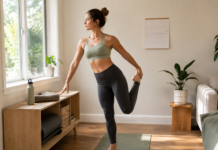
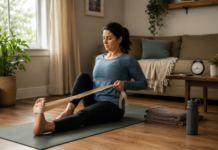
In a clinical setting, a therapist or partner applies manual resistance while the patient contracts the target muscle. At home, a stretch strap, resistance band, or folded towel takes the place of that second person, giving the same isometric loading without needing anyone else in the room.
The Three Common Variants
Most PNF programs use one of three structures, and the names describe what happens at each phase:
- Contract-Relax: the muscle is passively stretched, then contracted against resistance for roughly five to six seconds, then relaxed into a new, deeper stretch. This cycle repeats until range of motion plateaus.
- Hold-Relax: the muscle is held at the edge of its range and contracts isometrically without any joint movement, then relaxes so the limb can move further into the stretch.
- Hold-Relax-Agonist-Contract (also called contract-relax-antagonist-contract): after the isometric hold, the opposing muscle group actively contracts to pull the joint deeper, recruiting a second neural reflex on top of the first.
All three share the same skeleton: stretch, contract, relax, stretch deeper. The differences are in whether the joint moves during the contraction and whether the opposing muscle gets actively involved afterward.
The Physiology Behind Contract-Relax
PNF is not a mystery once you separate its two supporting reflexes: autogenic inhibition and reciprocal inhibition. Both are protective circuits built into the nervous system, and PNF essentially borrows them on purpose.
Autogenic Inhibition
Tucked inside every tendon are Golgi tendon organs, sensory receptors that monitor how much tension a muscle is generating. When a muscle contracts hard against resistance, as it does during the contraction phase of contract-relax stretching, tension in the tendon spikes. The Golgi tendon organ reports that spike to the spinal cord, and the spinal cord responds by briefly reducing the drive to that same muscle, a reflex that exists to prevent the muscle or tendon from tearing itself apart under excessive load. Because the muscle receives less neural drive right after the contraction, the tissue offers less resistance to the stretch that immediately follows, which is why the deeper stretch after a contraction often feels noticeably easier than the same stretch attempted cold.
Reciprocal Inhibition
The second mechanism works between opposing muscle pairs. When one muscle contracts, such as the quadriceps during a hamstring stretch that uses the hold-relax-agonist-contract variant, signals from muscle spindles travel to the spinal cord and trigger a reflex relaxation in the opposing muscle, in this case the hamstring. This reciprocal relationship is part of how the body coordinates ordinary movement. Bending the elbow requires the triceps to yield while the biceps contracts, and PNF routines that use active antagonist contraction are deliberately recruiting that same wiring to relax the muscle being stretched.
Additional Contributing Factors
Stress relaxation, the tendency of connective tissue to temporarily lengthen under sustained load, and gate control theory, in which pressure and proprioceptive signals can partially override sensory input related to stretch discomfort, both appear to contribute to the effect as well. None of these mechanisms works in isolation. A single contract-relax cycle likely draws on several of them together, which is part of why PNF often produces a larger single-session range-of-motion gain than a static hold of the same total duration.
PNF vs Static and Dynamic Stretching: What the Research Shows
Static stretching means holding a muscle at end range without movement, typically for twenty to sixty seconds. Dynamic stretching means moving a joint through its range repeatedly, gradually increasing the range with each repetition, and is more common as a warm-up before activity. PNF sits in a different category because it deliberately introduces a contraction into the sequence.
A controlled trial that assigned thirty participants with limited ankle dorsiflexion to either a contract-relax PNF protocol or a standing static calf stretch protocol for fifteen days found both groups improved, but the PNF group gained more. The PNF group, using three repetitions of a twenty-second isometric contraction, improved average dorsiflexion by 6.8 degrees, compared with a 5.0-degree average gain in the static stretching group, which held a standing wall stretch for thirty seconds across three repetitions per session.
Research on self-administered PNF specifically, meaning the strap-based version a person does alone rather than the partner-assisted clinical version, found that six weeks of self-PNF training produced significantly greater improvements in hip range of motion and sit-and-reach scores compared with a matched static stretching protocol. That distinction matters for anyone planning a home routine: the advantage over static stretching is not limited to the partner-assisted clinic version, it shows up with a strap as well.
A separate line of research specific to the hamstrings found large flexibility gains from PNF in the immediate and short term, among the more consistent findings in the stretching literature. Results are less uniform elsewhere. A review focused on hip flexion range of motion found that PNF and static stretching produced statistically similar long-term outcomes, with PNF showing only a small short-term edge rather than a clear overall winner. Stretching research is notoriously joint-specific and protocol-specific, so a technique that outperforms static stretching for the calf or hamstring will not automatically show the same margin at the hip or shoulder.
Dynamic stretching sits further from PNF than static stretching does, and the two are rarely compared head-to-head in the same trials because they tend to serve different purposes. Dynamic stretching, moving a joint repeatedly through an increasing range, is generally used as a pre-activity warm-up because it raises tissue temperature and primes the nervous system for movement without the temporary strength reduction that can follow an intense isometric contraction. PNF, by contrast, produces its largest range-of-motion gains when used as a dedicated flexibility session, separate from the warm-up portion of a workout. A sensible weekly structure treats dynamic stretching as the pre-training warm-up and reserves PNF for a standalone session, a cool-down after training, or a day set aside specifically for mobility work.
One additional finding is worth flagging for anyone hoping PNF is a one-time fix: a study using seven consecutive days of contract-relax stretching applied to the neck produced large short-term range-of-motion increases, but those gains faded quickly once the stretching stopped. PNF built and PNF is maintained through repetition. It is not a permanent unlock after a single session.
PNF vs Static Stretching at a Glance
| Factor | PNF (Contract-Relax) | Static Stretching |
|---|---|---|
| Mechanism | Isometric contraction, then autogenic and/or reciprocal inhibition, then deeper passive stretch | Sustained passive hold at end range, relying mainly on tissue creep and stress relaxation |
| Typical time per rep | Contraction 5 to 20 seconds, followed by a 15 to 30 second deeper stretch | 20 to 60 second continuous hold |
| Equipment needed at home | Strap, resistance band, or towel to provide resistance against the contraction | None, or a strap for assistance only |
| Single-session ROM gain | Often larger, especially for calf and hamstring muscle groups in trial data | Smaller but still measurable and reliable |
| Effort required | Higher, because it involves active muscle contraction | Lower, entirely passive |
| Best used | Post-workout or as a dedicated flexibility session, not immediately before max-effort lifting | Post-workout or as a calming cool-down; low-risk before most activities |
| Learning curve | Moderate; requires timing contraction and relaxation phases correctly | Low; hold and breathe |
A Solo, At-Home PNF Routine Using a Strap or Towel
Partner-assisted PNF relies on a second person to apply resistance and push you into the deeper stretch. Working alone, a stretch strap, yoga strap, or ordinary bath towel gives you a way to apply your own resistance during the contraction phase and gentle overpressure during the relaxation phase. The routine below adapts three common partner PNF stretches, hamstring, hip flexor, and calf, into a solo, strap-based format using the contract-relax structure.
General timing for every stretch in this routine: stretch to a comfortable end range, hold and contract for six seconds against the strap, fully relax for two to three seconds, then pull gently into a deeper stretch and hold for fifteen to twenty seconds before repeating. Two to three cycles per muscle group is enough for a home session.
Step 1 — Strap-Assisted Hamstring Contract-Relax
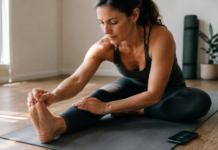
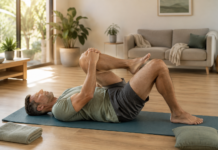
Lie on your back, loop the strap around the ball of one foot, and extend that leg toward the ceiling with the knee straight. Pull the strap until you feel a firm hamstring stretch. Press your heel into the strap for six seconds, as if trying to lower the leg, while your hands hold the strap steady so the leg does not actually move. Relax, then pull the strap to draw the leg a little closer to your chest and hold the new position for fifteen to twenty seconds. Repeat two to three times, then switch legs.
Step 2 — Towel-Resisted Hip Flexor Contract-Relax
Kneel in a half-kneeling lunge position with a folded towel under the back knee for cushioning. Shift your hips forward until you feel a stretch through the front of the back hip. Gently press the back knee downward into the floor, contracting the hip flexor and glute for six seconds, then relax and shift a little further forward into a deeper stretch, holding fifteen to twenty seconds. Repeat two to three times per side.
Step 3 — Strap-Assisted Calf Contract-Relax
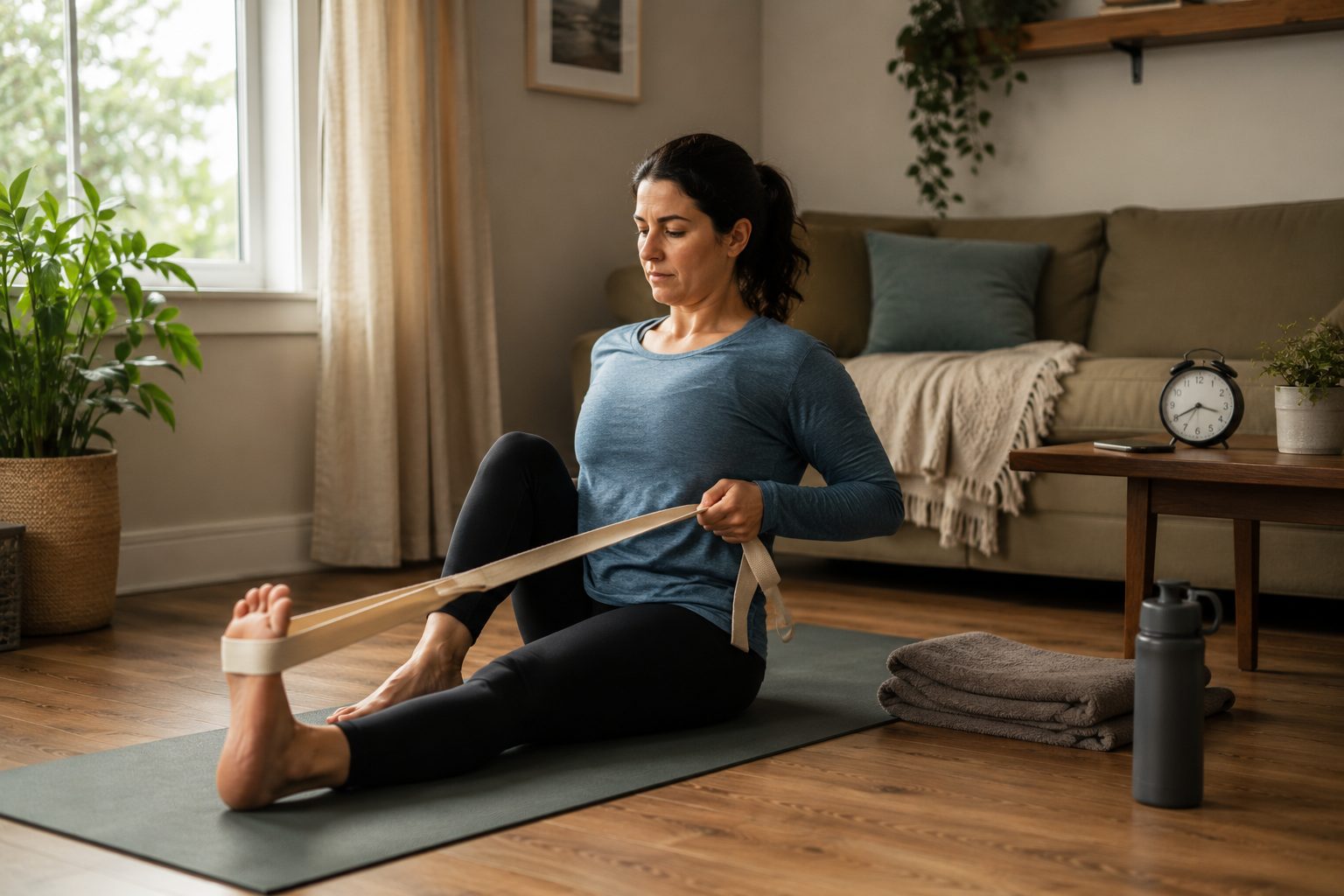
Sit with the leg extended, loop the strap around the ball of the foot, and pull the toes toward the shin until you feel a stretch in the calf. Push the foot away from you into the strap for six seconds, working the calf isometrically, then relax and pull the toes back for a deeper stretch, holding fifteen to twenty seconds. Repeat two to three times per side.
Step 4 — Cool Down
Finish with two or three slow, easy static holds of thirty seconds each on the same muscle groups, without any contraction phase. This settles the nervous system after the active work and is a comfortable way to end the session rather than stopping abruptly after a contraction.
Total time for the full routine, including both sides, typically runs fifteen to twenty minutes. Three sessions a week is a reasonable starting frequency for someone new to PNF; daily sessions are possible once the technique feels familiar, though the neck study cited above is a useful reminder that gains from any stretching protocol tend to recede once the stretching stops, so consistency over months matters more than any single week.
A stretch strap works better than a bath towel for the hamstring and calf stretches because the rigid loop holds its shape under tension, but a towel is a perfectly serviceable substitute if a strap is not on hand, and many people start with one before buying the other. For the hip flexor stretch, a towel or folded blanket under the knee is mainly there for comfort on a hard floor rather than for resistance, since the contraction in that stretch comes from pressing the knee down rather than pulling against fabric. Progression over several weeks usually looks like small increases in the depth of the final held stretch rather than adding more repetitions; once two to three cycles per muscle stop producing a noticeably deeper position, that is a reasonable signal that a session is complete for the day.
Who Tends to Notice the Biggest Difference
Not everyone starting a stretching routine will feel the same size gap between PNF and a plain static hold. People with naturally tight hamstrings or calves, desk workers dealing with shortened hip flexors from long sitting, and athletes returning to training after a period of reduced activity tend to report the most noticeable early improvements, likely because there is simply more available range for the contract-relax cycle to unlock. Someone who already stretches daily and has near-average flexibility for their joint may find the difference between PNF and static holding smaller from one session to the next, even if the underlying mechanism is still active. Adding a strap-based PNF routine two or three times a week alongside regular training, rather than expecting one or two sessions to produce a dramatic shift, is a realistic way to set expectations.
Safety Cautions
PNF asks more of the nervous system and the muscle-tendon unit than a static hold, and a few precautions are worth keeping in mind before adding it to a home routine.
- Warm up first. Contracting a cold muscle against resistance carries more strain risk than contracting one that has already had light activity. A five to ten minute warm-up before a PNF session is a reasonable precaution.
- Keep contraction intensity moderate. The isometric contraction does not need to be maximal effort. A firm, controlled contraction is enough to trigger the inhibitory reflexes; straining as hard as possible adds injury risk without adding benefit.
- Avoid PNF right before maximal-effort lifting or sprinting. Because PNF actively fatigues and inhibits the target muscle, doing it immediately before an activity that depends on that same muscle’s peak force output is not ideal timing. Save PNF for after training, on separate flexibility days, or well before the main activity.
- Recent injury or surgery changes the calculus. Anyone recovering from a strain, tear, joint surgery, or nerve-related condition should get individualized guidance from a physical therapist trained in PNF before applying these techniques at home, since the appropriate contraction intensity and range depend heavily on the specific injury.
- Age and experience matter. PNF is generally not recommended for younger, still-developing individuals, and anyone new to the technique benefits from learning the timing and feel of the contraction phase under the guidance of a trainer or therapist before working entirely alone.
- Sharp or shooting pain is a stop signal. A deep pulling sensation during the stretch phase is expected; sharp, sudden, or radiating pain is not, and is a reason to stop the stretch immediately rather than pushing through it.
Conclusion
PNF stretching earns its reputation because it works with reflexes the body already has, rather than only relying on time under tension. Autogenic inhibition through the Golgi tendon organ and reciprocal inhibition between opposing muscle pairs both reduce a muscle’s resistance to being stretched immediately after it contracts, and that combination tends to produce a larger range-of-motion gain in a single session than static holding alone, particularly for the calf and hamstring muscle groups where the research is most consistent. A stretch strap or ordinary towel is enough to bring the contract-relax structure home without a training partner, and a short routine covering the hamstrings, hip flexors, and calves takes about fifteen to twenty minutes. Go in warm, keep the contraction controlled rather than maximal, and treat sharp pain as a stop signal rather than something to push through. Used consistently and with reasonable caution, PNF is a practical addition to a home flexibility routine, not a replacement for warming up, strength training, or professional guidance when an injury is involved.
Frequently Asked Questions
Is PNF stretching safe to do without a partner?
Yes, for most healthy adults. Substituting a strap, band, or towel for a partner’s manual resistance preserves the contract-relax structure, and self-administered PNF has shown flexibility gains comparable to, and in some studies greater than, static stretching alone. Anyone recovering from an injury should check with a physical therapist first.
How long does it take to see results from PNF stretching?
Single-session range-of-motion improvements are often noticeable immediately after the deeper stretch phase. Studies measuring change over one to six weeks of regular sessions have found meaningful, measurable gains in joint range of motion, though as with any stretching method, gains tend to fade once the routine stops.
What is the difference between contract-relax and hold-relax?
Contract-relax typically allows the joint to move slightly during the isometric contraction phase, while hold-relax keeps the joint still during the contraction. Both are followed by a relaxation phase and a deeper passive stretch, and both rely on the same underlying inhibitory reflexes.
Can PNF stretching replace my warm-up before a workout?
It is better used after activity or as its own dedicated flexibility session rather than immediately before strength or speed work. Because the contraction phase actively fatigues the target muscle, doing PNF right before a max-effort lift or sprint is not ideal timing.
How hard should the contraction be during a PNF stretch?
A firm, controlled contraction, roughly moderate effort rather than an all-out maximal push, is enough to engage autogenic and reciprocal inhibition. Straining at full intensity raises injury risk without adding meaningful extra benefit.
Does PNF stretching hurt?
A deep pulling sensation during the deeper stretch phase is normal and expected. Sharp, sudden, or radiating pain is not part of a correctly performed PNF stretch and is a signal to stop and reassess technique or range.
References and Sources
- Massage & Fitness Magazine, “PNF Stretching: How to Do It and What Research Says” — https://massagefitnessmag.com/fitness/what-is-pnf-stretching/
- The Cooper Institute, “Self-PNF Stretching: Better Than Static Stretching?” — https://www.cooperinstitute.org/blog/self-pnf-stretching-better-than-static-stretching
- Symmetry Physical Therapy Miami, “What is Contract-Relax Stretching?” — https://symmetryptmiami.com/contract-relax-stretching/
- Healthline, “PNF Stretching: Technique and Guidelines” — https://www.healthline.com/health/fitness-exercise/pnf-stretching
- Journal of Sport Rehabilitation, “The Effectiveness of PNF Versus Static Stretching on Increasing Hip-Flexion Range of Motion” — https://pubmed.ncbi.nlm.nih.gov/28182516/
- PMC, “Proprioceptive Neuromuscular Facilitation (PNF): Its Mechanisms and Effects on Range of Motion and Muscular Function” — https://pmc.ncbi.nlm.nih.gov/articles/PMC3588663/
- Semantic Scholar, “Effect of PNF Stretching Versus Static Stretching on Calf Flexibility” (study data on dorsiflexion outcomes) — https://pdfs.semanticscholar.org/4602/7ee75a3d0a072b9552bc2279d032e2b9fe70.pdf