























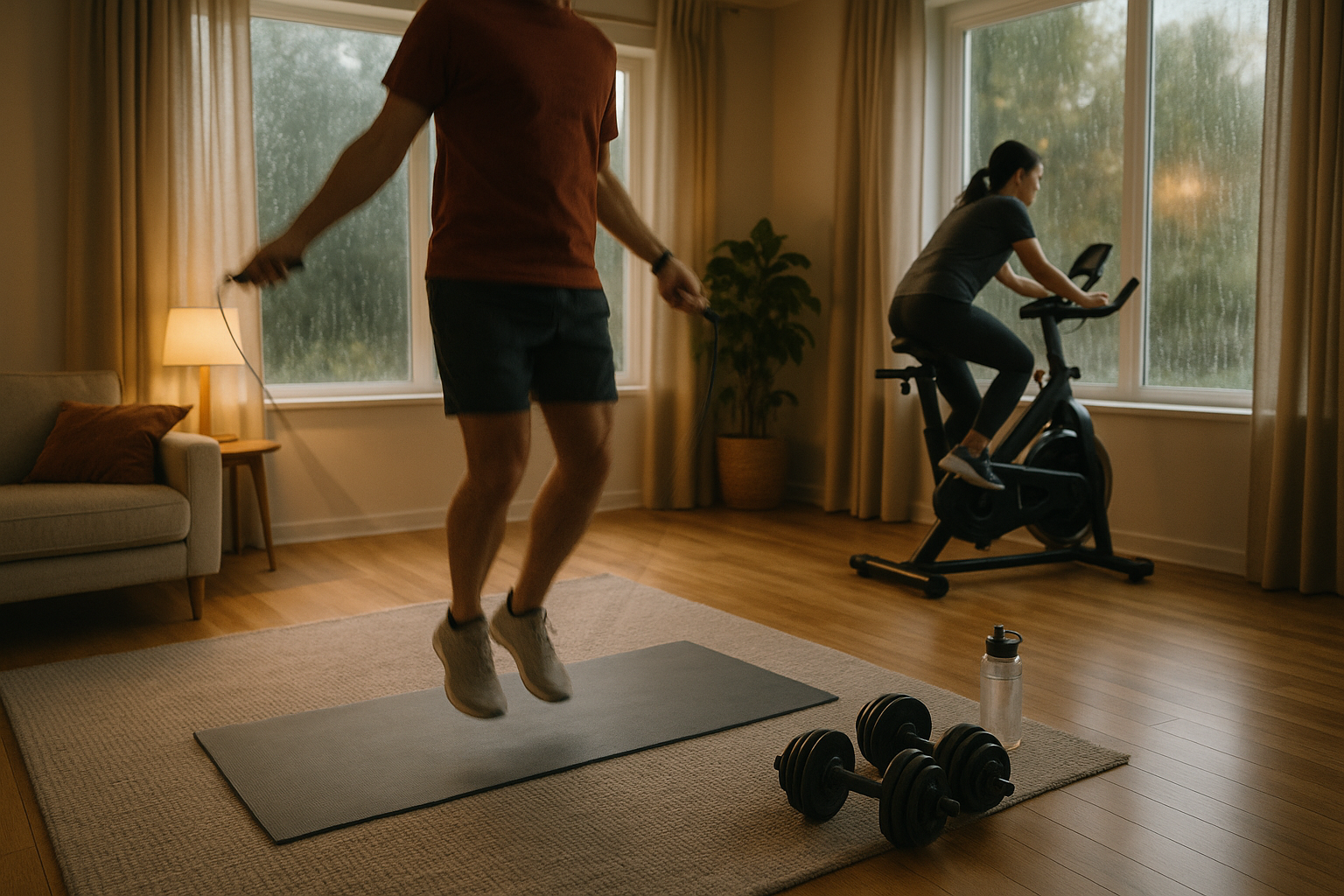
When bad weather shuts down your outdoor plans, you can still get an efficient, mood-lifting cardio session at home or in the gym. The best indoor cardio workouts for rainy days raise your heart rate, challenge large muscle groups, and fit a small space with minimal gear. Below you’ll find nine proven options—with exact steps, time ranges, and beginner-friendly modifications—so you can pick the right session for your goals and your room. Quick answer: choose one of these and work 20–40 minutes total—HIIT circuits, treadmill or bike intervals, jump rope (or rope-less hops), dance cardio, shadow boxing, stair climbs, rowing, and low-impact steady state—to keep fitness progress steady even when it pours.
Fast picks (choose one today): HIIT bodyweight circuit · Treadmill intervals · Stationary bike sprints · Jump rope/rope-less hops · Dance cardio · Shadow boxing/kickboxing · Stair climbing · Rowing machine · Low-impact steady-state circuit.
General note: This guide shares fitness education, not medical advice. If you have a health condition, get personalized clearance first.
1. Bodyweight HIIT Circuit (No Equipment)
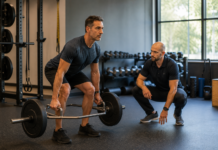
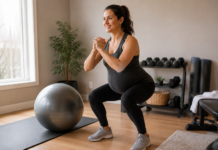
A bodyweight HIIT circuit is the most space-efficient way to get vigorous cardio indoors because it alternates intense efforts with brief rests, keeping your heart rate elevated without any equipment. In practice, you cycle movements like squats, lunges, mountain climbers, and fast step-outs to recruit big muscle groups and spike oxygen demand. Expect a strong afterburn and a quick sense of accomplishment in 20–30 minutes. Beginners can shorten intervals and choose low-impact options; experienced exercisers can add plyometrics or increase work time. Because it’s modular, you can train in a hallway, bedroom, or hotel room and still hit a solid RPE (rate of perceived exertion) 7–8. If joint stress or apartment noise is a concern, swap jumps for power marches and soft-landing patterns.
1.1 How to do it
- Warm up 5–8 minutes (march in place, arm circles, hip hinges).
- Choose 4–6 moves: bodyweight squats, reverse lunges, inchworms, mountain climbers, high-knees, squat-to-calf-raise.
- Work 30–40 seconds, rest 20–30 seconds; complete 3–5 rounds (total 20–28 minutes).
- Keep RPE ~7–8 on work bouts; talkable but breathy.
- Cool down with 3–5 minutes of easy walking and leg stretches.
1.2 Numbers & guardrails
- Total sets: 12–24 work intervals (as of August 2025, common HIIT templates use 1:1 to 2:1 work:rest).
- Heart rate target: vigorous zone ~77–95% of max; or use RPE if you don’t track HR.
- Apartment friendly: replace jumps with fast step-outs; land “quiet feet”.
1.3 Common mistakes
- Going all-out in the first round and fading; leave a rep or two “in the tank”.
- Letting knees cave inward on squats/lunges; track over toes.
- Skipping warm-up and cooldown, which increases stiffness later.
Finish with one sentence: Done well, a 25-minute bodyweight HIIT circuit is the simplest rainy-day plan that still checks the “vigorous cardio” box without any gear.
2. Treadmill Interval Run/Walk
Treadmill intervals are ideal indoors because speed and incline let you dose intensity precisely without worrying about weather, puddles, or visibility. By alternating faster bouts with recovery, you improve aerobic capacity and burn more calories per minute than steady easy walking. If you’re new, run/walk intervals (or brisk walk/incline power walk) deliver big benefits with low joint stress. Intermediates can add 1–3% incline to mimic hills and spare the knees. As you gain fitness, increase either the interval length or the speed—rarely both on the same day—to keep progression safe. For small home treadmills, focus on cadence and posture rather than top speed to avoid overstriding.
2.1 How to do it
- Warm up 6–8 minutes (easy walk building to brisk).
- Main set (beginner): 1 minute fast walk/jog + 1.5 minutes easy walk × 10–12 (25–30 minutes).
- Main set (intermediate): 2 minutes comfortably hard + 1 minute easy × 10 (30 minutes); optional 2% incline.
- Cool down 5 minutes easy, then stretch calves/hip flexors.
2.2 Numbers & guardrails
- RPE targets: hard intervals at 7–8; recoveries at 3–4.
- Cadence: aim ~160–180 steps/min running (short, quick steps reduce impact).
- Safety: clip the safety key; focus forward; never step off a moving belt.
2.3 Common mistakes
- Cranking incline too high too soon; keep ≤3% unless trained.
- Holding the front bar (alters posture, reduces training effect).
- Jumping speed by >0.5–0.8 kph between sessions; progress gradually.
Bottom line: Treadmill intervals give you precise control and reliable results, making them a rainy-day staple for walkers and runners alike.
3. Stationary Bike Power Intervals
A stationary bike (spin bike or upright) delivers joint-friendly cardio with easy power control through resistance and cadence. Intervals on the bike raise the heart rate quickly, train the legs and lungs, and suit apartments because they’re quiet. If you don’t have a bike, many gyms offer spin bikes with quick-adjust seat posts—set the saddle at hip height and a slight knee bend at the bottom of the pedal stroke. Focus on smooth circles instead of mashing, and keep your upper body relaxed. Whether you pick classic 30/30s or longer 3–4 minute efforts, the bike’s flywheel lets you hit repeatable intensities even when tired from the day.
3.1 How to do it
- Warm up 8 minutes: light spinning → 2 × 20-second pickups.
- Main set (beginner): 8 × 30 seconds hard (RPE 8) / 60 seconds easy (RPE 3).
- Main set (intermediate): 6 × 2 minutes hard (RPE 7–8) / 2 minutes easy.
- Keep cadence ~80–100 rpm seated; add resistance until effort feels “grippy”.
3.2 Numbers & guardrails
- Total time: 25–35 minutes including warm/cool.
- Knee comfort: align kneecap over pedal spindle at 3 o’clock; avoid rocking hips.
- Hydration: indoor rides can lose 0.5–1.0 L/hour; sip regularly, especially in humid climates.
3.3 Common mistakes
- Spinning too fast (120+ rpm) with no resistance; poor stimulus.
- Standing climbs with locked arms; keep elbows soft.
- Saddle too low, causing anterior knee discomfort.
In short, bike intervals are a low-impact, high-return choice when rain or humidity keeps you inside.
4. Jump Rope or Rope-Less Hops
Jump rope is a compact calorie burner that trains rhythm, calves, and coordination while driving the heart rate up fast. If ceilings are low or neighbors are below, switch to “air rope” (miming the rope with wrist flicks) or use a cordless handle set to reduce noise. Short sets of basic bounces mixed with occasional high-knees or boxer steps keep it engaging. The key is soft, quick contacts—jump only a couple of centimeters off the floor. On wet days, lay a mat on firm flooring to damp sound and protect your Achilles. New to jumping? Start with micro-sets of 15–30 seconds to condition tissues gradually.
4.1 How to do it
- Warm up: ankle circles, calf raises, 2 minutes light bouncing.
- Main set (beginner): 12–15 rounds of 20 seconds jump / 40 seconds march.
- Main set (intermediate): 10 rounds of 40 seconds jump / 20 seconds rest; sprinkle in high-knees and boxer step.
- Finish with calf/hamstring stretches.
4.2 Numbers & guardrails
- Cadence goal: ~120 turns/minute for basic bounce.
- Surfaces: wood, rubber, or mat over tile; avoid plush carpet (snags) and concrete (impact).
- Shoes: cushioned trainers with secure heel; replace worn laces to prevent trips.
4.3 Common mistakes
- Excessive knee lift; think “springy ankles”.
- Hands too wide; keep wrists near hip creases.
- Jumping for long continuous minutes early; build volume slowly (add ~1–2 minutes per week).
Takeaway: With minimal space and a little rhythm, jump rope (or rope-less hops) offers one of the most time-efficient rainy-day cardio options.
5. Dance Cardio Session
Dance cardio turns a rainy afternoon into a high-energy session that blends aerobic work with coordination and joy. Because you move multidirectionally—side steps, turns, arms high—your heart rate climbs without monotony. You can follow an online routine, attend a studio class, or freestyle to your favorite playlist. Intensity is easy to modulate: choose quicker songs (120–150 bpm) for vigorous work or mid-tempo tracks for moderate steady-state. If impact is an issue, keep moves low, focus on wide steps, and compress the bounce. For small apartments, limit travel steps and pivot in place; if humidity is high, open a window or use a fan for airflow.
5.1 How to do it
- Warm up 5–7 minutes with body rolls, step-touch, shoulder mobility.
- Build a 3-song block (~10 minutes): verse = moderate, chorus = push.
- Repeat 2–3 blocks for 25–35 minutes total; insert a 1–2 minute drink break between blocks.
- Use arm lines to raise intensity without adding impact.
5.2 Numbers & guardrails
- RPE targets: 5–7, with choruses touching 8.
- Floor safety: clear clutter; wear grippy socks/trainers on slick tiles.
- Noise: choose low-impact variations after 9 p.m. for neighbor friendliness.
5.3 Common mistakes
- Over-twisting knees on turns; pivot heels, not knees.
- Skipping arms; upper-body reach increases cardio demand safely.
- Staying on one plane; add diagonals for variety.
Bottom line: Dance cardio delivers serious conditioning disguised as fun, perfect for rainy-day motivation dips.
6. Shadow Boxing or Kickboxing Combos
Shadow boxing is deceptively intense: rapid punches, slips, and footwork spike heart rate while training agility and coordination. Add kickboxing elements—front kicks, knees, low kicks—for even more whole-body engagement. Because there’s no bag, it’s virtually silent and apartment-friendly. The key is crisp technique: wrap the core, keep the chin tucked, and snap punches back to guard. Short 2–3 minute rounds with 30–60 seconds rest mimic combat sports conditioning and feel immersive. If you’re new, start with basic jabs, crosses, and defensive slips; add hooks and kicks as confidence grows.
6.1 How to do it
- Warm up 6 minutes (jumping jacks or marches, shoulder circles, hip openers).
- Build 6–10 rounds of 2 minutes on / 45 seconds off (20–30 minutes).
- Combos to try: jab-cross-jab, slip-cross, hook-cross-hook, front-kick-knee-cross.
- Finish with 2 minutes of slow shadow flow as a cooldown.
6.2 Numbers & guardrails
- RPE: 7–8 during rounds; keep fists relaxed until impact line, then snap.
- Stance: left foot forward (orthodox) or right (southpaw); stay light on balls of feet.
- Range: imagine a target an arm’s length away; don’t overreach and hyper-extend.
6.3 Common mistakes
- Punching with arms only; generate power from hips and core.
- Flared elbows on hooks; keep 90-degree angle and rotate torso.
- Kicking without pointing toes up for front kicks; aim with ball of foot.
Summary: Shadow boxing and kickboxing are dynamic, low-equipment ways to get vigorous indoor cardio while sharpening movement skills.
7. Stair Climbing (Steps at Home or Building)
Stair climbing is a brutally effective indoor workout: it loads the glutes and quads, elevates the heart rate within seconds, and fits tight schedules. Whether you have a staircase at home, access to building stairs, or a gym stepmill, you can structure short intervals or steady climbs. Because each step is a small uphill, it’s naturally low-impact while still powerful. Many apartments and offices in multi-story buildings (common in dense cities and humid climates) offer ample stairs; just choose a clean, well-lit flight and be mindful of other residents. Keep one hand ready for the rail if you’re new, and descend slowly to protect knees.
7.1 How to do it
- Warm up 5 minutes of flat walking and knee lifts.
- Intervals: climb 1–2 flights quickly (RPE 8), walk down slowly (RPE 3) × 12–20.
- Or steady climb 10–20 minutes at RPE 6–7; turn at landings.
- Cool down with calf/hip stretches; sip water—stair work is sweaty indoors.
7.2 Numbers & guardrails
- Step rate: aim 60–100 steps/minute depending on height and fitness.
- Form: lean slightly forward, drive through mid-foot, keep knees tracking over toes.
- Safety: watch corners and wet soles on rainy days; use rail if dizzy.
7.3 Common mistakes
- Taking two steps too soon; earn doubles after 2–3 weeks.
- Bounding downstairs; always descend controlled to spare joints.
- Looking at your phone; eyes ahead, hands free.
Result: Stairs deliver maximum cardio per square meter—perfect when weather traps you indoors but your legs are ready to work.
8. Rowing Machine Intervals (Erg)
Rowing machines combine upper and lower body work in a rhythmic, full-range pull that taxes the heart and lungs efficiently. Because the stroke integrates legs, hips, back, and arms, you can sustain challenging intervals without joint pounding. Technique matters: drive with the legs first, hinge at the hips, then pull; reverse on the way back. Intervals on the erg are time-tested—short “on” bouts build power, longer sets build aerobic capacity. The flywheel’s feedback (pace per 500 m or watts) makes progression easy to track even if you train alone at home or during a quiet gym hour while rain hammers the windows.
8.1 How to do it
- Warm up 8 minutes: easy strokes → 3 × 10 strokes “firm” with full recovery.
- Main set (beginner): 10 × 45 seconds on / 75 seconds easy.
- Main set (intermediate): 6 × 3 minutes at hard but sustainable pace / 2 minutes easy.
- Stroke rate: 22–28 spm; focus on power per stroke, not frantic speed.
8.2 Numbers & guardrails
- Sequence: legs → body swing → arms (drive); arms → body swing → legs (recovery).
- Damper: mid-range (3–5) for efficient aerobic work; avoid max damper early.
- Posture: neutral spine; think “proud chest” and avoid over-leaning back.
8.3 Common mistakes
- Pulling early with arms; 60%+ of power should come from legs.
- Overrating (32+ spm) with shallow strokes; better to row strong at 24–26 spm.
- Slamming the seat forward; control the slide on recovery.
In essence, rowing intervals are a gold-standard rainy-day choice for full-body cardio with measurable progress.
9. Low-Impact Steady-State Circuit (LISS)
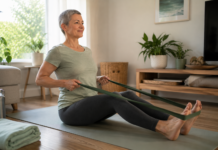
Low-impact steady-state (LISS) is your go-to when joints feel sensitive or you’re returning from illness but still want meaningful cardio. Instead of spikes, you maintain a moderate, continuous effort using gentle moves like marching, step-touch, side lunges, seated knee lifts, or a mini-step platform. The steady rhythm supports recovery, stress relief, and aerobic base building. It’s perfect for apartments or days with power outages because it requires zero equipment and minimal noise. You’ll breathe faster than normal but still hold a short conversation—an easy way to gauge the right effort without tech.
9.1 How to do it
- Warm up 5 minutes: slow march → arm swings → hip circles.
- Build a 25–40 minute circuit: 2–3 minutes each of marching, step-touch, side lunges, backward steps, heel digs, seated knee lifts; loop continuously.
- Every 8–10 minutes, sprinkle a 30–60 second “tempo” burst (faster march) if it feels good.
- Cool down 5 minutes and stretch.
9.2 Numbers & guardrails
- RPE: 4–6 throughout (moderate).
- Heart rate zone: roughly 64–76% of max for many adults.
- Breathing: in through the nose when possible to keep pace sustainable; use a fan in humid rooms.
9.3 Common mistakes
- Moving only in one plane; add lateral steps and gentle rotations.
- Shuffling feet on slick floors; lift and place deliberately.
- Treating LISS as “too easy”; consistency compounds—stack 3–5 LISS days per week during busy seasons.
Wrap-up: LISS keeps you consistent on rainy weeks, building the aerobic engine that powers faster sessions later.
FAQs
1) How long should an indoor cardio workout last on a rainy day?
Most people do well with 20–40 minutes, excluding warm-up and cooldown. Shorter high-intensity intervals (e.g., 15–25 minutes of work segments) can substitute on tight days. If you’re deconditioned, start with 10–15 minutes of LISS and add 5 minutes weekly until you reach your target duration without undue fatigue.
2) What’s the best warm-up before these workouts?
Spend 5–8 minutes raising temperature and rehearsing movements: marching, arm circles, hip hinges, light squats, and a few “pickups” (10–20 seconds slightly faster). A good warm-up should feel easy but purposeful and leave you a bit warm and ready to move—not tired.
3) How many rainy-day cardio sessions per week is ideal?
Aim for 3–5 cardio days weekly, mixing intensities: 1–2 vigorous interval sessions (HIIT, treadmill, bike, rowing) and 2–3 moderate LISS or dance/shadow-boxing days. If you also strength train, place hard cardio on separate days or at least 6–8 hours away from heavy lifts to recover well.
4) Can I do these in a small apartment without annoying neighbors?
Yes—focus on low-impact versions (no-jump HIIT, rope-less hops, LISS). Use a yoga mat or rubber tiles to dampen sound, avoid late-night thumping, and choose exercises with soft landings. Shadow boxing, cycling, and rowing are particularly quiet options when done with control.
5) Which option burns the most calories indoors?
Generally, vigorous intervals (HIIT circuits, jump rope, rowing, hard bike sprints) burn more per minute than steady walking. But total calories depend on body size, effort, and time. A sustainable 30-minute session that you repeat consistently will outpace a single “max burn” day.
6) I have knee discomfort—what should I pick?
Choose low-impact choices like the bike, rowing, shadow boxing, or LISS circuits. Keep knee tracking over toes, avoid deep knee angles early, and increase intensity through cadence or upper-body reach rather than jumps. If pain persists or worsens, pause and seek a personalized assessment.
7) What equipment do I actually need?
None is required. A mat, fan, and water bottle help. Optional gear includes a jump rope (or cordless handles), mini-step, stationary bike, rowing machine, or treadmill if available. Shoes with stable heels and cushioned midsoles make most sessions safer and more comfortable.
8) How do I track intensity without a heart-rate monitor?
Use RPE (rate of perceived exertion) on a 1–10 scale. LISS sits around 4–6; intervals push to 7–9 during work bouts. You should speak in short phrases during hard parts and full sentences during recoveries. Breathing rate and perceived leg fatigue are useful cues.
9) What if the room is hot and humid from the rain?
Ventilate: open a window, run a fan, and hydrate before and after. Reduce interval intensity slightly and extend recoveries by 10–20 seconds if overheating. Choose low-impact options like cycling or shadow boxing instead of repeated jumps to keep your effort productive.
10) How do I progress week to week?
Pick one progression lever at a time: add 1–2 minutes total duration, add one work interval, or increase speed/resistance slightly. Every 3–4 weeks, include a lighter “deload” week where you reduce volume or intensity by ~20–30% to consolidate gains and prevent burnout.
Conclusion
Rain doesn’t have to derail your fitness—indoors you can train smarter, safer, and more consistently than waiting for the clouds to clear. Choose from nine proven formats based on your needs: no-gear HIIT for efficiency, treadmill or bike intervals for precision, jump rope for compact intensity, dance for joy, shadow boxing for agility, stairs for power, rowing for full-body conditioning, and LISS for recovery and base building. Set your session length (20–40 minutes for most), warm up deliberately, target an appropriate RPE, and cool down. Then, progress one variable at a time each week to stay on track. The magic is in consistency, not novelty—pick one, press play, and move.
Ready to sweat? Pick your favorite from the nine and schedule tomorrow’s rainy-day session now.
References
- Physical Activity Guidelines for Americans, 2nd Edition, U.S. Department of Health & Human Services, 2018 (current guidance page updated periodically). https://health.gov/our-work/nutrition-physical-activity/physical-activity-guidelines/second-edition
- ACSM’s Guidelines for Exercise Testing and Prescription (10th ed.), American College of Sports Medicine, 2017; ACSM Position Stands and Updates (accessed 2025). https://www.acsm.org/education-resources/books/guidelines
- WHO Guidelines on Physical Activity and Sedentary Behaviour, World Health Organization, 2020. https://www.who.int/publications/i/item/9789240015128
- “Target Heart Rates Chart,” American Heart Association, updated 2024. https://www.heart.org/en/healthy-living/fitness/fitness-basics/target-heart-rates
- “Calories burned in 30 minutes for people of three different weights,” Harvard Health Publishing, updated 2021. https://www.health.harvard.edu/diet-and-weight-loss/calories-burned-in-30-minutes-of-leisure-and-routine-activities
- “High-Intensity Interval Training,” ACE (American Council on Exercise) Exercise Library and Research Roundup, 2018–2024. https://www.acefitness.org/education-and-resources/lifestyle/exercise-library/
- “RPE Scale (Borg CR10 and 6–20),” National Strength & Conditioning Association, accessed 2025. https://www.nsca.com/education/articles/kinetic-select/the-borg-scale-of-perceived-exertion/
- “How to Warm Up Before Exercise,” NHS (UK), reviewed 2023. https://www.nhs.uk/live-well/exercise/how-to-warm-up-before-exercising/
- “Rowing Technique,” Concept2 Technique Guides, updated 2024. https://www.concept2.com/indoor-rowers/training/technique-videos
- “Exercise and Hydration,” CDC Healthy Hydration, reviewed 2024. https://www.cdc.gov/healthyweight/healthy_eating/water-and-healthier-drinks.html