



























If you want your workouts to stick, you need more than motivation—you need a system. This guide breaks habit formation into nine practical stages so you can set reliable cues, keep routines friction-free, and reward consistency in a way that lasts. It’s written for beginners and “restart after a break” folks alike, but experienced athletes will also find structure they can use when rebuilding momentum. Quick disclaimer: this is educational, not medical advice; if you have health concerns or conditions, talk with a licensed professional before starting or changing your exercise plan.
What is habit formation in workouts? Habit formation is the process of making exercise automatic through context-dependent repetition—linking a clear cue (time, place, feeling) to a simple routine (your workout) followed by a satisfying reward (tracking, relief, social praise). In practice, you’ll engineer the environment so the cue fires, the routine is easy to start, and the reward reinforces the loop.
Fast-start steps: Pick a daily cue, define a 2–10 minute “minimum viable workout,” prep gear the night before, track completion on a visible calendar, and escalate effort gradually after 2–3 consistent weeks.
1. Name Your Why and Minimum Viable Routine
Clarity about why you’re training and what’s the smallest version you’ll always do is the foundation of a sticky habit. Start by articulating a motivating, specific reason (e.g., “Play 30 minutes of cricket with my kids without knee pain by December”) and pairing it with a “minimum viable workout” (MVW): the shortest, simplest version you can complete even on your worst day. This dual commitment reduces choice overload, lowers the start barrier, and keeps streaks alive when life gets busy. It also reframes success: you’re not trying to crush a perfect program—you’re trying to win the start. Over time, MVW creates a reliable track record that supports heavier sessions when energy is high. Aim for an MVW of 2–10 minutes: one set of squats and a 10-minute walk counts.
1.1 Why it matters
- A specific “why” fuels perseverance when motivation dips.
- MVW protects the routine from all-or-nothing thinking.
- Frequent “easy wins” cultivate identity (“I’m someone who trains.”).
1.2 How to do it
- Write one Outcome Goal (e.g., jog 5 km by November).
- Define one Process Goal: MVW you’ll do daily (e.g., 10 minutes mobility + 10 pushups).
- Pair them in a sentence: “Because I want [Outcome], I will never skip [MVW].”
Mini-checklist
- Outcome stated with a date
- MVW ≤10 minutes
- Visible note where you dress or leave home
Synthesis: Defining a personal “why” and a tiny, non-negotiable routine makes beginning your workout the default, not a debate.
2. Design a Concrete Cue (Time, Place, and Trigger)
A habit starts when a cue fires, so make your trigger explicit: same time, same place, same prompt. Vague plans like “exercise more” compete with dozens of daily tasks; specific implementation intentions—“If it’s 7:00 a.m. and I’ve brushed my teeth, then I put on my shoes and start my 10-minute routine”—dramatically increase follow-through. Choose a cue that already happens reliably (toothbrushing, after school drop-off, arriving home). Place gear in the line of sight where the cue occurs. If mornings are chaotic, anchor after an afternoon ritual (e.g., post-lunch walk). Use only one cue at first; more cues can dilute clarity.
2.1 Numbers & guardrails
- Keep the cue window tight (±15 minutes).
- Match workout length to the time you always control (commute? lunch?).
- If your schedule varies (e.g., shifts), pre-pick two acceptable cue windows (AM/PM) and decide the day before.
2.2 Tools/Examples
- If-Then Card: “If 6:45 a.m. tea is finished, then 10-minute kettlebell circuit.”
- Phone automation: Alarm named “Shoes On = Habit On.”
- Environment: Shoes + mat placed by the bathroom door.
Bulleted tips
- Avoid cues tied to rare events (e.g., “when it rains”).
- Avoid competing cues (phone notifications that derail focus).
- Use smell/sound cues (playlist, essential oil) to deepen context.
Synthesis: A dependable, context-rich cue removes negotiation and turns exercise initiation into muscle memory.
3. Shrink the First Step (Make Starting Frictionless)
The first 30 seconds decide the day. If your “start line” feels heavy—complex warm-up, long drive to the gym—motivation will lose to friction. Redesign the opening move so beginning is almost automatic. Strip your MVW to a two-minute entrance ramp that requires zero thinking: fill a water bottle, hit play on a saved timer, perform one easy set. When you design for “minimum effort to start,” you’ll start more often—and once you start, you usually continue beyond the minimum. Consider at-home variants for bad weather or late nights.
3.1 Common mistakes
- Overengineering day one (new shoes, five apps, perfect plan).
- Relying on future motivation rather than lowering today’s friction.
- Treating warm-up as optional; a short default warm-up is part of the start.
3.2 How to do it
- Pre-pack gym bag; place by the door.
- Preload a Timer (e.g., 10:00 EMOM).
- Create a 2-Minute Entry: 20 bodyweight squats + 20 brisk steps in place.
Mini example
- Day 1 at 7:00 p.m.: Put on shoes → start 2-minute entry → momentum carries into 10 minutes cycling. After 14 days, you’ve logged 140+ minutes even if “only the minimum.”
Synthesis: By engineering a tiny, frictionless start, you transform “should” into “already doing.”
4. Pair the Routine with Immediate Rewards (and Track It)
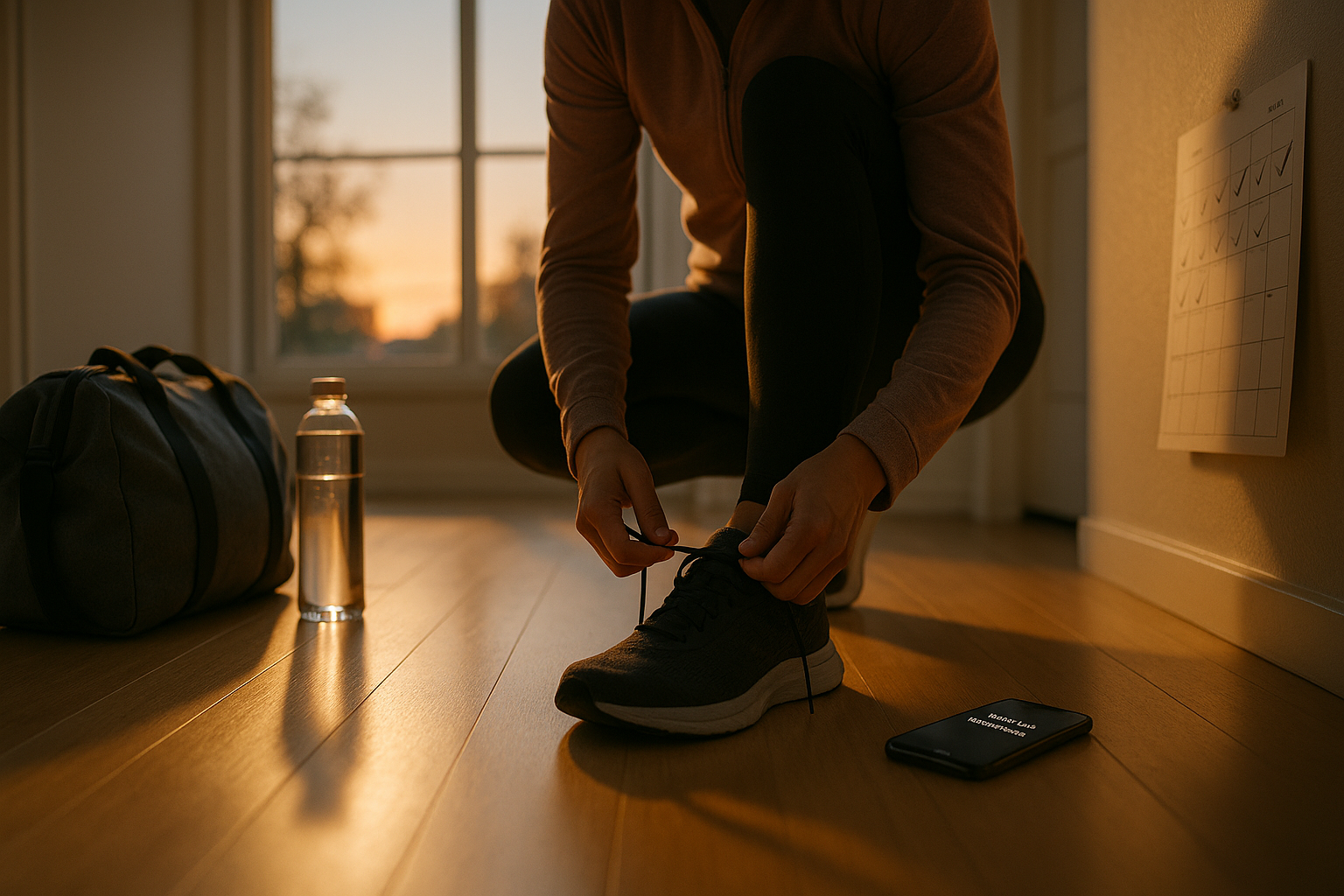
Your brain repeats what feels rewarding now, not later. Because fitness benefits accrue in weeks and months, you’ll bridge the delay with immediate, reliable rewards and simple tracking. Rewards can be intrinsic (post-workout relief), social (high-five in a group chat), or tangible (sticker on a wall calendar). Tracking reinforces identity—each mark is proof. Use low-effort tools: a visible paper calendar, a habit app with one-tap logging, or a smartwatch ring close. The key is immediacy and consistency: reward within 60 seconds of finishing.
4.1 Tools/Examples
- Wall tracker: Paper calendar + bold marker; aim for unbroken chains.
- App options: Any one-tap habit app or watch widget you already use.
- Social loop: Post a completion emoji in a private group after each session.
4.2 Numbers & guardrails
- Keep rewards small and predictable.
- Tie occasional “celebration rewards” to streak milestones (e.g., 14, 30, 60 days).
- Avoid food/alcohol rewards that conflict with your goals.
Bulleted tips
- Say out loud: “Nice—habit done.” Micro-celebration boosts salience.
- Use a brief post-workout ritual (shower playlist, stretching track).
- Track completion, not performance, for the first 4–6 weeks.
Synthesis: Immediate, lightweight rewards plus visible tracking turn abstract future benefits into a present-tense reason to show up.
5. Remove Friction and Add Enablers in Your Environment
Behavior follows the path of least resistance, so shape your surroundings to make exercise the easy choice. Reduce obstacles (commute time, equipment clutter, decision fatigue) and add enablers (pre-set space, ready gear, scripted workouts). For many beginners, proximity beats perfection: a 10-minute at-home plan done 5 times a week outruns a “perfect” 60-minute gym plan you make once a week. Use checklists for packing, lay out clothes, and store equipment in the room where the cue fires. If your apartment is small, a foldable mat and resistance bands cover most basics without setup hassle.
5.1 How to do it
- Proximity: Choose the closest feasible place to train.
- Defaults: Preload three “A/B/C” workouts on your phone (no scrolling).
- Preparation: Sunday 10 minutes for bag packing + laundry.
5.2 Common mistakes
- Relying on willpower to fight daily obstacles.
- Overbuying gadgets before the habit is stable.
- Hiding gear in a closet—the cue should see it.
Mini-checklist
- Gear visible at cue location
- Workout plans pre-saved
- Weather/backup option defined
Synthesis: By clearing friction and priming enablers, you create a glide path—exercise becomes the most convenient option in your environment.
6. Stack the Habit onto an Existing Routine
“Habit stacking” attaches new behavior to an established pattern so the old action becomes your cue. Because existing routines are stable (tea, commute, school run), they provide a dependable anchor that reduces forgetting. Choose a reliable anchor and append a specific workout action: “After I brew morning tea, I unroll the mat and start my 10-minute core circuit.” Keep the stack tight—no unrelated tasks in between. As the stack holds, you can lengthen the workout after the first minute or two.
6.1 Tools/Examples
- Morning stack: “After brushing teeth → put on shoes → 2-minute entry.”
- Workday stack: “After last email → 10-minute walk outside.”
- Evening stack: “After dinner → 8-minute mobility while TV loads.”
6.2 Numbers & guardrails
- Limit to one stack at first; add a second only after 2–3 consistent weeks.
- Keep the “gap” between anchor and action ≤10 seconds.
- If a stack breaks twice, simplify the action or pick a more stable anchor.
Bulleted tips
- Use the same words each time to rehearse the stack.
- Pair a consistent soundtrack with the stack for a multi-sensory cue.
- If the anchor moves (travel), pre-select a substitute anchor (hotel coffee).
Synthesis: Stacking harnesses the reliability of what you already do, turning your daily routine into a launchpad for exercise.
7. Pre-Plan Obstacles with If-Then “Coping Plans”
Life happens: travel, illness, overtime, heat waves, school events. Habits survive when you plan for disruptions in advance using if-then coping plans: “If I miss my morning session, then I’ll do a 10-minute walk after lunch.” This prevents missed days from becoming missed weeks. Create a short Plan B library for common obstacles—no equipment, no time, low energy, bad weather—and decide the default alternative before you need it. Also use “re-entry scripts” after breaks: the first day back is just the MVW; intensity resumes after two completions.
7.1 How to do it
- Identify top 3 obstacles you’ve faced before.
- Write one if-then line for each and post it near your tracker.
- Preload a Travel Workout (bands + bodyweight + stairs).
7.2 Common mistakes
- Trying to “make up” missed sessions with punishing catch-ups.
- Waiting for perfect conditions to resume.
- Redesigning the whole program after a minor slip.
Mini example
- If sick for 3 days: resume with 5-minute walk + breathing on day 1 back; evaluate intensity on day 3 if fully recovered and cleared by your clinician.
Synthesis: Coping plans turn predictable disruptions into routine variations rather than derailments.
8. Progress Slowly and Make Wins Visible
Once the habit of showing up is stable, then nudge difficulty with small, sustainable progressions. In practice, that means increasing volume or intensity gradually—often by 5–10%—and making those wins visible (updated personal bests, new weight plates, longer walk loop). Early on, prioritize consistency over capacity: it’s better to complete 5×10-minute sessions than one heroic 50-minute blowout. Use a simple progression rule per modality (e.g., add 1–2 reps to pushups weekly, extend walk by 3–5 minutes after two easy weeks). Celebrate milestones at 14, 30, and ~60 days—these reinforce identity.
8.1 Numbers & guardrails
- Maintain at least 1–2 rest days weekly for recovery.
- Increase total weekly load modestly if sessions feel “easy” for two consecutive weeks.
- If soreness >48 hours or sleep plummets, hold or deload for 1 week.
8.2 Tools/Examples
- Progress board: Whiteboard with “Last best / Today.”
- Simple metrics: Total minutes, sessions/week, steps, RPE (1–10).
- Milestone ritual: New playlist or walk route on day 30.
Bulleted tips
- Avoid changing everything at once (reps, sets, and exercises).
- Use perceived exertion to pace: aim for “moderate” most days early on.
- Keep at least one session per week at MVW to protect the streak.
Synthesis: Slow, visible progress preserves your streak and keeps motivation rising without spiking injury risk.
9. Review Weekly and Recommit with Data
Habits harden when you periodically review what’s working, adjust friction points, and recommit for the next week. A 10-minute Sunday check-in is enough: glance at your tracker, note the cue that worked best, and choose next week’s A/B/C sessions. If you like numbers, track a tiny set of metrics—sessions completed, total minutes, and one wellbeing marker (sleep quality, mood). The purpose isn’t perfection; it’s awareness. Expect the curve of automaticity to build over weeks; early variability is normal. Use the review to protect what works and fix one small friction point at a time.
9.1 How to do it
- Three questions: What helped me start? What got in the way? What’s one tweak?
- Recommit script: “Because [why], this week I’ll [MVW] after [cue].”
- Calendar lock: Put sessions on your calendar as meetings with yourself.
9.2 Common mistakes
- Switching programs weekly (never giving a routine time to stick).
- Tracking too many metrics (data fog).
- Letting one missed day erase the whole week.
Mini-checklist
- 10-minute review scheduled
- One friction point chosen to fix
- Next week’s alarms/cues set
Synthesis: A short weekly review converts experience into insight and resets your system so momentum compounds.
FAQs
1) How long does it take to make a workout habit feel automatic?
It varies widely based on behavior difficulty, context stability, and individual differences. In studies of everyday habits, the median time to reach a plateau of “automaticity” is around two months, but ranges from a few weeks to several months. For workouts, expect 6–12 weeks of consistent practice before it feels “strange to skip.” Focus on showing up daily (or most days) with a tiny minimum to keep the loop alive.
2) Is it better to work out daily or a few times per week when starting?
Consistency matters more than frequency early on. Many people succeed with short daily repetitions (e.g., 10 minutes) to build the habit loop, then settle into 3–5 longer sessions per week for training effect. If you prefer non-daily schedules, keep at least one “touch point” micro-session on off days to protect the cue and routine.
3) I always skip after work—what should I change?
Move the cue to a more controllable window. If evenings are unpredictable, try a morning or lunch anchor. Reduce friction by prepping gear the night before and scripting a two-minute start. If evenings are your only option, stack the habit on a fixed anchor (e.g., right after you park the car) and shorten the MVW to fit low-energy days.
4) What counts as a “reward” that isn’t food or shopping?
Use immediate, lightweight reinforcers: a bold mark on a wall calendar, a short celebration ritual (favorite song during cool-down), a message to an accountability buddy, or opening a special “after workout” photo album on your phone. The key is that it happens right away and feels genuinely pleasant.
5) How do I stay on track during travel?
Create a travel kit (bands, mini-loop, skipping rope) and a default 10-minute hotel workout, then write if-then plans before the trip. Use a portable anchor (morning coffee) and keep the MVW tiny. Treat travel as “maintenance weeks”: protect the start, not performance PRs.
6) What if pain shows up?
Stop the painful movement and substitute a non-painful variant. Avoid pushing through sharp pain. Use the MVW (e.g., easy walking, mobility) to keep the cue and routine alive while you seek professional advice if symptoms persist. Always prioritize safety and clearance from a clinician when needed.
7) Do apps and wearables actually help?
They can, if they reduce friction and make wins visible. Choose tools that take one tap to log a session, show streaks, and remind you at your chosen cue time. If an app feels noisy or complex, switch to a paper calendar or a simpler tracker. The best tool is the one you’ll use consistently.
8) How do I prevent boredom?
Build variety into a stable shell. Keep the cue, start ritual, and session length consistent, but rotate exercises weekly (e.g., different bodyweight circuits) or change locations (park vs. living room). Occasionally introduce a “novelty day” that still meets your MVW to keep interest high without disrupting the habit.
9) Is it okay to split workouts into micro-sessions?
Absolutely. Splitting into 2–3 short bouts (e.g., 3×10 minutes) can fit busy days and still contribute meaningful volume. Micro-sessions are particularly effective for beginners focused on building the habit loop rather than maximizing single-session performance.
10) When should I increase intensity?
After 2–3 weeks of steady completion with low soreness and good sleep, gradually nudge difficulty. Use small increments (often 5–10% in volume or load), add one set, or extend a walk by a few minutes. If recovery lags, hold or deload for a week and maintain the MVW.
11) What if I miss several days in a row?
Use a re-entry script: “Today I only do MVW.” Resume the cue, complete the tiny session, and mark the tracker. The next day, repeat or add one small layer. Avoid “make-up” marathons; your goal is to restore the loop, not punish yourself.
12) Can I build multiple fitness habits at once?
Start with one. When it’s stable (you’ve completed it on 80% of days for 3+ weeks and it feels easy to start), you can layer a second habit—for example, adding a short mobility session in the evening while keeping the original morning walk.
Conclusion
Building a lasting workout routine isn’t a mystery—it’s a series of small, designed decisions that make starting easy and repeating rewarding. You begin by clarifying a compelling why and defining a minimum viable routine. Then you select a reliable cue, lower friction to a two-minute entry, and pair the routine with immediate rewards and visible tracking. Stacking onto an existing anchor and pre-planning obstacles protect the habit from the chaos of real life. When the loop feels steady, you progress slowly, keep wins visible, and use a brief weekly review to learn and recommit. Across weeks, these elements fuse into a behavior that feels natural—something you do because it’s part of who you are. The path is straightforward, and you can start today with the smallest possible step.
Copy-ready CTA: Choose your cue, set a two-minute entry, and put your shoes where you’ll see them—then mark your first win tonight.
References
- Lally, P., van Jaarsveld, C. H. M., Potts, H. W. W., & Wardle, J. — How are habits formed: Modelling habit formation in the real world, European Journal of Social Psychology, 2010. https://onlinelibrary.wiley.com/doi/abs/10.1002/ejsp.674
- Wood, W., & Rünger, D. — Psychology of Habit, Annual Review of Psychology, 2016. https://www.annualreviews.org/doi/10.1146/annurev-psych-122414-033417
- Gollwitzer, P. M., & Sheeran, P. — Implementation Intentions and Goal Achievement: A Meta‐analysis of Effects and Processes, Advances in Experimental Social Psychology, 2006. https://www.sciencedirect.com/science/article/pii/S0065260106380050
- Fogg, B. J. — Tiny Habits: The Small Changes That Change Everything, Houghton Mifflin Harcourt, 2020. https://tinyhabits.com/book/
- Duhigg, C. — The Power of Habit: Why We Do What We Do in Life and Business, Random House, 2012. https://charlesduhigg.com/the-power-of-habit/
- Michie, S., Richardson, M., Johnston, M., et al. — The Behavior Change Technique Taxonomy (v1) of 93 Hierarchically Clustered Techniques, Annals of Behavioral Medicine, 2013. https://link.springer.com/article/10.1007/s12160-013-9486-6
- Centers for Disease Control and Prevention — How Much Physical Activity Do Adults Need?, last reviewed 2024. https://www.cdc.gov/physicalactivity/basics/adults/index.htm
- World Health Organization — WHO Guidelines on Physical Activity and Sedentary Behaviour, 2020. https://www.who.int/publications/i/item/9789240015128
- Ryan, R. M., & Deci, E. L. — Self-Determination Theory and the Facilitation of Intrinsic Motivation, Social Development, and Well-Being, American Psychologist, 2000. https://selfdeterminationtheory.org/SDT/documents/2000_RyanDeci_SDT.pdf
- Gardner, B., Lally, P., & Wardle, J. — Making Health Habitual: The psychology of ‘habit-formation’ and general practice, British Journal of General Practice, 2012. https://bjgp.org/content/62/605/664