




























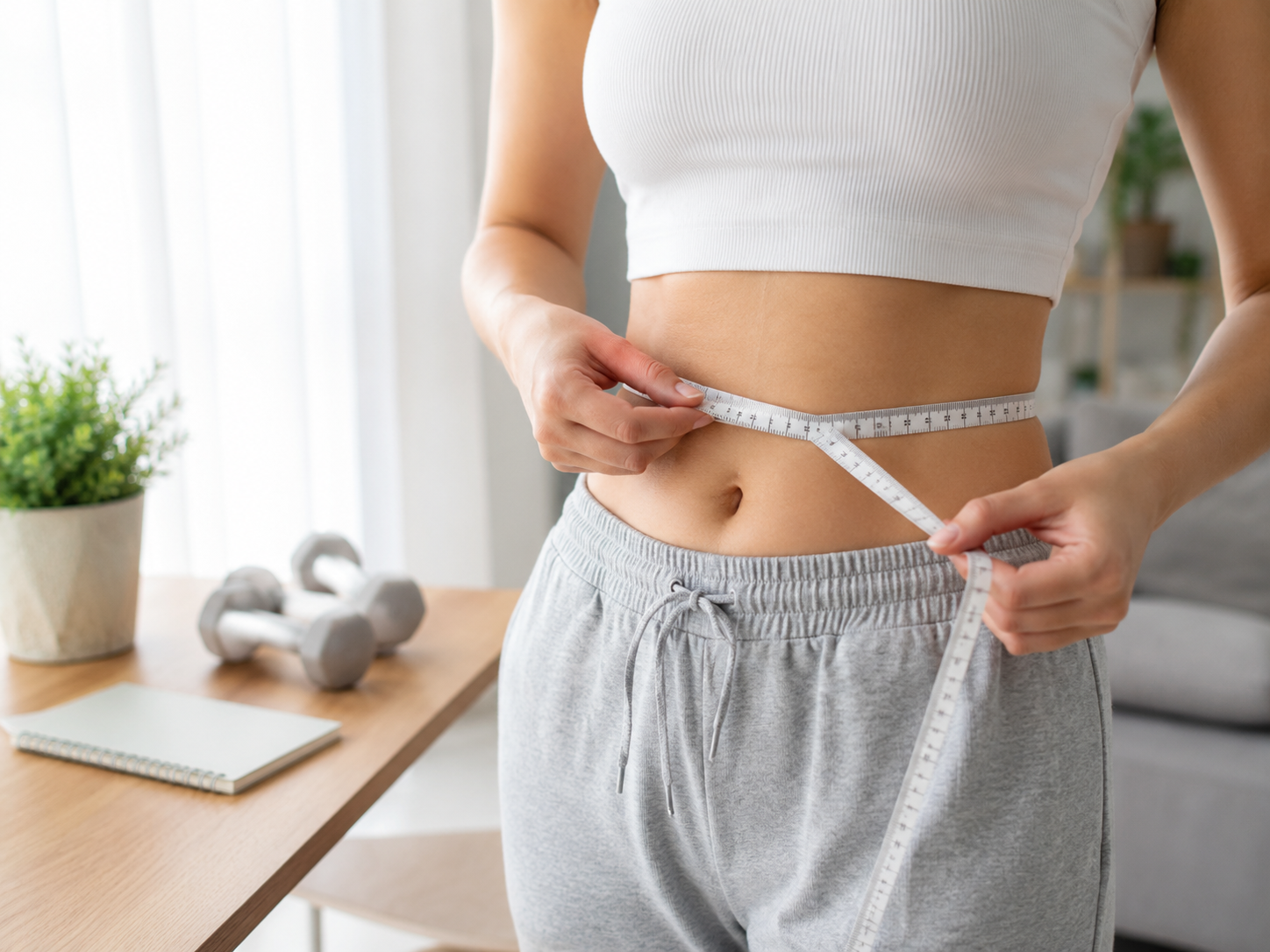
Quick answer: No single home method can tell you with certainty whether a change on the scale is fat or muscle. The most reliable approach is to combine several signals over time: strength trends in the gym, circumference measurements at consistent landmarks, progress photos taken under the same conditions, and (with caution) a consumer bioelectrical impedance scale. Together these paint a usable picture; alone, each one can mislead you. For precise numbers, ask a physician about clinical-grade options such as a DEXA scan.
By Charlotte Evans
Who This Matters Most For
This guide is written for people who are actively losing weight through diet changes, exercise, or medical treatment (including GLP-1 medications) and want a practical way to check whether the weight coming off is mostly fat, or whether they are also losing meaningful muscle. It is aimed at general consumers using tools available at home or at a typical gym, not at athletes preparing for physique competition or people managing diagnosed medical conditions that affect muscle mass.
This article is educational information only. It is not medical advice, and it is not a substitute for a conversation with your physician, a registered dietitian, or another qualified clinician. If you notice unexplained, rapid, or significant unintentional muscle loss, especially alongside weakness or new difficulty with everyday tasks, see the safety section near the end and talk with a doctor.
Why This Question Matters More Than Ever
The number on a bathroom scale cannot tell you what kind of tissue you lost. A five-pound drop could be almost entirely fat, almost entirely water and muscle, or some mix of everything in between. That distinction matters because muscle plays an outsized role in metabolic health, strength, balance, and the ability to keep weight off long term. Losing fat while preserving muscle is generally considered a favorable outcome. Losing a large share of muscle along with fat is a less favorable one, even if the scale trend looks the same.
This question has become especially relevant as more people pursue faster, larger amounts of weight loss, whether through aggressive calorie deficits, high training volumes, or newer medical treatments. Rapid weight loss of any kind tends to include a larger share of lean tissue than slower, more gradual loss. That is one reason researchers and clinicians increasingly emphasize pairing any weight-loss approach with resistance training and adequate protein intake, and why tracking body composition, not just body weight, has become a more common conversation in general fitness and primary care settings alike.
The good news is that you do not need a research lab to get a reasonable read on your own progress. You need a small set of consistent habits, realistic expectations about what each method can and cannot tell you, and a willingness to look at the whole picture rather than any single number.
Signals That Tend to Suggest Fat Loss vs. Muscle Loss
Before the step-by-step protocol, it helps to know what you are actually looking for. No single item below is proof on its own, but a pattern across several of them is informative.
Patterns That Lean Toward Fat Loss
- Waist and hip circumference trending down over several weeks
- Strength in main lifts holding steady or slowly increasing
- Clothes fitting looser around the midsection specifically
- Progress photos showing a leaner waistline with similar arm and leg shape
- Energy and workout performance holding up week to week
Patterns That Lean Toward Muscle Loss
- Strength dropping noticeably across several consecutive sessions
- Limbs looking visibly smaller or less full in photos, not just leaner
- Rapid weight loss (well above typical recommended rates) with little resistance training
- Very low protein intake alongside a large calorie deficit
- New fatigue, weakness, or trouble with everyday tasks like stairs or carrying groceries
The Step-by-Step Protocol
Use this sequence over a period of at least four to six weeks. Body composition does not change meaningfully in a few days, so the goal is to build a habit you can sustain, not to chase daily fluctuations.
Step 1: Establish a Strength Baseline
Pick three to five exercises you can perform consistently, such as a squat pattern, a hinge or row pattern, and a push pattern. Record the weight, reps, and how the effort felt (using a simple 1-to-10 perceived-effort scale) for two to three sessions before you draw any conclusions. This baseline becomes your reference point going forward. Strength is one of the more accessible windows into muscle status, because muscle tissue is what produces force, and a body genuinely losing significant muscle will generally struggle to maintain the same output over time, all else being equal.
Step 2: Take Circumference Measurements at Fixed Landmarks
Using a flexible tape measure, record your waist at the narrowest point (or at the navel, if you prefer a fixed landmark), hips at the widest point, and optionally thighs and upper arms. Measure at the same time of day, ideally first thing in the morning before eating or drinking, and use the same landmarks every time. Waist circumference specifically is a metric that public health resources point to as a useful, low-cost indicator connected to health risk, separate from body weight alone. Take these measurements every one to two weeks rather than daily, since normal fluid shifts can move numbers by half an inch or more day to day.
Step 3: Take Progress Photos Under Consistent Conditions
Photograph yourself from the front, side, and back in the same lighting, same time of day, similar clothing, and a similar level of muscle tension (relaxed, not flexed) every two to four weeks. Photos are useful because they capture shape changes that a scale or even a tape measure can miss, such as a waist getting leaner while shoulders and legs keep their fullness, versus a body that is simply shrinking all over, including areas where you would prefer to keep size. Compare photos side by side rather than relying on memory, since gradual change is hard to notice day to day.
Step 4: Use a Consumer BIA Scale Only as a Trend Tool
Bioelectrical impedance analysis (BIA) scales estimate body fat by sending a small electrical current through the body and measuring resistance, which is influenced heavily by water content. Hydration status, recent food or drink, exercise timing, skin temperature, and even time of day can shift a reading, sometimes by several percentage points, without any real change in tissue. Clinical and research reviews describe field methods like BIA as useful for tracking a rough trend when conditions are kept consistent, but caution that no single field method is universally superior or reliably precise for individual body fat percentage. Weigh in under the same conditions each time (morning, after using the bathroom, before eating), track the rolling trend over several weeks rather than any single reading, and treat the exact percentage shown with real skepticism.
Step 5: Combine the Signals Before Drawing Conclusions
Look at strength, circumference, photos, and BIA trend together, roughly every two to four weeks. If strength is holding steady, circumference is trending down, photos show a leaner waist with retained shape elsewhere, and the BIA trend (not a single reading) is drifting toward a lower fat estimate, that combination reasonably suggests you are losing more fat than muscle. If strength is dropping while circumference and body weight are both falling quickly, that combination is a reasonable signal that muscle loss may be a larger share of the total than you would like.
Step 6: Adjust and Recheck
If signals point toward excess muscle loss, consider slowing the rate of weight loss, increasing protein intake, or adding or adjusting resistance training, ideally with guidance from a coach, dietitian, or physician. Then repeat the same four measurements over the following month to see whether the pattern shifts in a more favorable direction.
Combining Signals: A Simple Decision Flow
The diagram below shows how the four signals feed into a single, more reliable read on your progress.
Comparing Tracking Methods
Each method below trades off accuracy against accessibility. Consumer-friendly options are useful for trends; clinical options are better suited to a precise, one-time or occasional snapshot.
| Tracking Method | Accuracy | Accessibility | Best Use |
|---|---|---|---|
| Strength trends | Indirect, but informative over weeks | Free with any gym access or bodyweight routine | Ongoing signal of whether muscle-supporting capacity is holding up |
| Circumference measurements | Moderate; sensitive to technique and timing | Very high; needs only a tape measure | Tracking regional shape change, especially waist |
| Progress photos | Qualitative, not numeric | Very high; needs only a phone camera | Spotting shape and proportion changes over months |
| Consumer BIA scale | Low precision for a single reading; usable for rolling trend | High; sold widely at moderate cost | Watching a multi-week direction, not an exact percentage |
| Clinical DEXA scan | High; considered a reference-level method | Low; requires a clinic or specialty facility, at a cost, with radiation exposure | Occasional precise snapshot, ordered through or discussed with a physician |
Monthly Body-Composition Check-In Checklist
- Log your top 3-5 lift numbers (weight x reps) for the month and compare to last month
- Measure waist, hips, and one limb at the same landmarks, same time of day
- Take front, side, and back photos in the same lighting and clothing
- Check your BIA scale’s rolling average (not a single day), if you use one
- Note your average protein intake for the past two weeks
- Note your average rate of weight change per week
- Note energy levels, sleep quality, and any new aches, weakness, or fatigue
- Write one sentence on what the combined signals suggest, and one adjustment (if any) to make
A Worked Example
Consider a hypothetical case that illustrates how this comes together in practice. A 42-year-old who has been in a moderate calorie deficit for six weeks, training with weights three times a week, notices the scale has dropped seven pounds. Taken alone, that number says nothing about what was lost. Looking at the other signals: their squat and row numbers from week one are within about 5 percent of where they started, sometimes slightly higher. Waist circumference is down just over an inch, while thigh and arm measurements are essentially unchanged. Side-by-side photos show a visibly leaner midsection with shoulders and arms looking similar in size and fullness. Their BIA scale’s rolling four-week average has drifted down about 1.5 percentage points in estimated body fat, though individual daily readings bounce around by two or three points depending on hydration and time of day.
Put together, these signals point in a consistent direction: strength maintained, waist down, limb size preserved, photos showing a leaner but proportionally similar shape, and a BIA trend (not a single reading) moving the same way. That combination is a reasonable, though not certain, indication that most of the seven pounds lost was fat rather than muscle. If instead their strength numbers had dropped 15 to 20 percent and their photos showed noticeably smaller arms and legs alongside the leaner waist, that pattern would suggest a meaningful share of muscle loss, and would be a reasonable prompt to slow the rate of loss, add protein, or check in with a coach or physician.
Common Mistakes to Avoid
| Mistake | Why It Misleads | Better Approach |
|---|---|---|
| Trusting a single BIA scale reading | Hydration, food, and timing can swing readings several points in a day | Track a multi-week rolling average under consistent conditions |
| Reacting to daily weight fluctuation | Water, sodium, and digestion can move body weight far more than actual tissue change | Use a weekly or biweekly average instead of daily numbers |
| Measuring circumference at inconsistent landmarks | Small shifts in tape placement create false trends | Mark landmarks and repeat the same time of day, same conditions |
| Comparing photos taken in different lighting or poses | Lighting and posture changes can exaggerate or hide real change | Standardize location, lighting, clothing, and a relaxed pose |
| Ignoring strength trends entirely | Strength is one of the more accessible clues to muscle status | Log key lifts and review the trend monthly |
| Assuming any single method gives a precise body fat percentage | Field methods are trend tools, not diagnostic instruments | Ask a physician about a clinical-grade option like DEXA if you need precise numbers |
What Researchers and Clinical Resources Say
The Harvard T.H. Chan School of Public Health’s Nutrition Source explains that standard measures like BMI cannot distinguish fat from muscle, noting that “an extremely muscular athlete may have a high body mass index, but may not actually be overweight or obese.” This is part of why weight-based numbers alone are a poor guide to what kind of tissue changed, and why the same source highlights waist circumference as a useful, accessible supplementary measure.
The 2017 International Society of Sports Nutrition position stand on diets and body composition, led by Aragon and colleagues, reviewed both laboratory methods (DEXA, air displacement plethysmography, underwater weighing) and field methods (BIA, skinfolds, ultrasound), concluding that “there is no universally superior method for body composition assessment” and that practitioners must weigh the practical accessibility of a method against its precision. The same position stand notes that a slower rate of weight loss tends to better preserve lean mass, particularly in leaner individuals, which is part of why pacing matters as much as the tracking method itself.
Public health guidance from the CDC frames BMI, and by extension most simple at-home metrics, as screening tools rather than diagnostic ones, stating plainly that such measures should be “considered with other factors when assessing an individual’s health” and are “not a substitute for professional medical advice.” Manufacturers of clinical DEXA systems, which reference large population datasets such as the CDC’s National Health and Nutrition Examination Survey (NHANES), position their scans as a more granular, research-grade alternative for those who want regional detail on fat, lean tissue, and bone, underscoring the accuracy gap between consumer devices and clinical imaging.
Taken together, these resources support the same practical conclusion: home methods are genuinely useful for spotting trends, but they are not a replacement for clinical-grade testing when precision actually matters, such as when a physician is trying to distinguish clinically meaningful muscle loss from normal weight fluctuation.
Safety Notes and When to See a Physician
Everything in this guide is general educational information, not medical advice, and it is not intended to diagnose, treat, or replace a clinical body composition assessment.
Contact a physician if you experience unexplained, rapid, or significant unintentional muscle loss, particularly if it comes with new weakness, fatigue, or difficulty with everyday tasks such as climbing stairs, carrying groceries, or standing up from a chair. These can be signs that deserve clinical evaluation rather than a home-tracking adjustment.
If you want precise, individualized body composition data, especially if you are managing a medical condition, taking a weight-management medication, or are at higher risk of muscle loss for any reason, ask your physician about clinical-grade options such as a DEXA scan, and discuss what an appropriate testing schedule might look like for your situation.
Key Takeaways
- No single home method can reliably prove whether weight loss is fat, muscle, or both.
- Combine strength trends, circumference measurements, progress photos, and a BIA rolling trend for a more complete picture.
- Consumer BIA scales are useful for direction over weeks, not for a precise single-day percentage.
- Slower, steadier weight loss paired with resistance training and adequate protein tends to preserve more muscle.
- Track everything under consistent conditions: same time of day, same landmarks, same lighting.
- Ask a physician about DEXA or another clinical-grade option if you need precise, individualized data.
- Unexplained, rapid, or significant muscle loss, especially with new weakness, warrants medical evaluation.
Frequently Asked Questions
Can a bathroom scale tell me if I am losing muscle?
Not by itself. A scale measures total weight, which includes water, food in the digestive tract, fat, and muscle, all mixed together. It cannot separate those components, which is why pairing scale weight with strength trends, measurements, and photos gives a much clearer picture.
How accurate are the body fat scales sold for home use?
Consumer BIA scales estimate body fat using electrical resistance, which is heavily affected by hydration, recent food and drink, and even skin temperature. Individual readings can shift by several percentage points without any real change in tissue. They are best used to track a rolling trend over weeks under consistent conditions, not treated as an exact, one-time measurement.
What is the most accurate way to measure body composition?
Clinical-grade methods like DEXA (dual-energy X-ray absorptiometry) are considered reference-level for measuring fat, lean tissue, and bone. They are far more precise than home methods but require a clinic visit and typically a cost, so they are best used occasionally rather than as a weekly tracking tool. Ask your physician whether this is appropriate for your situation.
How often should I take measurements and photos?
Circumference measurements every one to two weeks and progress photos every two to four weeks generally give enough separation to see a real trend without getting distracted by normal day-to-day fluctuation. Strength can be reviewed at the end of each training block or roughly monthly.
If my strength is dropping, does that always mean I am losing muscle?
Not always. Sleep, stress, illness, a large calorie deficit, or simple fatigue from training volume can all reduce performance temporarily without muscle loss. A short-term dip is common. A sustained drop over several weeks, especially alongside other signals like shrinking limb measurements, is more worth paying attention to.
Does losing weight quickly always mean losing more muscle?
Faster weight loss is generally associated with a larger share of lean tissue loss compared with slower, more gradual loss, particularly without resistance training or adequate protein. It does not guarantee muscle loss in every case, but it does raise the odds, which is part of why pacing and strength training both matter.
What should I do if my signals suggest I am losing muscle?
Consider slowing your rate of weight loss, increasing protein intake, and adding or adjusting resistance training. If the pattern continues or you notice new weakness or fatigue, talk with a physician, registered dietitian, or qualified coach rather than guessing at adjustments on your own.
Is this different for people on weight-management medications?
The same tracking principles apply, but the stakes can be higher, since faster or larger amounts of weight loss are common with these medications, which increases the importance of resistance training, adequate protein, and regular check-ins on strength and measurements. Discuss an appropriate monitoring plan, including whether a clinical body composition scan makes sense, with the physician managing your treatment.
References
- Harvard T.H. Chan School of Public Health, The Nutrition Source. “How is Body Fatness Measured?” hsph.harvard.edu/nutritionsource/healthy-weight/measuring-fat
- MedlinePlus (U.S. National Library of Medicine, National Institutes of Health). “Body Mass Index in Adults.” medlineplus.gov/ency/article/007196.htm
- Centers for Disease Control and Prevention. “Adult BMI Calculator.” cdc.gov/bmi/adult-calculator/index.html
- Aragon AA, Schoenfeld BJ, Wildman R, et al. “International Society of Sports Nutrition Position Stand: Diets and Body Composition.” Journal of the International Society of Sports Nutrition, 2017. jissn.biomedcentral.com/articles/10.1186/s12970-017-0174-y
- Hologic, Inc. “Horizon DXA System.” Product and clinical reference information on dual-energy X-ray absorptiometry. hologic.com/hologic-products/breast-skeletal/horizon-dxa-system