



























By Charlotte Evans
Every autumn, the same pattern repeats in walking groups, fitness apps, and step-count challenges: participation climbs through September, holds through October, and then falls off a cliff sometime around the first hard frost. The walk that felt automatic in July, the one you did without negotiating with yourself, suddenly requires an argument you have to win against your own couch. Three forces do most of the damage: shrinking daylight that pushes walks into darkness on either end of the workday, temperatures that make stepping outside feel like a small act of willpower, and ice that turns an ordinary sidewalk into a genuine fall risk.
None of that means the habit has to die. It means the habit needs a different structure for a different season. A walking routine built for warm, bright evenings was never going to survive a 4:45 p.m. sunset without changes, and expecting it to is where most people go wrong. Below is a step-by-step approach for adjusting gear, timing, routes, and motivation so your walks keep happening from the first frost through the spring thaw, along with the ice-safety knowledge that keeps those walks from turning into a trip to urgent care.
Why Winter Is Uniquely Hard on a Walking Habit
Habits are not simple willpower contests, they are behavior patterns that become progressively more automatic through repetition in a stable context. Research reviewing health-behavior habit formation across 20 studies and more than 2,600 participants found that the time needed for a behavior to become automatic ranges from about 4 days to 335 days, with habits like healthy eating typically taking a median of roughly 59 to 66 days to feel routine. The same body of research found that interventions lasting two to five months produced stronger habit strength than short-term pushes.
That research matters for winter walkers for one specific reason: many people only started their walking habit in spring or summer, when it was still forming. By the time the darker months arrive, the habit may not yet be fully automatic, and a stable context (daylight, mild temperatures, dry pavement) is exactly what gets disrupted. Winter does not just make walking less pleasant, it removes the environmental supports the habit was quietly leaning on.
Consider what actually shifts between September and December in most of the United States and Canada: sunset moves roughly two hours earlier, average daily temperatures drop 20 to 40 degrees Fahrenheit depending on the region, and sidewalks that were dry and even all summer start alternating between clear pavement, packed snow, and glare ice within the same week. A habit that depended on “walk right after work while it’s still light and warm enough” loses every one of those supporting conditions at once. That is a much bigger shock to the routine than most people give it credit for, which is why a single missed week in November can undo months of consistency built over the summer.
Step 1: Audit Exactly Where Your Walk Breaks Down
Before changing anything, identify the specific friction point. Vague resolve to “walk more this winter” rarely survives contact with a dark, 28-degree morning. Ask three questions:
- Is the barrier darkness (you’d have to walk before sunrise or after sunset)?
- Is the barrier temperature (you own the wrong gear, or none at all)?
- Is the barrier footing (your usual route has ice, unshoveled snow, or no sidewalk lighting)?
Most people have more than one of these stacked on top of each other, and each has a different fix. The next sections address each barrier in order.
Step 2: Build a Layering System That Actually Works
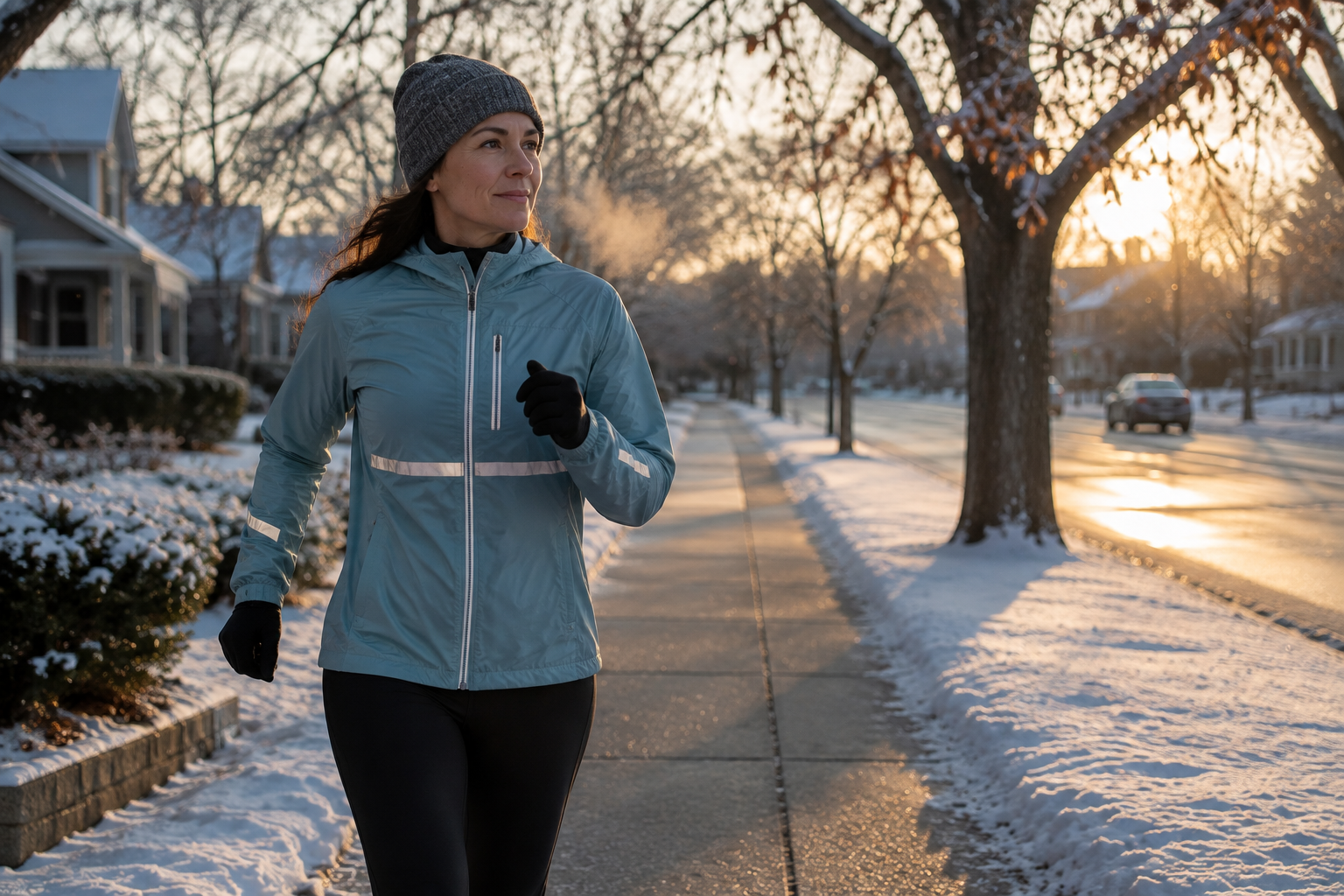
A large share of “I can’t stand walking in winter” is really “I’ve never dressed for it correctly.” Cold-weather training guidance from Mayo Clinic Health System recommends a three-layer system: a synthetic or wool base layer that wicks moisture away from skin, an insulating middle layer such as fleece, and a waterproof, breathable outer shell to block wind and precipitation. A useful gauge is that you should feel slightly cool for the first five minutes of a walk; if you feel warm standing at the door, you’re overdressed and will overheat once moving.
| Layer | Material | Purpose | Common Mistake |
|---|---|---|---|
| Base layer | Merino wool or synthetic (polypropylene) | Wicks sweat away from skin so you don’t chill once you stop moving | Wearing cotton, which holds moisture against skin |
| Middle layer | Fleece or light wool sweater | Traps warm air close to the body for insulation | Skipping this layer on “just cold enough” days, then turning back early |
| Outer shell | Waterproof, breathable jacket | Blocks wind and precipitation without trapping sweat | Wearing a heavy winter coat instead, which causes overheating |
| Extremities | Wool socks, wicking glove liners, insulated hat | Hands, feet, ears, and head lose heat fastest | Leaving hands and ears uncovered because “it’s not that cold” |
| Footwear | Trail or walking shoes one size up, plus traction devices in ice | Room for thick socks and stable footing on slick surfaces | Wearing summer sneakers with no tread on packed snow |
Wind chill matters as much as the air temperature reading. When the wind chill drops to roughly minus 18 degrees Fahrenheit, exposed skin can develop frostbite in about 30 minutes, according to Mayo Clinic Health System guidance, which is a reasonable line for deciding whether to move a walk indoors for the day. Hydration is easy to forget in the cold because thirst signals are blunted, but fluid loss through breathing and sweat still happens, so drinking water before and after a cold walk is still worth doing even when you don’t feel thirsty.
Extremities deserve extra attention because hands, feet, ears, and the tip of the nose lose heat fastest. A wicking glove liner under a heavier insulated mitten keeps fingers usable enough to check a phone or unlock a door, while wool socks combined with shoes sized a half to full size larger leave room for both the sock and normal circulation, which itself helps keep feet warm. If you have asthma, a heart condition, or Raynaud’s syndrome, cold air can trigger symptoms, so it is worth checking with a healthcare provider about safe temperature limits before committing to daily outdoor walks through the coldest stretch of the year.
Step 3: Adjust Your Route, Timing, and Lighting
If darkness is the main barrier, the fix is rarely “walk in the dark and hope for the best.” A few adjustments make a bigger difference than they sound like they should:
- Move the walk to align with available daylight. A short walk at lunch or right after arriving home, while there is still light, beats a longer walk planned for 6 p.m. that quietly gets skipped every day the sky is already black.
- Wear reflective gear and carry a light. A reflective vest or armband plus a small clip-on light or headlamp makes you visible to drivers on unlit streets, and a headlamp lets you see icy patches before you step on them.
- Choose routes with sidewalk lighting and consistent plowing. Main streets near businesses are usually cleared and lit faster than a quiet residential loop; that trade-off is worth it from November through March.
- Use daylight walks for light exposure, not just steps. Northwestern Medicine psychiatrist Dr. Michael Ziffra recommends short outdoor activity, framing it as “you can do a 20- or 30-minute walk, maybe combine it with some errands,” partly because morning and midday light exposure helps regulate mood and circadian rhythm during the darkest months.
Step 4: Anchor the Walk to a Routine You Already Run
Relying on motivation to remember and want to walk every day is a losing bet once the weather turns. A more durable approach, sometimes called habit stacking, attaches the new behavior to a routine that already runs on autopilot. The technique traces back to behavior scientist BJ Fogg’s Tiny Habits work, where he called the existing routine an “anchor,” and was later popularized by author James Clear with a simple formula: “After [CURRENT HABIT], I will [NEW HABIT].”
For winter walking, useful anchors include:
- After I pour my morning coffee, I put on my walking shoes and layers before I drink it.
- After I close my work laptop for the day, I walk to the end of the block and back before I sit down.
- After I let the dog out for the last time at night, I do one loop of the yard or driveway myself.
- After my lunch break starts, I walk for ten minutes before eating at my desk.
The anchor should be something that happens every day regardless of weather or mood, which is exactly why coffee, work transitions, and existing pet routines work so well. The walk becomes attached to something that is already non-negotiable.
Step 5: Build a Genuine Indoor Backup Plan
Some days the wind chill, freezing rain, or an ice storm makes an outdoor walk a bad idea regardless of gear. Skipping the walk entirely on those days is how the habit unravels, because one skipped day makes the next skipped day easier to justify. A pre-decided indoor backup removes that decision from a cold, tired version of yourself who doesn’t want to make it.
Backup Plan: What To Do When Walking Outside Isn’t Safe
- Stair loops. Ten to fifteen minutes of walking up and down a stairwell or a set of porch steps matches the effort of an outdoor block or two.
- Mall or big-box store laps. Many shopping centers open early specifically for indoor walkers; a few laps of a mall or large store covers real distance in a heated, lit, dry space.
- Treadmill or stationary bike. Even 15 minutes preserves the habit’s daily rhythm on the worst-weather days.
- Bodyweight circuit. A five-minute round of marching in place, step-ups on a sturdy stair, and bodyweight squats keeps the “movement happened today” streak alive.
- Indoor track at a rec center or gym. If one is nearby, it replicates the outdoor walk almost exactly, just under a roof.
Pick one backup option now, before you need it, and write it down somewhere you’ll actually see on a bad-weather morning.
Step 6: Set Up Accountability and Motivation Structures
Gear and routes solve the physical barriers, but winter also drains motivation directly, especially for people affected by seasonal affective disorder. University of Chicago clinical psychologist Shona Vas has compared consistent exercise to “a medication that treats depression,” noting that after three months of regular activity, “you can’t really tell the two groups apart” when comparing exercisers against those on medication for mood symptoms. That’s a strong argument for treating winter walks as more than a fitness line item.
A few structures make the habit easier to sustain through the darkest months:
- A visible streak tracker. A wall calendar, habit-tracking app, or even a simple checkmark chart gives a daily record that most people don’t want to break.
- A walking partner or standing text check-in. Committing to meet someone, even virtually, at a set time adds social cost to skipping.
- A recurring calendar block with a name, not just “walk.” “Morning light walk” or “post-work reset walk” reads as an appointment rather than an optional extra.
- A light box or sunlit window as a fallback for mood support. On days the backup indoor walk is all that fits, 15 to 20 minutes near a bright window or a light therapy lamp supports the same light-exposure goal a walk would have covered outdoors.
Step 7: Master Ice and Snow Safety Before You Need It
Ice is the barrier most likely to cause an actual injury rather than just discomfort, so it deserves specific tactics rather than general caution:
- Walk like a penguin on suspected ice. Take short, flat-footed steps with your weight centered over your front foot rather than your usual heel-to-toe stride, which reduces slip risk on slick patches.
- Use traction devices. Slip-on ice cleats or grips add real traction over packed snow and ice and are inexpensive compared to a fall-related injury.
- Watch for black ice at specific spots. Bridges, shaded areas, and spots near downspouts or gutters freeze first and refreeze fastest, often looking like ordinary wet pavement.
- Be extra cautious in early morning and after sunset. Melted snow from the afternoon sun frequently refreezes overnight, so a route that was fine at 3 p.m. may be glazed by 7 a.m.
- Keep hands free or usable. Avoid carrying too much, and keep at least one hand free from a phone or bags so you can catch yourself if you do slip.
- Choose shoes with real tread, sized to fit thick socks, rather than smooth-soled sneakers built for dry pavement.
None of this is about eliminating risk entirely, since some days genuinely call for the indoor backup plan instead. It’s about recognizing which days are walkable with the right precautions and which days are better spent on stairs or a treadmill.
What To Do After You’ve Already Broken the Streak
Almost everyone building a winter walking habit misses a stretch of days at some point, usually after a stomach bug, a work trip, or a week of genuinely dangerous ice. The instinct is to treat the break as proof the habit failed and quietly let it drop for the rest of the season. That instinct is worth resisting, because the habit-formation research above is describing an average trajectory, not a strict deadline; a habit that’s 80 percent formed after ten weeks does not reset to zero after a five-day gap.
A more useful approach is to plan the restart in advance, the same way you planned the indoor backup:
- Restart at a smaller size than before. If your habit was a 30-minute walk, the first day back can be a 10-minute walk around the block. The goal of day one is showing up, not matching your old distance.
- Re-use the same anchor. Whatever cue you attached the habit to before (morning coffee, the dog’s last outing, closing the laptop) is still there and still works; there’s no need to invent a new trigger.
- Name the break without judgment. A quick note in a tracker like “missed 4 days, sick” keeps an honest record without turning into a reason to quit entirely.
- Expect the first week back to feel harder than the streak ever did. That discomfort is temporary re-adaptation, not a sign the habit is gone for good.
Treating a broken streak as a pause rather than a failure is often the single biggest difference between people who walk consistently all winter and people who quit in November and don’t start again until spring.
Bringing It Together
A walking habit that survives winter rarely looks identical to the one you ran in July. The route changes to follow daylight and plowed sidewalks, the gear gains three layers and a headlamp, the timing shifts to anchor onto a routine that never skips, and a real indoor backup exists for the days ice or wind chill make the outdoors unwise. Each of these is a small, specific decision made in advance, which matters because habit research consistently shows that automatic behavior needs a stable, repeatable context to take hold. Winter removes the easy context. Rebuilding a slightly different one, on purpose, is what keeps the habit intact until spring returns it to easy mode.
Start with just one change this week rather than overhauling everything at once. Buy the base layer, pick the one anchor routine you’ll attach the walk to, or decide right now what your indoor backup will be the next time ice closes the sidewalks. Small, specific decisions made ahead of time are what carry a walking habit through the darkest, coldest, iciest months, and they are what will still be in place when the days start getting longer again.
Frequently Asked Questions
What temperature is too cold to walk outside?
There’s no single universal cutoff, but a commonly used guideline is to treat a wind chill near minus 18 degrees Fahrenheit as a signal to move indoors, since exposed skin can develop frostbite in around 30 minutes at that level. Above that, dressing in proper layers makes most winter temperatures walkable for healthy adults.
How do I stay motivated to walk when it’s dark before and after work?
Shift the walk to whatever daylight window exists, even a short lunchtime walk, and treat any outdoor walk as light exposure that also supports mood during the darkest months. Pairing the walk with a routine you already do without fail, like a coffee habit or a dog’s last outing of the night, removes the need to rely on motivation alone.
Is it bad to walk on ice at all?
Walking on ice carries real fall risk, but traction devices, shorter flat-footed steps, and avoiding known black-ice spots (bridges, shaded corners, areas near downspouts) reduce that risk substantially. On days with active freezing rain or glazed sidewalks, the indoor backup plan is the safer choice.
Do I need special clothing, or will my regular workout clothes work?
Regular summer workout clothes, especially cotton, tend to hold moisture against the skin and get cold once you stop moving. A three-layer system, wicking base, insulating middle, waterproof shell, along with wool socks and a hat, handles most winter conditions without needing expensive specialty gear.
How long until a winter walking routine feels automatic?
Research on health-behavior habit formation found a wide range, from about 4 to 335 days, with many health habits landing around a 59- to 66-day median before they start to feel routine. Interventions and routines sustained for two to five months tend to stick better than shorter attempts, so give a new winter schedule at least a couple of months before judging whether it’s working.
Can indoor walking replace outdoor walking for winter mood benefits?
Indoor walking still delivers the exercise benefits, and a psychologist at the University of Chicago has compared regular exercise to an antidepressant medication in its effect on mood after around three months of consistency. Outdoor daylight exposure adds an additional benefit for seasonal mood symptoms, so pairing indoor movement with time near a bright window or a light therapy lamp on non-walking days helps cover both bases.
References
- Mayo Clinic Health System. “Tips for cold-weather training.” mayoclinichealthsystem.org
- News-Medical.net. “How long does it take to form a healthy habit?” reporting on a systematic review and meta-analysis of health-behavior habit formation. news-medical.net
- James Clear. “Habit Stacking: How to Build New Habits by Taking Advantage of Old Ones.” jamesclear.com
- University of Chicago Medicine Psychiatry. “Winter weather got you down? Go outside, exercise to combat seasonal affective disorder, experts say.” psychiatry.uchicago.edu