





















By Laila Qureshi
Somewhere around 65, the question about exercise quietly changes. It stops being “how do I get stronger” and becomes something closer to “how do I make sure I can still get up off the floor by myself in ten years.” That shift in the question deserves a shift in the program. Strength training after 65 is not a smaller, gentler version of a young adult’s routine. It is its own discipline, built around a different goal: staying capable, staying steady, and staying out of the hospital.
This piece is about that goal. Not muscle definition, not personal-best lifts, not a beach-ready physique. The target is independence: the ability to rise from a low chair without using your arms, to carry two bags of groceries up a flight of stairs, to catch yourself instead of falling when a rug slips underfoot. Every recommendation below is built around that outcome, and around the real physical changes (bone density loss, joint wear, slower recovery) that make programming for this decade genuinely different from programming for someone in their 40s or 50s.
Before you start: talk with your doctor before beginning or significantly changing an exercise program, especially if you have osteoporosis, osteopenia, arthritis, a cardiovascular condition, a recent joint replacement, or a history of falls. A physical therapist or physician can screen for conditions that change what’s safe and can refer you to supervised programs where needed. Nothing in this article replaces that conversation.
Why “independence, not aesthetics” is the right frame
Muscle loss after 65 is not gradual in the way people assume. Research on age-related muscle loss shows the decline accelerates with age: adults who don’t strength train typically lose muscle at a rate of roughly 1 to 2% a year before age 60, and that rate climbs to around 3% a year afterward. Left unaddressed, this becomes sarcopenia, the clinical term for age-related loss of muscle mass, strength, and function. Sarcopenia does not announce itself with a diagnosis day. It shows up as a jar lid that won’t budge, a curb that suddenly feels tall, a grocery bag that used to be nothing.
The reason this matters more here than at any earlier stage of life is simple: strength and balance are what stand between an older adult and a fall, and a fall is one of the most disruptive events that can happen to an aging body. According to the CDC, more than one in four older adults falls each year, and falls send about 3 million people to the emergency department annually in the United States, with roughly 1 million resulting in hospitalization. Hip fractures are especially serious: falls cause the vast majority of hip fracture hospitalizations and deaths in older adults. Once a hip fracture happens, the path back to full independence is long, and for some people it never fully returns.
Strength training changes those odds. It builds the muscle that supports joints and absorbs shock, it improves reaction time and postural control, and, done with the right exercise selection, it loads bone in ways that help preserve density. None of that shows up on a bathroom scale or in a mirror. It shows up the day you trip on a curb and your leg catches you instead of your face.
What actually changes physically after 65
A program built for this decade has to account for several overlapping realities at once, not just muscle loss in isolation.
Bone density and fracture risk
Bone loss accelerates for many people in this age range, and osteoporosis or osteopenia becomes common, particularly for postmenopausal women, though men are affected too. This changes exercise selection directly: guidance from the International Osteoporosis Foundation recommends avoiding repeated forward spinal flexion (rounding the back under load, as in some sit-up or toe-touch variations) and forceful spinal twisting, because these movements raise the risk of vertebral compression fractures in someone with reduced bone density. The same guidance supports weight-bearing and resistance exercise, and balance and coordination training, as protective rather than risky, as long as intensity is introduced gradually and the exercises are chosen with the person’s bone health in mind.
Joint changes and arthritis
Cartilage thins with age, and osteoarthritis, especially in the knees, hips, hands, and spine, is extremely common by this decade. Joints that are irritated by high-impact loading or by movements pushed through pain need modification, not elimination of strength work. Resistance training around an arthritic joint, done through a comfortable range with appropriate load, generally reduces pain and improves function over time because stronger muscles take pressure off the joint surface. The nuance is technique and range of motion, not avoidance.
Slower recovery and connective tissue changes
Tendons and ligaments become stiffer and less elastic, and recovery between sessions tends to take longer. This doesn’t mean less frequent training. It means training frequency and intensity need to be balanced deliberately, with attention to how the body responds day to day rather than following a fixed script regardless of how a session felt.
Balance and reaction time
The systems that keep a person upright (vision, the inner ear’s vestibular system, and proprioception, the sense of where your joints are in space) all decline gradually with age. This is precisely why a strength program for this decade needs balance work built in as a core pillar, not an afterthought tacked on at the end of a workout.
The four pillars of an after-65 strength program
Rather than organizing a program purely by muscle group, it helps to organize it by the real-world capability each piece protects.
The four functional pillars
- Lower-body strength: the engine behind standing up, climbing stairs, and catching yourself mid-stumble.
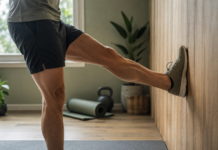
- Balance and proprioception: the sensory-motor work that prevents a stumble from becoming a fall.
- Upper-body and grip strength: carrying groceries, opening jars, pushing up from the floor, catching yourself with your arms.
- Core and postural strength: the trunk stability that supports every other movement and protects the spine.
A well-built weekly program touches all four pillars, generally across two to three strength sessions a week, with balance work woven in rather than treated as separate. This lines up with the National Institute on Aging’s guidance for older adults, which recommends at least two days a week of muscle-strengthening activity working all the major muscle groups, alongside balance exercises and 150 minutes of moderate aerobic activity weekly.
Building the lower body: the foundation of getting up and staying up
If there is one movement pattern that predicts independence more than any other, it’s the ability to rise from a seated or low position without using your hands. This is often tested clinically through the sit-to-stand test, and it is trainable directly.
Priority exercises
- Sit-to-stand from a chair: the single most transferable lower-body exercise for this age group. Progress by lowering the seat height, slowing the descent, or eventually adding light weight.
- Step-ups onto a low step or sturdy platform, which directly trains stair climbing.
- Goblet squats to a box or bench, holding a light dumbbell or kettlebell at chest height, which keeps the torso upright and reduces strain on the lower back.
- Standing hip hinges (a supported deadlift pattern using a light weight or resistance band) to train the posterior chain that stabilizes the pelvis and lower back.
- Calf raises, holding onto a counter or rail for balance, which support ankle stability, a frequently overlooked factor in fall risk.
Progression here is deliberately conservative: more repetitions or a slightly harder variation (chair to no-hands sit-to-stand, for instance) before adding significant external weight. The goal is control through a full range of motion, not maximum load.
Training balance directly, not as an afterthought
Balance is a skill, and like any skill it responds to specific practice. Strength alone will not fix balance if the nervous system hasn’t practiced the specific task of staying upright under challenge.
A simple progressive balance sequence
| Stage | Exercise | Support |
|---|---|---|
| 1 | Feet together, eyes open | Hand lightly on counter |
| 2 | Tandem stance (heel-to-toe) | Fingertip touch only |
| 3 | Single-leg stance | Near a wall, no touch unless needed |
| 4 | Single-leg stance, eyes closed briefly | Near a wall or sturdy chair |
| 5 | Walking heel-to-toe in a line | Open space, wall nearby |
Move to the next stage only once the current one feels stable for 20 to 30 seconds. Always have a wall, counter, or sturdy chair within reach. These few minutes, done consistently, are some of the highest-value minutes in the entire program for fall prevention.
This kind of progressive balance training is a central piece of the CDC’s STEADI initiative (Stopping Elderly Accidents, Deaths, and Injuries), which was built specifically to help clinicians and older adults screen for fall risk and intervene with targeted strength and balance work before a fall happens rather than after.
Upper body and grip: the strength behind everyday carrying and catching
Grip and upper-body strength get less attention than legs, but they matter just as much for independence. Grip strength specifically is used in geriatric research as a marker of overall physical frailty, because it correlates strongly with the ability to open containers, carry bags, use canes or walkers effectively, and, critically, push yourself up off the floor if you do fall.
- Seated or standing rows with a resistance band, training the muscles that support upright posture.
- Wall push-ups or incline push-ups against a counter, progressing toward the floor only when appropriate for the individual’s shoulders and wrists.
- Farmer’s carries: walking while holding a moderate weight in each hand, which build grip endurance and the exact carrying strength used for groceries and laundry.
- Overhead presses with light dumbbells or bands, useful for reaching into cabinets and lifting objects overhead, done through a comfortable, pain-free range.
Core and posture: the stabilizer for everything else
Given the caution around spinal flexion for people with reduced bone density, core work in this decade leans on anti-movement patterns rather than repeated crunching or twisting.
- Bird-dog (opposite arm and leg extended from a hands-and-knees position) for coordination and spinal stability.
- Dead bug variations, performed slowly and within a pain-free range, to train the deep core without spinal flexion.
- Standing marches holding onto a counter, which challenge core and hip stability together while mimicking walking mechanics.
- Modified planks from the knees or against a wall, focused on holding a neutral spine rather than duration for its own sake.
A sample weekly structure
Example week (adjust with your doctor or physical therapist)
- Monday: Full-body strength: sit-to-stand, standing hip hinge, seated row, overhead press, bird-dog. 2 sets of 8-12 reps per exercise.
- Tuesday: Balance progression (10-15 minutes) plus a 20-30 minute walk.
- Wednesday: Rest, or gentle mobility and stretching.
- Thursday: Full-body strength: step-ups, goblet squat to box, farmer’s carry, wall push-ups, dead bug. 2 sets of 8-12 reps.
- Friday: Balance progression plus a walk, or a low-impact activity like swimming or cycling.
- Saturday: Light full-body strength or active recovery, depending on how the week felt.
- Sunday: Rest.
This is a template, not a prescription. Someone recovering from a joint replacement, managing significant osteoporosis, or new to structured exercise entirely should build this out with a physical therapist or qualified trainer experienced with older adults.
Equipment that actually earns a place in this program
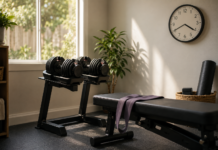
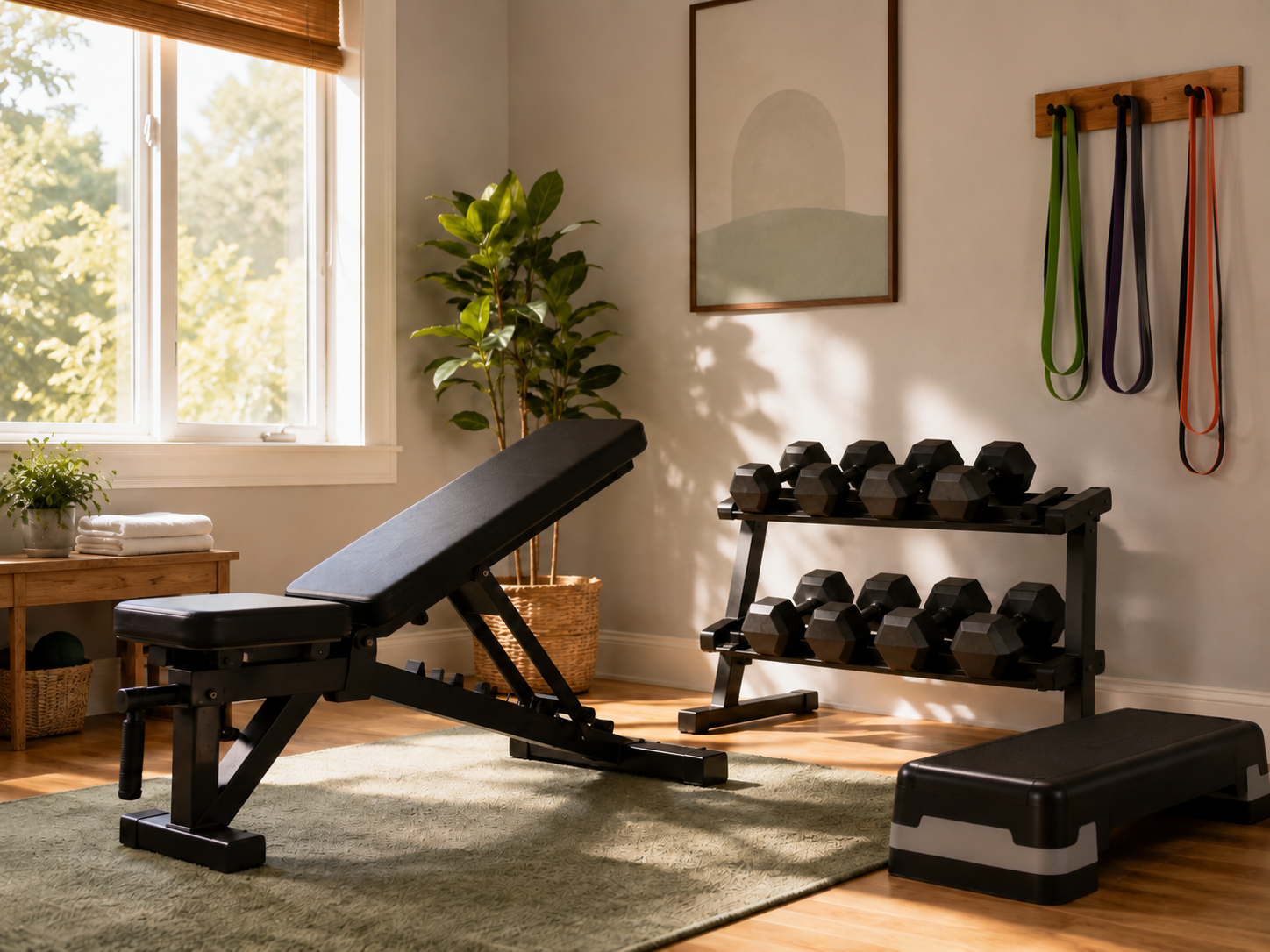
None of this requires a full home gym. A small, well-chosen set of equipment covers almost everything above: a pair of light dumbbells (roughly 2 to 8 kg to start, added to gradually), a set of resistance bands with varying tension, a sturdy chair without wheels, and a low step or platform for step-ups. A yoga mat helps for floor-based core work, and a countertop or wall gives you the support needed for early balance stages. What matters more than the equipment itself is a stable, uncluttered space with good lighting and a non-slip floor surface, since the same fall-risk factors that show up outdoors (poor footing, poor lighting, clutter) apply just as much to a home workout area.
If joining a class feels more sustainable than training alone, look for programs labeled specifically for older adults or fall prevention, often run through community centers, senior centers, or outpatient physical therapy clinics. Group settings also add an accountability and social element that tends to improve long-term adherence, which matters more for outcomes than any single exercise choice.
Loading, progression, and knowing when to hold back
Progressive overload, the principle of gradually increasing demand on the muscles over time, still applies after 65. What changes is the pace and the signals you use to decide when to progress.
Some practical rules of thumb:
- Increase repetitions before you increase weight. A movement done for 12 clean reps with good control is more valuable than 6 reps with strain.
- Give yourself at least 48 hours between sessions that stress the same muscle groups, since recovery genuinely takes longer in this decade.
- Track how you feel the next day, not just during the session. Soreness that fades within a day or two is normal; sharp joint pain, swelling, or soreness lasting several days is a signal to scale back and, if it persists, check in with a doctor or physical therapist.
- Warm up longer than you think you need to. Five to ten minutes of easy movement (walking, arm circles, gentle marching) before loading a joint makes a measurable difference in how it performs and feels.
Comparing intensity approaches by common condition
Signs a program needs a professional’s eyes on it
Get individualized guidance if you notice:
- A fall or near-fall in the past year
- Diagnosed osteoporosis, especially with a prior fracture
- Significant joint pain that limits daily movement
- Dizziness or lightheadedness with position changes
- A recent hospitalization, surgery, or extended period of inactivity
- Uncertainty about how to modify an exercise for a specific condition
A physical therapist can run a formal falls-risk assessment, similar in spirit to the tools built into the CDC’s STEADI program, and design a starting point that’s genuinely matched to your current ability rather than a generic template. That first session is worth far more than trying to guess your way through modifications alone.
What results actually look like in this decade
Research on progressive resistance training in older adults, including a large Cochrane review covering over 100 randomized trials, shows consistent, meaningful improvements in strength and in specific functional tasks, with the strongest effect seen in chair-rise ability, exactly the movement pattern tied most closely to daily independence. Gait speed and general physical function also improve, though the gains there tend to be more modest. Reported adverse events tied directly to well-designed resistance programs were rare, though the review’s authors noted that minor joint and muscle soreness is common and safety reporting across studies varies, which is part of why starting under some professional guidance, particularly if you have existing conditions, is worth the effort.
In practice, most people who stay consistent with a program like the one outlined here notice functional changes within four to eight weeks: an easier time on stairs, less hesitation on uneven ground, a chair rise that no longer needs a push from the arms. Strength gains measured in a lab show up faster than muscle actually visibly changes, which is part of why this work rewards patience and consistency over intensity.
Frequently asked questions
Is it safe to start strength training for the first time after 65?
For most people, yes, and the evidence base for benefit is strong even in people starting later in life or with existing frailty. The key is starting at an appropriately light level, progressing gradually, and getting cleared by a doctor first if you have osteoporosis, heart disease, recent surgery, or other significant conditions. Many communities also offer supervised group classes designed specifically for older beginners, which can be a good entry point.
How many days a week should someone over 65 strength train?
Guidance from the National Institute on Aging recommends at least two days a week of muscle-strengthening exercise covering the major muscle groups, with balance work included regularly and rest days between sessions targeting the same muscles. Two to three sessions a week is a reasonable and sustainable target for most people.
Should I avoid strength training if I have osteoporosis?
No, resistance training is generally recommended for people with osteoporosis because it helps maintain bone density and improves the balance and strength that prevent falls in the first place. The nuance is exercise selection: movements involving spinal flexion under load or forceful twisting are best avoided, and a physical therapist can help tailor the program to your specific bone density and fracture history.
What is the single most useful exercise for staying independent?
If forced to choose one, most geriatric fitness specialists point to some version of the sit-to-stand movement, since it directly trains the strength and coordination behind getting up from chairs, toilets, and the floor, one of the most common points of functional loss in this age group. Balance training is a close second, since it is what prevents a stumble from turning into a fall in the first place.
How long before I notice a difference in daily life?
Many people notice functional improvements, easier stairs, steadier balance, less strain when carrying things, within four to eight weeks of consistent training two to three times a week. Strength measured in the muscle itself typically improves before visible changes appear, so trust the functional feedback (how tasks feel) more than the mirror.
What if joint pain makes some exercises too uncomfortable?
Modify the range of motion, the load, or the exercise itself rather than skipping strength work around that joint altogether. A shallower squat, a supported step-up, or a resistance band instead of a dumbbell can all reduce joint stress while still building the strength that ultimately protects that joint. If pain persists or worsens, a physical therapist can identify a better-fitting substitution.
References
- CDC STEADI (Stopping Elderly Accidents, Deaths, and Injuries): https://www.cdc.gov/steadi/index.html
- CDC, Facts About Falls: https://www.cdc.gov/falls/data-research/facts-stats/index.html
- National Institute on Aging, Health Benefits of Exercise and Physical Activity: https://www.nia.nih.gov/health/exercise-and-physical-activity/health-benefits-exercise-and-physical-activity
- International Osteoporosis Foundation, Exercise for Individuals with Osteoporosis: https://www.osteoporosis.foundation/health-professionals/prevention/exercise/exercise-individuals-with-osteoporosis
- Cochrane, Progressive Resistance Strength Training for Improving Physical Function in Older Adults: https://www.cochrane.org/evidence/CD002759_progressive-resistance-strength-training-improving-physical-function-older-adults
- Harvard Health Publishing, Age and Muscle Loss: https://www.health.harvard.edu/exercise-and-fitness-1/age-and-muscle-loss-YAQZ7EMP