


























By Amara Williams
Skipping restaurants until you hit your goal weight is a plan that rarely survives contact with real life. Birthdays happen. Work trips happen. Friday nights with people you like happen. If your fat loss plan only works inside your own kitchen, it isn’t a plan you can actually keep for the months a real body-composition change requires.
The good news is that eating out and losing fat are not opposites. They’re a coordination problem. Restaurant food is built to taste incredible, which usually means it’s built with more oil, more sugar, and bigger portions than anything you’d plate at home. Once you understand those mechanics, you can order around them instead of guessing and hoping the scale cooperates.
This guide walks through why restaurant meals tend to blow past a calorie deficit, then gives you a step-by-step ordering system: menu reading, pre-planning, protein-forward choices, portion tactics, and alcohol decisions, so a dinner out stops feeling like a diet setback.
None of this requires a rigid list of “approved” restaurants or memorizing a spreadsheet of calorie counts. It requires knowing which few decisions actually move the needle at a restaurant table, and making those decisions before the server takes your order rather than after the plate arrives. That single shift, deciding early instead of deciding hungry, is responsible for most of the difference between people who eat out often and still lose fat and people who eat out often and stall.
Why Restaurant Meals Derail a Fat Loss Diet
Before fixing the problem, it helps to see exactly where the extra calories come from. It’s rarely one dramatic decision. It’s usually three quiet ones stacked on top of each other.
Portion Sizes Have Quietly Doubled
According to the National Heart, Lung, and Blood Institute’s Portion Distortion program, the amount of food landing on a restaurant plate has nearly doubled over the past 20 years. That shift happened gradually enough that most diners never noticed the baseline moving. A steak that once weighed six ounces is now routinely ten or twelve. A “regular” pasta bowl often contains three to four standard servings in a single dish.
This feeds directly into what researchers call unit bias: people tend to treat whatever is placed in front of them as a single, appropriate portion, regardless of how it compares to an actual recommended serving. If the kitchen sends out two servings of rice, most diners eat close to all of it simply because it arrived as one plate. A systematic review of 72 randomized controlled trials, summarized in the research literature on portion size, found this pattern consistently: people eat more food when offered larger portion, package, or tableware sizes, largely without noticing that anything changed.
Menu labels reinforce the same illusion. The FDA’s Reference Amounts Customarily Consumed, the standardized serving sizes used on nutrition labels, were set in 1993 based on typical intake patterns at the time. Ice cream, for example, carries a reference amount of half a cup. Almost nobody scoops half a cup at a restaurant, yet the printed nutrition information many diners glance at is still built around that smaller number, which makes a “one serving” claim on a dessert menu misleading in practice even when it’s technically accurate on paper.
Hidden Calories in Oils, Butter, and Sauces
Flavor in professional cooking is frequently built with fat, and fat carries roughly double the calories per gram of protein or carbohydrate. A pan-seared piece of fish might be cooked in two or three tablespoons of butter. A “light” vinaigrette can carry 150–250 calories per serving before you count anything else on the plate. Sauces, finishing oils, and butter basted onto grilled meat are calorie-dense and largely invisible on a menu description, which is exactly why the same dish name can vary by hundreds of calories between two restaurants.
Menu Descriptions Hide the Math
Words like “crispy,” “loaded,” “signature,” and “smothered” are marketing language, not nutrition information. The Food and Drug Administration’s menu labeling rule now requires chain restaurants with 20 or more locations to display calorie counts on menus and menu boards, and to provide additional nutrition details, including total fat, saturated fat, sodium, carbohydrates, sugars, fiber, and protein, on request. Independent restaurants and many regional chains are not covered by that rule, which means the calorie count is often simply unavailable unless you ask directly or estimate using comparable dishes.
Food eaten away from home also plays a larger role in the average diet than it once did. The USDA’s Economic Research Service tracks this shift directly, noting that food prepared outside the home now occupies an increasingly large share of how Americans eat, and studies both the nutritional quality of that food and its relationship to overweight and obesity. That matters for a fat loss plan because it means restaurant decisions aren’t an occasional exception to your diet; for many people, they’re a recurring input that needs its own strategy rather than an afterthought.
How Different Restaurant Types Compare
Not every restaurant category presents the same risk. Knowing where the calorie traps tend to hide in each style of restaurant makes ordering faster and less stressful.
Fast Casual and Counter-Service Chains
These are often the easiest category to manage because posted calorie counts are common under FDA menu labeling rules. The main risk here isn’t the entrée, it’s the add-ons: extra cheese, creamy sauces, tortilla bowls instead of lettuce bases, and oversized soda pours. Build your own bowl or sandwich concepts tend to give the most control since every component is chosen individually.
Traditional Sit-Down American Restaurants
This category tends to combine large entrée portions with bread service, appetizer pressure, and dessert menus presented at the end of the meal. Portion tactics (boxing half the plate, splitting an entrée) matter most here, since the base entrée size is often built for two servings before any sides are added.
Italian, Mexican, and Other Carb-Heavy Cuisines
Bread, chips, rice, and pasta arrive early and often free. These cuisines reward the pre-planning step: eating a smaller lunch, arriving less hungry, and choosing one starch source rather than stacking chips, rice, and dessert into a single sitting. Asking for protein-forward preparations, like grilled fish tacos instead of fried, or a protein-and-vegetable pasta rather than a cream-based one, keeps the same cuisine on the table without the same calorie load.
Steakhouses and Fine Dining
Portions of protein are often generous here, which works in your favor if you skip the butter baste and creamed side dishes that typically accompany them. The bigger risk in this category is the multi-course structure itself: bread, a starter, an entrée, and dessert stacked together can easily double a reasonable calorie target even when each individual course looks moderate.
The Step-by-Step System for Eating Out Without Losing Progress
None of this requires giving up restaurants. It requires a short sequence of decisions made before the food arrives, because almost every mistake in this category happens at the ordering stage, not the eating stage. Each step below builds on the last one, starting with how you read the menu and ending with how you handle the last course, so you can run through the whole sequence in the few minutes between sitting down and ordering.
Step 1: Read the Menu Like a Nutrition Label, Not a Story
Scan for cooking method words first: grilled, roasted, steamed, and blackened tend to run lower in added fat than fried, breaded, crispy, or “pan-seared in butter.” Look for sauces served on the side as an option; most kitchens will accommodate this even if it isn’t printed on the menu. If the restaurant is a chain with posted calories, use the app or in-store menu board before you sit down, since decision fatigue at the table makes people default to the first appealing option rather than the best one.
It also helps to notice which nouns tend to signal a bigger plate: “combo,” “platter,” “tower,” and “sampler” usually mean multiple servings bundled together. A dish described in a single sentence with one protein and one or two named vegetables is almost always the more moderate choice on a page full of longer, more elaborate descriptions.
Step 2: Pre-Plan Your Calorie Budget Before You Sit Down
If you know dinner is at 7 p.m., eat lighter earlier in the day and bank 300 to 500 calories toward the meal. This is simple math, not deprivation: your daily total still needs to land near your target, and shifting where those calories fall doesn’t change the deficit. What it does change is your willpower at the table. Arriving hungry and calorie-starved is what leads to bread-basket overeating before the entrée even lands.
A workable version of this looks like a normal breakfast, a moderate protein-and-vegetable lunch, and a light afternoon snack, leaving most of the day’s remaining calories for dinner. The goal isn’t to starve through the day; it’s to redistribute intake so the restaurant meal is the planned centerpiece rather than an unplanned overage stacked on top of three already-full meals.
Step 3: Order Protein-Forward
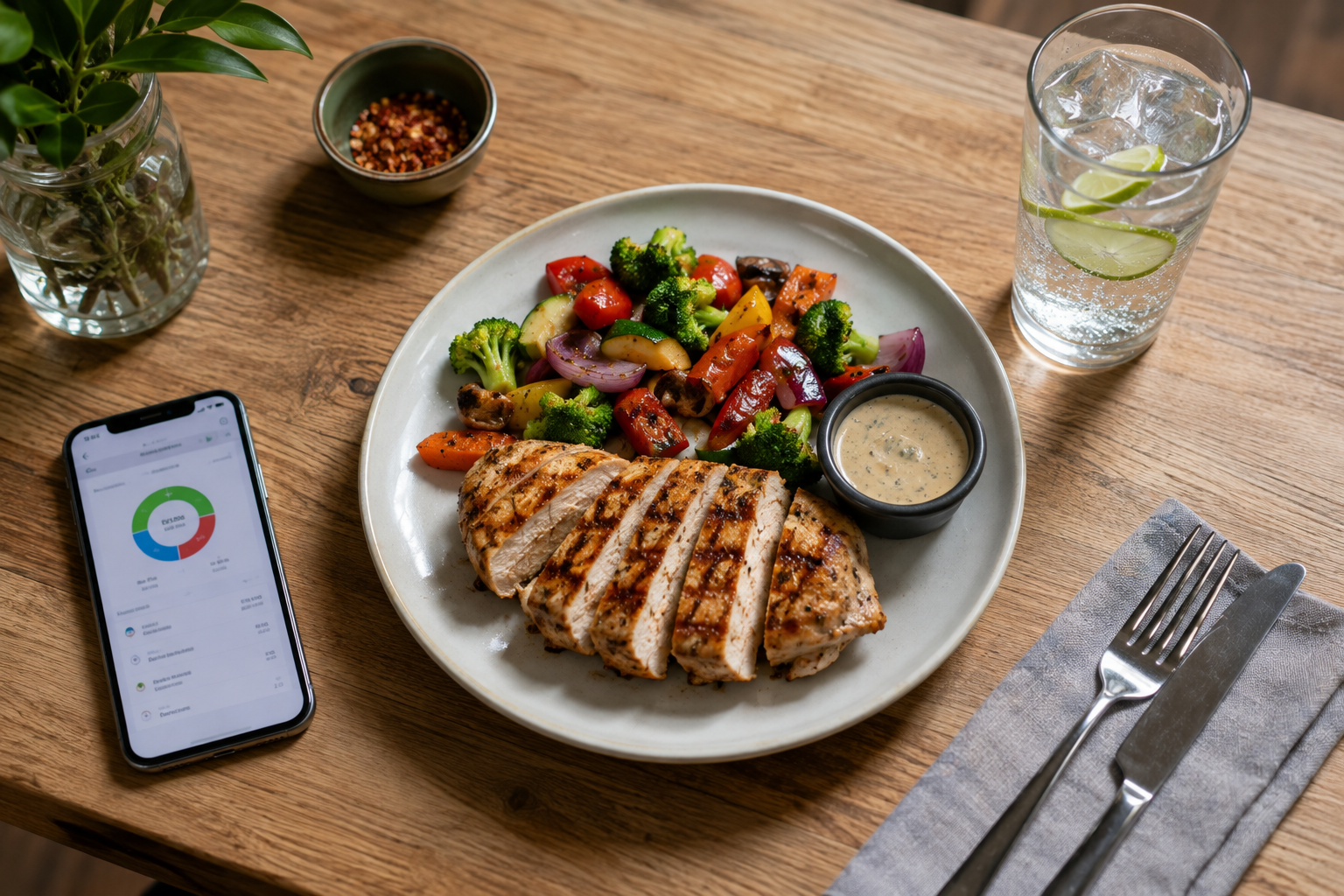
Protein is the single easiest lever at a restaurant. It’s the most filling macronutrient per calorie, and prioritizing it crowds out lower-value calories from bread, fries, and dessert. A practical rule: pick your protein source first, then choose one starch and one vegetable side, rather than starting with the dish that “sounds best” and building around it. Grilled chicken, fish, lean steak cuts, tofu, and legume-based entrées all fit this approach.
This step also solves a problem most diets don’t mention: staying satisfied for hours afterward. A meal built around 30 to 50 grams of protein tends to hold off hunger far longer than an equal-calorie meal built around pasta or bread alone, which lowers the odds of a second round of snacking once you’re back home.
Step 4: Use Portion Tactics at the Table
A few tactics consistently work because they change the environment instead of relying on willpower alone:
- Ask for a to-go box when the food arrives and portion half the plate before you start eating.
- Split an entrée with a dining partner, or order an appetizer-sized portion as your main if it’s offered.
- Request dressings, sauces, and gravies on the side, then use a fraction of what’s given.
- Skip the bread basket or ask for it to be brought with the entrée instead of before.
- Order a side salad or vegetable in place of a second starch whenever the menu allows a substitution.
Quick Reference: The Ordering Sequence
Step 5: Handle Alcohol Deliberately
Alcohol supplies roughly 7 calories per gram, more than carbohydrate or protein and second only to fat, and it also lowers inhibition around other food choices at the same meal. A glass of wine or a light beer fits into most calorie budgets; a sugary cocktail can carry 300 to 500 calories on its own before dinner starts. If you’re drinking, pick one option and plan for it the same way you plan for the entrée, rather than treating drinks as calorie-free extras.
If you’d rather skip alcohol entirely on a given night, sparkling water with citrus, an unsweetened iced tea, or a virgin version of a cocktail keeps the social ritual of having a drink in hand without the calorie cost. Alternating one alcoholic drink with one non-alcoholic drink across a longer dinner also works well for people who want to participate without tracking every ounce.
A Menu-Decision Table You Can Use at Any Restaurant
When a menu offers several versions of a similar dish, this comparison logic applies almost anywhere, from a diner to a steakhouse. Keep it in mind and you can size up an unfamiliar menu in under a minute, without needing to look up a single calorie count.
| Menu Signal | Usually Lower Calorie | Usually Higher Calorie |
|---|---|---|
| Cooking method | Grilled, roasted, steamed, blackened | Fried, breaded, crispy, battered |
| Sauce wording | Salsa, vinaigrette, broth-based | Cream, alfredo, aioli, buttered |
| Side option | Side salad, steamed vegetables | Fries, loaded mash, mac and cheese |
| Portion framing | Appetizer size, lunch portion, half order | Sharable, family style, “loaded” |
| Drink choice | Wine, light beer, spirit with soda water | Frozen cocktails, sweetened mixers, craft beer flights |
A Worked Example: One Dinner, Two Outcomes
Seeing the system applied to one full meal makes it easier to picture at your own table. Consider a typical Italian restaurant order. The default version: bread with olive oil while browsing the menu, fettuccine alfredo with grilled chicken added, a glass of house wine, and shared tiramisu for dessert. Depending on portion sizes, that sequence can easily total 1,800 to 2,200 calories before the table is cleared.
Now apply the system. Skip or limit the bread, since it’s the lowest-value item on the table. Order grilled chicken or shrimp over a tomato-based or vegetable-forward pasta rather than a cream sauce, and ask for a half portion or box half immediately. Choose one glass of wine instead of two, and split a single dessert three or four ways instead of ordering one per person. The same restaurant, the same cuisine, and largely the same experience can land closer to 800 to 1,000 calories, a difference large enough to matter over a week of similar decisions without feeling like a diet meal at all.
Common Mistakes That Sabotage Eating-Out Diets
A few patterns show up again and again in people who eat out regularly and still struggle to lose fat:
- Arriving starving. Skipping meals to “save calories” for dinner backfires because hunger overrides portion control within the first few minutes at the table.
- Trusting the menu description alone. A “grilled chicken salad” can still land at 900-plus calories once candied nuts, dried fruit, cheese, and a full ladle of dressing are added.
- Skipping protein to “save room.” This usually backfires into more bread and dessert, since protein is what keeps hunger in check for hours afterward.
- Treating every restaurant meal as a cheat day. One dinner does not need dessert, an appetizer, and a cocktail to feel worthwhile. Pick one indulgence, not all three.
- Not asking questions. Servers can usually tell you how a dish is cooked, whether sauce is added or on the side, and what substitutions are possible. Most people never ask.
- Ordering for the table instead of yourself. Shared appetizers and family-style mains are easy to lose track of, since nobody is monitoring a single serving. Mentally claim your portion before the dish is passed around.
- Giving up after one bad meal. A single high-calorie dinner does not undo a week of consistent habits; the response that actually matters is the next meal, not guilt about the last one.
Making It Sustainable
The system above works because it front-loads the decisions that matter: protein source, sauce placement, portion size, and drink choice, before food is in front of you. Once ordering this way becomes routine, restaurants stop being a threat to a fat loss plan and become just another meal you’re accounting for, the same as anything cooked at home. The opposite mistake is worth naming too: swinging so far into restriction that eating out stops being enjoyable. The goal is staying near your target on average across the week, not achieving perfection at every single meal.
Frequently Asked Questions
Can I really lose fat while eating out several times a week?
Yes. Fat loss depends on your average calorie balance over days and weeks, not on any single meal. Ordering protein-forward, controlling portions, and planning your calorie budget around the meal make it entirely possible to eat out three or four times a week and still lose fat steadily. Many people find this approach easier to sustain long-term than a strict no-restaurant rule, precisely because it doesn’t ask them to give up a normal part of their social life.
How do I estimate calories at a restaurant that doesn’t post them?
Compare the dish to a similar item from a chain restaurant that does post calories, since cooking methods and portion sizes tend to be similar across casual dining. Assume any visible oil, butter, or cream sauce adds a meaningful amount, and round your estimate up rather than down.
Is it better to order an appetizer instead of an entrée?
Often, yes. Appetizer portions are frequently closer to an appropriate serving size, and pairing one with a side salad or extra protein order can land closer to your calorie target than a full entrée built for two servings. This works especially well at restaurants where appetizers already lean toward protein, such as shrimp cocktail, seared scallops, or a lettuce-wrap style starter.
What should I do about the bread basket or chips and salsa?
Ask for it to arrive with your entrée rather than before, or decline it outright if you know it derails your appetite. These starters add calories quickly precisely because they arrive while you’re hungriest and least deliberate.
Does alcohol really matter that much for fat loss?
It matters more than most people assume, both because alcohol itself carries calories and because it tends to loosen decision-making around the rest of the meal. Picking one drink and planning for it protects the rest of your choices.
What if I go over my calorie target at a restaurant?
Treat it as one data point, not a failure. Return to your normal eating pattern at the next meal rather than restricting heavily the next day, which tends to trigger overeating later instead of correcting the imbalance. A single high-calorie dinner spread across a week of otherwise on-target eating rarely shows up on the scale at all.
References
- National Heart, Lung, and Blood Institute. “Portion Distortion.” nhlbi.nih.gov
- U.S. Food and Drug Administration. “Menu Labeling Requirements.” fda.gov
- U.S. Department of Agriculture, Economic Research Service. “Food Away From Home.” ers.usda.gov
- Wikipedia. “Portion size,” summarizing a systematic review of 72 randomized controlled trials on portion, package, and tableware size effects on consumption. en.wikipedia.org
- U.S. Department of Health and Human Services and U.S. Department of Agriculture. “Dietary Guidelines for Americans, 2020-2025.” dietaryguidelines.gov