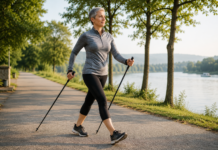

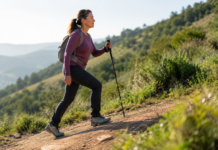


























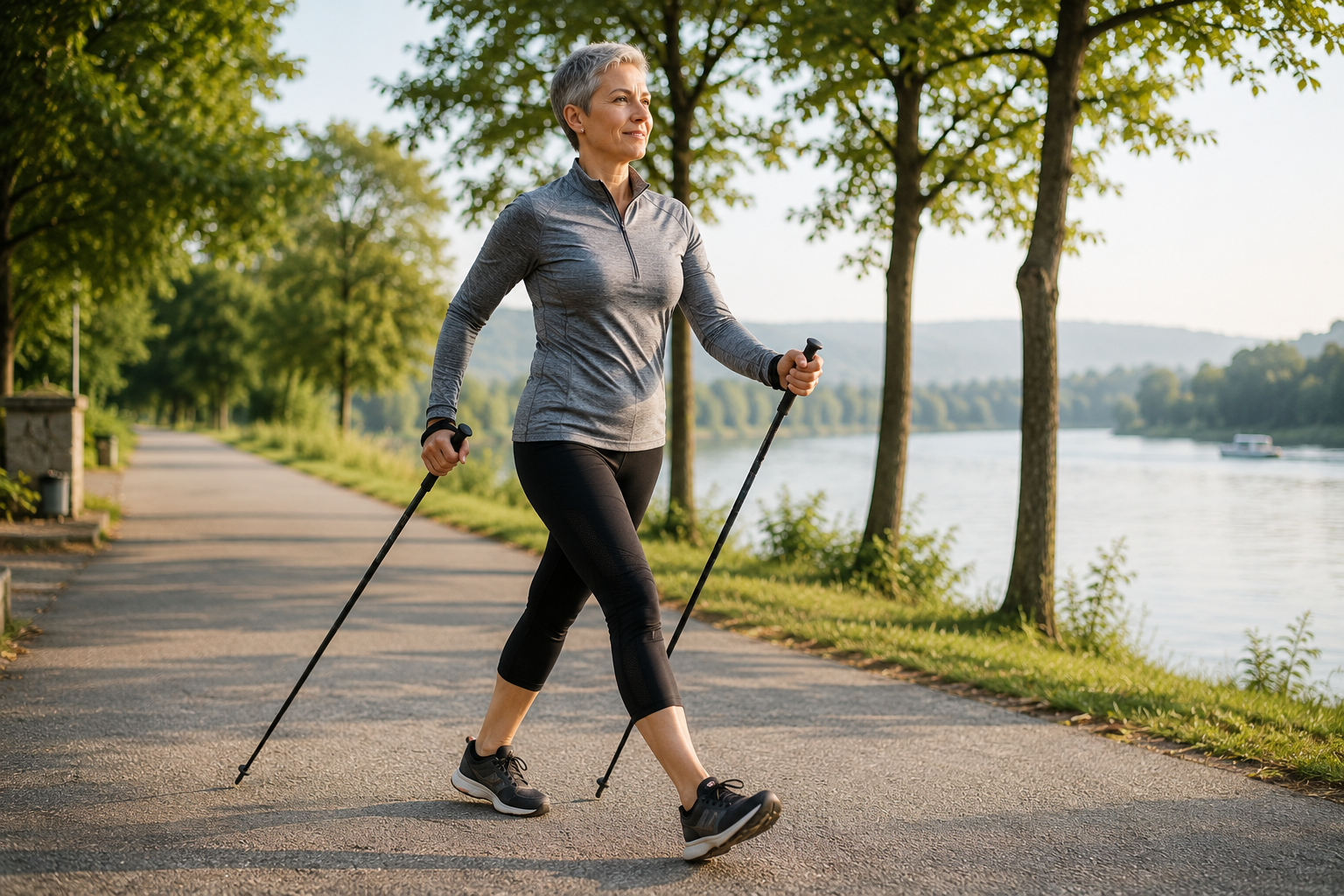
Two people leave the same trailhead at the same pace. One swings her arms loosely at her sides. The other plants a pair of rubber-tipped poles into the dirt with every step, pushing off behind her hip with each stride. To a passerby, the second walker looks like she’s working harder. She is. What’s less obvious is why, and what that extra work is actually doing to her heart rate, her shoulders, and the load traveling through her knees.
Nordic walking is regular walking with two poles added to the gait cycle, but that description undersells how much the poles change. A correctly used pole is not a stability aid or a fashion accessory bolted onto a walk. It is a lever that recruits the upper body into a movement pattern that, without it, stays almost entirely in the legs. This article looks at what the research actually says about that change: what happens biomechanically when poles enter the stride, what the calorie and cardiovascular data show compared with plain walking, how to hold and plant a pole correctly, and who tends to gain the most from making the switch.
What Actually Changes: The Biomechanics of Poles
Ordinary walking is largely a lower-body activity. The arms swing for balance and rhythm, but they contribute very little propulsive force. Nordic walking poles change that division of labor by giving the arms and torso an actual job: generating push-off force against the ground through the pole tip, timed to the opposite-side leg.
Upper-body engagement
The clearest evidence for this shift comes from surface electromyography (EMG) research that measures electrical activity in muscles during movement. In a 2015 study published in PLoS ONE, researchers recorded EMG data from nine experienced Nordic walking instructors walking on a treadmill at 4 km/h, both on flat ground and on a 15% incline, comparing conventional walking with Nordic walking. The triceps brachii, the muscle on the back of the upper arm responsible for driving the pole backward, showed an average 16-fold increase in activation during Nordic walking compared with plain walking, with peak activation spiking as high as 40-fold during the poling phase itself. The latissimus dorsi, a broad back muscle that helps pull the arm down and back, showed roughly a 4-fold average increase, and the anterior deltoid at the front of the shoulder showed a 2- to 3-fold increase across the entire gait cycle, not just during poling. Across the muscles measured, upper-body activation ran 2- to 15-fold higher in Nordic walking than in the same walk without poles.
That is a meaningful shift in where the workload goes. A regular walk barely registers on the triceps or lats. A Nordic walk, done with real poling force rather than just carrying the poles, turns the upper body into an active contributor rather than a passenger.
Load distribution
The second change is mechanical rather than muscular: some of the force that would otherwise pass entirely through the legs and feet is redirected through the poles and into the arms and shoulders. Each pole plant transmits ground reaction force up through the pole shaft into the hand, wrist, and shoulder girdle instead of that force being absorbed solely by the hip, knee, and ankle on the supporting leg. Over the course of a walk, that adds up to a measurable reduction in the proportion of total load carried by the lower-body joints, since a portion of body-weight support and propulsion during each step is now shared with the poles.
Joint impact
This redistribution is why Nordic walking is frequently recommended for people managing joint sensitivity, particularly in the knees and lower back. It does not eliminate impact, since walking is still a weight-bearing activity performed on the feet. What it changes is the share of that impact the lower-body joints have to absorb on their own, because the poles are actively taking on part of the propulsive and stabilizing work with each stride. Combined with the slight forward lean and more upright, elongated posture that correct pole technique encourages, many walkers report less lower-back strain over longer distances than with an unsupported walk at the same pace.
The Numbers: What Research Shows About Calorie Burn and Cardio Load
Muscle activation data explains the mechanism. The metabolic and cardiovascular research explains why that mechanism matters for anyone using walking as exercise rather than transportation.
Harvard Medical School has reported that Nordic walking can raise energy consumption by up to 46% compared with walking the same pace without poles. A study published in the Journal of Strength and Conditioning Research by Hansen and Smith found energy expenditure as much as 67% greater during Nordic walking than ordinary walking, an effect the researchers linked partly to pole length and how forcefully the poles were used to drive the stride, meaning technique quality directly affects how much extra work the body actually does. A separate line of research by Fujita and colleagues, published in PLoS ONE in 2018, measured heart rate, metabolic equivalents (METs), and energy expenditure in middle-aged adults and found that proficiency with the poles mattered: walkers who had developed real poling skill got a substantially larger physiological return than those who were still learning to coordinate the arm and leg movement.
Earlier field research, including a 2002 study by Church, Earnest, and Morss in Research Quarterly for Exercise and Sport, established the basic pattern that later work has continued to refine: oxygen consumption, heart rate, and total energy expenditure all run higher during Nordic walking than during regular walking at a matched pace, without a corresponding increase in perceived effort proportional to the extra cardiovascular work being done. That last point is part of what makes poles appealing as a training tool: walkers often rate a Nordic walking session as feeling only slightly harder than a normal walk, even though their heart is working meaningfully more.
Body composition research adds another layer. Comparative studies cited by Harvard Health found that groups doing structured Nordic walking programs showed larger reductions in BMI and waist circumference than matched groups doing regular walking, along with reductions in total body fat that appeared in the Nordic walking group but not in the plain-walking comparison group over the same study period. Research examining energy cost and pole force across different surfaces and gradients, including a 2009 study by Schiffer and colleagues in Medicine & Science in Sports & Exercise, has also shown that the metabolic cost of Nordic walking scales with incline in a way that plain walking does not match at equivalent effort, which is part of why the technique is used in some cardiac and pulmonary rehabilitation programs as a way to raise training intensity without switching to running.
None of this means Nordic walking replaces higher-intensity cardio for someone specifically training for speed or running performance. What the data does support is a straightforward claim: for a given walking pace, adding correctly used poles increases the metabolic and cardiovascular demand of that walk by a wide margin, commonly cited in the 20% to 46% range for energy expenditure and higher still when pole technique is strong, without requiring a faster pace or a change in terrain.
Technique Basics: Getting the Poling Motion Right
Every one of the physiological differences above depends on using the poles correctly. Simply holding a pole in each hand while walking normally captures almost none of the upper-body benefit, because the muscle activation increases described earlier come specifically from actively driving the pole backward through an extended arm, not from carrying it.
The core movement has four parts: the plant, the push, the release, and the swing.
The pole plants at an angle behind the body, not straight down beside the foot. Because the tip lands behind the hip rather than next to it, the arm can actually push the body forward instead of just bracing it. The hand drives the pole grip forward and down as the opposite foot swings ahead, and the arm extends fully behind the hip at the end of the push, essentially finishing in a straight line from shoulder to pole tip. At full extension, the hand opens and the fingers release the grip briefly, letting the pole trail from a strap around the wrist rather than gripping it rigidly through the whole cycle. Finally, the arm relaxes forward for the next plant, and the hand closes back around the grip as the cycle repeats on the opposite side.
Torso rotation matters more than most beginners expect. A relaxed rotation through the trunk, the same cross-body coordination used in a natural arm swing, lets the shoulder and hip on opposite sides work together rather than the torso staying rigid while only the arms move.
Four Technique Cues to Check Yourself Against
- Plant behind, not beside. The pole tip should land at an angle behind your hip, not straight down next to your foot.
- Extend fully. Let the arm straighten completely behind the body at the end of each push before it swings forward again.
- Open the hand. Release your grip at full extension so the pole trails from the wrist strap instead of staying clenched.
- Keep the torso tall. Chest open, gaze forward, and a relaxed rotation through the trunk rather than hunched shoulders.
Pole length matters too. A pole set too long forces the shoulder up and shortens the push; one set too short cuts the extension short before the arm has done real work. A common starting point is a pole height that puts the elbow at roughly a 90-degree angle when the tip rests on the ground and the grip is held straight down at the side, though many walkers gradually shift to a slightly shorter pole as their technique and forward lean improve.
Rhythm and breathing tend to sort themselves out once the arm-leg coordination becomes automatic. Beginners often try to consciously time their breath to their steps, which usually backfires and makes the whole movement feel stiff. A steadier approach is to let the breathing rate rise naturally with the added cardiovascular demand and focus attention on the plant-push-release cycle instead. Once that cycle is smooth, most walkers find their breathing settles into a comfortable pattern on its own within the first several minutes of a session.
Who Benefits Most From Adding Poles
Nordic walking is not a specialist activity limited to trekking enthusiasts. Several groups tend to see outsized benefit from adding poles to a walking routine.
People managing joint sensitivity. Because the poles share load with the lower-body joints, walkers dealing with knee discomfort, mild hip issues, or lower-back sensitivity often find they can sustain a longer or brisker walk with poles than without, since part of the propulsive and stabilizing demand is now handled by the arms rather than the legs and spine alone.
Anyone with upper-body deconditioning. Long periods of sedentary work, recovery from illness, or simply years without structured exercise tend to leave the shoulders, upper back, and arms significantly weaker relative to the legs. Because regular walking does almost nothing to address that imbalance, and Nordic walking actively loads the triceps, lats, and shoulders on every stride, it functions as an accessible way to reintroduce upper-body work without a gym or equipment beyond the poles themselves.
People in cardiac or pulmonary rehabilitation. Programs that need to raise cardiovascular training intensity without switching a patient to running or high-impact activity have used Nordic walking as a bridge, since it raises heart rate and oxygen demand at a walking pace and under close-to-normal joint loading.
Older adults working on balance and posture. Two points of ground contact through the poles, in addition to the feet, can improve confidence on uneven terrain, and the upright posture the technique encourages counters the forward-leaning, shoulders-rolled posture that becomes common with age.
Walkers who have plateaued on step count alone. Someone who already walks daily but has stopped seeing changes in fitness or weight may get more from adding poles to their existing route than from simply walking further, since the poles raise the intensity of the same distance rather than requiring more time or a change in terrain.
People rebuilding fitness after a layoff. Coming back from an injury, an illness, or simply months away from regular exercise often means starting from a lower baseline than before. Nordic walking offers a way to raise training intensity gradually and under control, since the pace can stay conservative while the poles still add meaningful upper-body and cardiovascular work, making it easier to rebuild capacity without the joint stress of returning straight to jogging.
Getting Started: A Practical Plan
Nordic walking poles are not the same as trekking poles, even though they look similar. Trekking poles are built for stability on descents and uneven ground and typically have a basket and a simple wrist loop. Nordic walking poles are designed around the push-off motion described earlier, usually with an angled, glove-like strap that lets the hand open fully at the end of the push without dropping the pole, and a rubber boot over the metal tip for use on pavement.
A practical way to start:
Week one: pole familiarity. Practice the plant-push-release-swing cycle at a slow pace on flat, even ground, focusing on full arm extension and the hand opening at the back of the push rather than on speed or distance.
Weeks two and three: build the habit. Extend to a normal walking route, aiming for the torso rotation and upright posture described above to become automatic rather than something that needs conscious correction every few minutes.
Week four onward: add intensity. Once the technique feels natural, gradually increase pace or add gentle inclines, since the metabolic gap between Nordic and regular walking widens as effort increases.
A short lesson with an instructor certified in a recognized technique standard, such as INWA, is worth the time for anyone serious about capturing the upper-body and metabolic benefits rather than simply carrying two sticks on a walk. Research comparing walkers by skill level consistently shows that technique quality, not just pole ownership, determines how much of the physiological benefit actually shows up.
Final Thoughts
The poles are not decoration. Used correctly, they redirect a portion of the work of walking away from the legs alone and into the arms, shoulders, and back, raising heart rate and energy expenditure well beyond what the same pace produces without them, while sharing some of the load that would otherwise land entirely on the hips, knees, and lower back. That combination, more muscle recruited, more calories burned per mile, and less joint strain per step, is a fairly rare one in exercise, and it is why Nordic walking keeps showing up in rehabilitation programs and fitness plans for people who want more from a walk without switching to running.
Frequently Asked Questions
Is Nordic walking actually harder than regular walking, or does it just look that way?
Both. It looks more active because the arms and torso are genuinely doing more work, and research measuring oxygen consumption and heart rate confirms the physiological demand is higher at the same walking pace, commonly by a wide margin when the poles are used with correct push-off technique.
Can I use regular trekking poles instead of Nordic walking poles?
You can walk with trekking poles, but you will not get the same upper-body activation. Nordic walking poles use an angled strap that lets the hand open at the end of the push, which is what allows full arm extension and the higher muscle activation described in EMG research. A tightly gripped trekking pole limits that extension.
Is Nordic walking safe for people with knee or hip arthritis?
It is frequently recommended for exactly this group, since sharing load with the poles reduces the demand on the lower-body joints compared with walking the same distance unsupported. Anyone with a diagnosed joint condition should still confirm with a physician or physical therapist before starting a new routine.
How long does it take to learn proper technique?
Most walkers can learn the basic plant-push-release cycle within a single session, though smoothing out full arm extension and natural torso rotation typically takes two to four weeks of regular practice. A short lesson with a certified instructor speeds this up considerably.
Does Nordic walking really burn significantly more calories than regular walking?
Research comparing the two at matched pace has found energy expenditure increases commonly cited in the 20% to 46% range, and as high as 67% in one study, when poles are used with strong technique rather than simply carried.
What pole length should I buy?
A common starting point is a length that puts your elbow at roughly a 90-degree angle when the tip touches the ground and the grip is held at your side. Many walkers move to a slightly shorter pole as their forward lean and push-off technique improve.
References
- Pellegrini, B., et al. (2015). “Exploring Muscle Activation during Nordic Walking: A Comparison between Conventional and Uphill Walking.” PLoS ONE.
- Hansen, E. A., & Smith, G. (2009). Energy expenditure and comfort during Nordic walking with different pole lengths. Journal of Strength and Conditioning Research.
- Church, T. S., Earnest, C. P., & Morss, G. M. (2002). Field testing of physiological responses associated with Nordic Walking. Research Quarterly for Exercise and Sport.
- Fujita, E., et al. (2018). Proficiency in pole handling techniques during Nordic walking and its influence on physiological responses. PLoS ONE.
- Schiffer, T., et al. (2009). Energy cost and pole forces during Nordic walking under different surface conditions. Medicine & Science in Sports & Exercise.
- Baek, S., & Ha, S. (2021). Estimation of energy expenditure of Nordic walking. BMC Sports Science, Medicine and Rehabilitation.
- Harvard Medical School, Harvard Health Publishing. Reporting on Nordic walking energy consumption and body composition outcomes.