


























Most people budget their commute as dead time: a stretch of the day to be endured with a podcast, a phone screen, or a window to stare out of. That framing misses what the trip actually is for a large share of the population: a fixed, non-negotiable block of twenty to sixty minutes that already happens twice a day, five days a week, without anyone having to carve it out of a packed schedule. Turning that block into a training session doesn’t require a gym bag, a shower at the office, or a total lifestyle overhaul. It requires a route, a pace, and a plan.
This guide walks through concrete, step-by-step ways to convert a commute into structured activity: which parts of a trip are easiest to convert first, how to use pace changes instead of just distance to build fitness, how to carry a loaded bag without wrecking your posture, what the traffic-safety research actually says about protective gear, and how to blend transit with walking so the strategy works even when biking or walking the whole way isn’t realistic. Real time-cost numbers are included throughout, because a training plan that quietly adds forty minutes to every day is not one most people will keep.
The Untapped Training Window Hiding in Your Commute
The scientific case for treating incidental movement as real exercise rests on a body of research into non-exercise activity thermogenesis, or NEAT, popularized by physiologist James Levine and colleagues. Their work found that NEAT, the energy spent on everything other than sleeping, eating, and deliberate workouts, can differ by as much as 2,000 kilocalories per day between two people of similar size, depending almost entirely on how much they stand, walk, and fidget throughout the day. In one commonly cited estimate, increasing standing and ambulation by roughly two and a half hours daily can raise energy expenditure by about 350 kilocalories, which is in the same range researchers say is needed to produce meaningful weight loss over time.
Commuting sits squarely inside that NEAT window, and it matters more than it used to. Levine’s research also points out that occupational physical activity has dropped by an estimated 140 kilocalories per day per worker since 1960, as manual labor gave way to desk jobs. A walk or ride to work is one of the few remaining places in a modern routine where that lost movement can be recovered without asking for extra hours in the day.
There is a caveat worth stating plainly: incidental movement is not a replacement for structured training or a substitute for breaking up long sitting stretches. A 2013 review found that a single hour of daily exercise cannot fully offset the negative metabolic effects (on insulin sensitivity and blood lipids) of spending the rest of the day sedentary. A commute converted into activity works best as one part of an active day, not as a stand-alone fix for eight hours behind a desk.
Step 1: Audit Your Route and Time Budget Before You Change Anything
Before picking a strategy, map the actual numbers. Pull up your commute in a maps app and note the distance, the estimated walking time, the estimated cycling time, and the time your current mode (car, bus, train) takes door to door. Write down how much slack already exists in your morning: if you currently leave with fifteen minutes to spare, that’s fifteen minutes of conversion available before you touch your wake-up time at all.
Most commutes fall into one of three categories once mapped out this way. Short commutes, roughly under two miles, are usually walkable or bikeable in full with only a modest time cost. Medium commutes, between two and eight miles, are typically a good match for cycling the whole distance or walking a meaningful segment of it. Long commutes, beyond eight miles, are where hybrid approaches, driving or transit for the bulk of the distance and then walking or biking the final stretch, tend to make more sense than trying to cover the whole thing under your own power every day.
Step 2: Walk Part or All of the Route
Walking is the lowest-barrier entry point because it requires no equipment beyond decent shoes and no special skill. The research on its fitness payoff is more nuanced than commuting advice usually suggests, though. A study of 776 young Finnish men found that only 24 percent commuted actively at all (10 percent walking, 14 percent cycling), and that walking to work, on its own, was not associated with measurable improvements in fitness, body composition, or cardiometabolic risk markers in that group. Cycling was linked to those benefits; walking, at the pace people typically use for it, largely was not.
That finding is not a reason to skip walking. It is a reason to walk with intent rather than assuming any stroll counts as training. The practical adjustments that turn a walk into a session:
- Pick up the pace. A brisk 3.5 to 4 mile-per-hour walk raises heart rate meaningfully above a casual 2.5 mile-per-hour stroll, and it’s the pace difference, not just the distance, that the Finnish data suggests matters most.
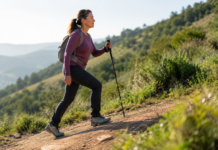
- Add hills or stairs on purpose. If your direct route is flat, a route that trades two extra minutes for a hill or a flight of stairs adds resistance work you won’t get otherwise.
- Walk the last mile instead of the whole trip. Parking or getting off transit ten to twenty minutes from the office and walking the remainder is often the most sustainable version of this step, since it doesn’t require restructuring the entire commute.
Step 3: Cycle Part or All of the Route
Cycling has the strongest evidence behind it of any single commuting strategy. In the same Finnish cohort study, cyclists showed lower BMI, smaller waist circumference, and higher aerobic fitness (measured by VO2 max) than those who drove or took transit, and the researchers attributed part of the gap to cycling’s naturally higher exercise intensity compared with walking at an ordinary pace. Separate epidemiological research cited in that study’s discussion found cycling to work associated with a 28 percent lower mortality rate, though that figure comes from observational data and can’t prove cycling itself caused the difference.
Getting started doesn’t require a road bike and full kit. A commuter bike, a rack or pannier for a bag, and a basic maintenance routine (tire pressure, chain lubrication, brake check) cover most needs. For anyone easing in, a hybrid week, biking two or three days and using another mode the rest, builds the habit and the leg strength without requiring daily commitment from day one.
Step 4: Pace-Interval Commuting
Once walking or biking the route feels manageable, pace intervals turn a fixed-distance trip into a genuine workout without adding time. The approach borrows from interval walking training, a protocol developed by Hiroshi Nose and Shizue Masuki at Shinshu University in Japan and first published in Mayo Clinic Proceedings in 2007. Their method alternates three minutes of walking above roughly 70 percent of peak aerobic capacity with three minutes at about 40 percent, repeated at least five times per session, four or more times a week.
A 2019 study following 679 participants with an average age of 65 found that this pattern improved peak aerobic capacity by an average of 14 percent and reduced a composite lifestyle-disease risk score by 17 percent over the study period, outcomes that outperformed steady, moderate-pace walking in head-to-head comparisons within the same research group’s earlier work.
Applied to a commute, the structure looks like this:
- Break your walk or ride into landmark-based segments: three lampposts, one city block, the distance between two intersections.
- Push the pace hard for one segment, ease off for the next, and alternate for the length of the trip.
- Use breathing as the intensity gauge if you don’t have a heart rate monitor: the hard segments should make conversation difficult; the easy segments should let you fully recover.
- On a bike, this translates to alternating a harder gear or higher cadence with a relaxed spin, matched to the same landmark or time-based segments.
Step 5: Carry a Weighted Bag Thoughtfully
Adding load to a walking commute, a practice with roots in military “rucking” training, increases the calorie and strength demand of the exact same route. Carrying roughly 20 percent of body weight in a well-fitted pack can roughly double energy expenditure compared with unloaded walking at the same pace, and loads around 30 percent of body weight can triple it. As a rough real-world comparison, a 170-pound person walking normally for an hour burns approximately 200 calories, while carrying a 25-pound pack over the same hour can burn closer to 400 to 500.
The load has to be introduced carefully, because a commute is not a controlled training environment and a sore back on a workday is a real cost. A sensible starting point is about 10 percent of body weight, around 16 pounds for a 160-pound person, increased by no more than about 5 pounds every two to three weeks as the back, shoulders, and core adapt. A few practical notes matter more than the math:
| Strategy | Best Commute Length | Typical Added Time | Training Effect |
|---|---|---|---|
| Brisk walking, full route | Under 2 miles | 10–25 min each way vs. driving | Low to moderate; higher with pace intervals |
| Cycling, full route | 2–8 miles | 0–15 min each way vs. driving | Moderate to high; strongest evidence base |
| Pace-interval walking or cycling | Any walkable/bikeable length | Same as base mode; no extra time | High for cardiovascular fitness |
| Weighted-bag walking | Under 3 miles | Same distance, slightly slower pace | High for strength and calorie burn |
| Transit-plus-walking hybrid | Any length | 5–15 min each way | Low to moderate; most scalable option |
Keep the pack close to the body with both shoulder straps used, not slung on one side. Choose a bag with a hip or sternum strap for anything over about 15 pounds, since that shifts load off the shoulders and lower back. Skip the added weight entirely on days already carrying a heavy laptop bag or gym kit, since the combined load can climb past a comfortable range without anyone noticing until the next day’s soreness shows up.
Step 6: Traffic and Safety Considerations You Shouldn’t Skip
None of the above matters if it results in an injury, and traffic is the primary risk in almost every walking or cycling commute. The clearest data point here comes from a systematic review and meta-analysis covering 40 studies and more than 64,000 injured cyclists: helmet use was associated with a 51 percent reduction in the odds of any head injury, a 69 percent reduction in the odds of serious head injury, and a 65 percent reduction in the odds of fatal head injury. The same review found no significant protective effect against neck injury, and its authors were direct that a helmet is not a substitute for defensive road behavior: it reduces the severity of a crash, not the odds of one happening in the first place.
Commute Safety Checklist
- Wear a properly fitted helmet on every ride, adjusted so it sits level and snug without room to rock.
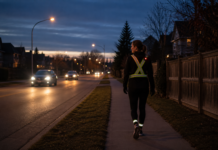
- Use front and rear lights any time visibility is reduced, including overcast mornings, not only after dark.
- Choose routes with bike lanes, wide shoulders, or sidewalks over faster arterial roads, even if it adds a few minutes.
- Make eye contact with drivers at intersections before crossing or turning; assume you have not been seen until confirmed otherwise.
- Wear reflective or high-visibility clothing, especially for early-morning or evening commutes in low light.
- Carry ID and a phone, and let someone know your general route and expected arrival time if it’s a new path.
- Check brakes, tire pressure, and chain lubrication weekly if cycling regularly, since a mechanical failure at speed is one preventable maintenance step away.
Step 7: Transit-Plus-Walking Hybrid Strategies
For commutes too long to walk or bike in full, or for days when weather, fatigue, or scheduling rules out the whole route, a hybrid approach keeps the training benefit without demanding an all-or-nothing choice. The basic pattern: take a bus, train, or car for the majority of the distance, then walk or bike the remaining segment.
A few versions of this work well in practice. Getting off transit one or two stops early and walking the rest adds a predictable, small block of activity, often five to fifteen minutes, without requiring any change to the main leg of the trip. Parking at the far end of a lot or a few blocks from the office accomplishes the same thing for drivers. Combining a folding bike with a train pass extends the reach of a cycling commute well past what would be practical to ride start to finish, since the bike only needs to cover the first and last mile rather than the whole distance.
The hybrid model also solves the weather and fatigue problem that trips up a lot of all-or-nothing commuting plans. A rigid rule of biking the entire route rain or shine tends to collapse after the first genuinely bad week; a rule of walking the last ten minutes regardless of mode is far easier to sustain because the cost of skipping it on a rough day is small and the cost of doing it is equally small.
Seasonal changes are worth planning for rather than treating as a reason to quit. Cold-weather commuting mostly comes down to layering: a wind-resistant outer layer, moisture-wicking base layers, and gloves and a hat that can be stuffed in a bag once body heat builds up. Wet-weather commuting benefits from fenders on a bike and a waterproof shell rather than an umbrella, which is unworkable on a bike and awkward on a brisk walk. Heat is usually the harder condition to manage on foot or by bike, since sweating before a workday raises the question of a change of clothes; an early start, a lighter pace, and a change of shirt kept at the office solve most of that problem without requiring a shower.
Realistic Time-Cost Tradeoffs
Every strategy above costs something in time, and pretending otherwise sets up a plan for failure. As a general guide: walking a mile takes 15 to 20 minutes at a brisk pace, compared to roughly 3 to 5 minutes by car over the same distance in light traffic. Cycling a mile takes about 4 to 6 minutes at a moderate commuting pace, which is close enough to driving time in congested areas that the difference often shrinks to nothing once parking and traffic lights are factored in.
The honest framing is that walking or cycling a short-to-medium commute usually costs somewhere between zero and twenty-five extra minutes each way compared with driving, and that cost drops close to zero in heavy traffic or when parking is difficult to find near the destination. Pace intervals and weighted-bag walking add no extra time at all over the base mode; they only change the intensity of the same trip. The transit-plus-walking hybrid is the cheapest option time-wise, typically adding five to fifteen minutes total, which makes it the most realistic starting point for anyone unsure whether they’ll stick with a bigger change.
A practical way to decide: try the smallest version of a strategy for two weeks, walking the last ten minutes or biking two days instead of five, before committing to anything larger. The habit that survives a bad-weather week and a rushed morning is the one worth keeping, and it’s easier to add distance or intensity to a habit that already exists than to rebuild one that collapsed under an overly ambitious start.
Making the Switch Stick
The commute is one of the few parts of a daily routine that repeats on a fixed schedule without needing to be scheduled. Treating it as a training window rather than dead time doesn’t require new equipment beyond what’s covered above, and it doesn’t require finding extra hours in a day that likely doesn’t have any to spare. Start with the smallest change that fits the route already in front of you: a brisker pace, the last ten minutes on foot, two days a week on a bike, and layer in intervals, load, or distance only once that first change has held for a few weeks. The trips were happening either way; the only real decision is how much of that time gets put to work.
Frequently Asked Questions
Is walking to work actually enough exercise on its own?
It depends on pace and consistency. Research on commuting patterns has found that ordinary-pace walking doesn’t reliably move the needle on fitness or body composition the way cycling does, largely because typical walking intensity is lower. Brisk walking, interval pacing, or adding a weighted bag closes much of that gap.
How much extra time should I expect if I switch from driving to cycling?
For most commutes under eight miles, cycling adds very little time compared with driving once parking and traffic lights are accounted for, often close to zero, and sometimes cycling is faster in congested areas.
Do I need a helmet even for a short, slow ride?
Yes. The injury-reduction data doesn’t distinguish by trip length or speed, and low-speed falls and intersection collisions are common causes of head injury on short urban rides.
What’s a safe amount of weight to add to a walking commute?
Start around 10 percent of body weight and increase gradually, by no more than about 5 pounds every two to three weeks, using a pack with a hip or sternum strap once the load exceeds about 15 pounds.
What if my commute is too long to walk or bike the whole way?
Use a hybrid approach: cover most of the distance by car or transit, and walk or bike the first or last segment. This adds a modest, predictable amount of time while still delivering a meaningful training effect.
Will this replace my regular workouts?
Not entirely. Commuting activity is best treated as additional daily movement layered on top of structured training and regular breaks from sitting, not as a full substitute for either.
References
- Vasankari, V. et al. “Cycling but not walking to work or study is associated with physical fitness, body composition and clustered cardiometabolic risk in young men.” PubMed, National Library of Medicine.
- Levine, J.A. “Non-exercise activity thermogenesis (NEAT).” Obesity Medicine Association clinical summary.
- Nose, H. and Masuki, S. Interval walking training research, Shinshu University Graduate School of Medicine; original protocol published in Mayo Clinic Proceedings, 2007.
- Høstmark, A.T. et al. Systematic review on sedentary behavior and metabolic risk, cited regarding the limits of daily exercise offsetting prolonged sitting.
- Olivier, J. and Creighton, P. “Bicycle injuries and helmet use: a systematic review and meta-analysis.” International Journal of Epidemiology, Oxford Academic.
- Rucking calorie-expenditure estimates drawing on the Pandolf load-carriage equation, as summarized in contemporary rucking-fitness research.