
























By Noah Sato
A pedestrian is killed in a traffic crash roughly every 74 minutes in the United States, and government crash data shows that more than three-quarters of those deaths happen after dark, even though only a fraction of all walking trips occur at night. That gap between exposure and risk is the part most people miss. Walkers tend to picture the danger of night walking as a matter of personal caution: stay alert, watch your step, keep to well-lit streets. In practice, the bigger issue is a visibility mismatch. A driver’s low-beam headlights typically illuminate a walker who is wearing dark clothing at a distance far shorter than the space needed to stop the car, so by the time a driver perceives a person in the roadway, physics has already decided the outcome.
This guide treats dark-walking safety as a system with several moving parts rather than a single rule to remember. It works through gear that makes you detectable, lighting choices that let you see and be seen, route decisions that reduce your exposure to risk, situational awareness habits that catch problems early, personal safety tools, and the simple but often-skipped step of telling someone where you are. None of these steps alone solves the problem. Together, they close most of the gap between how visible a night walker feels and how visible they actually are to a driver, a cyclist, or another person on the path.
Why the Risk of Walking in the Dark Is Widely Underestimated
Most pedestrians overestimate their own visibility at night. Researchers who study nighttime conspicuity have repeatedly found that people walking in ordinary clothing believe drivers can see them from much farther away than is actually the case, sometimes by a factor of two or three. The walker is standing under a streetlamp, can see the approaching headlights clearly, and assumes the reverse is equally true. It usually is not. A driver’s eyes are adjusting to headlight glare, scanning a windshield full of reflections, and trying to process a scene with much less contrast than what the pedestrian experiences.
The scale of the problem is visible in national crash data. In the most recent full year of federal reporting, 7,080 pedestrians were killed in traffic crashes in the United States, with more than 71,000 additional pedestrians injured. Preliminary data for the following year put the pedestrian death toll above 7,000 again, and safety researchers who track these figures found that more than three in four of those fatalities occurred after dark. Just as concerning, fatal nighttime pedestrian crashes climbed 84 percent between 2010 and 2023, compared with a much smaller 28 percent increase in daytime pedestrian fatalities over the same period. Night walking has not simply stayed dangerous, it has become the fastest-growing part of the pedestrian safety problem.
Several factors compound at night. Drivers have less time to react because their sight distance is shorter. Alcohol-impaired driving is more common after dark, and impaired drivers brake later and steer less predictably. Fatigue affects both drivers and walkers in the evening hours. And a pedestrian in dark clothing, which most people default to for evening walks and commutes, often blends directly into the shadowed background a driver is scanning. The result is a hazard that builds from several small, ordinary decisions, none of which feels risky in isolation.
A Step-by-Step Framework for Walking Safely in the Dark
The following steps are ordered the way a walker should actually think through an evening walk: first make yourself detectable, then make sure you can see the ground and hazards in front of you, then choose a route that reduces exposure, then build habits that keep your attention where it needs to be, then add a layer of backup tools, and finally make sure someone else knows your plan.
Step 1: Build a Visibility Layer With Reflective and High-Visibility Gear
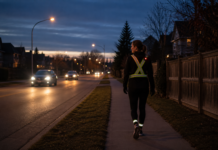
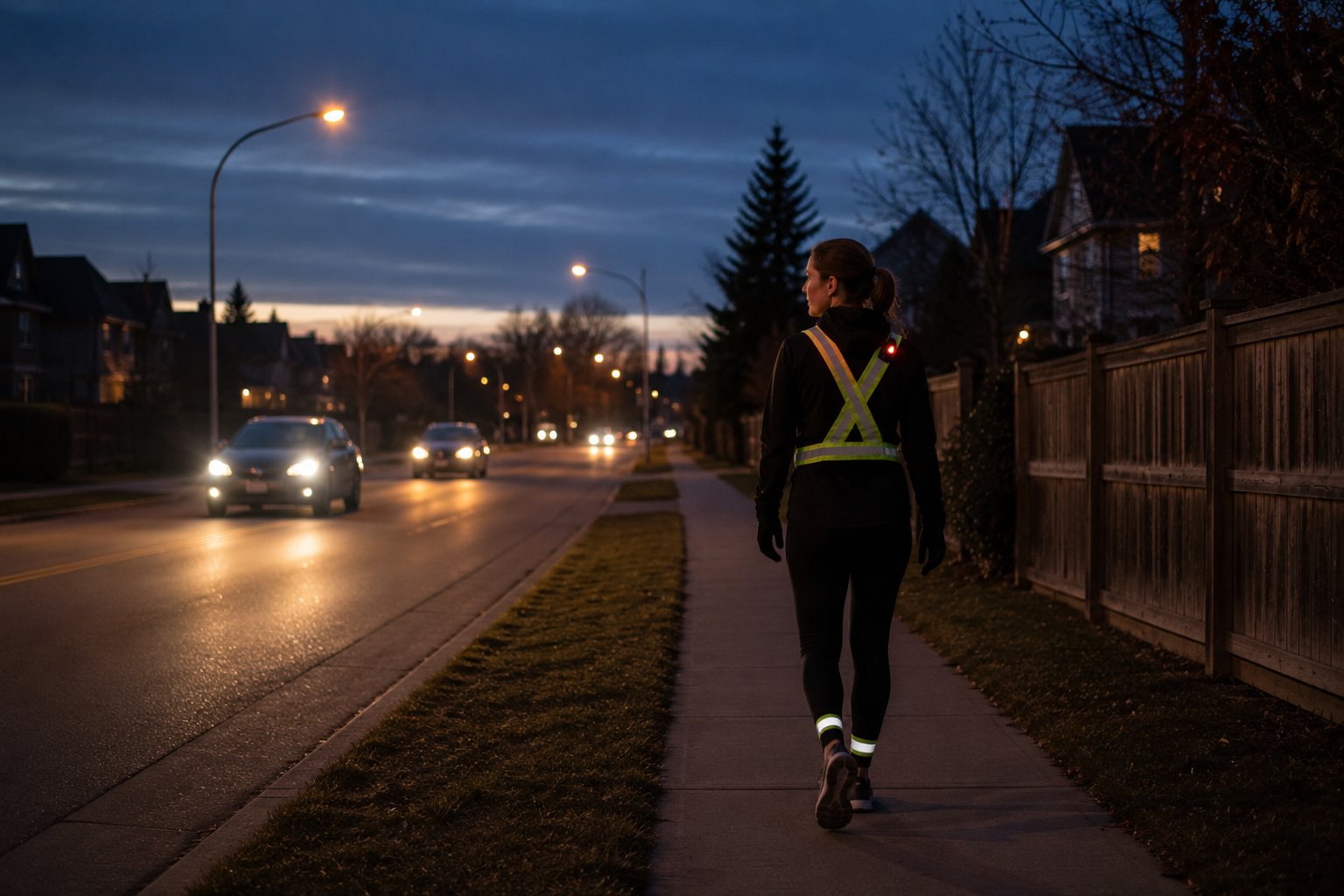
The single highest-leverage change a night walker can make is wearing gear designed to reflect a driver’s own headlights back at them. This is not the same as wearing “light-colored” or “bright” clothing. Retroreflective materials, the silver-grey strips used on running vests, backpacks, and shoe clips, are engineered to bounce light directly back toward its source, which makes them dramatically brighter to a driver than fluorescent or pastel fabric.
Placement matters as much as material. Biomechanics research on pedestrian conspicuity, often called biomotion studies, has found that retroreflective markings placed on the body’s moving joints, ankles, wrists, and knees, are recognized by drivers at distances roughly ten times farther than an identical amount of reflective material worn only on the torso, such as a standard reflective vest. The moving-joint pattern helps a driver’s brain quickly parse the shape as a walking person rather than a static, ambiguous object, which is what actually triggers early recognition and braking.
Gear Checklist for Night Walks
| Item | Where to Wear It | Why It Helps |
|---|---|---|
| Reflective ankle or wrist bands | Ankles and wrists | Moving-joint placement is recognized far sooner than static torso reflectors |
| Reflective vest or sash | Torso, over outer layer | Adds overall surface area and a chest-height silhouette |
| Clip-on LED light (steady or blinking) | Front and back of jacket | Active light source, visible even without headlights aimed directly at you |
| Headlamp or handheld flashlight | Forehead or hand | Lights the path ahead and signals your position to oncoming traffic |
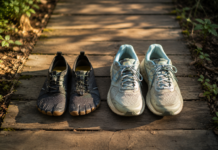
| Light-colored or reflective shoes | Feet | Reinforces the gait pattern drivers use to identify a person |
| Reflective dog leash or harness | If walking a dog | Prevents the leash itself from becoming an unseen tripping hazard for others |
Testing performed by student and academic researchers on garment visibility commonly checks recognition at 25, 50, 100, and 150 meters, distances chosen because they roughly correspond to the space a vehicle needs to stop at typical residential and arterial road speeds. Plain dark clothing frequently fails to register at all of these distances under low beams; retroreflective markings on limbs are picked up reliably even at the farthest test point. If you only make one change from this guide, layer reflective material at your ankles and wrists in addition to a chest-level vest.
Step 2: Use a Headlamp or Handheld Light, Even on “Lit” Streets
Streetlights are inconsistent. Spacing varies, bulbs burn out, and foliage blocks pools of light exactly where a curb, pothole, or root heave is most likely to trip someone. A headlamp or handheld flashlight does two jobs at once: it lets you see the ground and any obstacles a few strides ahead, and it gives oncoming drivers and cyclists an active light source rather than relying entirely on passive reflectors.
A few practical points on lights. Angle a headlamp down toward the ground rather than straight ahead, so you are not blinding oncoming drivers, cyclists, or fellow walkers. A steady beam is usually better for lighting your path, while a blinking or strobe light on your jacket is more effective at catching a driver’s peripheral attention from a distance. Keep a spare set of batteries or a charged power bank if you walk the same route regularly after dark, since a light failing halfway through a walk removes exactly the tool you were relying on.
Step 3: Choose Routes That Reduce Exposure to Traffic
Gear and lighting cannot fully compensate for a route that puts you in the path of fast-moving vehicles with no separation. Route selection is where a walker has the most control over overall risk, because it changes how much exposure to conflict you accept before a single car ever appears.
Favor streets with sidewalks, marked crosswalks, and lower posted speed limits over unlit arterial roads or highway shoulders, even if the arterial route is shorter. Where no sidewalk exists, walk facing oncoming traffic so you can see headlights approaching and react, rather than walking with your back to traffic. Cross only at intersections or marked crosswalks, and pause to make eye contact with a driver before stepping in front of a stopped or slowing vehicle, since eye contact is one of the more reliable ways to confirm a driver has actually registered you.
- Does this route have a sidewalk or shoulder wide enough to walk well clear of traffic?
- Are there streetlights, storefront lighting, or other ambient light along most of the path?
- Does the route avoid unlit stretches of high-speed roads, even if that means a longer walk?
If the answer to any of these is no, consider an alternate route, a different time, or a companion for that stretch.
It is also worth reconsidering timing rather than only the path. Walking at dusk, right as light is fading but before streetlights and headlights are both fully in use, is one of the more hazardous windows, since neither drivers nor pedestrians have fully adjusted their expectations to low-light conditions. Where your schedule allows it, shifting a walk to earlier in the evening, when some daylight remains, or later, once full dark has settled and drivers are more attuned to using headlights and scanning for pedestrians, can reduce this transitional risk.
Step 4: Practice Active Situational Awareness
Gear and route choices set up a safer walk, but attention is what catches the exceptions. Situational awareness at night means keeping your senses available rather than occupied elsewhere. Walking with one earbud instead of two, or at a volume that still lets you hear an approaching vehicle or bicycle, preserves an early-warning channel that noise-canceling headphones remove entirely.
Scan intersections and driveways before you reach them, since a driver pulling out of a driveway or alley is looking for headlights, not necessarily for a pedestrian on the sidewalk. Give parked cars and hedges a wider berth than you would in daylight, because they hide both approaching vehicles and anyone else who might be on the path. Avoid burying your attention in a phone screen while walking, both because the light temporarily impairs your night vision and because it removes your eyes from the environment during the exact minutes you need them most.
Trust discomfort. If a stretch of road, a person, or a situation feels off, changing your path, crossing the street, or turning back costs you very little compared with the alternative. Confident, aware body language, walking at a steady pace with your head up, also signals to others that you are alert, which on its own reduces the likelihood of being targeted for petty crime.
Step 5: Carry Personal Safety Tools as a Backup Layer
Personal safety devices are not a replacement for the steps above, but they add a layer of backup for the moments awareness and route planning cannot fully cover. A charged phone with location sharing enabled is the most universally useful tool, since it lets a trusted contact see your live position and lets you reach help quickly if needed. Many phones also include a hold-button emergency SOS feature that can alert contacts and share your location automatically.
A personal alarm, a small device that emits a loud siren when triggered, can startle an aggressor and draw attention from nearby homes or businesses. A whistle serves a similar, lower-cost purpose. Some walkers carry a small, legal, non-lethal deterrent such as pepper spray, though local laws on carrying such items vary and should be checked before purchase. Whatever tools you choose, keep them somewhere you can access in seconds, a jacket pocket or a hand, not buried at the bottom of a bag, since a tool you cannot reach quickly provides no real protection.
Step 6: Walk With Others and Always Tell Someone Your Route
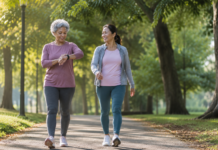
Where possible, walking with a friend, a family member, or a dog remains one of the most effective deterrents to both traffic risk and personal safety risk, since a group is easier for drivers to notice and less often targeted for crime. Community or workplace walking groups can make this a regular habit rather than an occasional favor.
When walking alone is unavoidable, tell someone your planned route and expected return time before you leave. A simple text message, “heading out for a 30-minute walk down Maple and back, should be home by 8,” takes seconds and gives someone a concrete reason to check in if you go quiet. Pair this with live location sharing during the walk itself so a delay is noticed immediately rather than after the fact. This single habit, more than any gear purchase, is what turns a solo night walk into one where help can be summoned quickly if something goes wrong.
Adjusting the Framework for Weather, Season, and Setting
The six steps above hold up across most situations, but a few conditions change how much emphasis each one deserves. Rain and fog cut visibility further than darkness alone, since wet pavement scatters headlight glare and a driver’s windshield wipers reduce the clarity of the scene even more. On rainy evenings, add an extra light source if you have one, slow your pace at crossings, and give yourself more buffer time before stepping into a crosswalk, since a driver’s stopping distance on wet pavement is longer than on dry roads at the same speed.
Winter walking brings its own layering problem: bulky coats often cover reflective gear worn underneath, and gloves and hats absorb rather than reflect light. Clip lights and reflective bands to the outside of your outermost layer rather than tucking them away, and check that a hood or hat brim is not blocking a headlamp’s beam. Ice and snow also change the awareness calculation, since a slip in the roadway takes longer to recover from than a slip on a sidewalk, which is one more reason to keep well clear of the travel lane in winter conditions.
Rural roads and suburban streets call for different route judgment than urban sidewalks. A rural road often has no sidewalk, minimal lighting, and higher speed limits, which raises the stakes of every choice in the route-selection step: walking facing traffic, wearing gear visible from as far away as possible, and timing walks to avoid rush-hour traffic all matter more, not less, in that setting. Suburban neighborhoods with sidewalks and 25 mph speed limits still benefit from the same gear and awareness habits, but the margin for error is naturally wider.
Walking with children or older family members after dark adds a coordination layer on top of the individual steps. Fit reflective gear to each person rather than assuming one adult’s vest covers the group, keep the group together rather than strung out along the sidewalk, and assign one adult to watch traffic at each crossing while the rest of the group waits. A dog on a reflective leash should walk on the side away from traffic, not the side closest to the road, so the leash and the animal are not pulled toward passing vehicles.
Bringing the Steps Together
None of these six steps is complicated on its own, and that is part of the point. Retroreflective gear at your ankles and wrists, a headlamp aimed at the ground, a route that keeps you off unlit high-speed roads, an attention span that stays with your surroundings instead of a screen, a personal alarm or phone ready in hand, and a text to someone before you leave the house. Layered together, these steps close most of the visibility and awareness gap that makes dark walking statistically riskier than it needs to be.
Treat the framework as a short pre-walk routine rather than a list to memorize once and forget. Before heading out after dusk, run through it in order: gear on, light charged and in hand, route chosen with sidewalks and lighting in mind, phone charged with location sharing ready, and a message sent to whoever should know where you are. That routine takes under two minutes and applies to a five-minute walk to the mailbox as much as it does to an hour-long evening run. Night walking does not have to be avoided altogether. It has to be planned for with the same seriousness that drivers are asked to apply when they get behind the wheel after dusk, and that planning is well within reach of anyone willing to spend a couple of minutes on it before locking the front door.
Frequently Asked Questions
Is it actually more dangerous to walk after dark, or does it just feel that way?
It is measurably more dangerous. Federal crash data shows that more than three-quarters of pedestrian fatalities occur after dark, and nighttime pedestrian deaths rose 84 percent between 2010 and 2023, far outpacing the 28 percent rise in daytime pedestrian fatalities over the same span. The perception and the data agree on this one.
What single piece of gear makes the biggest difference for visibility?
Retroreflective bands on your ankles and wrists tend to outperform a torso-only reflective vest by a wide margin. Biomotion research shows the moving-joint placement is recognized by drivers at roughly ten times the distance of reflective material worn only on the chest, because the movement pattern helps a driver’s brain register “person” more quickly.
Are reflective vests enough on their own, or do I need lights too?
Reflective material only works when a light source, typically a car’s headlights, is pointed directly at you. An active light, such as a clip-on LED or headlamp, is visible from more angles and does not depend on a driver’s headlights being aimed your way, which is why the two are meant to be combined rather than treated as substitutes.
Is it safer to walk facing traffic or with my back to it on a road without a sidewalk?
Facing traffic is safer. It lets you see an oncoming vehicle’s headlights and react, whether that means stepping further off the shoulder or pausing, rather than relying entirely on a driver noticing you from behind.
Should I wear headphones while walking at night?
If you want music or a podcast, keep one ear free or keep the volume low enough that you can still hear approaching traffic, footsteps, or a car horn. Removing your hearing entirely removes one of your main early-warning senses at exactly the time visibility is already reduced.
What is the most overlooked step in staying safe on a night walk?
Telling someone your route and expected return time. It costs nothing, takes a few seconds, and is often the single factor that gets help moving quickly if something does go wrong, whether that is a fall, a car issue, or a personal safety incident.
References
- National Highway Traffic Safety Administration, Pedestrian Safety data and countermeasures, nhtsa.gov/road-safety/pedestrian-safety
- Governors Highway Safety Association, Pedestrian Traffic Fatalities by State: 2024 Preliminary Data, ghsa.org/resource-hub/pedestrian-traffic-fatalities-2024-data
- Science Buddies, “Reflective Clothing and Pedestrian Safety: The Science of Being Seen,” sciencebuddies.org/blog/reflective-clothing-and-pedestrian-safety-the-science-of-being-seen
- Oakland Transportation Management Association, summary of biomotion research on retroreflective placement and driver recognition distance, otma-pgh.org