





























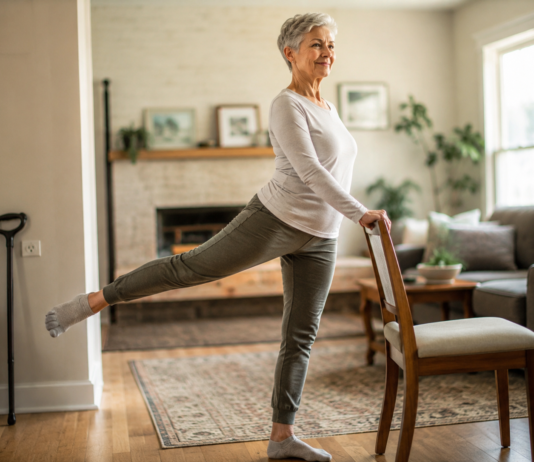

Wrist Mobility for Lifters and Desk Workers: A Combined Guide
Quick Answer
Wrist mobility affects both barbell training and desk work because the same joint has to tolerate two very different...

Thoracic Spine Mobility: Why It Fixes Shoulder and Neck Complaints
A stiff mid-back forces the shoulder blades and neck to pick up movement they were never built to supply on their own....

Spinal Rotation: Why You Lose It and How to Keep It
Quick answer
Spinal rotation, the ability to twist your trunk, comes mostly from your thoracic (mid-back) spine, with help from your...

Shoulder Mobility Screening You Can Do Against a Wall
Quick answer: Standing with your back against a wall and running through a wall slide, a wall angel, and a wall-supported shoulder...

Neck Mobility Without Aggravating Existing Pain: A Pain-Guided Approach
Quick answer
If your neck is already tender or achy, gentle, slow range-of-motion movement kept inside a pain-free or mildly uncomfortable...

Morning Stiffness: What Is Normal and What Is Not
Quick answer: A little stiffness when you first get out of bed is normal and usually eases within a few minutes of moving around....

Mobility vs Flexibility vs Stability: A Practical Distinction
Quick answer
Flexibility is how far a joint can move when something else does the moving (gravity, a strap, a partner)....

Mobility for Runners: The Four Areas That Matter Most
Quick Answer
For most runners, four mobility areas drive both efficiency and injury risk more than any others: ankle dorsiflexion, hip...

Mobility Work for People With Arthritis: Gentle Progressions
Quick Answer
For most people with arthritis, gentle movement helps rather than harms affected joints. Major guidelines from the Arthritis Foundation...

Loaded Stretching: How to Do It Without Overreaching
Quick Answer
Loaded stretching means adding light resistance, such as a band, cable, or dumbbell, to a stretch position instead of relying on bodyweight alone....
Joint Loading for Cartilage Health: Movement as Maintenance
Quick answer
Cartilage has no blood supply, so it depends on the mechanical pumping action of joint movement to draw in oxygen and nutrients from...

How to Test Your Own Mobility and Retest in Eight Weeks:...
Quick Answer
Test your mobility with a battery of five self-administered checks — overhead squat, weight-bearing ankle lunge, shoulder scratch reach,...

How to Regain Squat Depth Safely: A Step-by-Step Guide
Quick Answer
Most lost squat depth comes from a restriction in one of three places: the ankle (dorsiflexion), the hip (rotation...

How to Move Better With Hypermobility: A Step-by-Step Stability Guide
Quick answer
Moving well with hypermobility means training joint awareness and stability before range of motion, building strength within a controlled range rather than stretching...

How to Mobilize Before Lifting vs. Before Running: A Comparison Guide
Quick answer
Mobilizing before lifting should target the specific joints and movement patterns the day's lifts demand, using light, load-matched activation...

How to Keep Overhead Reach as You Age: A Step-by-Step Guide
Quick answer: Overhead reach naturally narrows with age largely because of soft-tissue stiffness, posture changes, and reduced rotator cuff and scapular strength, not because...

How to Build a Ten-Minute Daily Mobility Routine (Step-by-Step Guide)
Quick answer
A ten-minute daily mobility routine works best when it moves through the whole body in one continuous block, rather...

How to Build Mobility Into Workday Micro-Breaks
Quick answer: Build mobility into your workday by scheduling short movement breaks, roughly 2 to 10 minutes long, every 30 to 60 minutes instead...

Hip Mobility for People Who Sit Nine Hours a Day: A...
If you sit for roughly nine hours a day, your hips need two things: brief movement breaks scattered through the workday (not saved up...

Hip Flexor Tightness: Why Stretching Often Fails
Quick answer: That "tight" feeling in the front of your hips is often not a shortened muscle at all. Research on stretching and flexibility...

Foot Strength and Arch Function: A Neglected Foundation
Quick Answer
The arch of the foot is not a fixed shape held up by bone alone. It is a spring...

Fall Prevention Training for Adults Over 60: A CDC STEADI-Based Guide
Quick answer: The exercise programs that most reliably reduce falls in adults over 60 combine three elements: balance training, lower-body strength work, and gait...

End-Range Strength: Why Stretching Alone Does Not Hold
Quick answer: Static stretching reliably increases range of motion in the short term, but research tracking people after they stop shows a chunk of...

Balance Training: Progressions From Beginner to Confident
Quick answer: Balance training works best as a staged progression: start with simple, well-supported static holds, then gradually shrink your base of support, remove...

Ankle Dorsiflexion: How to Test and Improve It
Quick answer
Ankle dorsiflexion is how far your shin can travel forward over a fixed foot. You can screen it yourself with the weight-bearing lunge...

Three-Day Hybrid Template for People With Real Jobs
Quick answer: A three-day hybrid template works because it concentrates strength and cardio training into three focused, non-consecutive sessions a week, which lines up...

The Interference Effect: How Real Is It for Non-Athletes?
Quick answer
For most recreational lifters training three to five days a week, the interference effect is small to negligible for...

Strength-Endurance Circuits vs. True Hybrid Training: How to Tell Them Apart
Quick answer: Strength-endurance circuits (short rest, high reps, one continuous loop of stations) and true hybrid or concurrent training (a dedicated maximal-strength session plus...

Rucking Programming: Load, Distance and Progression Rules
Quick answer: Start a rucking load near 10 percent of bodyweight and cap most training loads at 30 percent, since injury-risk research on military...

Recovery Demands of Hybrid Training and How to Budget Them
Quick answer: Hybrid training stacks strength and endurance work on the same body in the same week, so it draws on sleep, food, recovery...