


























By Noah Sato
Cutting calories without a protein target is how people lose weight and end up looking like a smaller, softer version of themselves. The scale drops, but so does muscle, and the mirror doesn’t reward the effort the way it should. Protein is the one macronutrient with a direct, dose-dependent relationship to how much of that weight loss comes from fat versus lean tissue — which is exactly why “eat less” is not a complete plan.
Why Protein Targets Matter More During a Deficit
When calorie intake drops below what the body burns, it starts pulling energy from stored fat, but it also starts breaking down muscle protein for fuel and for amino acids needed elsewhere. Resistance training sends a signal to preserve muscle, and protein supplies the raw material to act on that signal. Without enough of either, a chunk of the weight lost during a diet comes from lean tissue rather than fat, which slows metabolism and makes the next phase of fat loss harder because muscle is metabolically active tissue.
Protein also has the highest thermic effect of the three macronutrients, meaning the body spends more energy digesting and processing it compared with carbohydrate or fat. It is more satiating per calorie, which matters when total intake is restricted and hunger becomes the main obstacle to sticking with a plan. Higher protein diets consistently score better on measures of fullness and diet adherence in controlled feeding studies, and adherence, more than any single macro ratio, determines whether a deficit is sustained long enough to matter.
None of this means protein is magic. A calorie deficit still has to exist for fat loss to happen. Protein’s role is to determine the composition of the weight that comes off, and to make the deficit easier to hold.
Muscle tissue also matters beyond appearance. It is one of the larger drivers of resting energy expenditure, meaning a body that retains more muscle through a diet burns somewhat more at rest afterward than one that loses an equivalent amount of weight mostly from lean tissue. That difference compounds over repeated diet cycles: a person who diets down while losing mostly fat keeps more of the metabolic “engine” that made the next round of fat loss possible, while someone who loses a large share of muscle each time enters each new attempt from a worse starting position. Protein intake is one of the few variables a person controls directly that influences which of those two outcomes happens.
Research-Backed Protein Ranges by Bodyweight and Activity Level
The right protein target is not one universal number. It scales with bodyweight, training status, and how aggressive the calorie deficit is. Below are ranges drawn from sports nutrition research rather than a flat rule of thumb.
Sedentary Adults Starting a Fat-Loss Phase
The baseline Recommended Dietary Allowance (RDA) for protein in the general population is 0.8 grams per kilogram of bodyweight per day, a figure set by the Institute of Medicine to prevent deficiency in a healthy, non-dieting adult. That number is not a fat-loss target. It was never designed to protect lean mass during a calorie deficit, and research on hypoenergetic diets consistently shows it falls short for that purpose. For a sedentary adult cutting calories without a structured training program, a range of roughly 1.2 to 1.6 g/kg/day is a more realistic floor to reduce muscle loss and support satiety, even without a resistance-training stimulus driving demand higher.
Moderately Active Adults
The International Society of Sports Nutrition’s 2017 position stand on protein and exercise concludes that 1.4 to 2.0 g/kg/day is sufficient for most exercising individuals to build and maintain muscle mass through positive protein balance. For someone doing regular cardio, recreational sports, or general activity a few times a week while in a deficit, sitting in the upper half of that range — around 1.6 to 2.0 g/kg/day — gives a margin of safety against the lean-mass losses that accompany calorie restriction.
Resistance-Training Individuals in a Deficit
This is where the research gets more specific. A 2018 systematic review and meta-regression published in the British Journal of Sports Medicine, pooling data from 49 studies and 1,863 participants, identified a breakpoint at 1.62 g/kg/day of total protein intake, beyond which additional protein produced no further resistance-training-induced gains in fat-free mass (95% CI: 1.03–2.20 g/kg/day). That threshold was established mostly in muscle-building contexts, but it is the closest thing sports nutrition has to a well-supported ceiling for lean-mass-per-gram efficiency.
For lifters dieting aggressively — particularly leaner individuals in a large deficit — the numbers run higher. Helms and colleagues’ 2014 review of evidence-based natural bodybuilding contest preparation recommends 2.3 to 3.1 g/kg of lean body mass per day during caloric restriction, scaling toward the top of that range as body fat drops and the deficit gets steeper. The ISSN position stand echoes this, noting that intakes above 3.0 g/kg/day have been associated with greater fat loss in resistance-trained individuals in some trials, likely through the combined effect of satiety, higher diet-induced thermogenesis, and stronger protection of lean tissue.
Training experience changes how much a given protein intake actually delivers, too. The Morton meta-regression found that resistance-trained participants gained roughly 0.75 kg more fat-free mass from added protein than untrained participants, who gained only about 0.15 kg more. In other words, an experienced lifter already applying consistent training overload gets substantially more out of hitting a higher protein number than someone just beginning a training program, where the training stimulus itself is doing most of the work. That does not mean beginners should ignore protein, but it does mean a new lifter can reasonably stay in the middle of a range rather than chasing the upper end reserved for advanced, lean, aggressively-dieting athletes.
What the Research Actually Shows
- ISSN (2017): 1.4–2.0 g/kg/day supports muscle maintenance in most exercising adults.
- ISSN (2017): a per-meal dose of about 0.25 g/kg, or 20–40 g absolute, maximizes muscle protein synthesis.
- Morton et al. (2018): resistance-training gains in fat-free mass plateau at 1.62 g/kg/day (95% CI 1.03–2.20).
- Helms et al. (2014): 2.3–3.1 g/kg lean mass/day is recommended during aggressive contest-prep dieting.
How to Calculate Your Individual Protein Target
Generic ranges are a starting point. Turning them into a personal number takes a few extra steps.
Step 1: Use Bodyweight, Not Goal Weight
Calculate targets from current bodyweight, not the weight a person hopes to reach. Basing intake on a future, lighter body under-shoots protein needs today, when the muscle-preservation demand is highest.
Step 2: Adjust for Body Fat Percentage
Protein needs scale with lean mass, not total mass, so total-bodyweight formulas overshoot for people carrying a higher body fat percentage. A simple correction: estimate lean body mass by subtracting estimated fat mass from total weight, then apply the higher end of the g/kg-lean-mass ranges (2.3–3.1 g/kg lean mass) for leaner individuals in a steep deficit, or a total-bodyweight range for those with more fat to lose, where the gap between total weight and lean mass is larger.
A worked example makes this concrete. A 90 kg man at roughly 28% body fat carries about 65 kg of lean mass. Applying a total-bodyweight range of 1.6–2.0 g/kg would put him at 144–180 g/day, while applying the leaner-individual range of 2.3–3.1 g/kg of lean mass to his 65 kg lean mass would suggest 150–200 g/day. Because he is not lean and is not doing an aggressive contest-style cut, the moderate total-bodyweight range is the more appropriate starting point; the lean-mass-based range is best reserved for people who are already fairly lean and pushing a steep deficit, where total-bodyweight math would overshoot by a wide margin.
Step 3: Match the Number to Training Status and Deficit Size
Someone lifting weights three or more times a week in a moderate 15–20% calorie deficit sits comfortably in the 1.6–2.4 g/kg/day range. Someone in a larger deficit, dieting toward a lean physique, or coming off a long stretch of training benefits from pushing toward the higher end, closer to the 2.3–3.1 g/kg lean-mass figure from contest-prep research. Someone who is mostly sedentary and not lifting can stay nearer the 1.2–1.6 g/kg/day floor without losing much practical benefit from going higher.
Step 4: Round to a Workable Number and Track It
A target of “127 grams” is harder to hit consistently than “about 130 grams” split across three or four meals. Round to a number that is easy to plan around, then track actual intake for one to two weeks using a food scale or tracking app to see how close real eating comes to the target before adjusting further.
Practical Food Sources and Meal-Structuring Tips
Protein-Dense Whole Foods
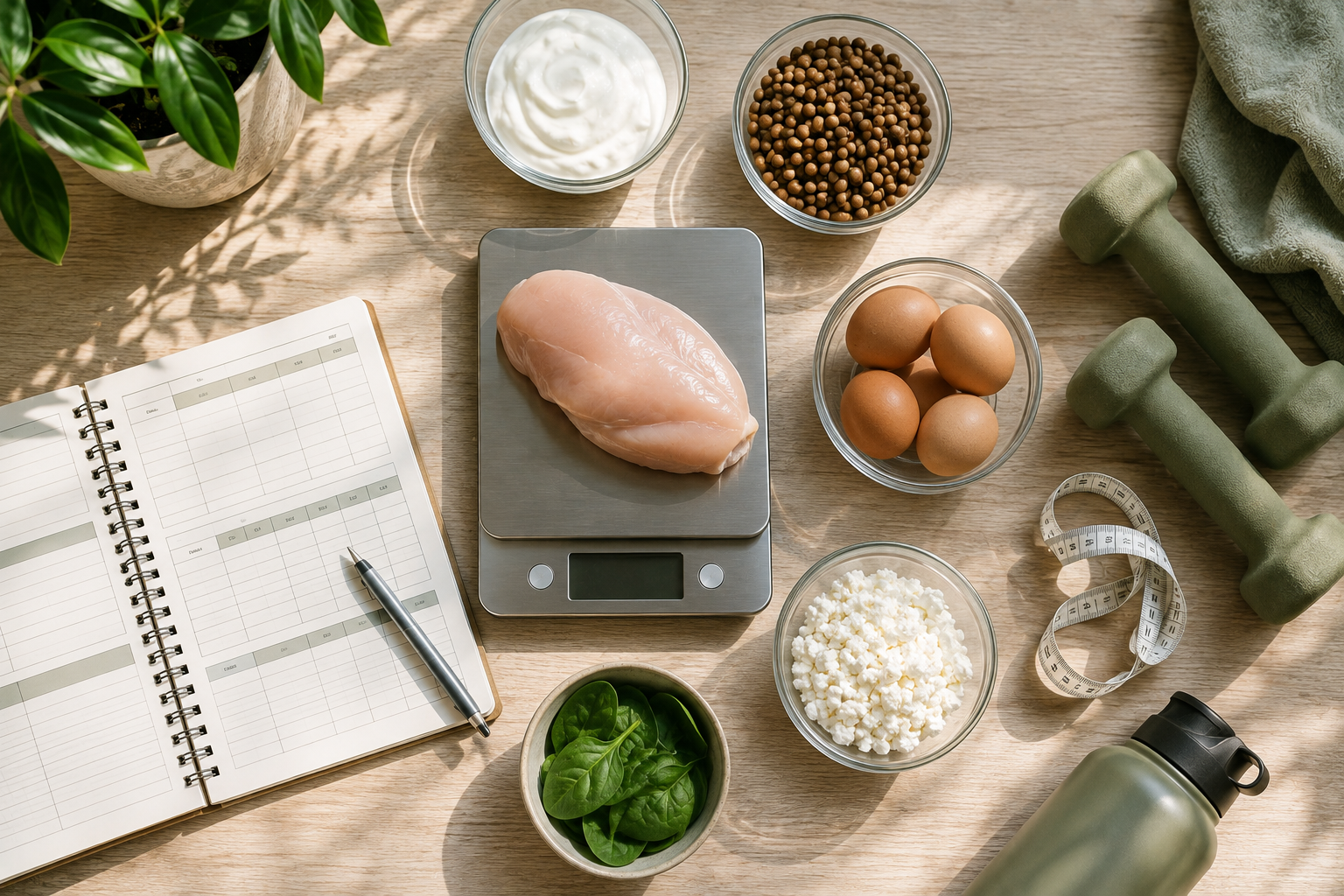
Chicken breast, turkey, lean beef, fish, and eggs deliver 20–30 grams of protein per typical serving with minimal added fat or carbohydrate, which is useful when total calories are already restricted. Greek yogurt and cottage cheese offer 15–20 grams per cup along with calcium and a texture that works well for high-volume, low-calorie meals. Lentils, beans, tofu, tempeh, and edamame are the strongest plant-based options, typically providing 12–18 grams per cooked cup, though combining a few different plant sources across the day helps cover the full amino acid profile that a single plant food may lack.
Not all protein sources are equal in how efficiently the body uses them to build and maintain muscle. Animal sources, including eggs, dairy, meat, and fish, are complete proteins containing all nine essential amino acids in proportions the body absorbs and uses well. Most single plant sources are lower in one or more essential amino acids, which is why pairing grains with legumes, or simply eating a variety of plant proteins across the day rather than relying on just one, closes that gap for people eating a vegetarian or vegan diet. Total protein volume across the day still matters most, but food quality affects how much of that volume actually translates into preserved or built muscle.
Distributing Protein Across Meals
Spreading protein across three to five meals, each containing roughly 0.25 g/kg or 20–40 grams, aligns with the per-meal dosing research behind maximal muscle protein synthesis rather than loading most of the day’s total into one large dinner. In practice, that looks like eggs or Greek yogurt at breakfast, a chicken or tofu bowl at lunch, a protein shake or cottage cheese as a snack, and a fish or lean beef dinner. This structure also blunts hunger more evenly through the day than back-loading protein late.
Using Supplements Sensibly
Whey, casein, or plant-based protein powders are a convenient way to close a gap between whole-food intake and the day’s target, especially around workouts or on busy days, but they are a tool for hitting a number, not a substitute for the underlying target itself. A shake does not fix a day where total protein was never planned for in the first place.
A Sample Day at a 140-Gram Protein Target
Numbers on a page are easier to apply with a concrete example. The layout below is built for someone targeting roughly 140 grams of protein across four meals, close to the 1.6–2.0 g/kg/day range for an 80-kilogram, moderately active dieter.
The exact foods matter less than the pattern: a protein source at every meal, none of them skipped, and no single sitting left to carry the whole day’s total. Swapping any item for a similar-protein alternative — turkey for chicken, tofu for salmon, a different bean for lentils — keeps the same structure while fitting personal taste and budget.
Common Mistakes People Make With Protein Targets
Setting the Target Too Low
The most frequent error is anchoring to the general RDA of 0.8 g/kg/day, a figure meant to prevent deficiency in a non-dieting adult, and assuming it also covers a calorie-restricted, training body. It does not. Dieters who eat at RDA levels while cutting calories lose a larger share of lean mass than those eating in the ranges described above, and that lost muscle is difficult to regain later.
Backloading Protein Into One Meal
Hitting the daily gram target while eating almost all of it at dinner leaves earlier meals under-dosed relative to the roughly 20–40 gram per-meal threshold associated with maximizing muscle protein synthesis. Total daily intake still matters most, but distribution improves how efficiently that intake is used.
Ignoring Training Status When Setting the Range
A sedentary dieter does not need to chase the 2.3–3.1 g/kg lean-mass numbers built for lean, resistance-trained bodybuilders in contest prep, and an experienced lifter in a steep deficit shortchanges recovery by staying at the low end meant for someone doing occasional cardio. Matching the range to actual training load and deficit size avoids both over- and under-shooting.
Treating Protein as a Substitute for a Calorie Deficit
Higher protein improves body composition outcomes during fat loss, but it does not create fat loss on its own. A person eating at maintenance calories with excellent protein intake will preserve muscle well and still not lose fat, because the deficit — not the macro split — is what drives weight down.
Never Reassessing the Target
As bodyweight drops over weeks of dieting, the gram target calculated from an earlier, heavier bodyweight becomes progressively too high relative to current weight, though rarely by an amount that causes harm. Recalculating every few weeks, or whenever bodyweight shifts by several kilograms, keeps the number aligned with the body actually being fed.
Estimating Instead of Measuring
Guessing that a chicken breast is “about 30 grams of protein” without ever weighing a portion tends to drift low over time, since restaurant and home-cooked portions are frequently smaller than the mental reference point a person built from a nutrition label. Weighing food with a kitchen scale for one to two weeks, even loosely, calibrates that mental estimate and makes future guessing far more accurate.
Key Takeaways
A useful protein target during fat loss is not a single number pulled from a supplement label. It is a range chosen based on current bodyweight, training status, and how steep the calorie deficit is: roughly 1.2–1.6 g/kg/day for sedentary dieters, 1.6–2.0 g/kg/day for moderately active adults, 1.6–2.4 g/kg/day for resistance-trained lifters in a standard deficit, and 2.3–3.1 g/kg of lean mass for lean, heavily-training individuals in an aggressive cut. Built from whole foods, spread across several meals, and reassessed as bodyweight changes, that target does more to protect the muscle underneath a weight-loss result than almost any other single dietary lever.
Progress is easiest to judge with more than one measurement. Bodyweight trending down while strength in main lifts holds steady, or drops only slightly, is a good sign that protein intake and training are doing their job of protecting lean tissue. A waist or hip circumference measurement taken every couple of weeks adds a second data point that is less noisy than a daily scale reading, since bodyweight fluctuates with water and food volume in ways that circumference and strength do not. When strength drops sharply or bodyweight falls faster than roughly 1% per week for an extended stretch, it is worth checking whether protein intake, total calories, or training volume needs adjusting before continuing the same plan for another month.
Frequently Asked Questions
How much protein do I need per day to lose fat without losing muscle?
Research supports roughly 1.6–2.4 g/kg of bodyweight per day for most people doing resistance training in a calorie deficit, with sedentary dieters doing reasonably well closer to 1.2–1.6 g/kg/day and lean, aggressively-dieting lifters benefiting from 2.3–3.1 g/kg of lean body mass per day.
Is more protein always better for fat loss?
No. Research on resistance-training-induced muscle gains found a plateau around 1.62 g/kg/day, beyond which extra protein added little further benefit for that specific outcome. Very high intakes above 3.0 g/kg/day have shown some fat-loss benefit in certain trials, largely through appetite control and thermic effect, but returns diminish well before that point for most goals.
Should I calculate protein targets from total bodyweight or lean body mass?
Total bodyweight works reasonably well for people who are not significantly overweight. For individuals carrying more body fat, calculating from an estimated lean body mass avoids over-prescribing protein, since metabolically active lean tissue, not fat mass, is what actually drives protein requirements.
Does protein timing matter as much as the daily total?
Total daily protein intake is the stronger driver of outcomes, but spreading it across three to five meals of about 20–40 grams each — roughly 0.25 g/kg per meal — appears to make better use of that total by repeatedly maximizing muscle protein synthesis throughout the day rather than concentrating it in one sitting.
Can I hit these protein targets on a plant-based diet?
Yes, though it typically takes more planning. Lentils, beans, tofu, tempeh, edamame, and plant-based protein powders can reach the same gram targets as animal sources; combining a variety of plant proteins across the day helps cover the amino acid profile that a single source might miss.
Do older adults need a different protein target?
Many researchers argue for protein intakes at the higher end of the ranges discussed here for older adults, since aging is associated with reduced sensitivity to the muscle-building effects of protein per meal. That is a related but separate topic from the bodyweight-and-activity framework covered in this article, and anyone with specific medical or kidney-related concerns about protein intake should check with a physician or registered dietitian first.
References
- Jäger R, Kerksick CM, Campbell BI, et al. International Society of Sports Nutrition Position Stand: Protein and exercise. Journal of the International Society of Sports Nutrition. 2017;14:20.
- Morton RW, Murphy KT, McKellar SR, et al. A systematic review, meta-analysis and meta-regression of the effect of protein supplementation on resistance training-induced gains in muscle mass and strength in healthy adults. British Journal of Sports Medicine. 2018;52(6):376–384.
- Helms ER, Aragon AA, Fitschen PJ. Evidence-based recommendations for natural bodybuilding contest preparation: nutrition and supplementation. Journal of the International Society of Sports Nutrition. 2014;11:20.
- Institute of Medicine (National Academies). Dietary Reference Intakes for Energy, Carbohydrate, Fiber, Fat, Fatty Acids, Cholesterol, Protein, and Amino Acids. National Academies Press; 2005.