














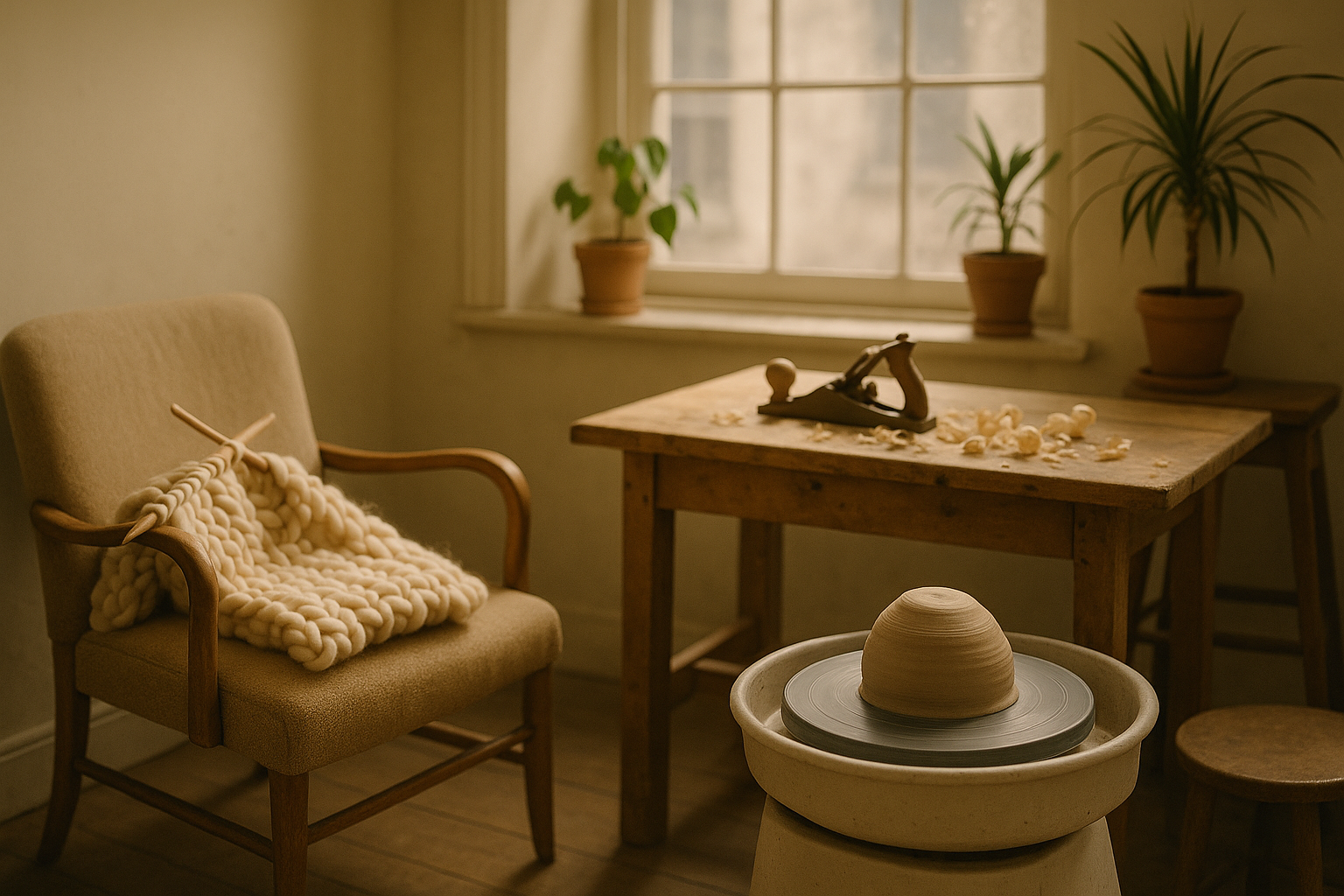
Mindful crafting is the deliberate use of hands-on projects—like knitting, woodworking, or pottery—to anchor attention in the present and steady the nervous system. By pairing simple, repeatable motions with sensory feedback, you can lower mental noise and restore cognitive focus while making something tangible. This guide shows you exactly how to turn your craft time into a reliable calm routine, with safety and accessibility in mind. Educational note: this article is informational and not a substitute for medical care or professional training; follow relevant safety standards and consult qualified professionals when needed.
Quick-start (5 steps):
- Set a single intention (“thirty quiet minutes”).
- Prepare materials and safety gear.
- Use a breath-to-motion rhythm.
- Pause every 20–30 minutes to stretch and check posture.
- End with a small reflection or cleanup ritual.
1. Set a Clear Intention and Micro-Goal Before You Start
A mindful session begins with deciding what calm will look like for the next 20–45 minutes, then choosing a micro-goal that fits: one swatch of garter stitch, planing a board’s face flat, or centering 500 g of clay. Stating your intention out loud (“I’m here to breathe, notice the material, and finish one small step”) reduces decision fatigue and creates a built-in finish line. In knitting, a row count is a natural unit; in woodworking, a pass count or a pencil-line target works; at the wheel, centering and opening the clay provides a crisp milestone. Micro-goals help you avoid the anxious urge to multitask or “finish everything,” which often defeats the whole point of crafting for calm. They also make it easier to practice stopping—ending on purpose rather than when you’re exhausted. Over time, you’ll link these short, successful sessions with a quieter mind and better focus.
1.1 How to do it
- Write a one-line intention on a sticky note where you work.
- Pick one measurable unit (rows, passes, grams) and stick to it.
- Set a timer for 25–30 minutes so the session has edges.
- Decide in advance how you’ll close (photo, tidy tools, note).
- If you finish early, stop anyway; bank the win for next time.
1.2 Common mistakes
- Vague intentions (“be productive”) that invite overreach.
- Stacking goals (three projects at once).
- Skipping a closing ritual, which weakens habit formation.
Synthesis: A tiny, well-defined target plus a planned close turns crafting from “open-ended task” into a reliable, calming practice you can actually sustain.
2. Pair Breath With Repetition in Knitting (Rows as a Metronome)
Knitting is built on rhythm—loops, tension, and the gentle click of needles—making it ideal for breath-paced focus. Start by choosing a simple stitch pattern (garter or stockinette) so attention can rest on sensation rather than counting complexity. Your left hand becomes a tactile anchor (yarn tension), the right hand executes motion (needle transfer), and your breath keeps time. Try two slow breaths per stitch cluster or one breath per four stitches; when thoughts wander, return to the feel of yarn sliding over skin. Use a row as your “lap”: finish it, pause your shoulders and jaw, sip water, and scan for tension. This pattern invites a quiet, sustained attention and makes it easy to pick up where you left off without mental friction.
2.1 How to do it
- Choose needles that suit yarn (e.g., 5–6 mm for bulky wool for beginners).
- Practice 4-stitch breathing: inhale while placing stitches 1–2, exhale for 3–4.
- Use row markers every 10 rows to create natural check-ins.
- Keep wrists neutral and shoulders relaxed; adjust chair height.
- End with blocking or a progress photo to reinforce the ritual.
2.2 Tools & guardrails
- A simple row counter or phone timer avoids mental tracking.
- Prefer natural fibers (wool, cotton) early on; their grip improves control.
- If fingers tingle or ache, pause; short, frequent sessions beat marathons.
Synthesis: Treat stitches as a breath metronome, and knit rows become miniature meditations that soothe without straining attention.
3. Use Planing, Sanding, and Shaping in Woodworking as Moving Meditation
Hand planing and sanding produce immediate feedback—sound, resistance, shavings—that reward steady attention. Begin with a safe, simple surface task: flatten one board face, break an edge, or hand-sand to a grit milestone. Let each stroke match a slow exhale; reset grip and posture on the inhale. Keep your stance athletic, core engaged, and feet planted—this reduces strain and channels restless energy into smooth motion. Because woodworking involves hazards (edges, dust, noise), mindful calm here depends on predictable safety routines: eye and hearing protection, dust collection/respirator, and sharp tools used with intention. The goal isn’t speed; it’s consistency—ten clean strokes beat fifty rushed ones.
3.1 How to do it
- Pick one objective: e.g., plane to remove pencil marks uniformly.
- Work with the grain; adjust angle by feel and shaving quality.
- Sand in grit ladders (80 → 120 → 180 → 220), 10–20 passes each.
- Use light pressure—let the tool do the work to maintain rhythm.
- After each grit, wipe dust and rotate the piece to reset attention.
3.2 Safety & setup
- Wear eye/hearing protection; manage dust with a shop vac or respirator.
- Keep blades sharp; dull edges demand force and break flow.
- Clamp workpieces; stability is a prerequisite for calm.
Synthesis: With stable setups and simple surface goals, woodworking transforms into a body-based meditation that’s both grounding and productive.
4. Centering and Throwing Clay: The Pottery Wheel as a Flow Engine
Centering clay demands presence: you can’t fake symmetry under your palms. Start with 400–700 g of prepared clay; wedge it to align particles and remove air. On the wheel, anchor elbows to hips, breathe, and lean with your body—not just your hands. The clay “tells” you when it’s centered (vibration fades, surface smooths); then open and pull with a steady, even lift. The wheel’s hum plus water’s cool slip cues a parasympathetic shift, but don’t chase perfection—chase uniformity of pressure and pacing. Mindful pottery is also mindful of silica safety: wet clean, avoid dry sweeping, and use ventilation so calm never trades off with respiratory risk.
4.1 How to do it
- Wedge for 1–2 minutes until the clay “peels” cleanly.
- Cone up/down 2–3 times while breathing evenly to pre-align the clay.
- Use slow-to-medium wheel speed for control; fast isn’t calmer.
- Keep one hand steady as an anchor; move the other deliberately.
- Stop at one form (a cylinder or bowl) to avoid decision overload.
4.2 Numbers & guardrails
- Target 3–5 pulls per wall; more can overwork and collapse.
- Maintain even wall thickness (~5–7 mm for beginners).
- Clean with water and sponge; avoid creating airborne dust.
Synthesis: Pottery’s centering and pulling sequence trains equal parts attention and patience—flow emerges when pressure, speed, and breath stay even.
5. Choose Materials and Textures That Regulate Your Senses
Materials shape mood. Lofty wool cushions the hands and quiets fidgeting; dense cotton makes stitches crisp. Straight-grained pine planes like butter; interlocked grain demands slower, shorter strokes. Stoneware clay holds form longer than porcelain, which amplifies every wobble. Picking the right sensory profile—temperature, drag, weight, sound—helps your nervous system settle. If you’re easily overstimulated, pick quieter textures (matte yarns, hand tools, slower wheels). If you struggle to stay alert, choose materials that talk back: audible knitting needles, aromatic woods, gritty clay bodies. Sensory-fit reduces frustration, increases perceived control, and makes practice feel restorative rather than draining.
5.1 How to do it
- Audit sensations: list what calms (warmth, soft drag) vs. agitates (squeak, glare).
- Start with beginner-friendly options: wool or wool-blends, straight-grained softwoods, mid-plasticity stoneware.
- Match tools to materials (needle size to yarn; plane iron camber to cut).
- Introduce one variable at a time to learn its feel.
- Keep a materials log noting mood and ease each session.
5.2 Common mistakes
- Chasing exotic materials that frustrate skill-building.
- Ignoring lighting and color—harsh glare or low contrast strains eyes.
- Switching too many variables at once so you can’t tell what changed.
Synthesis: When materials fit your sensory profile, the craft greets you like a friend—attention follows naturally.
6. Build a Distraction-Proof Setup and Repeatable Ritual
Calm thrives on frictionless starts and predictable patterns. Design your space so the next session is one switch away: project bag prepped with yarn and needles, bench cleared with tools staged, wheel splash pan clean with a wrapped bat ready. Add lighting that reduces shadows and a comfortable seat or stance that keeps joints neutral. Then script a before–during–after ritual: cue (tea, playlist, timer), practice (breath-matched work), close (photo, tidy, jot one line). Rituals reduce decision-making, signal safety to the brain, and create a satisfying “end” so sessions stop before fatigue or aches.
6.1 How to do it
- Use a tray or caddy to batch tools by project.
- Keep PPE in arm’s reach (glasses, ear protection, respirator where relevant).
- Set a 30–60 lux/cm²-equivalent task light estimate (practically: a bright, diffused desk lamp positioned to the side to minimize glare).
- Place a standing mat or supportive chair to keep posture neutral.
- Create a one-song warmup (cast on 10 stitches, 10 plane strokes, 30 seconds centering).
6.2 Mini-checklist
- Surfaces clear?
- Timer set?
- Safety gear on?
- Phone silenced/away?
- End note/cleanup planned?
Synthesis: A repeatable environment and ritual turn crafting from “something to fit in” into a dependable decompression routine.
7. Pace, Pause, and Recover With Gentle Metrics
Mindful crafting rewards steady pacing over heroic bursts. Use soft metrics to regulate effort: rows per 10 minutes, shavings per pass, wall thickness by caliper. Pair these with scheduled pauses—every 20–30 minutes, relax shoulders, open hands, sip water, and scan for numbness or strain. Gentle metrics reduce self-judgment (“am I good?”) and replace it with process checks (“is my pace even?”). If a session goes sideways—knots in yarn, tear-out in grain, collapsing clay—practice active recovery: stop, breathe, step back, and reset a smaller goal. Recovery protects your calm more than perfection ever could.
7.1 How to do it
- Choose one metric per session (e.g., 3 rows/10 minutes; 10 clean strokes; 6 mm walls).
- Set vibration reminders on a timer for micro-breaks.
- Track comfort (0–10) at start/end; aim for stable or improved.
- Keep hand stretches in view and do them on every pause.
- End with a two-sentence journal: what felt smooth, what to try next.
7.2 Numbers & guardrails
- New knitters: sessions of 20–30 minutes minimize hand fatigue.
- Hand-tool sanding: 10–20 passes per grit keeps rhythm without overworking.
- Wheel work: limit to one form until consistency is routine.
Synthesis: Light-touch metrics plus planned breaks preserve flow and make progress visible without pressure.
8. Make Mistakes Part of the Method: Rework Without Self-Critique
Calm collapses when errors feel like judgments. Instead, treat mistakes as signals: yarn tension off, plane skewed, clay under-compressed. Build rework into your method: “frog” a few rows to correct a twisted stitch; mark and re-plane a high spot; wire off and reclaim a wobbly form. This mindset preserves learning and keeps the nervous system out of threat mode. Use neutral language (“the cut tore because grain reversed”) and experiment with two fixes before you quit. Over time, rework becomes a satisfying sub-skill that prevents small issues from growing into discouraging failures.
8.1 How to do it
- Create a redo buffer: expect to redo up to 10% of a session.
- Label errors objectively (tension, angle, moisture) rather than “I’m bad.”
- Practice two remedies per error (e.g., loosen grip vs. change needle).
- Keep scrap wood and practice clay specifically for experiments.
- Save a “mistakes shelf” as a visual record of growth.
8.2 Tools/Examples
- Knitting: lifelines in lace; smaller needles to tighten loose rib.
- Woodworking: card scraper to erase tear-out; shooting board for square ends.
- Pottery: rib compression for rims; calipers to check thickness.
Synthesis: When rework is normalized, curiosity replaces criticism—and calm endures even on messy days.
9. Close the Loop: Share, Gift, or Journal to Reinforce Calm
Mindful crafting becomes stickier when it connects to meaning beyond the session. Sharing progress with a friend, gifting a small wooden tray, or noting what felt peaceful in a journal ties craft to relationships and self-knowledge. This closing loop also guards against perfectionism: a simple, thoughtful coaster or wobbly bowl can still deliver warmth and purpose. Choose low-pressure formats (private album, local group, or a donation program) and treat each share as the end of a cycle—acknowledge the calm you built, not just the object you made.
9.1 How to do it
- Snap two photos: one detail, one context, then stop.
- Write a three-line reflection: intention, one sensation, one learning.
- Keep a “gift box” of small makes ready to give.
- Join a low-stakes circle (library knit night, community studio hours).
- Schedule a monthly review to celebrate small wins.
9.2 Common mistakes
- Posting for validation instead of connection (watch for anxiety spikes).
- Hoarding projects “until perfect” and never sharing.
- Over-documenting; one minute of reflection is enough.
Synthesis: Closing with connection or reflection consolidates the calm you cultivated—and motivates your next mindful session.
FAQs
1) What is “mindful crafting” in one sentence?
It’s using hands-on, repetitive creative work—like knitting, woodworking, or pottery—to anchor attention in the present with deliberate pacing, safety, and simple goals so your body and mind downshift together. You’re not chasing output; you’re practicing steady presence while you make something tangible.
2) How long should a mindful session be if I’m just starting?
Aim for 20–30 minutes. That’s long enough to find rhythm without overloading joints, nerves, or attention. If you finish your micro-goal early, stop anyway; ending on purpose is part of training your brain that craft time is safe and satisfying, not a race to exhaustion.
3) Is knitting, woodworking, or pottery “better” for calm?
Pick the one whose sensations you enjoy. Knitting offers soft, portable repetition; woodworking offers rhythmic full-body motion; pottery offers immersive, centered touch. The best craft is the one you’ll practice consistently and safely; enjoyment and fit beat any theoretical advantage.
4) How do I avoid aches and repetitive strain?
Use neutral wrist/shoulder positions, take breaks every 20–30 minutes, vary tasks (e.g., switch grips or stances), and stretch gently during pauses. Choose tool sizes that match materials, keep edges sharp in the shop, and stop if you feel tingling, numbness, or pain—resume after rest or adjustments.
5) What basic safety do I need to stay calm in the woodshop?
Wear eye and hearing protection, control dust (collection plus respirator when needed), clamp work securely, and keep tools sharp. A stable, well-lit setup is the foundation of calm; safety routines reduce background stress and allow attention to rest on the work rather than worry.
6) Is clay dust dangerous during pottery?
Dry clay can contain respirable crystalline silica. Wet-clean surfaces, avoid dry sweeping, use ventilation, and keep sanding or trimming dust controlled. Good studio hygiene keeps the practice restorative while protecting your lungs—especially during trimming and cleanup.
7) What if I get frustrated when things go wrong?
Build rework into your method. Name the problem neutrally (tension, angle, moisture), try two fixes, and set a redo buffer (about 10% of session time). Frustration usually drops when errors are expected and handled as part of learning rather than as judgments about your ability.
8) How can I track progress without killing the vibe?
Use gentle metrics: rows per 10 minutes, a grit ladder completed, wall thickness consistency. Pair metrics with short reflections (“the yarn felt grippy today; lighter tension helped”). Process visibility—not scoring—keeps motivation up without pressure.
9) What minimal gear do I need to start knitting mindfully?
One ball of medium-weight wool, 5–6 mm needles, a yarn needle, a row counter or slip-on markers, and scissors. Add a notebook for intentions and reflections. Start with garter stitch swatches; simplicity lets your senses settle and your breath set the pace.
10) Can I practice mindful crafting in short breaks at work or with kids around?
Yes—keep a small project bag or a pocket-size whittling stick (where safe/legal) or hand-building clay. Use micro-goals (one row, five strokes, a small pinch pot stage), a three-minute breathing warmup, and a tidy close. Short, clean cycles compound into a reliable calm habit.
Conclusion
Mindful crafting works because it pairs repetitive, sensory-rich motions with clear edges: an intention to start, a simple metric to guide pace, and a ritual to close. Across knitting, woodworking, and pottery, the same principles apply—pick materials that fit your sensory profile, build a distraction-proof setup, and treat mistakes as part of the method. Safety and ergonomics are not add-ons; they’re what make calm sustainable. Over time, these practices rewire your default from scattered and pressured to steady and present, with a shelf of small, meaningful objects to show for it. Choose one practice from this guide, script your next 30-minute session, and let your hands lead your mind home.
CTA: Pick a craft, pick a micro-goal, and schedule one calm session this week.
References
- Corkhill, B., Hemmings, J., Maddock, A., & Riley, J. (2014). Knitting and Well-being. British Journal of Occupational Therapy. SAGE Journals. https://journals.sagepub.com/doi/10.4276/030802214X14151078348209
- Knit for Peace (2019). The Health Benefits of Knitting. Knit for Peace. https://www.knitforpeace.org.uk/wp-content/uploads/2019/01/Health-benefits-of-knitting-final.pdf
- World Health Organization Regional Office for Europe (2019). What is the evidence on the role of the arts in improving health and well-being? A scoping review. WHO Europe. https://www.euro.who.int/en/publications/abstracts/what-is-the-evidence-on-the-role-of-the-arts-in-improving-health-and-well-being-a-scoping-review-2019
- American Art Therapy Association (2024). About Art Therapy. AATA. https://arttherapy.org/about-art-therapy/
- U.S. Occupational Safety and Health Administration (OSHA) (2023). Woodworking eTool. OSHA. https://www.osha.gov/etools/woodworking
- U.S. Occupational Safety and Health Administration (OSHA) (2024). Wood Dust. OSHA. https://www.osha.gov/wood-dust
- National Institute for Occupational Safety and Health (NIOSH) (2024). Crystalline Silica. CDC/NIOSH. https://www.cdc.gov/niosh/topics/silica/
- National Institute for Occupational Safety and Health (NIOSH) (2023). Ergonomics and Musculoskeletal Disorders. CDC/NIOSH. https://www.cdc.gov/niosh/topics/ergonomics/
- Mayo Clinic (2023). Mindfulness exercises. Mayo Clinic. https://www.mayoclinic.org/healthy-lifestyle/consumer-health/in-depth/mindfulness-exercises/art-20046356
- Csikszentmihalyi, M. (2008). Flow: The Psychology of Optimal Experience (Updated edition). HarperCollins. https://www.harpercollins.com/products/flow-mihaly-csikszentmihalyi